A great article with tips for using donate now badges on your site. Everyone needs to find ways to increase their earned income so that they can add long term supporters and reduce the annual grant writing frenzy. The best way to do that is to make sure that your listings and website send the right professional message and reach as many supporters as possible.
Racial Justice webinars
One of the areas in which farmers market organizers need to examine their own biases and be open and honest about the barriers in our part of the movement is on racial equity. We should tip our hat to the community farm movement, because these issues are being raised in many more communities that work on urban ag and with immigrant farmers but unfortunately, in my experience it happens much less often in the general farmers market movement.
We can begin to learn how to address issues by attending webinars like this. This series was brought to my attention by my colleague Oklahoma farmer, market organizer and food activist Demalda Newsome who is leading the way in her own community and also throughout the U.S. as a board member of the Community Food Security Coalition and SSAWG.
Webinar Series Registration
Register now for both sessions, and save $5 per webinar!
“Changing the Conversation on Race”
March 15, 1pm ET/10am PT
Avoid circular conversations around race that only lead to frustration and hurt. This session will help you move the discussion around racial justice past stalemate and towards one that’s more productive.
Presenters Kai Wright, Editorial Director of Colorlines.com, and Terry Keleher, Director of ARC’s Racial Justice Leadership Action Network will use examples from the award-winning Colorlines.com on framing sensitive topics.
“Taking Real Steps Towards Racial Justice”
April 19, 1pm ET/10am PT
Most people want to eliminate racism, but are not sure what to do or how to do it. Racism often occurs without consciousness or malice, but creating racial justice requires clarity and methodology.
Presenter Terry Keleher, Director of ARC’s Racial Justice Leadership Action Network will draw on examples of legal, policy and budgetary initiatives that have changed communities across the country.
In this interactive training, you’ll get practical tools to:
Talk effectively about racism
Keep conversations constructive and productive
Move from conversation towards actions and solutions
In this webinar, you’ll learn how to:
Counteract unconscious bias
Identify everyday opportunities for advancing racial justice
Move from institutional racism to “institutionalizing racial equity
If you want even more in-depth learning, save the date for November 15-17. ARC’s 2012 Facing Race Conference brings the most exciting thinkers, leaders, and activists together in Baltimore, MD. Early Bird registration is open now!
Longtime vendors are heart of French Market: Letter | NOLA.com
In my old city is an old shed market that is constantly undergoing its own trials and tribulations. It is the very heart of our city, being the spot that Native Americans traded their wares and the French built the city around. However, in my lifetime it has become a set of buildings without a plan.
The link leads to a letter to the editor of our local paper and it and the ensuing comments are important to note as they come from some of the vendors. I am not sure the entire story is being told in this letter- well, let’s say it is not, nor did the letter writer expect to cover 250 years of history in it.
I will add that as a farmers market organizer I ran a weekday open-air market in this place as a favor to this corporation and its history as our market heritage, and one of the only things I was glad of post-September 2005, was that my organization could rethink that decision before reopening. We did not reopen that market- it was the only one that we ultimately did not and had more to do with resources and new management unknown to us, then the potential of the place. But, it was a difficult place to run an entrepreneurial market, and this is from someone who ran 3 others weekly and another holiday market every December.
There are many ideas that could work here, but none of them (in my mind) start with reducing the vendors without a strong plan to reinvent the base. I still am not sure the management know who their target audience is and how to reach them. I am not sure they even know how to find their target vendors or how to work with existing vendors to maximize their hard work and the market’s investment.
In short, even though I study markets daily, I am not sure of anything when it comes to the French Market.
Longtime vendors are heart of French Market: Letter | NOLA.com.
How Mardi Gras Boosts New Orleans’ Economy
Economic measurement is the first ruler we need to apply to the world of food systems, and specifically to our farmers markets. In many ways, Mardi Gras has a lot of similarities to the alternative food system- it’s informal, held mostly within the public space and all about entrepreneurs. This report shows how spring Carnival season adds value to the GNO region. This type of evaluation wis possible for markets to have for their own by using marketumbrella.org’s SEED tool which shows the impact a farmers market has on its own region.
Oyster bed recovery from Gulf oil spill on advisory committee agenda
The local farmers markets starting losing their oystermen even before Hurricanes Katrina and Rita. The ecological consequences of being at the mouth of the river that drains 2/3 of the Continental US should have been seen as a crisis by every level of government long ago. Instead, the beds became increasingly polluted with runoff and then without proper levees in place Empire La (the home of oyster harvesting down here) was toppled and little money or energy was offered to rebuild it.
The good news is that there are smart scientists and fishers working on solutions, such as making new beds away from the river and pollution and introducing new types of shellfish, such as triploids quahogs. (Some information on these mollusks here. )
How do I know all of this? Why, because I go to the farmers market where it is discussed and shared regularly. Another way to measure the need for farmers markets is to add up all of the conversations that flow from the market square back to the habitats of the wildlife we want to save.
Oyster bed recovery from Gulf oil spill on advisory committee agenda | NOLA.com.
Hershey-more than chocolate
As I have mentioned here before, the folks at marketumbrella.org began looking at market typology when they began designing their pilot tools NEED and FEED. Since going on my own, I have continued that research and share it back with them. I hope to do a paper on the subject on typology this year.
This story points to a “campus market” The campus market has characteristics such that resemble the food security market, in that supply (or competition) may be limited, shoppers are meant to be drawn from a smaller radius and intervention in health outcomes is more pronounced.
Organizers asked hospital staff to educate their patients about the opportunities to purchase local fresh foods and participate in free wellness programs offered at the market.
“The key differentiating point for a farmers market located on a medical center campus is the proximity of experts in areas such as medicine, public health, nutrition, kinesiology and psychology, which enables the market to serve as a credible community venue for powerful public health promotion,” George said.
Raw milk farmer closes dairy
“Allgyer operated Rainbow Acres Farm, a small dairy farm in Kinzers, in Lancaster County, Pa., that packaged raw milk and sold it to a group of suburban Washington, D.C., consumers called Grassfed On The Hill. FDA agents infiltrated the buyers’ group by posing as customers and placing orders for delivery across state lines.”
So glad they stopped that crime wave.
Mobile Market Greenpaper
This is a Greenpaper that I wrote while I was with marketumbrella.org (with help from Leslee Goodman, technical writer and editor) on the phenomena of mobile markets. I have had loads of requests for it recently, so am posting it here. It is available on marketumbrella.org’s marketshare page, which remains an excellent site for markets to find resources, as does the FMC Resource Library. The mobile market idea is interesting, but I believe that it is a short term fix that benefits the industrial system of food, rather than extending the reach of the alternative system we are creating. Because, without adding dignity and sharing wealth, nothing will change.
Southern Living’s 2012 Foodways Hero of the South: Crescent City Farmers Market Founder and Director
My old boss and ongoing collaborator on farmers markets theory and practice, Richard McCarthy has been honored with the Southern Living 2012 Foodways Hero of the South award. The runner up was the equally brilliant Poppy Tooker. Both are intimately involved with food system work in the South, throughout North America and across the globe. The Crescent City Farmers Markets are the fulcrum of the social justice movement in New Orleans and the two have been the most instrumental people in the scope of that work.
Congrats to them both.
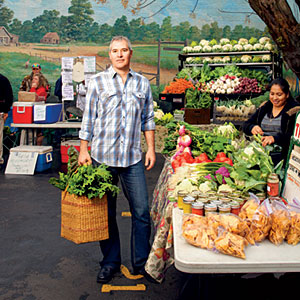
Slavery By Another Name
A very important book, film and blog on the “neoslavery” that existed from Civil War through World War II, including the sharecropper system that continues to influence the way that corporations think of labor as a commodity. This history (including that of the Black Belt in the South) must be known by more Americans and the history of subjugation in every era must be remembered.It matters to all of us as food organizers since shared good health, social justice and dignity are what we are really working towards.
Shareable: A Perfect Match: Economic Gardening & Worker Co-ops
Economic Gardening is a lovely expression of true local investment. So, as the article explains: “Economic gardening programs tend to focus their efforts on nurturing second stage companies: local enterprises already supporting between 10 and 99 employees that have moved beyond the stress of daily survival.”
That concept fits in beautifully with the worker cooperative movement and should be an area that farmers markets put some effort in the next few years-working with their existing vendors and potential ones to build on the ingenuity in products while using cooperative principles to add owners to food and agricultural companies.
Shareable: A Perfect Match: Economic Gardening & Worker Co-ops.
Request for proposals for Farm To Cafeteria conference
“6th National Farm to Cafeteria Conference: Digging In!” Burlington, Vermont August 2-5, 2012
Presented by: National Farm to School Network
Proposal Application Period: February 8, 2012 – March 7, 2012
No proposals will be accepted after March 7, 2012
Tools for Living
A few years ago, a coworker of mine who was one of the best children’s booksellers I had ever encountered, told me she felt “without purpose” in her life. It occurred to me then that many of my female friends had said something similar while in their 30s. I opined that it had to do with the way that modern women had only recently stopped having to do any of the work that fed, clothed or housed them and so had just begun to feel the loss of a particular type of usefulness. It seemed that men had lost track of that a few generations before, but women had only fully moved away from it in the 1970s.
I said then that when young people felt it, something would then happen. Now. I don’t see myself as a seer, but it’s clear that humans want to be useful and work on things they need for their own survival. So, once again, there is a lesson for all of us in the alternative food system-add dignity and fun to the place to those seeking real connections to their own survival.
Tools for Living – The Chronicle Review – The Chronicle of Higher Education.

