Motion Code to the rescue
At first glance these cards don’t look any different from the ones you carry around today, but they’re hiding some technological wizardry.
The three digits on the back of this card will change, every hour, for three years.
Motion Code to the rescue
At first glance these cards don’t look any different from the ones you carry around today, but they’re hiding some technological wizardry.
The three digits on the back of this card will change, every hour, for three years.
As my colleagues wished me a happy birthday last week, they asked me what fun thing I had to do on my birthday: I told them that one of them was to go to the opening of the first Trader Joe’s in the area, which opened in the suburbs of New Orleans that very day. I am sure some that the choice of viewing a retail store was odd, but not only is grocery store obsession a very New Orleans thing, it is most certainly one of my favorite “busman’s holidays.” (I also went to the inaugural fried chicken festival on Sunday so don’t worry about me too much.)
Now, speaking as a farmers market consultant…
I think knowing who the core shoppers are for the stores around a market is very helpful. In many cases, research is available on the chains or a visit to the local store (at both its peak and at its slow time) can usually tell you about that store’s demographic.
To give an illustration, I have included some global demographic info from Whole Foods and Trader Joes as well as a few market shopper personas. Forgive the errors and the oversimplifications. The data on the stores comes from retail research available online. The market data comes from the many surveys and data collection reports I have either participated on or read. Do be aware that there are many subgroups within each of these to be explored.
Grocery store shoppers
Whole Foods:”Decentralized” systems: regional management, store team approach and “localized” inventory management
Trader Joe’s: Centralized, secretive inventory management, mostly direct from manufacturers and a detailed screening process for hiring.
Nice article on food-based communities cropping up in rural areas, although I am bit puzzled by the choice of title.
In many ways, rural places are in a better position to build an entire system that supports the farmer than the urban garden movement has been able to do. There, one can start with the farm and the farmer and build out in an expanding set of connected circles.
Of course, we need all types of food production in our regions; urban, suburban and rural and building prototypes of each is the first step to that.The next step will be to then connect these local food systems into a regional system which has been done in very few instances.
I know the Saxapahaw model and even wrote about the store and farm in an
https://darlenewolnik.com/?s=saxapahaw on here. I have also written about the tension that arises when a rural farm community adds these innovative entrepreneurial outlets; in a book that Ben Hewitt wrote about Hardwick VT.
Source: The Farm-To-Table Movement and Rural Gentrification – CityLab
Shailene Woodley, Rosario Dawson, Will Smith and Kristen Bell are just a few of the big name stars teaming up with Thrive Market, a digital marketplace where individuals can purchase affordable, healthy food. They’re petitioning lawmakers and retailers to allow the use of food stamps online.
A few times a year, I take advantage of online courses available on edX. I just began a new one: “Making Sense Of Social Impact: Acumen’s Building Blocks For Impact Analysis” which may be a little heavy on company promotion but is still helpful to learn more about linking non-financial impacts to the usual $ ones, ultimately encouraging more investment and partnerships for non-traditional initiatives.
One of the helpful documents* used in the course so far is below and of course I thought of the FMPP/LFPP grantees who call me in frustration when attempting to create a logic model for their proposal. Simply put, a logic model offers an “if such and such resource is used to do such and such, these will be the results, both directly and indirectly” outline to those assessing what is being proposed:
| Input | Output | Outcome | Impact |
|---|---|---|---|
| what resources go into a program | what activities the program undertakes | what is produced through those activities | the changes or benefits that result from the program |
What is also helpful in the Acumen graphic below is that you can see how you will measure inputs internally and then measure the “customers” (stakeholders) for the rest. In other words, Market A uses these resources and staff time (input) to create this many events and materials (output), resulting in # of attendees taking # materials, which also added # of potential new shoppers to the market db (outcomes). Vendors reported they saw new shoppers who were knowledgeable on those issues; also, local media reported on the market as an educational resource for those searching for info on healthy food in this period (impact).
Impact is the one area I find markets struggle with the most; one of the best ways to decide what impact to choose for your project is to look at the market’s mission or vision statement and use those. Or ask your project partners to offer a single impact that they are hoping to see: for SNAP projects, often stakeholders goal is for increased access to healthy foods among their client base or added business stability among market vendors from adding regular shoppers. At a network level, increased collaboration is an important impact.
When markets are still stymied by this process, I suggest they start on the right with the impacts and work their way back to inputs, step-by-step, rather than starting there.This may also help another problem I often notice which is too many inputs proposed for relatively simple projects. After all, the goal of most funders is to see longterm impact within the market or a system level impact, not to see dozens of activities that result in little effect so it’s important to keep going back to the impacts.
Lastly, funding should be used strategically whenever possible (are there other supporters who are offering volunteers or resources that can be listed as in-kind?), resulting in a clear plan with room to alter it as lessons are learned or the situation changes.
I also recommend that folks take a look at Whole Measures framework to find descriptive and inclusive levels of impacts for food systems.

This post clearly outlines how to use the Facebook fundraising page that is available; it does require that you are a 501 (c) (3) and uses GuideStar’s listing as confirmation. It also offers the chance for your donors to opt in to your email list and allow your supporters to fundraise on the market’s behalf. For some markets, this feature may be the answer to their fundraising needs for now.
As is mentioned in the post, the key to this is to make sure that your GuideStar page is up to date.
I swear this story was already set up to go live this week long before Libertarian Party Gary Johnson’s fail this week. Okay maybe it was due to go live next Monday and I sped it up a little.
This incredibly moving and tragic story is a glimpse at how some people share beauty and kindness even in the face of ugliness and despair. We must honor this level of selflessness and belief in the power of community, anywhere and anytime that it happens. And remember.
(For another view of life in Aleppo click here)
“I am deeply aroused by the world,” she said, because for Joan, the world is a feeding web: No one eats without affecting someone else and impacting the environment, and she can’t consider one part of the system (access to good food, big ag, what’s for lunch, pop culture) without considering every other part (poverty, advertising to children, the endless rise and fall of trends, school lunches). She can’t stand to be in grocery stores (“A whole aisle of juice!”) and fears that innovations like boxed meal kits could kill CSAs. She’s skeptical of the food-tech movement, an area where so many others see potential: “What we need is a more direct contact between people and the earth,”she said.
Spent Wednesday morning tagging along with Copper Alvarez on her BREADA Small Farm Fund site visit to Lucy Capdeboscq’s home and farm near Amite. Copper has been crisscrossing the state seeing farmers who are reporting losses from this month’s floods. It’s important to note that BREADA is not focused only on their market farmers needs, but doing their best to get funds to any market farmer across the state. Although one of Lucy’s daughters had been one of Red Stick market vendors in the past, Lucy sells only at the Saturday Crescent City Farmers Markets down in New Orleans. As a result, she was surprised when Copper contacted her by phone, asked if she had damage and then offered an evaluation visit in case BREADA’s fund might be able to help.

Of course, no decisions or promises are made during the visits about any support, but as Lucy commented, the contact and visit were very welcome. Crescent City Farmers Market is also reactivating their Crescent Fund and has already had Lucy fill out their short form to receive assistance. The Crescent Fund is hoping to raise enough money to handle the 8 or so CCFM market farmers who have indicated losses, by quickly offering up to $1,500 for their farm needs.
To get to Lucy’s place, one turns off the main road at the permanent sign indicating it is also the direction to the legendary Liuzza strawberry farm. Although their famous berries are still a few weeks from being planted, other products like cucumbers could be seen in some of their fields. When you know that Lucy is a Liuzza by birth , it is clear why she lives amid those fields, (just off Jack Liuzza Lane) on the land deeded her by her parents. She and her late husband Allen raised their children here and kept their land productive even when they took on other professional occupations.
Allen and Lucy joined the Crescent City Farmers Market shortly after it opened. The Caps (as their farm name is known) were a huge hit immediately due to Lucy’s charming customer service and Allen’s practical sense for growing their traditional yet innovative items. Lucy’s arrangements of zinnias and lilies with her decorative okra, hibiscus buds and her legendary sunflowers have remained market favorites since those early days. As Poppy Tooker wrote in the 2009 Crescent City Farmers Market cookbook: “Lucy and Al have built a reputation for forward thinking innovation. They were the first to try early harvested rapini and green garlic made so popular in California.”

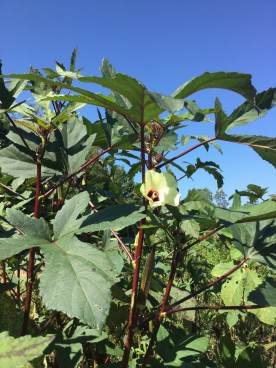
Lucy’s okra, used for her bouquets.
To me, the Caps are a quintessential market vendor type: growing traditional and newer South Louisiana products on a small piece of land behind their home within sight of other family members also still farming. As a matter of fact, on one of my visits to the farm years ago, Lucy told me how much she was looking forward to letting a shopper know that next Saturday that their favorite item had been planted that week and would soon be back at market. That deep awareness of specific customer likes seemed to me then (and still) to be the best illustration of the personal touch of direct marketing farming that I have come across in my site visits.

The flood leaves a watermark stain on the tree’s leaves as U.S. Geological Survey surveyor Scott Hedgecock works to survey the water levels along the Tangipahoa River along Highway 190 just west of Robert, Louisiana. (Photo by Ted Jackson NOLA.com )
Climate change is not entirely accepted, even by those for whom it should be obvious possibly because it is not entirely understood. People don’t feel its effects as they move in comfort from their air-conditioned personal vehicle to living amid a span of concrete around their glass-enclosed home away from coasts or forests, getting most of their information through a thumbnail headline or from friends who work and live in the very same setting. In other words, industrialized countries.
Another culprit may be the environmental work done in the 1970s and 1980s, which often used unfamiliar phrases that lacked relevancy such as global warming (or even the term used at the beginning of this post, climate change) and focused mostly on national policy changes or in shaming users of resources without compelling evidence of the effect of that reduction. Environmentalists were seen as “do-gooders” who meant well but lacked realistic goals (this was actual feedback from focus groups at an organization I worked at in the 1980s.)
The strong pushback showed the fallacy of engaging ordinary citizens using lofty or scientific terms and led to many turning to food as an organizing tool. After all, what could be better as an impetus to understanding and sharing the repair of the natural world but food?
Yet in the roll call of environmentalists circa 2016, food system organizers are usually in the middle of the pack. Most can certainly outline the issues involved with food production that both imperil and reboot Mother Nature, but are rarely working directly on those issues in concert with environmental organizations. Farmers markets have done an admirable job on promoting entrepreneurial activity and improving access, but efforts to highlight the stewardship of the natural world by market farmers has fallen a little behind.
I hear our great writer Wendell Berry exhorting us to remember the farmers:
“Good farmers, who take seriously their duties as stewards of Creation and of their land’s inheritors, contribute to the welfare of society in more ways than society usually acknowledges, or even knows. These farmers produce valuable goods, of course; but they also conserve soil, they conserve water, they conserve wildlife, they conserve open space, they conserve scenery.”
The “eyes to acres” ratio suggested by Berry and Wes Jackson needs to be included in regional planning theory and in the metrics that assess our work. Within the framework of disaster, the acknowledgment of the need for that ratio could mean”deputizing” farmers to supply immediate indicators of the level of destruction.
Disasters point out the fragility of a place and at the same time remind us of the strength of human ties and the resolve of communities. Following that line of thinking, deeper knowledge of local and regional systems would help knit everyone more closely together, allow for rescue and recovery to happen faster even as it is offering a narrative with more relevancy to those in far-off but similarly sized food systems. If the watershed or the regional system for food production were one such way to describe the need among those participating in food initiatives, assistance could be met one farm, one family or even one small town at a time.
If you read the From 0 to 35 in Mississippi post here last fall, you know that the good food revolution in my neighboring state has been lacking a few important items to help build their capacity such as USDA processing facilities. The news of one opening in MS is very, very welcome as without it, producers are severely limited to what, where and how much they can sell. Let’s hope this is the beginning of a new level of infrastructure for direct marketing family farms across the Magnolia State.
Here is a good site for producers of niche meat processing to have handy.
Source: Home Place Pastures to Become First Slaughter, Processing Plant in Mississippi | HottyToddy.com
One of the innovations I have seen in the decentralized recovery efforts (and we have moved from rescue to recovery, with rebuilding as the next step to come) is the idea of aligned organizations in New Orleans using Amazon and other online sites and their direct shipping to buy supplies for their sister organization in one of the flooded zones. Or, create or use accounts for those registered with them and send them items needed directly to the households the next day!
What we learned here in years past is that sending funds to a general account can delay support as it means that checks have to be deposited or those knee-deep in flooded homes have to manage the funds away from recovery work, wherever internet connections and computers can be found.
This method allows friends outside of the flooded zone to upload the list of items and then those items to be purchased and sent directly to those in need.
Here are 3 of those; the first one in the Baton Rouge area and the second in the Acadiana area:
Blessings For New Iberia Their Facebook site
The third may require a little added explanation: Many folks across the U.S. see Mardi Gras only as a time of debauchery, but in reality, it is a celebratory Lenten public event with deep community attachments. Most of the “krewes” that parade are actually social aid clubs that give back to the community throughout the year. The list of their good works is too long to list, but here is one of my favorite walking clubs that will use the direct donation process to help with recovery. They have a list of folks to send the items directly to via the online purchases made by the organization.
I have encouraged some of the farmers in the Acadiana parishes to do this as well, as there are few if any food or farming organizations in the area to collect support on their behalf. As I receive those, I’ll post them in future updates.
For those farmers in the Baton Rouge areas, BREADA has had an active small farms fund for over a decade that will help many such farmers. I saw a sign at the New Orleans farmers market suggesting that Market Umbrella will also be setting up a farm recovery fund that will support their farmers on the North Shore hit hard by this event. More on that later as I get more information.
Truly the recovery has been managed most ably by on the ground organizations, tied together to others via word of mouth, social media or texting. The larger organizations are working as well, but seemingly unable to process real-time innovations or absorb local help very well. This is the new reality of disaster zones: two separate efforts working at the same time, rarely transecting and with different expectations. Sounds a lot like the food system.
A thoughtful post about CSAs from Small Farm Central’s Simon Huntley is excerpted and linked below. His questions mirror some of the same that are being asked in the farmers market field about sales levels and how to build a regular, return shopper out of an occasional user or even some (of the majority) non-users. I am interested in his CSA research as the relationship between CSAs and farmers markets has yet to be studied in order to more fully understand farmers markets. The market box programs that he mentions are one great example of the shared characteristics that CSAs and farmers markets have that need to be better understood. I remember seeing this for the first time a few years back at the Lakewood Ohio LEAF market that used a CSA vendor as the anchor market vendor. That vendor had signs for their CSA members (how much of an item to take per share) but also a price for walk up non-CSA shoppers with a barter table at the end for CSA members to trade in items they didn’t want. The other vendors benefited greatly from this farmer being on site at this tiny weekday evening market. The last time I was there, the CSA/market vendor was only doing CSA shares (still managed by the volunteer market leadership) as the demand was high enough and other producers had been added to take care of market sales of produce. The whole thing was extremely well-managed, with a lot of opportunities for interactions for shoppers and vendors.
That is an example of a local organization using strategic thinking to build a market appropriately sized and structured for its growers and its shoppers. That thinking led to the organizers using the right type of place, products, people and procedures for their intention.
If only we had a list of the characteristics and projects for each type, we could shorten the learning curve and assist more partners interested in using markets as part of their program goals, and help producers by giving them better information on the outlets they can choose from, able to position themselves better to create the right business plan for those outlets.
As those who read here know, I am devoting my time to assisting FMC in building the Farmers Market Metrics program in order to gather data from the markets themselves that can help all of us find those answers. Certainly, the same framework can be used for CSAs and other direct marketing outlets to allow us to share the impacts on producers, shoppers and the larger community.
Exactly 30 years from the founding season of CSA in the United States, I think we are at an inflection point. Anecdotally, many farms are reporting declining CSA sales, though I should note that this decline has not yet shown up in our data.
Will CSA exist in its current form in 5 or 10 years? I honestly don’t know. I think it could easily go either way: CSA could grow substantially or membership may continue to shrivel…
I believe we need “CSA 2.0” for CSA to thrive over the next 10 years. There likely will continue to be room for traditional CSAs in the marketplace, but to grow the number of families that participate in CSA, we need to become more customer focused. We need to serve eaters better because that is what makes happy members, keeps them coming back, and recommending CSA to their social circles. I know change is hard, but I hope to be a part of modernizing CSA and helping you be profitable with your CSA.
My research leads me to believe that it is fundamentally about providing more choice to members about what is in their box. There are many models out there already that provide that already.
.
Source: CSA: We Have a Problem
A study in misrepresentation
The data used in the Virginia Tech study ends in 2007 — five years before the first round of new school lunch standards went into place, three years before Congress passed the Healthy Hunger-Free Kids Act of 2010, and two years before Barack Obama was officially sworn is as president.
In short, the data from the Virginia Tech study has absolutely nothing to do with Michelle Obama’s school meals program — and actually shows how much reform for school nutrition was needed.
“We found that the longer children were in the programs, the higher their risk of being overweight,” Wen You, associate professor of agricultural and applied economics in the College of Agriculture and Life Sciences at Virginia Tech and co-author of the study, said in a press release. “The question now is what to do in order to not just fill bellies, but make sure those children consume healthy and nutritious food — or at least not contribute to the obesity epidemic.”