One of my ideas for building the movement is for network leaders to think about how to alternate or expand manager trainings. For experienced managers that have attended (and maybe even presented?) at their own state conference, maybe there is way to save some of that funding for those managers to be able to go visit another market instead. There are markets operating year round in every region now and so finding the appropriate market for these managers to learn from has become much easier.
For example, here in Southeastern Louisiana this early spring, we are in the middle of one of our best seasons already; strawberries, citrus, greens and generally full tables since mid January.
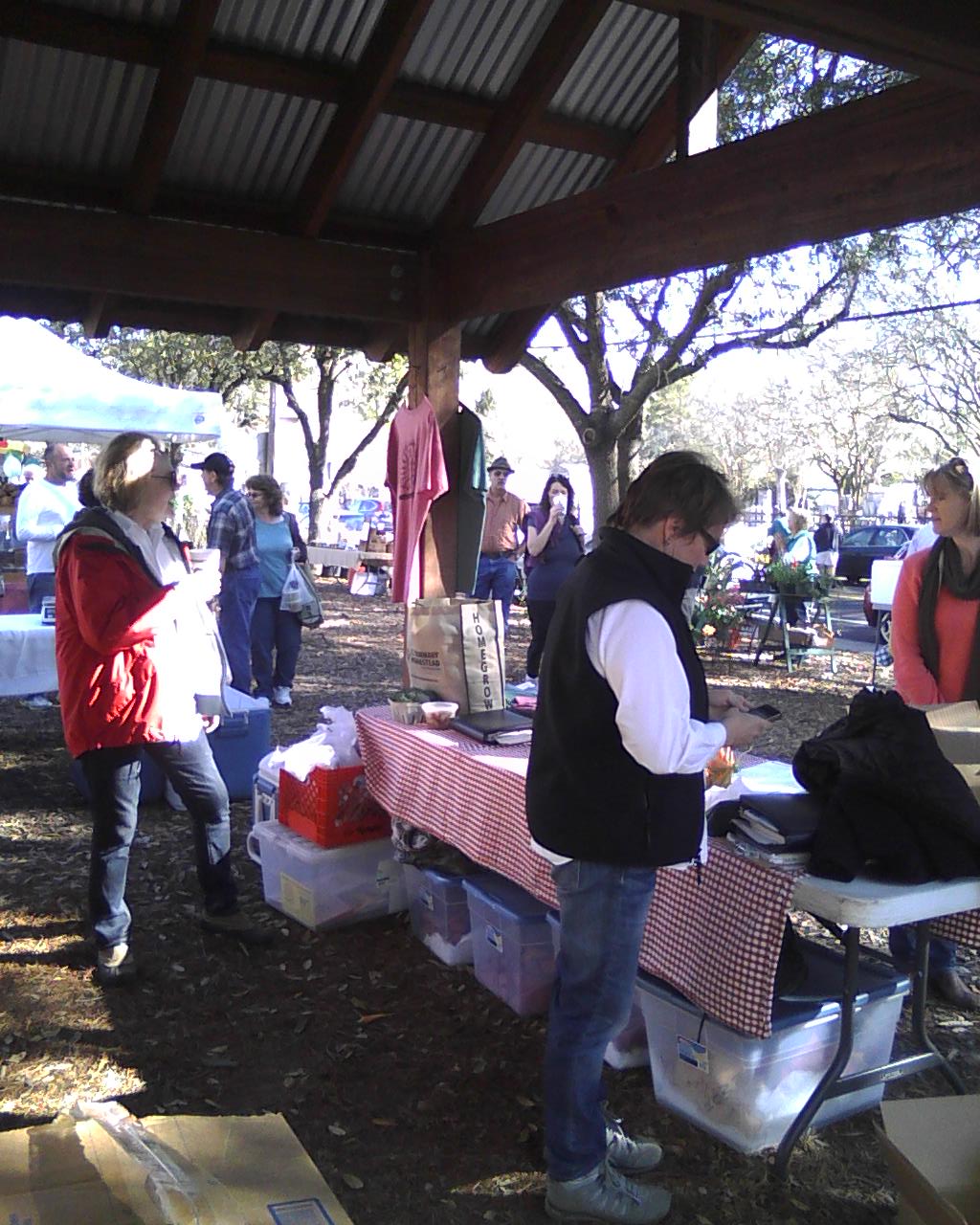
Covington Louisiana market this last weekend; 40 miles from New Orleans, this is a classic rural neighborhood-style market. They have about 35 vendors all of which live within 30 miles of the market. The market is held in a green space downtown in the city that is the parish (county) seat which allows plenty of parking nearby on Saturday morning; the market does almost no paid marketing and has no plans to offer credit, debit or EBT sales at all. The vendors can send their teenagers to sell or bring their toddlers because they are more comfortable with its small town air than they would be in the city. All in all, this would be a very good market to visit for a manager of a similar rural area.
Author: D.W.
A Food Atlas For Everyone
Food Atlas by Darin Jensen
My rating: 4 of 5 stars
I love maps. When I travel, I study maps online to have some sense of the geography underfoot, as much to understand who the people might be as not to get lost. It’s amazing how people appreciate that bit of homework when you go to their place.
I have maps of my city (New Orleans) and of my river (Mississippi) on the wall of my house and the Slow Food RAFT map (see below) on my business card.
I have books of maps authored by favorites such as geographical historian Rich Campanella and activist Rebecca Solnit, whose collaborative map book (“Infinite City”) of her home of San Francisco is a thought-provoking juxtaposition of right and wrong, culture and place.
When I came across the Kickstarter campaign for this Food Atlas, I jumped at the chance to support it. It arrived last week and I have read it while sipping my morning coffee (while reading about Strong Coffee traditions in the Middle East and “Bird Friendly” coffee origins), referred to it while writing about farmers markets (the one on SNAP and farmers markets) and studied the Texas Seafood Landings map after making flounder tacos just north of Lake Pontchartrain, home of most of the seafood catch for my bioregion. It’s a very new book and so won’t be found everywhere yet, but you can buy it from them now at
http://www.guerrillacartography.net/home
It is a wealth of maps on food production, distribution, security, exploration, identities and to pick out my favorites is to shortchange the breadth of this book.
It’s not just for activists, or “foodies” but for everyone and I think it could affect (and galvanize) people just as M. Pollan’s “The Omnivore’s Dilemna” did. I grow tired of long text articles about food (Yes, I do include myself in that finger pointing!) and would hope that this sort of map project could become a new way to educate and illuminate the small world that we live on.
I can’t wait for the editors to follow up on their promise to expand the reach of this series including to add more Asian and African food maps and to get this Atlas in hands everywhere. Its a bit heavy on maps of the West Coast and of the US, so much so that it occurs to me that having a set of food maps that show the lopsided view we have of ourselves in the US versus how others see us or experience us might be a good edition. In any case, hurrah.
..
Shareable: Bringing People Together with Benches
I love the circle bench. How many of you have designed face to face seating for your market? Years ago in New Orleans, we added wheeled picnic tables that rolled in and out of storage on market day. I heard they bit the dust this year – which is understandable – but I know people had some great chat moments at those tables. I would notice that friends would often sit next to each other and then find themselves starting a larger conversation with unknown people across from them . Lovely.
I tried (unsuccessfully) to convince the founder to name the benches the “Jane Jacobs” benches to honor our hero but I know she would have been proud of them with or without the plaque.
MarketUmbrella releases report on SFMNP incentive project
I’ve always been very proud of the very active way that my old workplace promoted FMNP in Louisiana. Since FMNP’s inception in Louisiana, MU’s markets have been at the forefront of expanding the program’s reach and redemption levels.
The FMNP incentive idea is a great one and allows seniors to continue shopping after their booklet was spent: they bring their empty booklet to the Welcome Booth and get 24.00 more in tokens to spend throughout the year, on any item.
With amenities like senior bingo, guided trips through the market and lots of assistance from staff, senior numbers continue to grow (by more than a thousand seniors!) at all three of their markets and their Field Note shows how the staff made it happen. Medium to large markets can certainly benefit from this report.
St. Joseph’s Day Festivities
Like most Americans, New Orleanians too celebrate St. Patrick’s Day, although here in New Orleans we also celebrate St. Joseph’s Day. There already was a parade through the Quarter in St. Joseph’s honor and March 19 (St. Joseph’s actual feast day) will be quite the day for viewing of the altars throughout the city.
The tradition, which is Sicilian in origin but carried on locally by Italian-Americans and people of all nationalities and faiths, includes baking cookies and cakes and preparing foods for the altar. According to a legend, a drought and famine during the Middle Ages caused much suffering in Sicily. People prayed to St. Joseph, the husband of Mary, and promised to thank him with food altars on his feast day, March 19, and give away the food to all. Supposedly on midnight of March 19, it started to rain and broke the Sicilian drought. Many now create altars to thank St. Joseph for their personal prayers as well.
Over the years, the Crescent City Farmers Market has done many altars, with local media legend and Slow Food Chapter founder Poppy Tooker leading the design and collection of the goods. At least 3 altars have been created to be viewed on market day and one even included 19th century prayer benches borrowed from the Ursuline nuns who are the founding order of the city and have been here since the 1720s tending to their duties which includes their venerable girls school, the oldest operating Catholic school in the US.
The altars are found in churches, businesses and homes throughout the city and when you leave after viewing, you will receive a fava bean. The fava bean will bring you luck throughout the year. Part of the tradition requires that no money be spent on the altar, so its creators must beg for all items. Once the day is over, the altar is broken down and its content donated to the poor.
St. Joseph’s Day has another connection to food: it is also traditionally considered to be the last day to plant summer tomatoes for this region.
SNAP and SNAP-ED under fire
The Healthy Farms Healthy People Coalition is sharing the below information, that was distributed by Steering Committee member organization, Public Health Institute.
Public Health Institute Call to Action:
Tell the Senate: America Depends on Our Nutrition Programs
On Wednesday the Senate Budget Committee began considering proposals that would slash billions from our country’s nutrition programs-reducing funding that provides SNAP (food stamps) to over 47 million Americans, and completely eliminating the nutrition education program SNAP-Ed. As budget conversations continue over the next few days, a proposal on the table from Senator Roberts, to slash $36 billion, is expected to be the first of many misdirected attempts to balance the budget by literally taking healthy foods off of people’s plates. The proposed cuts could go even higher, if we don’t stand up for nutrition programs today.
On the heels of last week’s devastating sequester cuts, we can’t afford to sever one of the most important safety nets for our poorest families. Cutting nutrition programs won’t reduce poverty, stop children from going hungry or provide resources that improve diets.
Call your senators.
Sing-along at the IFMA
Old friends and multiple-movement-colleagues Ken Meter and Karen Lehman lead a cooperative sing along at the Illinois Farmers Market Association with a song found in a attic of a woman organizer from the 1930s, song to the tune of Auld Lang Syne called Cooperate. A sweet moment.
North American Urban Agricultural Survey
We are very excited to invite you to participate in a Portland State University survey of organizations and businesses across the US and Canada involved in urban agriculture projects.
Urban agriculture is growing rapidly throughout North America, and we are interested to learn about the experiences of the organizations involved, as well as any obstacles they face. Municipalities have begun to craft new policies and regulations related to urban agriculture, and we hope that the information obtained from this study will help guide city planners and policymakers as they develop policies and programs that effectively meet the needs of practitioners.
This survey is intended for organizations and businesses, big or small, formal or informal, that are engaged in urban agriculture on any scale. The survey should take about 20 minutes to complete. Feel free to email us (urbanagsurvey@pdx.edu) or call Nathan McClintock at 503-725-4064 if you have any questions about the study.
We appreciate your time and interest. We’d also be grateful if you could forward this widely to your urban agriculture networks throughout the US and Canada – we know that there are many exciting urban agriculture initiatives that do not have a web presence, and we would like to hear from all the organizations that are doing this great work. Apologies in advance for cross-postings.
Follow this link to the Survey:
http://survey.qualtrics.com/WRQualtricsSurveyEngine/?SID=SV_9TOXJEPPQKIUSqx&_=1
Ken Meter talks about food systems
Great points from Meter at the Illinois Farmers Market Association Thursday:
Community food systems build health, wealth, connection and capacity
Local food may be the best path toward economic recovery in U.S.
If we can’t grow an economy around food, how do we expect to grow it around windmills or technology?
Counting food miles matter less than banding business together to work for a social value.
Farmers often create systems that are often more efficient by reducing energy costs and using “waste” products to do value-added. Snowville Creamery in Pomeroy Ohio sells their skim to Jeni’s Splendid Ice Cream for a high quality ice cream product. Both businesses are innovating waste reduction and distribution systems that shorten the chain.
Community food systems don’t just measure the multiplier-they build the multiplier.
Southern Illinois farmers (Meter’s study) show that from 1969 to 2010 commodity farmers sold 1.1 billion worth of products and spent 1.1 billion in production costs during the same time.
1.8 billion amount of food bought in Southern Illinois region; 1.7 billion of it was produced outside of the region.
If every person in that region bought 5.00 of local food directly from local farms each week, farms would earn 191 million of new farm income (why not have a 5.00 campaign at farmers markets?)
The promise of permanent markets abroad in the 1970s drove farmers into the “Get big or get out” mindset and into more debt. Those permanent markets disappeared within the generation.
The link between the oil crisis of 1973 can most likely be directly linked to the obesity crisis: the oil crisis in the U.S. led to the rise of the corn economy which added high fructose corn syrup to production.
Viroqua, Wisconsin is a model of an economic development recovery after their national company that had supplied 85 jobs left town. The city government convinced the owner to sell their building for a small amount (explaining to the company that the investment that the county had made for 30 years maybe should be repaid before leaving).
Viroqua used 100,000 square foot building to start to build an entire local food system and expect to replace those 85 jobs within the next 2 years.
Products increasing at farmers markets
The Monica family, who have been Crescent City Farmers Market vendors for more than a dozen years, continue to add new products derived from the markets products already grown and offered.
Their evolution as savvy and leading market vendors has been remarkable and a pleasure to watch.
Bivalve Project from Louisiana
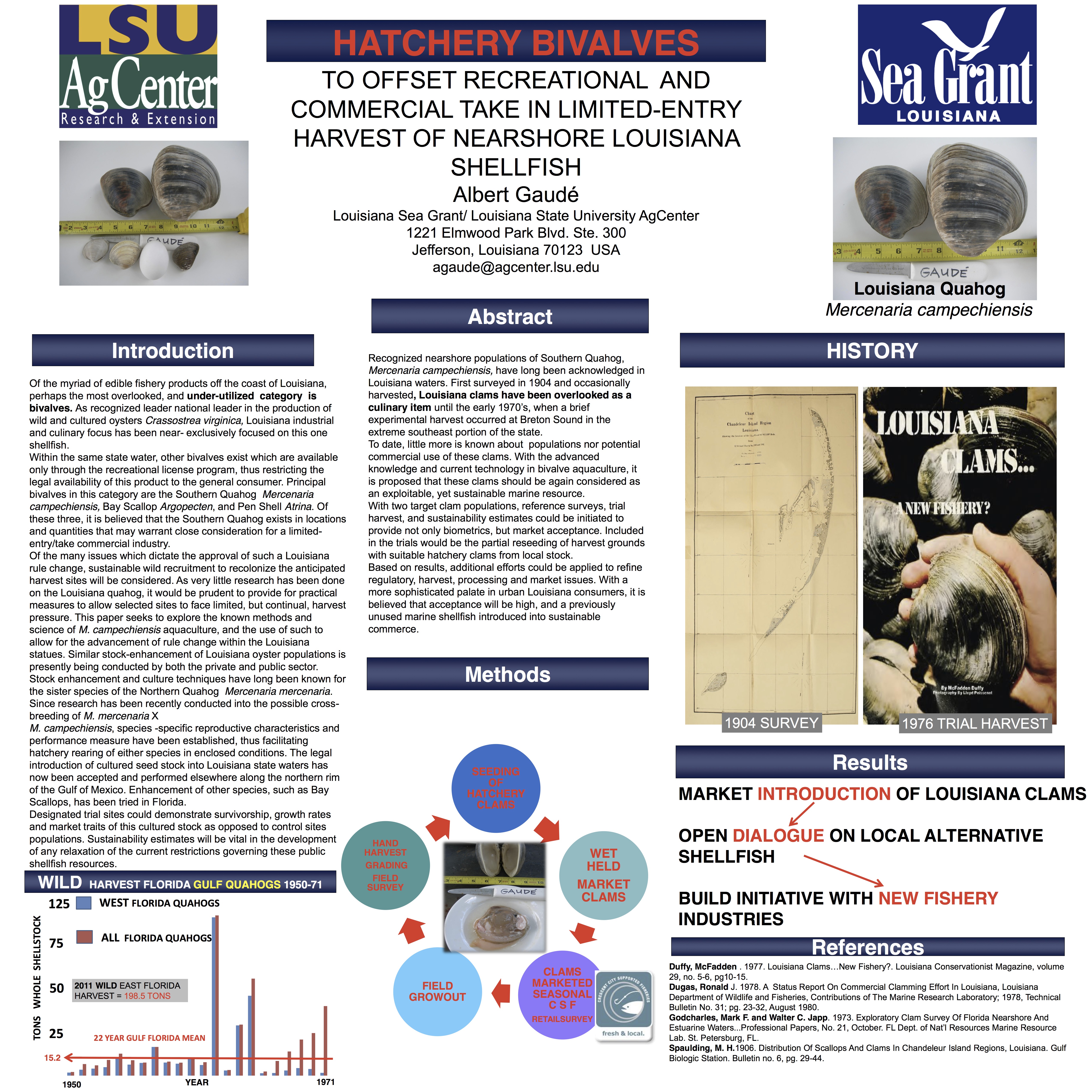
Fisheries Agent Rusty Gaude has long advocated for more production of the Southern Quahog, Mercenaria campechiensis and sees it as a possible new direction of direct marketing to offset the reduced output of oyster production in Southeast Louisiana. He has served on the New Orleans farmers market board and is advocating that the bivalve test be carried out as part of the Crescent City Supported Fisheries project. This project is done during Lent each year, where Crescent City Farmers Market shoppers can preorder a bag each week of seafood caught by the family fishers at the market.
Review of “Black, White and Green: Farmers Markets, Race and the Green Economy”
Black, White, and Green: Farmers Markets, Race, and the Green Economy by Alison Hope Alkon
My rating: 3 of 5 stars
Very well done snapshot of a piece of the Northern California local food system, especially its history. As much as I thought I knew, I learned some more about how it began from this book. I appreciated that this book was centered around these two farmers markets and their environmental and social justice leanings, which is a great lens to view multiple types of organizing, intentions and sets of outcomes.
I especially like the time she takes to link the work in each market to their larger community goals AND to the economic goals of the green economy.
here are some wonderful passages on the tensions and values of this emerging alternative system:
“One becomes an environmentalist, for example, through the consumption of green products such as organic food rather than the traditional means of voting, lobbying or attending protests. While this strategy allows supporters to inscribe their social movement goals into their everyday life practices. it also creates individuals who infuse the logic of the market into both their ordinary behavior and their desires for social change (Larner and Craig 1999)”
“The promise of the green economy is that the market can be made to value, and therefore to protect, humans and the environment.”
“In these markets, actors choose from among competing narratives to envision and emphasize the spaces where buying and selling green products leads to environmental protection and social justice.”
“Furthermore, proponents of the social change potential of the green economy attempt to redefine capitalism not as an exploitative system that must be overcome or restricted in order to protect people and the environment but as a tool to create a more just and sustainable world.”
“…Working towards these goals (environmental sustainability and social justice) becomes possible, in part, because participants in each farmers markets define environment and justice in ways that render them compatible with one another.”
“The compatibility between sustainability and justice achieved at these farmers markets is not inherent. Farmers market managers, as well as some vendors and regular customers, actively work to conceptualize strategies that speak to both goals.”
>As a community food system organizer, I believe this book is a necessary whistle stop on anyone’s travels to successful organizing around food.
Take the time to read this thoughtful book and then pass it along to your friends and comrades.
Bill McKibben’ s Math Starts Adding Up
Standing in front of an estimated crowd of 50,000 people gathered for the Forward on Climate rally yesterday on the National Mall in Washington, D.C. he said, “All I ever wanted to see was a movement of people to stop climate change, and now I’ve seen it.”
Certainly, anyone involved in shortening the food chain and shifting the power structure of wealth and health in this world should have Bill McKibben as one of their bookmarked writers. What I really like about this story is the excitement he has in the movement itself. I look forward to this day with our sub-sect of community food system community.
When asked what he thought winning would require, McKibben said, “I’ve got no idea. It will take more than any of us can imagine.” That might be surprising coming from a man so concerned with numbers and so good at making them compelling. But right now, the only math that seems to matter to him is how long it has taken to get to this point. And for that reason, he’s savoring the moment.
Read more: http://www.utne.com/environment/bill-mckibbens-math-starts-adding-up.aspx#ixzz2MVdRmHwy
Community Wealth Workshop
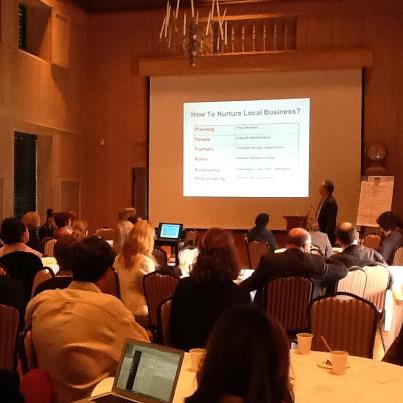
Spent most of Wednesday in a lovely room at historic LongueVue House and Gardens in New Orleans with bankers, community development coordinators and cooperative activists listening to economist/writer Michael Shuman describe different ways to encourage investment in localized systems.
His latest book, Local Dollars, Local Sense details strategies for creating investment in local systems as well as measuring the power of these systems. Michael is available to come to your community and have the same talk with YOUR investors and to expand your community’s knowledge about capital. I strongly encourage you to do that.