Farmers Market Coalition Farmers Market Training Programs Webinar


Wed, Oct 10, 2012 1:00 PM – 2:00 PM EDT


Register at:
 https://attendee.gotowebinar.com/register/2490526123394749184

Please share with market state or network leaders that are interested in developing models of accreditation or training programs.

5 minutes – Welcome and logistical overview of webinar from Elizabeth Comiskey, FMC Membership Coordinator
10 minutes – Bernie Prince, FMC Board President and co-founder and co-director of Fresh Farm Markets will give an overview of how FMC can help networks build training programs: no need for a “one-size-fits-all” model!.
20 minutes – Dru Montri, Director of Michigan Farmers Market Association (MIFMA) will share their model: a market manager certification program
5 minutes –Darlene Wolnik, FMC Market Programs Advisor and Independent Market Consultant will share general evaluation success measures that could be used in training market managers and vendors
20 minutes – Q&A/open discussion- Moderated by Darlene

Questions can be typed in at any time; Liz and Darlene will make a list and ask each of them (as time permits) during the Q&A period. Webinars of other models will be presented in upcoming months, so questions should be focused on the model presented.


Vegetarian Awareness Month

One way that markets can spike their vendors sales is to use these widespread marketing campaigns for their own. Vegetarian Awareness Month sounds like a fine series of events to hold every October, maybe followed by Fish for the Brain Month and so on….

vegetarian awareness month

Food as an organizing tool…

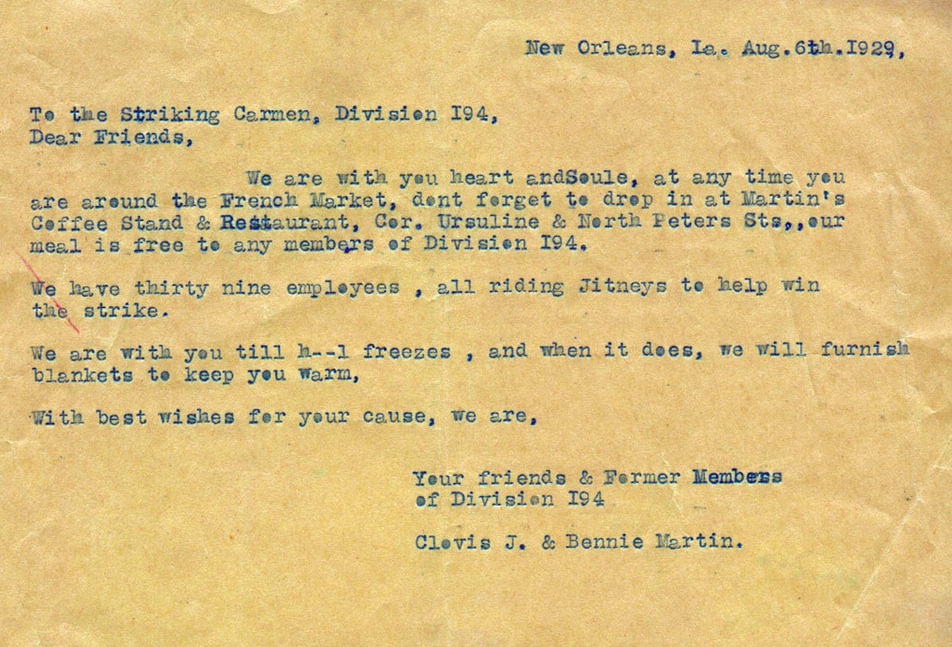
In an email today, I referenced the birth of the New Orleans sandwich that we call the po-boy, so I thought I would share the story more fully. The po-boy is a french bread sandwich loaded with seafood, meat or believe it or not, potatoes and gravy inside. The origin of this sandwich has to do with the streetcar strike in New Orleans in 1929: baker John Gendusa and restaurant owners Bennie and Clovis Martin made this sandwich and sold it as cheaply as possible to its customers and gave it for free to the “poor boys” on strike.
The telegram that the Martin Brothers sent the strikers is legendary in New Orleans:

Remember how the food world can support larger issues as an inspiration or simply as an economic haven for those on the front lines. Lucky for me, po-boys are still available everywhere in New Orleans, although the Martin Brothers restaurant closed in the 1970s: however, the Gendusa Bakery remains one of our beloved French bread bakeries in the city still.

Barry Commoner Dies at 95

Barry Commoner, crusading scientist for the last 50 years has passed away. His work was crucial to the evolution of the environmental movement, starting with his work to bring to light the effects of fallout of nuclear radiation in the 1950s.
He linked environmental concerns to poverty, public health and global unrest and unraveled the DNA of political influence of corporate polluters and bad government science. As a young organizer in the Midwest in the 80s and 90s, I read a great deal of Commoner and was glad for the clarity.
I encourage food organizers that have not gone back and read some of these early works of the sustainable sector to take the time to do so. Read about what he termed the three Es that were plaguing the United States in the 1970s: “First there was the threat to environmental survival; then there was the apparent shortage of energy; and now there is the unexpected decline of the economy.”
And this of course:
His four laws of ecology:

Everything is connected to everything else.
Everything must go somewhere.
Nature knows best.
There is no such thing as a free lunch

Southern SSAWG conference news

The 2013 conference program and registration information is now available on the Southern SAWG website. You will love the program we have put together for this year’s Practical Tools and Solutions for Sustaining Family Farms conference. There are even more sessions and pre-conference events this year!
Pre-Conference Offerings:
Wed & Thurs – Jan. 23-24
Short Courses
Our popular 1½ day pre-conference short courses are intensive learning experiences that provide comprehensive information on whole farming enterprises. With the in-class presentations and the extensive take-home materials, they give you the knowledge you most need to be successful with your enterprise.
Program info here

Mini Courses
Our ½ day pre-conference mini courses provide in-depth information on specific topics in greater depth than is possible in our regular conference sessions. Our expert presenters provide you the latest information and answer your pressing questions on the topics you requested.
Mini Courses Here
Field Trips
For those who learn best by getting out in the field, we offer five outstanding field trips this year. Our ½ day pre-conference field trips are geared toward organic and sustainable production and marketing of horticultural crops and livestock and community food initiatives. Click here to learn more about these outstanding field trips.

General Conference Info:
Fri & Sat – Jan. 25-26
Expert Presenters
Each year conference participants tell us the great line-up of presenters with their practical experience is what makes our conference program so valuable. These people know their stuff and are willing to share their expertise. One older farmer said “I sure wish I had had access to this kind of expertise when I got started. I’d have gotten a lot further a lot faster!”
Presenters Here
62 Educational Sessions
The general conference, running all day Friday and Saturday, offers more choices: 62, 1½-hour sessions on a broad range of topics for start-up and seasoned producers alike. Sessions include; sustainable and organic production and marketing information for commercial horticultural and livestock producers, enterprise management lessons, farm policy education and community food systems development information.

Registration and Fee Waivers
The Southern SAWG conference is always a great bargain, given the quality of the information to be gained and the networking opportunities that come with such a large turnout of the South’s most innovative and successful producers, organizers and advocates in sustainable agriculture. Your farming operation or local foods organization can’t afford to miss this event.
This year we have three options for those looking for a fee waiver to participate in this conference.
Fee Waivers here

Be a 2012 Conference Sponsor
Your presence as a sponsor will help hundreds of farmers, community food advocates, educators and researchers across the South, and with the visibility this event affords, it will distinguish you as a supporter of the sustainable agriculture movement.
Note to organizational and institutional leaders: We can provide letters of support to your potential funders if you are seeking funds for producers in your area to participate in the pre-conference and conference activities. Just contact us with the details.
Keep up with Southern SAWG through Facebook and Twitter. Show your support for Southern SAWG by liking and following us!

SSAWG conference link here

“Phony” farmers markets studied

A very interesting, albeit small study about customer perception and local produce at farmers markets. I would argue however that perception and awareness needs depend on the community the market sits in. In other words, types of markets differ and therefore the expectations of the market success differ. All that really matters is if the market manager and the vending and shopping community are making sure everyone knows the same information; such if there is reselling happening and it’s for a reason that is to do with the intention of the market. As long as everyone knows about it and accepts it, I think it’s doing its job. Of course, whether it should be called a farmers market if its all resellers is another story…
In any case, I would suggest that every market community survey the perceptions of their shoppers about different items that are available at markets.

http://news.ifas.ufl.edu/2012/09/farmers-market-phonies-raise-ire-of-some-customers-but-not-all-uf-researchers-say/

Phoenix mayor lives on food stamps for a week

http://www.huffingtonpost.com/2012/09/26/greg-stanton-phoenix-mayor-food-stamps_n_1915608.html

Sail alone, anchor together

A few years ago, I was watching a Charlie Rose interview with the musician, Tori Amos. She was going on tour with Alanis Morrisette and Charlie asked her how that worked, how could they combine their shows. Tori frowned in concentration and said (I’m sort of paraphrasing here):
it’s not really about merging them. Really, I’m… a pirate ship. I have a captain, I have my own mates, my own wenches…..and so does she…
That comment stuck in my mind. When I went to work the next day, I shared it Richard McCarthy,  who was then the Executive Director of Market Umbrella. We were constantly searching for metaphors for farmers market organizing to describe the way it was bending  (or could be) to becoming a true movement rather than a series of random events in towns and cities. We had collected some cool descriptions, still wondered if we had yet found the best way to describe it.
“A pirate ship. Hmmm,” he said. True to his nature as a leader who employs engaging and system-level thinking, he kept at it, coming up with a powerpoint on the pirate ship idea that he continues to refine and use in his global work with civic and food organizers.

When I’m out in the field, I find that much of what we do in markets and in food systems is duplication of the worst sort, meaning unnecessary and a time waster for overworked markets or networks, or just as bad is the an expectation that all markets or projects should operate and be measured the exact same way. Why is that, I often wondered? Why don’t markets or organizers talk more to each other, sharing more tools peer-to-peer and find the strength to resist being measured and judged by inappropriate metrics?

Well, I do know why it happens. It happens because the work of community organizing is so important to do correctly and yet so unrelenting that it is hard to find time to share. And then what should be shared and how it could be shared is often as complicated.
The Tori Amos interview spoke to that idea.

The idea that innovation and creativity is handmade and often an individual exercise, or coming from a small committed group who are learning as they go.

And that sharing is not necessarily about combining efforts, but more often about connecting when needed and not overemphasizing one set of values over another.

That individuals or small groups need some autonomy and yet, in order to build a movement there are times when building the networks is as important.

So from that Amos interview came this line that Richard and I created while standing outside of a coffeehouse:
Sail Alone, Anchor Together
Like pirate ships or if you prefer, privateer ships, markets have their own flag, their own code and their own mates. Sooner or later though, they may need to join up in order to defend themselves from other forces or come together to succeed on an issue.
How they do that is important. When they do that is important too.

The lack of a national or even a regional convening primarily for farmers markets  may be starting to hamper our efforts for long term policy changes and impair capacity building. In lieu of that, we can (and should) moor our nimble little ships to sides of elegant liner like a re-imagined public markets conference or join a strong armada such as a well-organized school food initiative when we can, but even then, when we don’t know what to share and when, it’s hard to contribute meaningfully.

We also have our own issues to talk about. What about SNAP/EBT? Disaster planning for market farmers? Training for market managers? Food safety issues? Permanent locations? Sustainable funding? Building appropriate networks for policy work? Evaluation? We need to work this stuff out together and decide how it’s appropriate to our scale.

Some market networks are lucky. They have solid food systems that they work in and grow in sustainably. But even the best need to anchor with the odd little markets and share and hear because innovation within a field often comes from unlikely sources.

And sometimes it’s as hard to get the larger, more established markets to take the time and find the right voice in which to share their ideas and plans, to do that even as they are piloting ever more complex projects.

Respect to each pirate ship must be paid by the others. Learn to spot the flags and to find ways to anchor together.
Hunting and fishing popular again

http://usat.ly/Qt2O4N

Here at the PPS conference, unexpected relationships can start too

Just like a market, conferences bring people together and from that moment good things can begin. Things like flagship markets meeting up and sharing ideas:

(below) Leslie from the Athens OH market community chats with Chris of the Burlington VT Farmers Market. Both of these markets have existed for decades, are over 80 vendors and are year round. Their markets definitely have plans and issues that the other can truly understand!

20120922-132031.jpg

or things like people from the same city meeting and openly sharing ideas across projects:
Toronto Food Policy Chair Helene St. Jacques and Greenbelt Farmers Market organizer Anne Freeman make friends with St. Lawrence Market vendors Odysseas and Sandra Gounalakis of Scheffler’s Deli and Cheese while they are all far from home and waiting on a “rapid” to the evening PPS conference event. Odysseas and Sandra paid their own way to the conference to learn about public markets so that they can be of assistance to the managers.

20120922-132042.jpg

Meeting the larger market community can lead to unexpected lessons, ideas and friendships. Take the time to take a “busman’s holiday”!

Games people play

Although it might be better for the Chinese government to spend more time thinking about the environmental degradation of their country than sport, the idea of a “farmers games” does have its provocative side.
It sort of harkens back to county fairs with log rolling and bale tossing games. Games that show a different set of skill and worthiness.
It would just be nice if 4F activities were valued again…

http://usat.ly/TaHO6h

2012 FMPP grants awarded

http://www.ams.usda.gov/AMSv1.0/getfile?dDocName=STELPRDC5100605