One way that markets can spike their vendors sales is to use these widespread marketing campaigns for their own. Vegetarian Awareness Month sounds like a fine series of events to hold every October, maybe followed by Fish for the Brain Month and so on….
articles
Food as an organizing tool…
In an email today, I referenced the birth of the New Orleans sandwich that we call the po-boy, so I thought I would share the story more fully. The po-boy is a french bread sandwich loaded with seafood, meat or believe it or not, potatoes and gravy inside. The origin of this sandwich has to do with the streetcar strike in New Orleans in 1929: baker John Gendusa and restaurant owners Bennie and Clovis Martin made this sandwich and sold it as cheaply as possible to its customers and gave it for free to the “poor boys” on strike.
The telegram that the Martin Brothers sent the strikers is legendary in New Orleans:
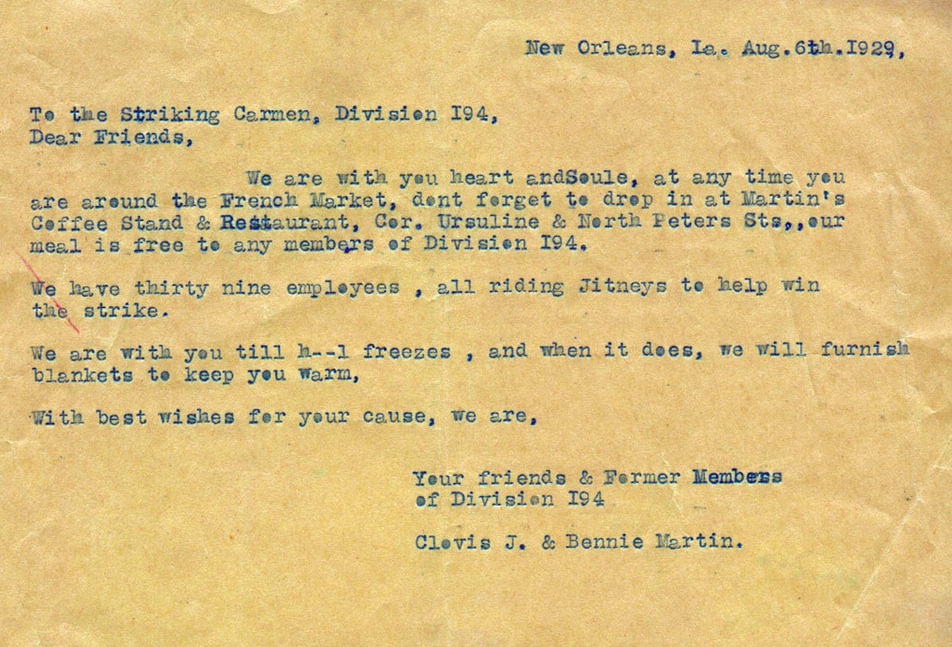
Remember how the food world can support larger issues as an inspiration or simply as an economic haven for those on the front lines. Lucky for me, po-boys are still available everywhere in New Orleans, although the Martin Brothers restaurant closed in the 1970s: however, the Gendusa Bakery remains one of our beloved French bread bakeries in the city still.
Games people play
Although it might be better for the Chinese government to spend more time thinking about the environmental degradation of their country than sport, the idea of a “farmers games” does have its provocative side.
It sort of harkens back to county fairs with log rolling and bale tossing games. Games that show a different set of skill and worthiness.
It would just be nice if 4F activities were valued again…
Planning ahead: Consumers prefer fewer options when thinking about the future
How people shop is crucial for markets to understand. We cannot assume that there is only one style of market farm table or only one version of local marketing that will attract more people. I have been fascinated by retail anthropology issues for years and I think it is key that market organizers build retail knowledge into market job descriptions and helping vendors to understand so they can refine their business strategies.
Planning ahead: Consumers prefer fewer options when thinking about the future.
INTERVIEW: Zoning for Food Access in New York Neighborhoods – Next American City
A must read for any food organizer. Understanding how cities are using zoning and tax incentives to encourage businesses to sell food is important. And it’s important to remember that city governments work with a “broad brush” when it comes to encouraging growth so that the most innovative entrepreneurial initiatives will most likely come from other stakeholders in food systems.
In other words, its up to us to define food system sustainability and success and for cities to remove barriers for us to do that.
INTERVIEW: Zoning for Food Access in New York Neighborhoods – Next American City.
Support the development of the food systems journal to expand applied research
This is Amy Christian and Duncan Hilchey. We are the founders and editors of the Journal of Agriculture, Food Systems, and Community Development, also known as the Food Systems Journal. We are fundraising because we are in the process of transitioning the Food Systems Journal into a nonprofit organization. We boot-strapped the Food Systems Journal three years ago with our own labor and investments, and have continued to subsidize it. Now that we’ve proved the concept of the journal, it’s time to grow and become more sustainable ourselves!
We have recently been accepted as a project of the Center for Transformative Action, an affiliate of Cornell University. The mission of the Journal meshes very well with the Center for Transformative Action’s, which is about making positive change in the world. With your support we are transforming the Food Systems Journal into a nonprofit that can receive grants and donations.
Drought
For those of you on the FMC Listserve (hopefully all of you!) you may have seen my post from a few days ago asking if anyone had a written drought plan for their market. Many of us in flood prone or winter storm zones have emergency plans for those type of weather events, but how does one create a plan for a “non-event” like a drought?
Raising money for vendors is difficult even in the most dramatic times, but to get support when conditions are just about invisible to the urban or suburban world is extremely difficult. Unfortunately, crisis propels project funding and no one has stepped forward on this crisis yet, but maybe it’s time a state association or a network of markets found some funds to create some templates and best practices so we can be prepared.
Allergic levels higher for urban kids
Urban kids have more allergies.
Data revealed that the odds of food allergies were significantly higher in more densely populated areas as compared to rural areas and small towns. Rates varied significantly from almost 10 percent prevalence in urban centers to only 6 percent in rural areas. The study also found that the most common food allergy was for peanuts, and milk and soy were two of the most consistent allergies throughout the various demographic areas.
One explanation for a higher prevalence of food allergies in urban areas is that exposure to certain “microbial agents’” or agitants earlier in life may somehow protect a child from developing food allergies later in life. Kind of the same argument for people who use sanitizers too much on their hands and become more susceptible to getting sick as it weakens their immune system. Either way, the association between food allergy prevalence steadily rose as population density rose as well, which makes it clear rural kids are far less likely to suffer from an allergies than their city-dwelling counterparts.
So, once again like in the Dirt Adds Value story from the NYT, linked on this blog, we need to be part of the natural world from the beginning for so many reasons. Farmers and farmers markets contribute to that familiarity and need to be recognized for that.
dirt adds value
What a great column in the New York Times today. Every time I think we have covered the gamut of what info we need to gather to show how local food systems are working, another imaginative and appropriately scaled data collection point comes along.
Dirt.
In particular, the amount of dirt that farmers and markets are returning to the food system on our just picked products. Dirt that humans used to consume more of (and now in the author’s theory) need in order to reduce the autoimmune issues we have given ourselves from too many antibiotics and scrubbed clean food choices.
Having just consumed handfuls of organic berries, figs and tomatoes straight from the garden this week, I join that chorus.
How Veggie Co-ops and Ice Cream Collaboratives Could Save the Economy | Mother Jones
This entrepreneur throws some great numbers out in this excellent blog post and also entices us all with visions of local ice cream and veggies at what he, very interestingly calls a winter food bazaar. That typology term may fit in quite nicely to the project that we call Market CITY (Characteristics, Indicators and Typology)
His reference to Civic Economics and Ken Meter’s work is not surprising, since their reports (along with Michael Shuman at BALLE and Jeffrey O’Hara at Union of Concerned Scientists) make up much of the data that we are using to build the economic argument for local food systems.
How Veggie Co-ops and Ice Cream Collaboratives Could Save the Economy | Mother Jones.
Food Stamp Subsidies for Junk Food Makers, Big Box Retailers, and Banks?
As 2012 Farm Bill debate rages in Congress, a new investigative report demands SNAP program transparency
Oakland, CA, June 12, 2012 — Are food stamps lining the pockets of the nation’s wealthiest corporations instead of closing the hunger gap in the United States? Why does Walmart benefit from more than $200 million in annual food stamp purchases in Oklahoma alone? Why does one bank, J.P. Morgan Chase, hold exclusive contracts in 24 states to administer public benefits?
These are a few of the questions explored in a new report called: “Food Stamps, Follow the Money: Are Corporations Profiting from Hungry Americans?” from Michele Simon, president of Eat Drink Politics, a watchdog consulting group. This first-of-its kind investigation details how the food stamp program—originally designed to help farmers and those in need—lines the pockets of junk food makers, food retailers, and banks.
Right now, Congress is debating the farm bill, including significant cuts to the Supplemental Nutrition Assistance Program (or SNAP, formerly known as food stamps). Much attention has focused on how agricultural subsidies fuel our cheap, unhealthy food supply. In reality, the largest and most overlooked taxpayer subsidy to the food industry is SNAP, which comprised two-thirds of the farm bill budget in 2008.
“Michele Simon’s well-researched, credible investigation breaks new ground and exposes who else stands to gain from the government’s largest food assistance program,” said New York University Professor Marion Nestle, author of Food Politics. “While reauthorizing the farm bill, Congress needs to make sure that the poor get their fair share of SNAP benefits,” she added.
Food Stamps, Follow the Money examines what we know and don’t know about how much the food industry and large banks benefit from a tax-payer program that has grown to $78 billion in 2011, up from $30 billion just four years earlier, and projected to increase further due to current economic conditions.
“Transparency should be mandatory. The people have a right to know where our money is going, plain and simple,” said Anthony Smukall, a SNAP participant living in Buffalo, New York. He says his fellow residents are “facing cuts year after year, with no sustainable jobs to be able to get off of programs such as SNAP.” Smukall added, “J.P. Morgan is shaking state pockets, which then rolls down to every tax paying citizen. I am disgusted with the numbers in this report. If people knew how such programs were run, and how money is taken in by some of the world’s conglomerates, there would be outrage on a grand scale.”
As the largest government-funded agriculture program in the nation, SNAP presents a tremendous opportunity to help tens of millions of Americans be better nourished and to reshape our food system in a positive way. SNAP dollars now represent more than 10 percent of all grocery store purchases.
“Every year, tens of billions of SNAP dollars are propping up corporations that are exploiting their workers and producing foods that are making America sick,” said Andy Fisher, founder and former executive director of the Community Food Security Coalition, who is currently writing a book about the anti-hunger movement. “It’s high time we stopped this madness, and returned the food stamp program to its original purpose: providing needy Americans healthy real food grown by farmers,” he added.
“I hope Congress does not cut SNAP. Food prices have been skyrocketing while salaries remain unchanged, and many people I know have two jobs to try to make ends meet,” said Jennifer L., a SNAP participant living in Massachusetts. “As a single mom who has only recently re-entered the workforce, the SNAP assistance I receive makes a huge difference in my ability to support my children,” she added. “I am in favor of making retailers’ and banks’ information regarding SNAP public. What are they hiding?”
Food Stamps, Follow the Money offers several recommendations on how to improve SNAP in order to maximize government benefits for those in need. These include:
· Congress should maintain SNAP funding in this time of need for millions of Americans;
· Congress should require collection and disclosure of SNAP product purchase data, retailer redemptions, and national data on bank fees;
· USDA should evaluate state EBT contracts to determine if banks are taking undue advantage of taxpayer funds.
“Congress should make SNAP more transparent by mandating accurate tracking of SNAP expenditures. Why should only the likes of Walmart, Coca-Cola, and J.P. Morgan know how many billions of our tax dollars are spent each year?” said Ms. Simon.
About: Michele Simon is a public health lawyer specializing in industry marketing and lobbying tactics. She is president of Eat Drink Politics, a consulting group that helps advocates counter corporate tactics and advance food and alcohol policy. http://www.eatdrinkpolitics.com Twitter: @MicheleRSimon
Coming soon: .ngo and .ong domain extensions
This news is very helpful (as explained below) because the .org extension is not necessarily reserved for non-profits (NGOs). The new extensions will be and therefore it may be a little easier to see what is what online.Add to that the NGO (non-governmental organizations) name is more universal that using the term “non-profits” since that term really applies to U.S. organizations only while the NGO tag is used globally.
From Mashable writer Matt Petronzio:
The Public Interest Registry (PIR), the non-profit that manages and operates the .org domain, has formally submitted its applications to the Internet Corporation for Assigned Names and Numbers (ICANN) for the .ngo and .ong domain extensions.
Although the .org extension is often associated with non-profits and has been their go-to domain extension, it is an open domain, meaning that individuals and for-profit corporations can register under it as well. But .ngo will be administered as a closed domain exclusively for NGOs, and there will be a verification component at the time of registration.
If the .ngo extension is approved, non-profits and NGOs that currently have a .org extension won’t be required to make the transition.
Chicago Outdoor Produce Stands Serving Underserved Areas Approved By City Council
Hopefully, many of you are planning on heading to the Midwest for the PPS September International Public Market Conference on September 21-23, 2012. If you do, it might be worth an extra few days to drive or take the train to Chicago and see their growing local food presence. Every time I go, I find another sustainable project or food system piece to check out. It certainly has to do with the current federal administration’s own interest (and connection to the new mayor) in their home city, and probably also has to do with the last mayor’s interest in greening the city; Daley was the one who put the rooftop garden on city hall after all.
The cart approach that Mayor Emmanuel is offering in the press release attached here has its supporters and detractors. I, for one think before we use these less balanced fixes to try to address food insecurity and sovereignty issues, the farmers market movement needs to be better at knowing how to identify the types of markets that work in these different situations. Or, at least, make sure that the powers that be have farmers needs in mind and have time to build food producers’ long range direct marketing plans. Those types of markets would be collected using the research that myself and others are working on: identifying characteristics, indicators to get typology of markets. My project, using the acronym Market CITY, will be bringing together researchers, practioners and stakeholders to start to build the typology framework. More on that later.
But, do start to plan your Midwestern fact-finding trip and I hope you can find time to seek out these regional farming initiatives when you travel.
Chicago Outdoor Produce Stands Serving Underserved Areas Approved By City Council.
 Helping Farmers Markets Grow