Farmers Market Metrics Vendor Metrics Released

Farmers Market Impact Metrics Released for First Season of Testing
Research project addresses the need for consistent measurement of farmers market impacts nationwide.

Researchers at the University of Wisconsin-Madison and the national nonprofit, the Farmers Market Coalition (FMC) released metrics this week that will allow markets and their partners to gather data on vendor and customer activities. The data will assist market organizers in constructing targeted marketing and advocacy plans and will offer farmers and other producers specific information on building their business goals.
The project is funded by the USDA’s Agriculture, Food, and Research Initiative (AFRI) and will allow nine markets across the U.S. to test data collection and reporting techniques in 2015 and 2016. The project team gathered known metrics used over the last decade in farmers markets and food system research and prioritized those that could be easily gathered by the market community itself. The metrics were grouped into one or more of four types of benefit they provide:
economic (i.e. sales or job creation), ecological (land stewardship), social (new relationships) and human (skills gained or knowledge transferred).
The research project’s principal investigator Alfonso Morales, Assistant Professor at University of Wisconsin-Madison said, “We believe that it is vital that grassroots markets have the tools and embedded skills to gather data on behavior for their own needs, not only on shopper activity but also on the small businesses that depend on these markets for their family’s income.”
From the list of 90 metrics identified, the team focused its initial efforts into refining 38 of those metrics for immediate use by the nine pilot markets chosen for the project. Participating markets selected those metrics that are most useful to their current work and will begin to gather data in late spring 2015. The data will be analyzed by the project team and final reports shared with the markets later in the year. The team will conduct another round of data collection at the same pilot
markets in 2016.
The first round of metrics sent to the markets focus on collecting vendor data through questions embedded into vendor applications or through direct surveys or observation at market of vendors. Later rounds of metrics will allow visitor data to be collected using the same methods, while future metrics are likely to focus on the “placemaking” skills of the market and the internal workings of the organization running the market.
Vendor metrics for this project include acres in production for markets, distance traveled from production to market, sales data, and the number of women-owned businesses. Jen Cheek, Executive Director of Farmers Market Coalition affirmed, “Many markets are not sure what to collect and when; others already collect some of this data but are unsure of how to use it once collected. These measurement projects that FMC is taking on with the University of Wisconsin will offer shared language and common-sense guidelines for reporting, while allowing markets and
their vendors the freedom to define what success means to their market and community.”
Find the vendor metrics here and a template letter for vendors here and a glossary of terms and vendor tree here.
#
The Farmers Market Coalition (FMC) is a 501(c)(3) nonprofit dedicated to strengthening farmers markets for the benefit of farmers, consumers, and communities. For more information about the Farmers Market Coalition, including Farmers Market Metrics please visit their website at http://www.farmersmarketcoalition.org.

Still time to register for the Southern Sustainable Agriculture Working Group meeting in Mobile AL, January 14 – 17 2015

unnamedEarly bird registration for the Southern Sustainable Agriculture Working Group is still open for a little bit longer (2 more days) through December 21st. Register online, or download a registration form and get it postmarked no later than Dec 21st for the lowest conference rates. They accept, via mail, checks made payable to Southern SAWG. They accept, via mail and online, VISA, Master Card, American Express and Discover credit cards. Pre-registration continues through midnight on January 7th. After that, registration will be on location in Mobile.

I will be leading two workshops and also moderating an open discussion (information exchange) this year. Find me here:

Information Exchange:
Friday, 10:45 a.m. – Noon

Using EBT, “Double Coupon” and Other Programs at Farmers Markets – Does your market employ the EBT, FMNP, Food Insecurity Nutrition Incentive Program (FINIP) or WIC programs? Do you have a double coupon incentive program for SNAP, WIC or SFNMP? Discuss technology issues and share best practices for implementing these programs at markets.

Workshops:

Saturday, 10:30 a.m. – 12:00 noon
Why Farmers Markets? Learn to Communicate Their Value to Your Community – Making the case for farmers markets to farmers, shoppers and community leaders is crucial for continued community support, yet most markets struggle with this task. Learn how to capture and communicate meaningful measures of your market’s success. Using exercises and worksheets from the Farmers Market Metrics project, this session will give you practical examples of simple and effective data collection techniques that you can use for your market. Darlene Wolnik, Helping Public Markets Grow (LA) and Sarah Blacklin, NC Choices (NC).

Saturday 3:30-5:00 pm
Farmers Markets as Business Incubators: How Market Managers Can Help Improve Their Vendors’ Businesses – Increasingly competitive market outlets for local food means that the top farmers often jump from market to market. This session will offer practical strategies for market managers and board members on identifying and understanding their anchor vendors and their needs, as well as addressing the challenges of retaining new vendors. Darlene Wolnik, Helping Public Markets Grow (LA) and Sarah Blacklin, NC Choices (NC).

2015 Conference Program — Southern Sustainable Agriculture Working Group.

Food Systems for Healthy Places

Great post by Dr. Morales on some of his current project work, including his perspective on the Indicators for Impacts AFRI-funded project that we both are working on through 2016.
morales.vertical

Food Systems for Healthy Places | BEPHC | Georgia Institute of Technology | Atlanta, GA.

Open Data Kit – Smartphone data collection and aggregation

I was able to attend a workshop on Friday at Tulane School of Public Health in New Orleans on Open Data Kit (ODK) which is an open-source suite of tools that helps organizations author, field, and manage mobile data collection solutions.

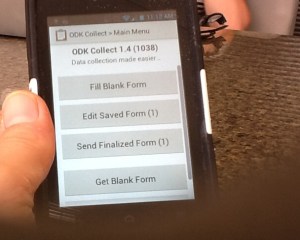
The data is hosted for free on the ODK server (well for now since no one is ever sure of the evolution of these companies) but the data can easily be hosted on a different server and can be downloaded and saved offline as well. It works with simple excel spreadsheet surveys downloaded from a site like Formhub to android phones with a user friendly format (see pic).
photo
It allows for safeguards like reviewing data collectors work and yet it does not require expensive data plans for smart phones. The data can be collected offline and can be transferred using USBs (although that adds extra steps).
There are also proprietary systems and tools available using this process to take community organizations to the same place, if they feel more comfortable in pursuing a company to help them with a mobile system.
ODK has the possibility to capture data in many more formats than typical surveys relying on paper forms (i.e. text, numbers or single/multiple choice)

Pictures and videos

Capture (e.g. household survey with follow-up)

Display (show picture and ask people to identify / reflect on them

Capture signature (Consent forms)

Bar and QR Code (Anonymous identification)

Urban Quality of Life and Green Placemaking | Sustainable Cities Collective

Perhaps the most striking finding of the study is the fact that happiness was more strongly correlated to green space than socioeconomic status. Participants living on blocks with 10% fewer green areas than the average were more likely to report stress and depression. Following this logic, a ‘poor’ resident living in an area with more trees and open space would report being happier than a ‘rich’ resident living in an area without access to green space.

Another study, this one by the University of Exeter in the United Kingdom, uses 18 years of survey data from over 10,000 participants across the United Kingdom. Its analysis shows a strong correlation between access to green space, self-reported well-being, and even physical health. The researchers even found that the sensations associated with living close to green space yield similar feelings and levels of satisfaction to getting a new job or getting married.

Urban Quality of Life and Green Placemaking | Sustainable Cities Collective.

Survey Monkey sez start with your conclusion

Writing your conclusion first is just like proposing a hypothesis for a science experiment.

FNS begins process to offer grants for replacement EBT services and equipment

This is a pre-solicitation notice to assist Department of Agriculture (USDA), Food and Nutrition Service (FNS) and State agencies to establish a process to award support grants to eligible farmers’ markets and to develop a method that offer replacement Supplemental Nutrition Assistance Program Electronic Benefits Transaction (SNAP EBT) equipment and services for farmers’ markets and direct-marketing farmers.
The solicitation package will be posted on fedbizopps on or August 22, 2014. All additional details (i.e. closing date, FAR Clauses, Evaluation Factors) will be included in the solicitation package.

The request for proposal (RFP) will have a two part evaluation. Part 1 will be evaluated using a pass/fail evaluation. Part 1 evaluation factor is Experience: Offeros shall demonstrate experience with Farmers Markets and direct-marketing farmers nationwide and associated partnership experience working with the Farmer Market and direct-marketing farmer.

RFP

Part 2 evaluation factors will be provided in the solicitation package.

Alternatively, interested parties may go to https://www.fbo.gov/ and search for the Notice by using the solicitation number AG82014.

Michel Nischan

Great interview with Michel Nischan, founder of Wholesome Wave and long time Farm To Table chef. He tells Louisiana Eats host Poppy Tooker about how and why he created his public role.
http://wwno.org/post/tradition-begs-evolution-changing-federal-policy-reviving-local-customs” title=”Interview withMichel Nischan by Poppy Tooker”

Farmers Market Metrics Prototype Released

The story about the completion of the FMC Prototype Report project done from January to June with 8 markets can be found here:

FMM Prototype story

A new Wisconsin NPR story about the AFRI-funded research for the Farmers Market Metrics work:

NPR story

What Ruins A Performance Review?

As a human resources manager in a previous work life, I can tell you that this post linked below has some excellent points to consider. As more and more markets add staff (and I mean staff and not independent contractors!), those organizations must add the skills necessary to manage that staff; if the organization is run entirely by a volunteer board, then a handbook on staff management or completing a short course should be required for the Executive Committee or at least the president of each term. If there is a paid director, then certainly basic human resources training available online or possibly through local community colleges or non-profit training centers should be required.
Over and over, I hear from market managers that most of them don’t get an annual review at all or if they do, don’t feel the review is in-depth enough or fair or designed to allow for improvement; they often report that the review contains criticism of issues that were beyond their control or their work is measured in ways that is news to the staff person. All of those are no-nos.
It does seem odd that people management skills are often lacking in non-profits and community initiatives, since that is exactly what they rely on to get the job done.

What Ruins A Performance Review? | LinkedIn.