Seed in Oregon City

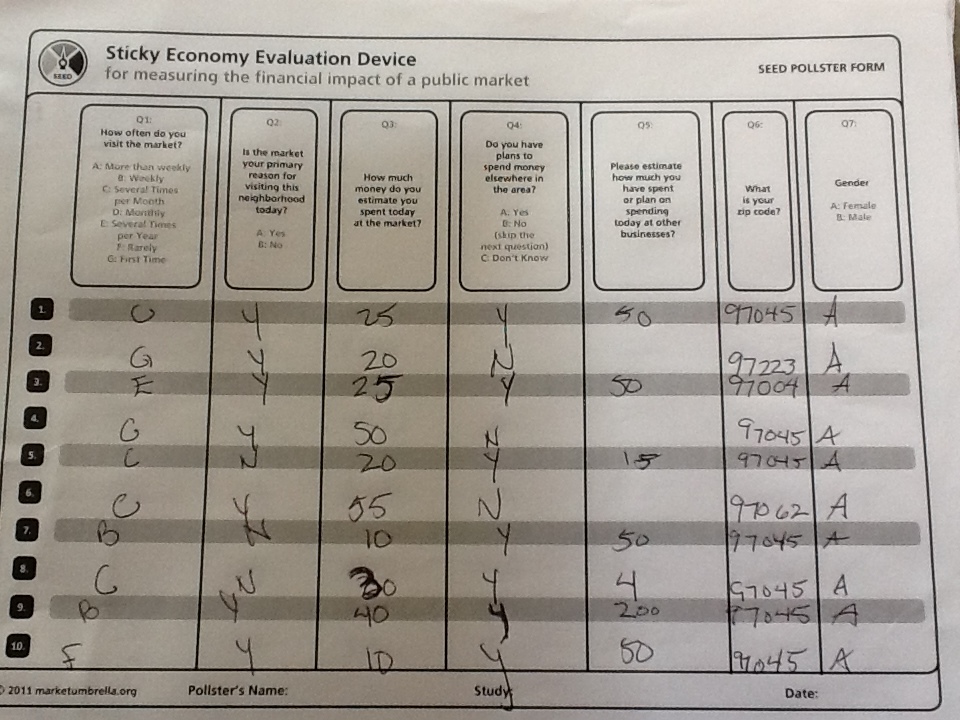
Just finished the first ever SEED http://www.marketumbrella.org/marketshare/
study in Oregon City, Oregon. Market manager Jackie Hammond-Williams puts together an amazing market every few days and has a lot of fun while she does it. Look for my upcoming FMC newsletter story about the study day and how this economic tool measures a markets impact. AND you’ll be able to read the report too – which was ready the next day. I guess we’ll let OCFM look at it first but I’m sure they will have it on their website very soon, and it will be followed by their weekday market SEED report too.

20120626-081822.jpg

How Veggie Co-ops and Ice Cream Collaboratives Could Save the Economy | Mother Jones

This entrepreneur throws some great numbers out in this excellent blog post and also entices us all with visions of local ice cream and veggies at what he, very interestingly calls a winter food bazaar. That typology term may fit in quite nicely to the project that we call Market CITY (Characteristics, Indicators and Typology)
His reference to Civic Economics and Ken Meter’s work is not surprising, since their reports (along with Michael Shuman at BALLE and Jeffrey O’Hara at Union of Concerned Scientists) make up much of the data that we are using to build the economic argument for local food systems.

How Veggie Co-ops and Ice Cream Collaboratives Could Save the Economy | Mother Jones.

Morven Summer Institute studies farmers markets evaluation

Morven Summer Institute, University of Virgina

The University of Virginia has begun their latest set of summer courses at their Morven Summer Institute outside of Charlottesville. The Farmers Market Coalition has partnered with professors Tanya Denckla Cobb, Department of Urban & Environmental Planning and Paul Freedman, Department of Politics to present a 2-week course on farmers markets.

Farmers Markets and Applied Food Systems Research will explore the history of the modern farmers market movement, its purpose and discuss emerging evaluation techniques through guest lecturers such as Stacy Miller, Executive Director of FMC, Richard McCarthy, Executive Director of marketumbrella.org, Bernie Prince, FMC Board President and Co-Director of Fresh Farm, and yours truly, independent researcher and public market trainer. The students will also attempt some market-level research using the Indicator Matrix we are developing at FMC and marketumbrella.org’s SEED tool.
About Morven:
In 2001, philanthropist John W. Kluge gave an extraordinary gift of real estate to the University of Virginia Foundation for educational and charitable purpose. The 7,379-acre gift, valued in excess of $45 million, more than doubled the University’s land holdings. Located in southeastern Albemarle County, the properties comprised 11 farms and estates, including historic Morven Farm.

Building a matrix for measurement

I’m off to Charlottesville this a.m. to join in on the Morven Summer Institute at University of Virginia’s Farmers Market Evaluation course. Stacy Miller of FMC, Richard McCarthy of marketumbrella.org and Bernie Prince of Fresh Farm Markets and Board President of FMC will be joining me as lecturers this week. I, of course, will be talking about the Indicator Matrix and what to be aware of as far as market capacity to do measurement. The link below will take you to the story I wrote about this measurement approach last month.
I encourage any food system that is working on evaluation to take a look and to contact me if you have ideas or questions about the Indicator Matrix.

http://farmersmarketcoalition.org/building-a-matrix-for-market-measurement-an-update-on-fmcs-indicator-project

Business Alliance for Local Living Economies Conference

I was fortunate enough to receive a Community Capital Sponsorship from RSF Social Finance for the annual conference that is being held in Grand Rapids Michigan this week. I am especially looking forward to the workshop on indicators for measuring local economies, as well as listening in on some of the case studies for funding entrepreneurial businesses.

If you have not heard of BALLE, it’s high time:

The Business Alliance for Local Living Economies, or BALLE, is North America’s fastest growing network of socially responsible businesses, comprised of over 80 community networks in 30 U.S. states and Canadian provinces representing over 22,000 independent business members across the U.S. and Canada.

BALLE believes that local, independent businesses are among our most potent change agents, uniquely prepared to take on the challenges of the twenty-first century with an agility, sense of place, and relationship-based approach others lack. They are more than employers and profit-makers; they are neighbors, community builders and the starting point for social innovation, aligning commerce with the common good and bringing transparency, accountability, and a caring human face to the marketplace.
BALLE’s mission is to catalyze, strengthen and connect networks of locally owned independent businesses dedicated to building strong Local Living Economies.

In late 2001, BALLE was officially launched with Laury and Judy as founding co-chairs and Michael Shuman and David Korten on the first board of advisors. Under Laury’s leadership, BALLE eventually spun off from SVN to become its own nonprofit organization, and held its first national conference in Portland, Oregon, in 2003. Since then BALLE has grown to include more than 80 other local business networks encompassing over 22,000 entrepreneurs in the US and Canada.

BALLE is a 501c3 non-profit organization.

http://www.livingeconomies.org/conference-2012
Toronto trip #1

I just returned from giving the keynote at the Greenbelt Farmers Market Network Market Manager Day in Toronto Canada. I know, how lucky does one person get…

Spending four days with my peers to the north taught me a great many things and confirmed some others. I will post a few different stories and highlights about the trip this week, but let me start today with some generalities:
1. The deep awareness of the importance of civil society in Canada serves the market and food system well. Those working on these issues know that in order for change to be calibrated correctly, it is important for citizens to constantly act as “civic agents.” They are not afraid to be oppositional when needed (when dealing with government especially) but also understand that they need to “assist each department in achieving their particular mandate” as eloquently stated by Barbara Emanuel, Manager of the Food Strategy at Toronto Public Health. (That civic agent term was defined again for me in an article I read on the way home in the latest Democracy: A Journal of Ideas in a series called Reclaiming Citizenship which I heartily recommend as well.)
2. Every food organizer I met on that trip understood that the farmer/producer needs to remain as the central partner in all projects. In other words, I didn’t come across lip service to the needs of the farmer. That lip service is usually found in code words or phrases such as “scaling up” or “elitist farmers markets” in food system conversations that I find myself in across North America and in other Western countries. Those code words tell you that the sayers are content to ignore the facts of the relative age and sophistication of our work and the intractable nature of the industrial food system so far.
I instead heard complex, thoughtful responses to the needs of farmers while balancing health equity needs for shoppers. I wish I found that more often in my travels.
3. A set of organizers who recognize that they all must remain at the same table. More specifically, that they all sit at the table but may not have the same menu of choices in front of them. Debbie Fields, the extraordinary Executive Director of FoodShare Toronto said as much to me about her colleague Anne Freeman (my host, the organizer of the Greenbelt Farmers Market Network and founder of the Dufferin Grove Farmers Market) “Anne and I understand that we have the same goal but have to use different avenues to get there.”
4. Internal evaluation is becoming known and necessary. I can’t wait to tell you more about the dynamic presentation (and later meeting of the mind) I experienced through Helene St. Jacques, a Food Share board member and marketing research professional showing results of the research done on behalf of the markets. . And, I look forward to doing some of that US/Canada evaluation sharing with Helene as well.

So much to tell you….

Canada Reports 3.09 Billion Dollar Farmers Market Impact

Seems like a well done economic impact report from Farmers Market Canada for the 2008 season.

www.bcfarmersmarket.org/pdf/fmc_brochure09.pdf.

Price comparisons at farmers markets: understanding value and affordability

In the February Farmers Market Coalition webinar, farmer and community and economic development specialist Anthony Flaccavento of Rural SCALE, Inc. will discuss his recent price comparisons between farmers markets and grocery stores in six states, and offer advice on how this data can be part of efforts to reinforce markets’ commitment to equity and affordability. Webinar is scheduled for Tuesday February 7, 2012 2:00-3:00 p.m. EST

FMC registration

FMC to Partner with University of Virginia on Interdisciplinary Course on Researching Farmers Markets

FMC story

FMC Price Comparison Webinar – February 7

Tuesday February 7 at 2 pm EST.
In this webinar, farmer and community and economic development specialist Anthony Flaccavento of Rural SCALE, Inc. will discuss his recent price comparisons between farmers markets and grocery stores in six states, and offer advice on how this data can be part of efforts to reinforce markets’ commitment to equity and affordability.

FMC registration

A Disciplined Approach to Evaluating Ideas – Scott Anthony – Harvard Business Review

An extremely useful article for the market world. Evaluation techniques should represent what is doable in a particular field while it asks people to stretch their imagination and analytical skills. Stepped evaluation (or as it is called in the article, “Stage-gate process”) for markets really is the best idea. marketumbrella.org’s 4M worksheets use that idea, and I know they have more coming along those lines in 2012…

to see the 4M sheet, go to marketumbrella.org and then log in to the marketshare project. View it under Shares.

A Disciplined Approach to Evaluating Ideas – Scott Anthony – Harvard Business Review.

Wholesome Wave data circa 2010

An excellent reference for all farmers markets. This link will take you to Wholesome Wave’s program page, where a pdf of their survey is available. This will tell you the impact of their double value coupon projects and also give some very helpful demographics.
Wholesome Wave

Utne Visionary #2

Another worthy person that Utne picked for 2011. Those of us involved in the conversation around living economies are lucky enough to listen in on this. What is money but a proxy for labor and resources? And how should we define wealth generation in our world? David Korten et al are bravely following these threads:
“Imagine an economy in which life is valued more than money and power resides with ordinary people who care about one another, their community, and their natural environment. It is possible. It is happening. Millions of people are living it into being. Our common future hangs in the balance”

Money Changer

New Economy 2.0

Study debunks myths on organic farms

Let’s remember that its our job to spread the environmental message of good farming.

Study debunks myths on organic farms.