From 0 to 35 in MS

I have worked with markets and farmers in Mississippi for a dozen years and have found more barriers to getting regional food accepted than in most other areas of the US, yet also have met some of the most optimistic and capable people  working on it there.
What’s interesting is that in going from a deeply (still) entrenched commodity/plantation culture of farming directly to a new economy of small family farming for markets and restaurants can mean that some of the middle steps can be skipped, which is beneficial to innovative growers.

In other words, the situations is similar to what has happened in many non-industrialized or colonized countries in regards to technology; having skipped the landline era, the new users adapt much more quickly to the technology of mobility*.
I can see this leapfrogging in play for sustainable farming in the Gulf States with new farmers pushing the envelope with pesticide-free and heirloom varieties at markets and in CSAs, rather than  being influenced by the less inspiring midcentury distribution system that hardened growers’ experience into growing the hardiest and tasteless products to ship.
The area around Oxford MS is one that is ready for takeoff. The small farmer markets offer organic products at a higher rate than the New Orleans farmers markets for example, and the average age of the vendors seems markedly less than the US average, to my unscientific eye. The chef quoted in the article below is a pal of mine and had been the Board President of the New Orleans-based Market Umbrella before Katrina, and now is a leader in the regional food movement in Oxford. He offers his knowledge to the markets and farmers around the area as well supporting the leading agricultural advocates, Mississippi Sustainable Agriculture Network (MSAN), which was founded with Wallace Center support a few years back. Corbin and MSAN are good example of the quiet revolution happening up there.

Additionally, the folks in Hernando MS (north of Oxford, closer to Memphis TN) are leading the state in innovative healthy living strategies and thinking deeply about how to expand regional farming to support those strategies. Their weekly market is large enough to attract serious attention from regional funders and even policy makers, and I have hopes that they might soon attempt to create a year round market.

Continue reading

Baker shutting the door on markets


I had written about this baker giving up the weekday market almost exactly 2 years ago and now via his wonderfully written email newsletter excerpted and linked at the bottom of this post, I see that he is about to give up the remaining farmers market that he attends.

I have certainly heard a wide range of reasons given by producers about why markets no longer work for them, and thanks to my long ago human resources training, I learned to ask myself and my market peers what I used to ask of my staff about departing or failing employees:

Did we do all that we could do to help this person succeed? Did we offer the same resources and attention that we could offer or do offer to others? What else should we offer (if anything) to help situations like this not happen as often in the future? Or are there just circumstances out of anyone’s control that made this inevitable?

When I post this news on my personal FB page, I guarantee you I’ll hear  responses from market shopping friends as well as non-market shopping friends telling me their opinion of his products and his stall, both good and bad, a few who will blame the market and still others who will shrug and say it goes with the territory.

I also guarantee you that when I go and talk to him directly about this email, he will be fair (he always is) to the market management but also specifically critical about markets. He will suggest marketing ideas to me, some of which might very well work for this market and some that have been tried and not worked in the past, all of which may or may not have helped his business. I expect that we will find ourselves in somewhat of a standoff, although I will agree with him that markets should be reactive to the needs of their anchor and to their specialty vendors. I’m not saying that this market was not – I cannot know what the recent relationship is-  but wearing my hat of a market strategist for a minute, any and all markets should constantly fine tune their management and marketing based on their measurement of positive and negative impacts, and that does include measuring a spectrum of individual stall activity across the market.

The trick is to measure within the context of each business’ set of goals and true interest in being at markets long-term.

As a specialty item vendor (he’d  disagree with that description I am guessing, but his breads are unique enough for purchase that they have to be seen as specialty rather than staple goods still), finding his customers can be slightly more tricky than it is for the market to find the anchor vendors customers. And to further confuse matters, in some markets, once in a while the specialty vendors ARE the anchor vendors.

Continue reading

Farmers market ‘reconnects’ with campus 

This is a project I have assisted whenever called on to do so. This university attracts a great many rural and suburban from a diverse set of backgrounds and yet has almost no attention paid to environmental sustainability or food policy in its coursework, outside of a very few entrepreneurial and committed professors.

A selected student runs the 2-3 times per semester market, and is in charge of adding vendors, running the actual market day and doing on-campus marketing. From my vantage point, this simple project has taught quite a few young adults about farming and about healthy food at a point when they are willing to take in new information. It has also opened an ongoing discussion of why the campus outlets don’t offer better and local food whenever possible.
This market is also an example of the expanded typology that we need to categorize and share so that organizers or partners don’t only expect a 30 + member heavy-on-raw-goods Saturday morning market as the only appropriate intervention. The goals of this market are closely tied to their unique structure and strategy or, what we used to call the 4Ms at Market Umbrella (well, I still call them that)-the market’s mission, management, marketing and measurement. Those first two Ms are the framework for the internal systems created and are linked (the mission should tell you what type of management/governance is required) and the following two are designed once the system of management has been created.

(By the way, this is also a framework we used for evaluating any new project at MU for many years: we first decided if any project suggested was clearly within our mission; then we discussed the type of supervision (management) that would be required and decided if we had the skills and hours to do it well; any marketing and outreach also meant ensuring that our vendors and present shoppers understood the project and of course measurement was based on the external benefits of the project but the impact on the market itself was also measured. Even if the project was successful by external measures, if the present market community felt the project had negative impacts that outweighed the positive ones, then it was not repeated or made into a actual program past pilot stage.)

Many vendors found having a farmers market on campus was beneficial towards the students. It offered students a way to buy local food. Ory explained that Locally Preserved products could easily be incorporated into easy meals for college students. One option is adding their apple pie butter to a bowl of oatmeal for flavor.

Source: Farmers’ market ‘reconnects’ with campus | lionsroarnews


Some background from the professor and the founder…

Big data doesn’t have to be Big Brother

This article easily says what I attempted to do in my 3-part Big Data, Little Farmers Markets posts earlier in the year.

The same data and algorithms that wreak havoc on workers’ lives could just as easily be repurposed to improve them. Worker cooperatives or strong, radical unions could use the same algorithms to maximize workers’ well being…

…Big data, like all technology, is imbued within social relations. Despite the rhetoric of its boosters and detractors, there is nothing inherently progressive or draconian about big data. Like all technology, its uses reflect the values of the society we live in.

Under our present system, the military and government use big data to suppress populations and spy on civilians. Corporations use it to boost profits, increase productivity, and extend the process of commodification ever deeper into our lives. But data and statistical algorithms don’t produce these outcomes — capitalism does. To realize the potentially amazing benefits of big data, we must fight against the undemocratic forces that seek to turn it into a tool of commodification and oppression.

Big Data article

WW 2016 Early Bird Special closes Friday

Transforming Food Access
The Early Bird Special for the 2016 Transforming Food Access Summit closes in two days, this Friday, November 20th. If you’ve already signed up, we look forward to seeing you there. Otherwise, don’t miss out. Register before the 20th with the code EARLYBIRD2016, to receive a $75 discount on registration costs!

We are pleased to share an outstanding array of speakers, panelists, and contributors for this year’s summit, including featured speaker, Kevin Concannon, the Under Secretary for Food, Nutrition and Consumer Services at USDA.

Join a host of speakers from respected organizations in the field: Ecology Center, Fair Food Network, Farm Fresh Rhode Island, Fresh Approach, Common Market, DC Central Kitchen, DC Greens, Eat SF, The Food Trust, Hartford Food System, Health Care Without Harm, Maine Farmland Trust, Union of Concerned Scientists, Harvard Pilgrim Health Care Foundation, and many more. To see the comprehensive agenda, click here.

We are also happy to announce that on the evening of Monday, January 11, Wholesome Wave Founder & CEO, Chef Michel Nischan, and his local Atlanta friends, Hugh Acheson, Linton Hopkins, and Anne Quatrano, will host a “Chefs’ Potluck” welcome reception at the Floataway Cafe. We are thrilled to have these award-winning chefs who are dedicated to local, sustainable food join us that evening. There’s limited availability and tickets will be available on a first come first serve basis for Summit attendees.

Michel       Hugh Acheson.png       Linton Hopkins.png       Anne Quatrano.png

We would like to extend a thank you to our sponsors, Fresh Sound Foundation and Farm Credit Council, for their generous support of this year’s summit.

Fresh Sound.png                        Farm Credit Council.png

And finally, a special thank you to Wholesome Wave Georgia for their hospitality and advice.

Please contact programs@wholesomewave.org with any questions. For periodic updates, sign up for Summit emails on our website.

ww.png

Ed Whitfield | Community-Wealth.org

This is a great in-depth interview on grassroots organizing, the growing resistance movement, the importance of policy work (which I think too many market leaders avoid) and most importantly, economic democracy. Ed’s work is so expansive that to talk of only one campaign would be too limited, but in does include food system work which is partly why it is posted here.

Our recent work has been around economic democracy. In 2010 and 2011, we asked ourselves how is it that we can focus our work more sharply? We wanted to know how to help people have opportunities to be productive for themselves and their community. We ended up pretty quickly deciding that cooperative solutions would be among the best solutions to those economic questions. They are rooted in that spirit of self-reliance. It wasn’t honest for us to say that if you have a giant jobs march that the federal government will do something good. We wanted to be as up front and honest as possible. We talked about the fact that, yes, there is resistance work that is needed. There are powerful people, places and forces where you can be crushed if you don’t. Advocacy is needed because you need to steer resources. But in the final analysis, you need to build community power so communities can be self-reliant and do things for themselves. That is the fundamental insight.

Source: Ed Whitfield | Community-Wealth.org

Slow Food Int’l Food Sovereignty Tour with Eddie Mukiibi

274

Where & When

will visit five American cities where disparities in power and wealth trigger an inspired use of food to grow leadership, self-reliance and cooperation. Stops on the tour include universities, schools and school gardens, and urban farms.

November 5-18, 2015: New York City, Detroit, New Orleans, Petal, and Sacramento. Learn more about the public events listed below on theNational Slow Food Calendar:

  • November 5-7 in New York City
    • Thursday, November 5: Kelso Beer Tap Takeover at the Berg’n Beer Hall (6-8pm)
    • Friday, November 6: A global discussion at NYU followed by light refreshments and Ferrari sparkling wines (5-7pm)
  • November 7-10 in Detroit, MI
    • Sunday, November 8: A discussion at the Spirit of Hope Church about youth and food with Detroit youth activist Kadiri Sennefer followed by soup and bread (6-8pm)
  • November 11-14 in New Orleans, LA
    • Wednesday, November 11: Slow Food New Orleans Happy Hour at Café Carmo (6-8pm) featuring under-utilized seafood species
    • Saturday, November 14: Ring the opening bell at the Crescent City Farmers Market (8am-12pm)
  • November 13 in Petal (Hattiesburg), MS: Invitation-only event
  • November 15-18 in Sacramento, CA
    • Monday, November 16: A Slow Food Fall Mixer to draw solidarity between African and American garden projects (6-8pm)
      More information here

Kairos

Recently, I had the opportunity to talk at length with a few market network leaders who are thinking deeply about potential issues for markets they expect over the next few years. It is important to note that all are doing excellent work either overseeing multiple markets or managing partnerships on behalf of markets, and that they remain hopeful about the great possibilities of the work they do. And they know everyone is doing their best to create the right programs, based on what they know about market culture.
And yet, they are thinking about difficult decisions.

What made these market leaders feel this way?
They are all receiving a great deal of support to grow one part of the customer base-namely, attracting benefit program users either by adding technology or incentives to existing markets or through adding more points of sale/outlets in underserved areas. There is no doubt that those markets and networks are grateful for that support, believe in the need to do it and are pleased that markets are seen once again as for all people (as they were before 1995), but that they also see the beginning of a few lopsided effects and unintended consequences to these efforts. Here are some:

That added support is not based on any regularly used capacity benchmarks (i.e. markets with the financial or management systems able to manage back office systems or those with significant data collection capabilities), nor on any uniform measure designed in partnership with the markets (i.e. # of vendors enrolled in FMNP or availability of SNAP-eligible goods versus sales) but primarily on geography and the willingness to participate.

  • In many cases, new markets or struggling markets are the first to raise their hand to add these programs, and yet these leaders know that accurate timing in a market’s growth cycle is essential to a successful rollout. Unfortunately, they know this through personal experience and anecdotal evidence of past failures and standout successes, and not from any comprehensive analysis of these systems. And since the level of participation in these programs must remain at a certain level, they cannot turn away those who they suspect are not ready for the added programming.
  • Since the key success indicators are often preordained and limited to increases in sales, most markets do not measure that which is more useful for their community goals, such as is developing a new trusting relationship with a community support agency, reaching the level where a significant number of the products necessary to offer a healthy family meal are regularly available or students learning about regional food production firsthand.
  • The systems are usually designed to expand into a very specific type of market; typically, one with a dozen or more producers participating, with significant F&V items available and paid staff with skills for implementing these projects. Yet, even among those that share those characteristics, other factors may be present to severely reduce the ability to successfully open or implement more than a season of this type of programming.

Secondly, assistance for incentivizing “middle-class” shopper participation and farmer participation is not available.

  • As had been said many times by smarter people than me, successful markets rely on multiple cycles of participation that best represent the community’s evolving demographics. In many cases, markets are using either a deep but limited or a wide, shallow approach to community engagement which may not create MORE shoppers or farmers, but just replace the existing with others or adds new ones at the wrong time, or asks existing farmers to anchor a number of outlets far beyond their comfort level.

Thirdly, the data that markets are gathering on those programs is not always contextualized to their system, is not shared back with analysis useful for their continued participation in these programs and in many cases, the actual data collection and entry is overwhelming those markets.

  • I’ll take this a step further; in almost no system that I have spent time listening to or working with, have I found robust data that the grassroots leaders developed themselves and then shared with their partners, or many that were able to participate deeply in the analysis. Therefore, the strategy for creating any new program is haphazard and built from the outside in rather than the way we all want it to be designed.

I’ll keep it to those points for now: So in a nutshell, they see that many of the interventions markets and their partners make – and the policies and systems built from those interventions – are often out of scale and lack credible data. And that they believe this is the market field’s responsibility to fix.

Why now?
What those leaders seem to be sensing is there is enough now enough activity and history in the farmers market field to make possible and necessary finding the appropriate tools for our work. And that using any other sector’s system of interventions without closely adapting them to our scale is no longer appropriate. That we are big enough and yet small enough to be able to decide what we need and to do so with deep deference to the resources that we are honor bound to steward and the people that we rely on for that system, the producers.

As any student of food or civic systems knows, people like Jane Jacobs, E.F. Schumacher and Wendell Berry have brilliantly offered these ideas in terms of the systems that each participated in and wrote about, such as political engagement, economic activity and resource husbandry. All three wrote about being smart about scale and about honoring local decision-making constantly and warned us of the outcomes if those things were not taken into account when working, advocating or protesting.
The ancient Greeks had a term to describe a mode of communication that truly reflects the present conditions: kairos.. Kairos can also describe a decisive moment and the right intervention for it.

Seems like we are there now, in the moment were we need to not only continue the necessary work to expand our programs to more community members, but to also simultaneously build and share the appropriate tools and interventions at the most opportune times.
Along those lines, it is time to be careful of just using “more” as a success measure or in only thinking of our community in terms of those who shop. And to expect that every market should share their particular context when designing any future interventions. And that any tool or intervention that is used has transparency with data to be shared, including any unintended consequences.

As you can imagine, this subject is just beginning, and I look forward to more conversations through email and chatting in person as I travel to winter/spring conferences.

3 Reasons Why Foodborne Illness Outbreaks Are Getting Bigger And Deadlier Than Ever

  (maybe not so odd to those of us working in community agriculture)

Major outbreaks linked to contaminated meat, produce, or other food products have now become terrifyingly commonplace.

As these numbers grow, so do the scientific and industrial advances. So why have these outbreaks continued to accelerate?
Oddly enough, these answers seem to lie in the advances themselves.

        Industrial Agriculture, Top-Notch Technology, Global Commerce

Source: Read the story here

Locally grown coffee

In the years since I joined the farmers market community, many things have changed about my life because of that connection. One of those changes is how I get my news and what kind of news that I now find interesting. An example of this is RFD-TV, which I often catch on a sleepy Sunday morning as I cook up items from my Saturday market. RFD-TV is full of state agricultural updates, national farm reports and even some old-timey music shows like the Porter Wagoner Show. Exciting right?

This week the California Bountiful show featured a farmers market grower from the Santa Barbara area, Jay Ruskey of Good Land Organics and the locally grown coffee beans he is selling at farmers markets. Yes, that’s right – coffee beans. This farmer has also experimented with other unusual crops like the caviar lime and the cherimoya; his never-ending enthusiasm for new trials and offering those products to his shoppers is a great example of how innovation and farmers markets are intrinsically connected.

If your market has a vendor who regularly offers new varieties or talks about his or her dreams of adding crops currently unavailable in your region, it may be worthwhile for the market organization to seek funding in partnership with that farmer and local Extension in order to get that item in full production and to promote it once available. It’s important that Extension or an agricultural advocate is involved to ensure that the production snafus that are inevitable to this type of project can be addressed. One of my favorite examples of this work was done in Toronto for their World Crops Project which I wrote about a few years back for Growing For Markets. What was so impressive were the depth of the partnerships assisting in every step of the process and that they focused on involving new citizens who had some experience as farmers in other world regions to introduce culturally appropriate products to Ontario.

Also, I always recommend that markets keep an ongoing list of crops that they’d like to see added to their market and to circulate that list every once in a while to the vendors. Who knows…you might just spark an idea…

http://www.californiabountiful.com

October Newsletter from Center for Agriculture and Food Systems (CAFS)

I am a huge fan of the Center for Agriculture and Food Systems at the Vermont Law School. This activist center has already added a great deal of thoughtful research to the field of community food and their impact continues to grow exponentially. It is my honor to be working on one of their projects, a legal toolkit for farmers markets, along with the good folks at NOFA-VT.

OCTOBER 2015

  Like us on Facebook    Follow us on Twitter    View our profile on LinkedIn

GREETINGS
As I write this, the harvest is in and the farmers markets are in their final weeks. At CAFS, we have also had a bountiful season, presenting at conferences on each coast (the University of Oregon and Harvard University), teaching a wonderful class of food and agriculture law and policy students, and continuing our project work for food and agriculture producers and entrepreneurs. We are thrilled to report the award of additional funds through the National Agriculture Library, expanding that partnership through our innovative collaboration with William Mitchell Public Health Law Center and the Rudd Center for Food Policy and Obesity at the University of Connecticut. We are also pleased to announce the expansion of our staff with one of our own graduates, Sarah Danly, who is spearheading our leading-edge use of design, technology and the law to produce relevant and powerful legal tools. These are just a few highlights of what you will read below.
I hope you enjoy the fall issue.
Eat well, be well,
Laurie Ristino
Director, Center for Agriculture and Food Systems
Banner image courtesy of Brooklyn Grange

PROJECTS & RESOURCES
USDA National Agricultural Library
Awards CAFS $728,273 Grant
In September, CAFS received a $728,273 grant from the USDA National Agricultural Library. The grant will support three new projects; the largest — the Community FoodWorks project — is a collaboration with the Public Health Law Center at William Mitchell College of Law and the Rudd Center for Food Policy & Obesity at the University of Connecticut. The two additional projects, How to Use a Lawyer and Farmland Access Lease Assistant, will be designed to help farmers find and utilize legal resources.

STAFF SPOTLIGHT
Sarah Danly
Program Officer for Legal Design
Sarah recently earned her MELP (Master of Environmental Law and Policy) from Vermont Law School. She also holds a BA in Architectural Studies and Community Health from Tufts University, as well as a BFA from the School of the Museum of Fine Arts, where she focused on sculpture, drawing, design, and digital skills.
   Sarah will work with students in the Food & Agriculture Clinic on designing accessible online legal tools and information, which include the animated clip, “What Does the Food and Ag Clinic Do?” Prior to coming to CAFS, Sarah conducted outreach for Next Step Living, a Boston-based home energy efficiency company, and worked at farmers markets as a vendor and assistant manager.

FACULTY SPOTLIGHT

CAFS Welcomes Practicing
Faculty Members Beth Boepple
and Amy Manzelli
Beth Boepple (right) is developing the fourth food and agriculture distance-learning course for CAFS, drawing on her rich experience practicing food and farm law. A VLS alum, Beth is a shareholder and attorney with Lambert Coffin in Portland, Maine, specializing in corporate, commercial and banking law; farm and food production law; and real-estate and land-use law.
    In addition, Beth will be co-teaching Agriculture and Food Entrepreneur Lawyering Skills with Amy Manzelli (left) in the spring. Amy currently collaborates with CAFS on two USDA-funded projects. She is a partner at BCM Environmental & Land Law, PLLC in Concord, New Hampshire, specializing in environmental, conservation, and land law.
NEWS & EVENTS
Director Laurie Ristino Presents at Harvard Law and the University of Oregon School of Law
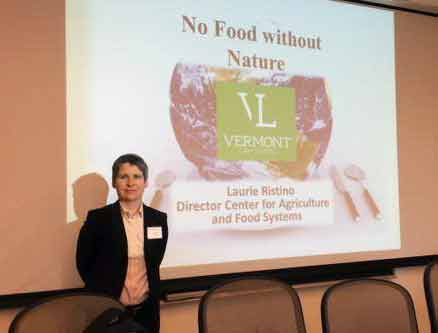
On September 25, 2015, Ristino gave the presentation “Food, Agriculture, and Drought: Implications of Water Supply Scarcity on Food Production and Policy Solutions at the Federal, State, and Local Levels” at the Drought in the American West Symposium at the University of Oregon School of Law in Eugene. On October 3, she also gave a seminar at Harvard’s Food Law Student Leadership Summit entitled “No Food Without Nature.”
Associate Director Laurie Beyranevand Contributes to Recently Published Books
Beyranevand wrote the chapters “Breaking Down Barriers to Local Food Distribution in Urban Centers” from Urban Agriculture: Policy, Law, Strategy, and Implementation, and “Agricultural Biotechnology and NAFTA: Analyzing the Impacts of U.S. and Canadian Policies on Mexico’s Environment and Agriculture,” from NAFTA and Sustainable Development: The History, Experience, and Prospects for Reform.
People at CAFS
* Associate Director Laurie Beyranevand was interviewed October 1, 2015 on Heritage Radio Network’s Eating Matters podcast about food labels and CAFS’ food labeling site Labels Unwrapped. She was also quoted in Mother Jones‘ article, “Chipotle Says it Dropped GMOs. Now a Court Will Decide if That’s Bulls-t;” in ClimateWire‘s “Businesses learn there are tax incentives and laws to help them recycle mountains of food;” in the Valley News‘ article “Food Notes: A Modern Take on an Old-Time Product;” and in the Health Affairs Blog article “The FDA’s Determination on Artificial Trans Fat: A Long Time Coming.”
* Director Laurie Ristino was quoted in the Law360 article “9th Circ. Pesticide Ruling Holds EPA to High Standards,” commenting on the 9th Circuit Court’s decision to vacate several EPA registrations of bee-killing pesticides.

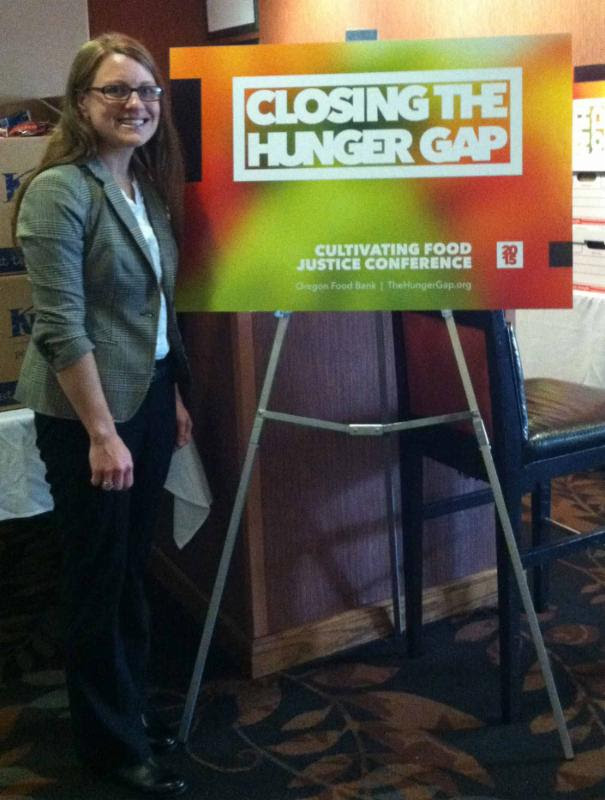
* Research Fellow Amber Leasure-Earnhardt(right) attended the Closing the Hunger Gap: Cultivating Food Justice conference in Portland, Oregon, in September. She met with food bank representatives, farmers, and advocates to discuss the role of CAFS’ gleaning research in furthering food justice.
* LLM Fellow Carrie Scrufari will be presenting her paper “Generally Recognized as Safe-Until They’re Not: Why the FDA Never Subtracts Food Additive From GRAS” at the Yale Food Systems Symposiumon October 30-31, 2015. She workshopped the paper in September at Pace Law School’s 2nd Annual Future Environmental Law Professors Workshop.
 

The Gift of Food: What to Give to Those Who Have Lost

I absolutely love this reminder of gifts of food as a source of comfort to those grieving or healing. I remember well how my pals put together a schedule of healthy food after I had surgery a few years back, as well as food being dropped off by my friends and work colleagues when family members passed in the last few years, and how much those very special gifts from all of those busy people meant to me and to my family.

I wonder if markets could assist their customers (and make some income too) by stretching this idea with “winter cold” baskets, full of greens, carrots, garlic and chicken or a “welcome to summer” baskets with flowers, fruits and light foods or by printing cards with room for a note and a list of what is being dropped off for the basket?

Source: The Gift of Food: What to Give to Those Who Have Lost | Cooking Light

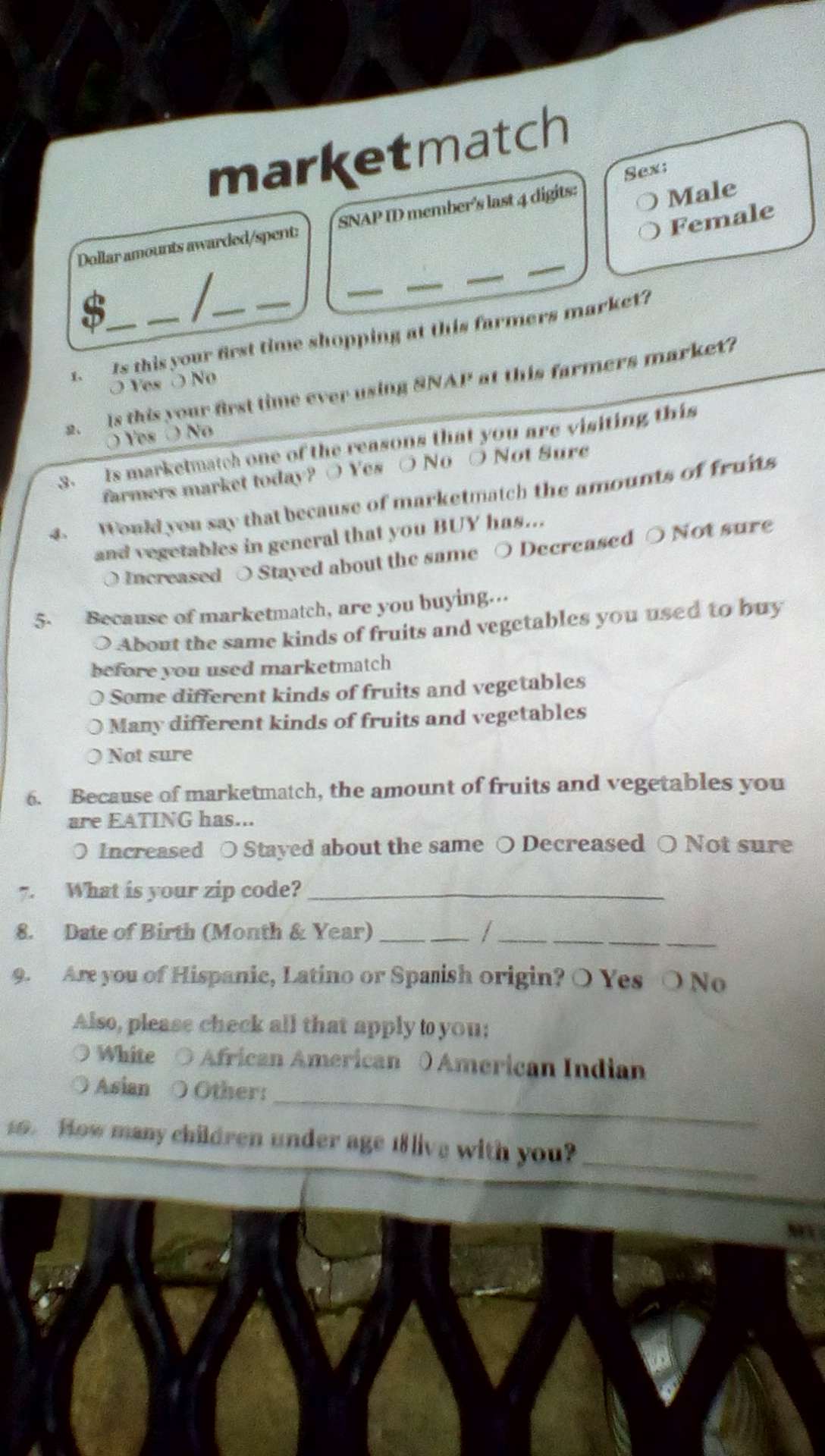
Self-administered survey-New Orleans Market Match user

This is (basically) the same system that Crescent City Farmers Market (CCFM) in New Orleans has used to gather data from incentive users (incentiv-ers?) since they began doing them some years back. They call their incentive Market Match.

As one of the staff who was responsible for doing it when it began and was part of the discussion about it, I really liked it. It is on a pad that is pulled off to have the person fill out and then each slip is added to the clipboard (or put in a container) to be entered into spreadsheets at a later time. The darker grey is filled out by the market staff person after the other part is completed by the shopper. What I know is that the system was designed with both the shopper and the market staff needs in minds, which as we all know is important and yet not always done. I’d like them to be numbered chronologically so as to know that none were lost. Maybe they are numbered, I’ll check to see.

Sorry for the wrinkles- it ended up in my market bag under the citrus. I’ll get some more pics of their system-including a better version of this and maybe the other collection forms if they will allow me to continue to peek over their shoulder.

MMtracking form_CCFM