Lompoc growers sue farmers market

Wow, two stories posted today about vendors publicly disagreeing with markets. Not my favorite subject but certainly a necessary one to acknowledge.
I wonder if anything could have been done (in either case) to reduce the scope of these problems by assessing the problem ahead of time or maybe by asking for outside facilitation. I often hear stories from markets about disagreements they have with vendors. The best markets respond quickly and fairly to those issues and whenever possible, create more avenues of transparent governance to ensure that increasingly complex market projects do not leave loyal vendors behind.
So, as we expand the reach of markets, I think we need to make doubly sure that our main partners-the farmers-understand how decisions are made and are included when possible. Of course, it is possible that in both cases that there was nothing that could be done to avoid this conflict. In any case, let’s hope that the markets and the farmers rebound quickly from this.
Market suit story

Nine Meals Away from Anarchy

My brilliant colleague Wayne Roberts adds some thought-provoking ideas to the New Year. Now I understand how the four systems of food: production, logistics, nature and cities could be the cause (any or all of them) of a serious crisis and a real panic. So once again, how can markets and direct marketing farmers work to ensure a safe (uninterrupted) food supply?

Nine Meals Away from Anarchy – Environment – Utne Reader.

Complaints feed Santa Rosa farmers market feud

Certification is a great idea. Associations are a great idea. Feuds are not a great idea.

Complaints feed Santa Rosa farmers market feud.

If You Build It, Will They Come? Consumer Behavior Concepts for Effective Marketing of Healthy Food – an NGFN webinar

Thursday, October 18, 2012 3:30 PM – 5:00 PM EDT

Connecting all the dots to ensure a good supply of healthy food is challenging, particularity in underserved and limited resource populations. Creating access to Good Food alone does not necessarily guarantee community members will purchase and eat it. Increasing food access is good, but increasing the consumption of healthy food is even better.

To “close the deal” with the consumer, we must truly and respectfully understand several factors including, how people in the community live, the constraints they live with, and how they shop. This information, when handled in a sensitive and thoughtful way is critical to creating an effective healthy food marketplace that considers what products should be marketed, at what price and to which specific consumers.

Farmers Market Coalition Farmers Market Training Programs Webinar


Wed, Oct 10, 2012 1:00 PM – 2:00 PM EDT


Register at:
 https://attendee.gotowebinar.com/register/2490526123394749184

Please share with market state or network leaders that are interested in developing models of accreditation or training programs.

5 minutes – Welcome and logistical overview of webinar from Elizabeth Comiskey, FMC Membership Coordinator
10 minutes – Bernie Prince, FMC Board President and co-founder and co-director of Fresh Farm Markets will give an overview of how FMC can help networks build training programs: no need for a “one-size-fits-all” model!.
20 minutes – Dru Montri, Director of Michigan Farmers Market Association (MIFMA) will share their model: a market manager certification program
5 minutes –Darlene Wolnik, FMC Market Programs Advisor and Independent Market Consultant will share general evaluation success measures that could be used in training market managers and vendors
20 minutes – Q&A/open discussion- Moderated by Darlene

Questions can be typed in at any time; Liz and Darlene will make a list and ask each of them (as time permits) during the Q&A period. Webinars of other models will be presented in upcoming months, so questions should be focused on the model presented.


well sure

Home Brewer in Chief

http://usat.ly/NBR9fD

Community Supported Enterprise Webinar offered

BALLE offers a webinar on a CSE (Community Supported Enterprise) called Worker’s Diner, which is using a local stock offering to finance a worker-controlled restaurant. Learn about the process and raising funds locally from the perspective of a worker cooperative:

Local Stock Offerings Part Two
Worker Ownership and Direct Public Offering

Chris Michael and Workers Development have been working to create Workers Diner, a family-friendly dining establishment serving traditional New York City diner cuisine in the heart of Central Brooklyn. Pending funding through a Direct Public Offering launched this spring, Workers Diner will be organized as a worker cooperative, with all voting rights and profits retained by worker-owners.

The founders of Workers Diner intend on establishing a replicable model for the financing of worker-controlled businesses: with startup costs raised from local communities, profits and proceeds can remain in local communities. Join Chris as he shares this model and the Worker Diner story.

Tuesday, August 14 at 10am PT / 11am MT / 12pm CT / 1pm ET / 8am HT

Learn more and register:
http://www.livingeconomies.org/node/852

Transition for CFSC

Community Food Security Coalition

Dear Community Food Security Coalition community:

I am writing to let you know that after 16 years of leadership, collaboration, and groundbreaking work in the food justice movement, the Board of Directors and senior staff of the Community Food Security Coalition have made the difficult decision to begin transitioning our programs and services to our trusted partner organizations and coalition members and close current operations of the Community Food Security Coalition by the end of 2012.
 
The inspiring growth of the food movement in the last few years has brought a diverse range of extraordinary and highly skilled partner organizations to the movement, and grant funding has become more competitive. As several of our significant grants come to a close, we had to ask ourselves a tough question: What will best serve the movement? Should we compete for funding, or sow our work with great care back into the broader movement, where we know it will continue to grow. 
 
At CFSC’s 2011 Annual Conference, one of our members referenced a book about movement building and the evolving model of organizations called “The Starfish and the Spider.” A spider, when you cut off one of its legs, becomes weaker. A starfish, on the other hand, when faced with the loss of a leg, regenerates another—and the first leg, off on its own, grows a new starfish. “Is CFSC a starfish or a spider?” we asked ourselves.
 
As a new leader within CFSC, I spent the last months in conversation with our membership and our leaders, contemplating our purpose and our role within the movement. Ultimately, our leadership came to the decision that the movement is best served by sunsetting CFSC’s operations, and embedding components of our work with trusted partner organizations. We are the starfish.
 
On behalf of CFSC, I humbly thank the hundreds of organizers, activists, staff and members who made this great organization a founding cornerstone of this vibrant movement. 
 
As we implement our transition plans over the next few months, I encourage you to follow our blog to stay updated, and visit the FAQ page of our website for more information.  I welcome your thoughts and ideas as we embark upon this next chapter together. 
 
In great solidarity and with deep gratitude,
 
Miriam Barnard, Executive Director
with Darlene Wolnik, Chair, CFSC Board of Directors and the CFSC Board

Jobs seem plentiful

Even though this article seems to suggest that corporations are the target for all of these grads, I think we know that many are hoping to work in small-scaled sustainable ag. Now it’s our job to make that a reality with some serious job programs for alternative food systems.

http://usat.ly/RpLTBc

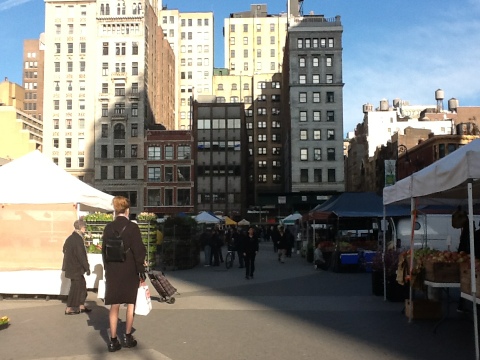
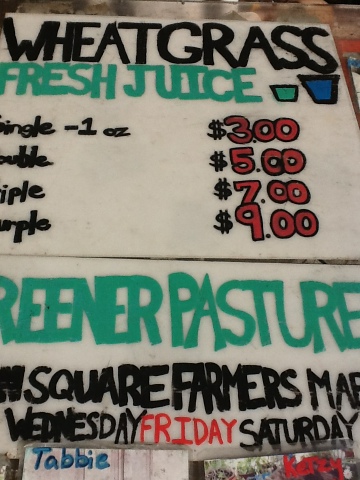
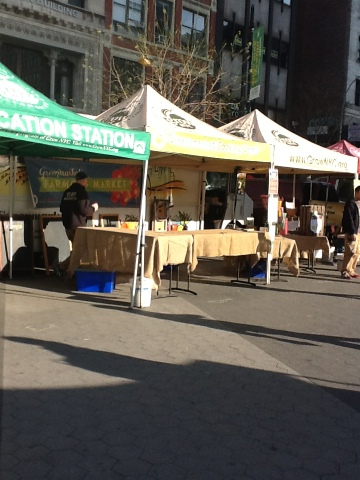
Greenmarket Union Square – Wednesday

On my way to a morning meeting, I had the great fortune to be able to stop at the Greenmarket on a beautiful Wednesday morning. This is the first half hour of opening, and let me tell you, it never looks this quiet again! I didn’t get close ups of vendors this time, but will whenI go back on Friday morning!

20120404-105156.jpg

20120404-105220.jpg

20120404-105233.jpg

20120404-105251.jpg

20120404-105308.jpg

2 market organizers, sharing.

One of my favorite sights is when two market managers have a minute. Jan, the longtime market organizer of the Covington Farmers Market and Richard, founder and director of the Crescent City Farmers Market in New Orleans catch up after many years of running neighboring markets. The Covington Farmers Market is across Lake Pontchartrain from New Orleans, only about 50 miles north of the city but the two have not seen each other for a long time. Richard assisted Covington when they first opened (the year after CCFM opened) and the two markets amiably share a great many vendors and so also share information when needed. This type of warm, informal market relationship is found in almost region. I can think of many examples-Durham and Carrboro in North Carolina, Mount Pleasant and 14th and U markets in Washington DC, the Westside Community Market and Dane County Farmers Market and so on. Networking doesn’t always mean a formal association; it can simply mean professional sharing and interdependence.

Canada Reports 3.09 Billion Dollar Farmers Market Impact

Seems like a well done economic impact report from Farmers Market Canada for the 2008 season.

www.bcfarmersmarket.org/pdf/fmc_brochure09.pdf.