Sail alone, anchor together

A few years ago, I was watching a Charlie Rose interview with the musician, Tori Amos. She was going on tour with Alanis Morrisette and Charlie asked her how that worked, how could they combine their shows. Tori frowned in concentration and said (I’m sort of paraphrasing here):
it’s not really about merging them. Really, I’m… a pirate ship. I have a captain, I have my own mates, my own wenches…..and so does she…
That comment stuck in my mind. When I went to work the next day, I shared it Richard McCarthy,  who was then the Executive Director of Market Umbrella. We were constantly searching for metaphors for farmers market organizing to describe the way it was bending  (or could be) to becoming a true movement rather than a series of random events in towns and cities. We had collected some cool descriptions, still wondered if we had yet found the best way to describe it.
“A pirate ship. Hmmm,” he said. True to his nature as a leader who employs engaging and system-level thinking, he kept at it, coming up with a powerpoint on the pirate ship idea that he continues to refine and use in his global work with civic and food organizers.

When I’m out in the field, I find that much of what we do in markets and in food systems is duplication of the worst sort, meaning unnecessary and a time waster for overworked markets or networks, or just as bad is the an expectation that all markets or projects should operate and be measured the exact same way. Why is that, I often wondered? Why don’t markets or organizers talk more to each other, sharing more tools peer-to-peer and find the strength to resist being measured and judged by inappropriate metrics?

Well, I do know why it happens. It happens because the work of community organizing is so important to do correctly and yet so unrelenting that it is hard to find time to share. And then what should be shared and how it could be shared is often as complicated.
The Tori Amos interview spoke to that idea.

The idea that innovation and creativity is handmade and often an individual exercise, or coming from a small committed group who are learning as they go.

And that sharing is not necessarily about combining efforts, but more often about connecting when needed and not overemphasizing one set of values over another.

That individuals or small groups need some autonomy and yet, in order to build a movement there are times when building the networks is as important.

So from that Amos interview came this line that Richard and I created while standing outside of a coffeehouse:
Sail Alone, Anchor Together
Like pirate ships or if you prefer, privateer ships, markets have their own flag, their own code and their own mates. Sooner or later though, they may need to join up in order to defend themselves from other forces or come together to succeed on an issue.
How they do that is important. When they do that is important too.

The lack of a national or even a regional convening primarily for farmers markets  may be starting to hamper our efforts for long term policy changes and impair capacity building. In lieu of that, we can (and should) moor our nimble little ships to sides of elegant liner like a re-imagined public markets conference or join a strong armada such as a well-organized school food initiative when we can, but even then, when we don’t know what to share and when, it’s hard to contribute meaningfully.

We also have our own issues to talk about. What about SNAP/EBT? Disaster planning for market farmers? Training for market managers? Food safety issues? Permanent locations? Sustainable funding? Building appropriate networks for policy work? Evaluation? We need to work this stuff out together and decide how it’s appropriate to our scale.

Some market networks are lucky. They have solid food systems that they work in and grow in sustainably. But even the best need to anchor with the odd little markets and share and hear because innovation within a field often comes from unlikely sources.

And sometimes it’s as hard to get the larger, more established markets to take the time and find the right voice in which to share their ideas and plans, to do that even as they are piloting ever more complex projects.

Respect to each pirate ship must be paid by the others. Learn to spot the flags and to find ways to anchor together.

Here at the PPS conference, unexpected relationships can start too

Just like a market, conferences bring people together and from that moment good things can begin. Things like flagship markets meeting up and sharing ideas:

(below) Leslie from the Athens OH market community chats with Chris of the Burlington VT Farmers Market. Both of these markets have existed for decades, are over 80 vendors and are year round. Their markets definitely have plans and issues that the other can truly understand!

20120922-132031.jpg

or things like people from the same city meeting and openly sharing ideas across projects:
Toronto Food Policy Chair Helene St. Jacques and Greenbelt Farmers Market organizer Anne Freeman make friends with St. Lawrence Market vendors Odysseas and Sandra Gounalakis of Scheffler’s Deli and Cheese while they are all far from home and waiting on a “rapid” to the evening PPS conference event. Odysseas and Sandra paid their own way to the conference to learn about public markets so that they can be of assistance to the managers.

20120922-132042.jpg

Meeting the larger market community can lead to unexpected lessons, ideas and friendships. Take the time to take a “busman’s holiday”!

Still time to join the PPS conference…

About every two years, Projects for Public Spaces hosts a dynamic public market conference that draws a wide selection of market organizers, researchers and municipal officials. This time, this it’s being hosted by my other home town of Cleveland, Ohio. The city worked hard to get the conference to showcase their 100-year-old market West Side Market AND its vibrant alternative food system. If you haven’t been to what USED to be called “the mistake on the lake” ever or recently, you would be amazed at some of the changes around town. Those of us who have done community organizing there shouldn’t be: the long tradition of neighborhood and issue organizing on issues like housing, utility reform and brownfields has been expanded to excellent food campaigns.
I can’t wait to see my colleagues, to hear about what they are up to and to see more of the Northeast Ohio food and farming system. If you haven’t checked out PPS’ website and excellent work to support public space and markets role in them, please take the time.

PPS

Toronto Market profile-Dufferin Grove Farmers Market

I had the pleasure of visiting our food community in Toronto in mid April, courtesy of the Greenbelt Farmers Market Network and its organizers, Anne Freeman and Sara Udow. Before I left, I was able to visit Anne’s well established, highly respected market (many people I chatted with throughout the city mentioned this market to me when they found I work with public markets), the Dufferin Grove Farmers Market.
The Dufferin Grove Park is a study in itself, and deserves to be used as an example by other neighborhoods that want to be a bridge for their residents and to use their space to inspire and share. I had the great fortune (thanks to Anne Freeman) to sit down with Jutta Mason who has dedicated much of her time to the evolution of this park and its activities. I could say more nice things about Jutta, how market organizers should be so lucky to have a partner like her, but she’d just find this lionizing of her quite odd probably.
But do take some time to see the wealth of resources and activities this informal group has brought to their area:
Friends of DGP

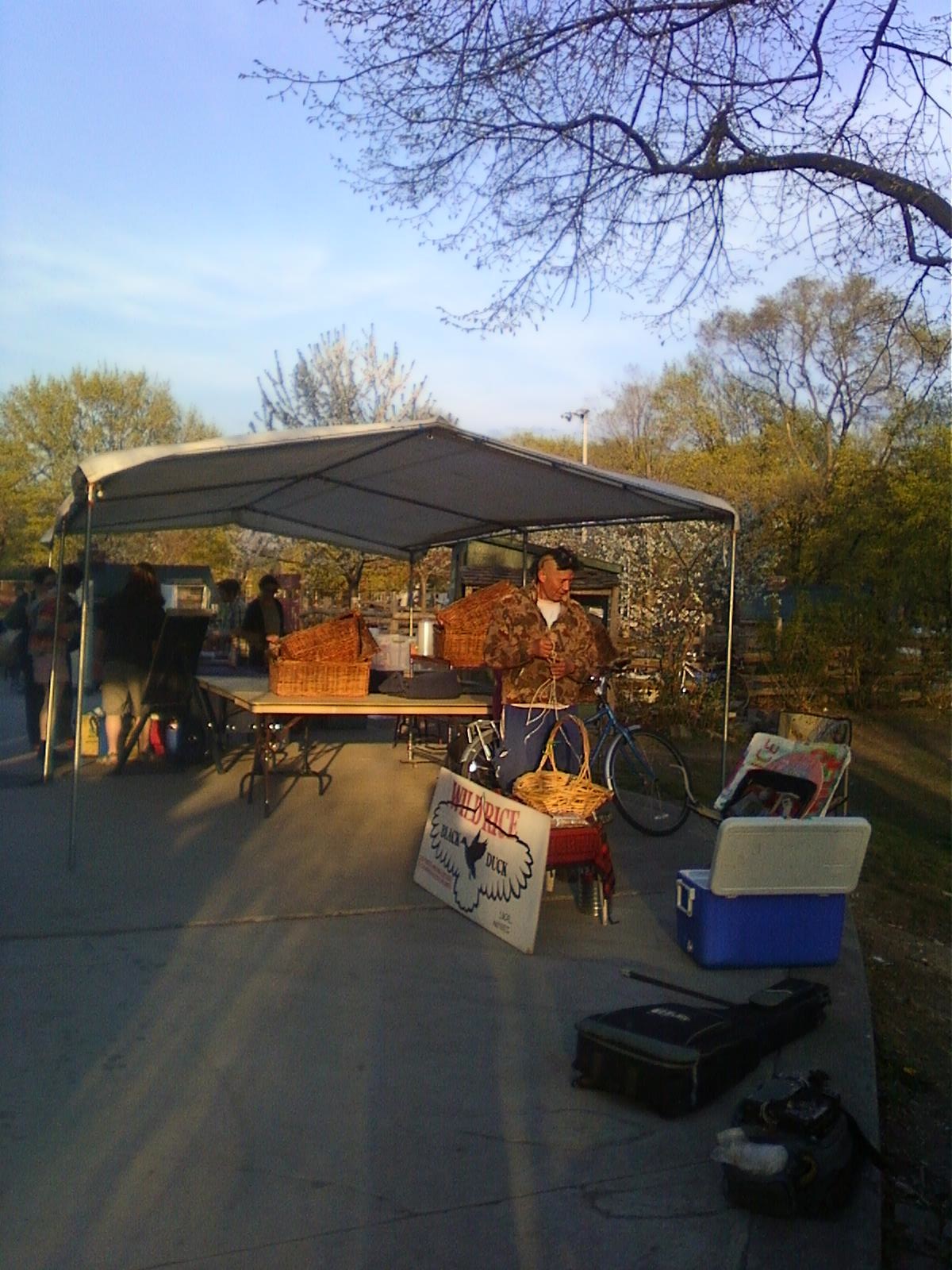
The market itself runs year-round (take that, northerners that say it can’t be done!) and has focused on organic producers, but does have farmers that represent non-organic farming as well. A good mix of small and large vendors. The wild rice vendor is a good example of the mix of season and scale of the vendors- he was sold out for the year after I bought some of his rice and would be back to his regular work until he harvested rice next year. (He told me to throw some of his rice into the swamps down in New Orleans- I might take that idea for an old creek bed on my family property…)
In any case, this is a fantastic Thursday evening farmers market that has been around for a decade already and will be there for future generations….

Black Duck Wild Rice-Toronto

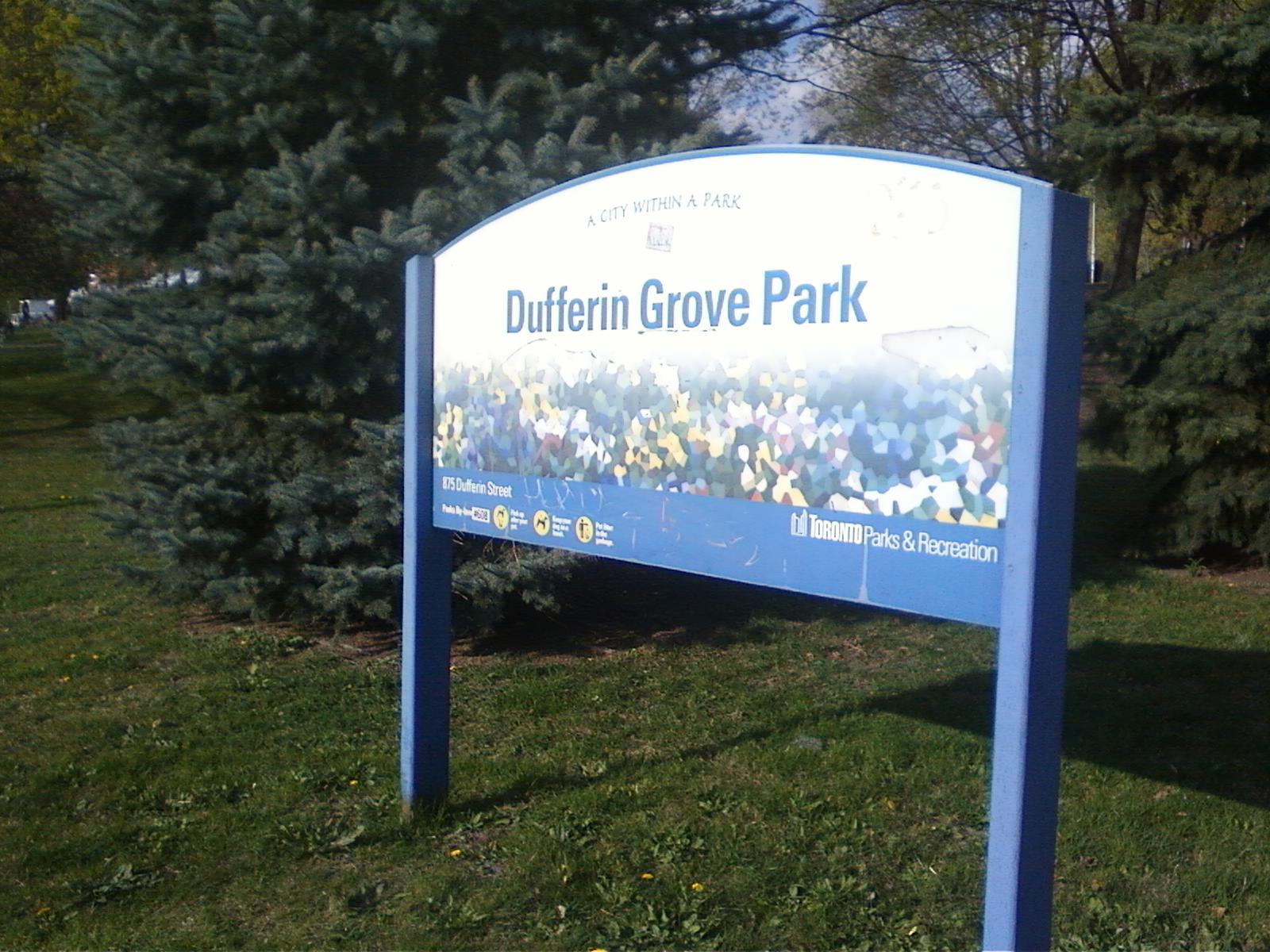
Toronto CA community park


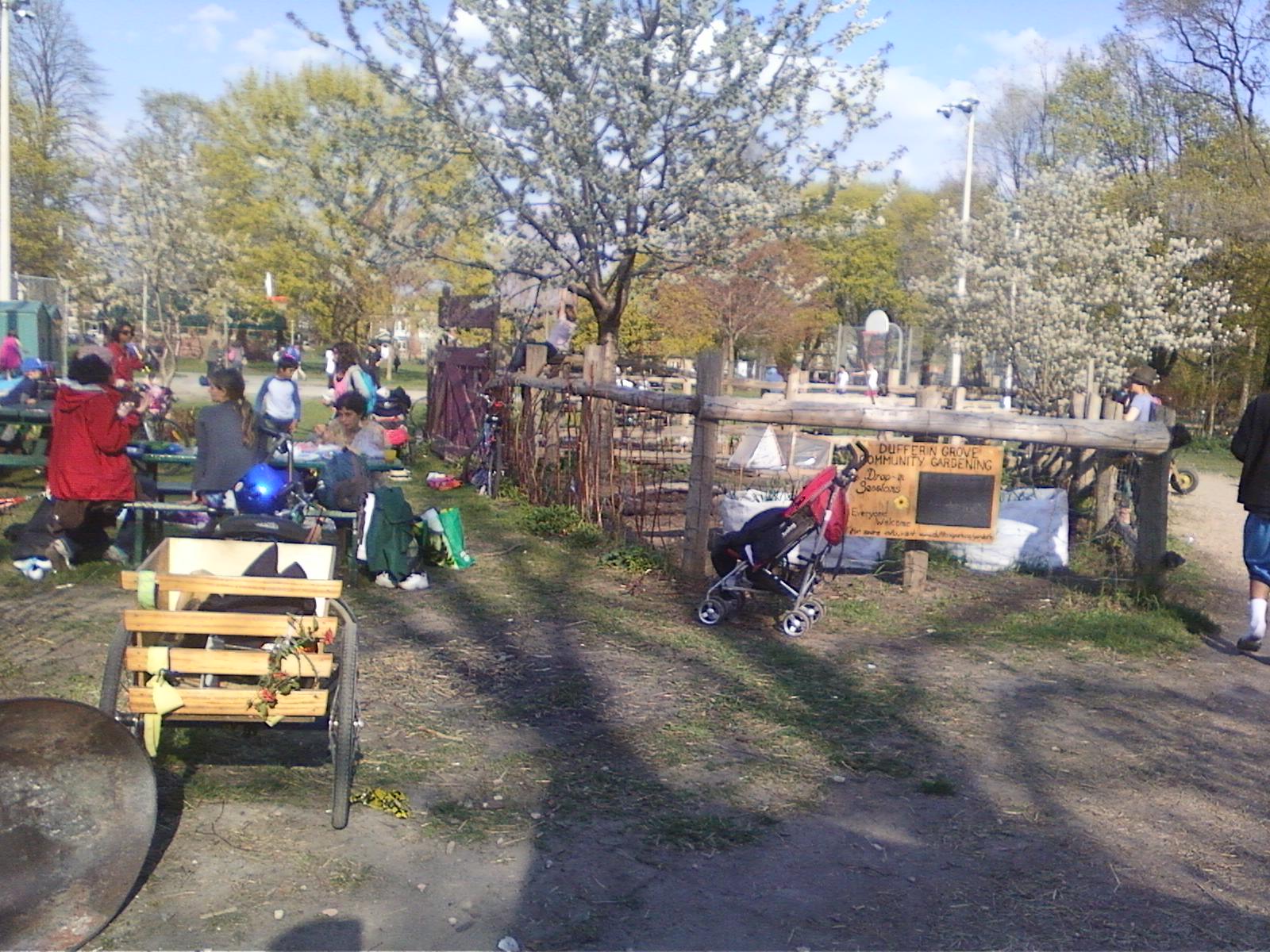
The community garden at the Dufferin Grove Park in Toronto. Sits right next to the weekly farmers market...


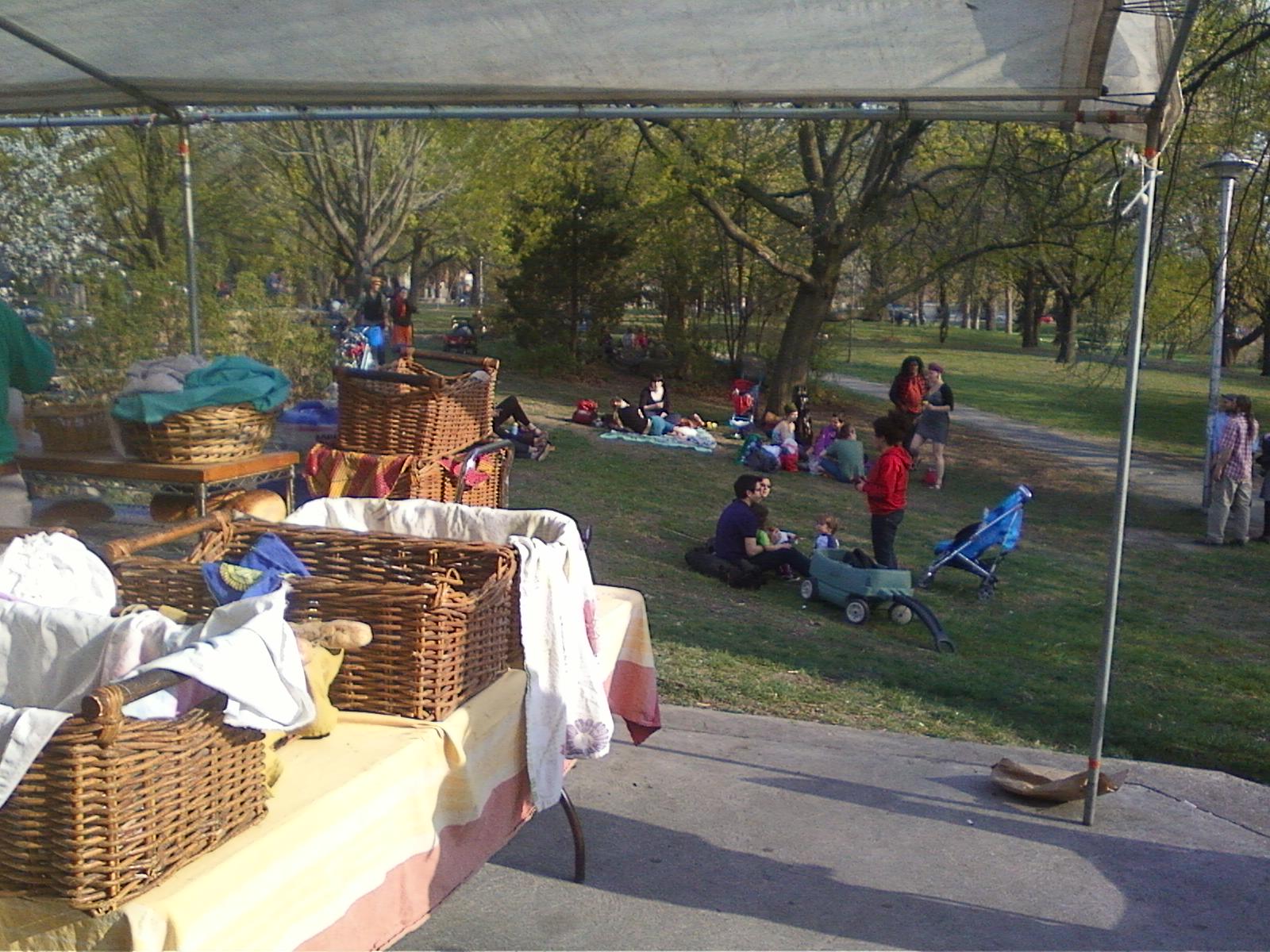
Folks sitting on the grass in Dufferin Grove Park next to the weekly farmers market.


Anne Freeman, the manager of the Dufferin Grove Park Farmers Market is seen here (in pink shirt) talking with one of her vendors in the Zamboni storage area (it is Canada after all!) where the market camps out in the winter and then spills out into the walkway for the rest of the year.


The market sets up this cleaning station for shoppers to add condiments and to clean their plates. A very attractive set up..


The market sale board for the park folks who make bread and food in their bake ovens and have a Friday night dinner as well.

Toronto trip #1

I just returned from giving the keynote at the Greenbelt Farmers Market Network Market Manager Day in Toronto Canada. I know, how lucky does one person get…

Spending four days with my peers to the north taught me a great many things and confirmed some others. I will post a few different stories and highlights about the trip this week, but let me start today with some generalities:
1. The deep awareness of the importance of civil society in Canada serves the market and food system well. Those working on these issues know that in order for change to be calibrated correctly, it is important for citizens to constantly act as “civic agents.” They are not afraid to be oppositional when needed (when dealing with government especially) but also understand that they need to “assist each department in achieving their particular mandate” as eloquently stated by Barbara Emanuel, Manager of the Food Strategy at Toronto Public Health. (That civic agent term was defined again for me in an article I read on the way home in the latest Democracy: A Journal of Ideas in a series called Reclaiming Citizenship which I heartily recommend as well.)
2. Every food organizer I met on that trip understood that the farmer/producer needs to remain as the central partner in all projects. In other words, I didn’t come across lip service to the needs of the farmer. That lip service is usually found in code words or phrases such as “scaling up” or “elitist farmers markets” in food system conversations that I find myself in across North America and in other Western countries. Those code words tell you that the sayers are content to ignore the facts of the relative age and sophistication of our work and the intractable nature of the industrial food system so far.
I instead heard complex, thoughtful responses to the needs of farmers while balancing health equity needs for shoppers. I wish I found that more often in my travels.
3. A set of organizers who recognize that they all must remain at the same table. More specifically, that they all sit at the table but may not have the same menu of choices in front of them. Debbie Fields, the extraordinary Executive Director of FoodShare Toronto said as much to me about her colleague Anne Freeman (my host, the organizer of the Greenbelt Farmers Market Network and founder of the Dufferin Grove Farmers Market) “Anne and I understand that we have the same goal but have to use different avenues to get there.”
4. Internal evaluation is becoming known and necessary. I can’t wait to tell you more about the dynamic presentation (and later meeting of the mind) I experienced through Helene St. Jacques, a Food Share board member and marketing research professional showing results of the research done on behalf of the markets. . And, I look forward to doing some of that US/Canada evaluation sharing with Helene as well.

So much to tell you….

La Via Campesina and the International Women’s Day

Today (March 8) is International Women’s Day. In the market world, we should honor our women entrepreneurs and also tip our hat to the overwhelming numbers of women organizers involved with public markets. La Via Campensina has long been promoting women in their worldwide peasant movement and today would be a great day to support their work.

La Via Campesina and the International Women’s Day.

Remember to remember Japan

From Jacqueline Church’s excellent food newsletter, even though its now more like 10 months since the disaster:’As I finish these edits, I am just back from the debrief by the Japanese Disaster Relief Fund team. They had are just back from Tohoku, Japan. Two months after the March 11 triple disaster, 115,000 people are still in living in 2,000 shelters scattered around Tohoku. Volunteers from within Japan and from Boston are on the ground in various towns, helping to clear debris, trying to elicit health status from quiet and stoic citizens in shelters.

Don’t focus on your heavy heart. Be grateful for what you have but don’t forget Japan. Giving feels good. Help in whatever way, small or grand, you can. Just do something. You will be enriched for it and feel less helpful in the face of the horrific news as it continues to unfold, as surely it will.”

And in the months to come. Remember to remember. Japan is counting on us.

Leather District Gourmet

Muddy fish tales

The world’s largest independent product-testing organization revealed last week that 22% of the seafood it tested at supermarkets, restaurants, fish markets, gourmet stores and big-box stores in three states was either mislabeled, incompletely labeled or misidentified by store or restaurant employees.

I would assume that this research does not include producer-only farmers markets that have seafood.
So its another example of how criteria at farmers markets helps consumers.

USA Story

Japanese farmers market visit

What a treat to go along with this writer for her farmers market trip in Tokyo. Her purchases alone are worth the peek:
What we bought:

Ginger syrup kit from Tokaji Farm
White, brown, and black rice from Shigeyuki Kanai
Mochi, rice flour, and genmai meal from Kaya no Sato
Carrot jam from Tanno Farm
Edamame from Sanosuke Farm joined gifts of sweet potatoes and togarashi
Akagawa Amaguri winter squash from Kosaka Nouen

Her descriptions of the samples and products available are lively and show you the vendors pride in offering lovely offerings of basic human needs.
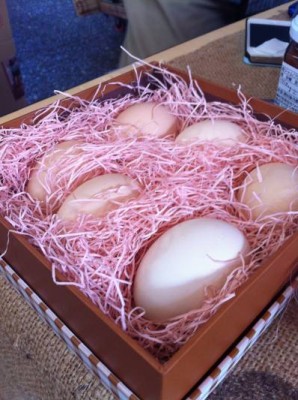
Just take a look at how eggs are displayed as if jewelry:

Eggs displayed at the Roppongi Market, Tokyo

Japanese market
Someday, I’d like to see it for myself.

Australian interview on markets

Australian farmers, Garry Stephenson Coordinator of the Small Farms Program at Oregon State University, Stacy Miller, Farmers Market Coalition Executive Director and Jane Adams, the Australian farmers market organization founder talk about the growth of farmers markets in both countries. The market movement in Australia has grown in their first 10 years to 150 markets nationwide and this interview examines the growth concerns in both countries. Jane Adams speaks well on the criteria Aussie markets employ and being able to “buy dinner” and on the size of the markets versus diversity of products. Australian organizers will be in the U.S. at the end of the month to share their lessons and will attend the Community Food Security Coalition conference November 5-8 in Oakland CA.

Australian farmers market interview

Layers of partnerships

Today, The Humane Society of the United States and the United Egg Producers announced in a joint statement that they will work together to urge U.S. lawmakers to craft legislation overseeing the living conditions of the 280 million hens involved in U.S. egg production. This would mark the first federal law regulating the treatment of animals on farms.

THS story

Markets as safe havens

In the Alley of Straw Sellers:

Afghan market

Other Countries Food Pyramids

World Food Pyramids

Earth Markets

In the quest to find your sister markets, don’t forget to look outside of the U.S.
Slow Food International has been working on a project to create markets that closely resembles the mission-driven ones in the farmers market movement here.

Here are their principles:
A worldwide NETWORK of farmers’ markets respecting the SLOW FOOD philosophy.
COMMUNITY-run markets that strengthen local food networks.
Quality food you can TRUST, bought directly from the producers.
Fair prices for both consumers and producers that foster LOCAL ECONOMIES.
Access to good, clean and fair food from the local area to reduce food miles and SHORTEN the FOOD CHAIN.
Consumers become COPRODUCERS, learning from producers and EDUCATIONAL activities.

The Network of Earth Markets:

Parndorf, Austria
Tel Aviv, Israel
Alba, Italy
Bologna, Italy
Cairo Montenotte, Italy
Calamandrana, Italy
Ciampino, Italy
Colorno, Italy
Milan, Italy
Montevarchi, Italy
San Daniele del Friuli, Italy
San Miniato, Italy
Umbertide, Italy
Riga, Latvia
Beirut, Lebanon
Tripoli, Lebanon
Bucharest, Romani