“Anti-Food Truck Meddling Ends Up Ruining Miami Farmer’s Market”

I know many markets are using food trucks as a way to get more traffic to markets, especially weekday and evening markets. Based on this and other articles that I run across, it sounds like food trucks should be specifically written into market rules to head off this sort of unwelcome publicity.
In New Orleans, we added a “Green Plate Special” many years ago so a restaurant could come and sell for a month of Tuesdays at one of our tents (it was a 10 am-2 pm market then, now it’s 9-1), as long as they had entrees under 10 bucks, sourced from the vendors when possible and followed the specific risk and vendor rules for serving prepared food.

This added amenity was to help us to draw office lunch traffic and it has done that and much more over the years, although I have to admit it killed off a lot of the prepared food items that the other vendors were selling, but maybe that was a blessing in disguise after all. It made those vendors concentrate on their fruits and veg staples and to stop trying to corner the sandwich business at the market.
And even though it was a difficult start (can I tell you the number of restaurants and chefs that I haunted in those early years?) 99% of those that participated over the years that I ran the markets asked to be able to return.

We wrote guidelines for that spot and asked them to pay double what our regular vendors paid which was still a bargain for what they received: shoppers already amassing needing food and meals, in a market with seating and local producers willing to sell items for the menu. So I recommend that markets think about how to include caterers, restaurants and food trucks into their market, but to do it without upsetting the balance of the market too much.
By the way, this article seems to suggest that this is not a “true” farmers market as most of us across the U.S.  define that term, but is more of a food and artisan market. I know Florida has many of those and they seem to be an appropriate market type and serve their shoppers and vendors well in many case but maybe we need a type to describe the market that offers prepared food as its main offering. As I often say to markets when they ask me if a rule is “okay,” it’s only important that the market can defend and explain their rules to their community. If they can, if people around there understand and most agree, then I say full steam ahead.
Okay, one story about the Green Plate. When we developed the idea, we would talk about how we wanted restaurants like Commander’s Palace to do this (often rated as the #1 fine dining restaurant in New Orleans) and although we asked them in the beginning, they quickly sent their regrets (as they are very polite folks). We were seen as a quirky little food event and hadn’t moved to “beloved institution” phase at that point…
After the levee breaks of Katrina 2005, this 100 year old+ restaurant had some damage, needed time to repair and to the great sadness of many New Orleanians, did not reopen that year. However, in 2006, they asked us if they could come to do the GPS, brought their A-team and spread the word that they would sell quarts of their famous turtle soup and a few beloved entrees. So that first day (right after we ring the bell to open the market) we hear a cheer from their tent and see the celebrated chef and owner holding a ten dollar bill over their heads while saying with great emotion, “Our first sale since Katrina!”
The next week, they brought their Maitre d’to manage the line that went out of the market.

So I’ll never forget how our little market helped this great establishment and how our original dream came true all at once. All because we always thought: “what if…”

Anti-Food Truck Meddling Ends Up Ruining Miami Farmer’s Market – Hit & Run : Reason.com.
Simple online customer survey

Recently did a quick survey for Long Beach Farmers Market in Mississippi as their organizer mulls a decision to move the market to a green space with more parking and some shade, but away from the coffee-house and asphalt.This sort of decision, as many organizers have discovered, sounds like an easy decision but never is!
Mississippi Gulf Coast markets continue to manage the after effects of Katrina (where the damage was most severe) with their cities often just now finishing rebuilding their downtowns and green spaces.
Those spaces often come last after city halls, schools and roads so the markets have been the hosts for the few vibrant public spaces along the Gulf over the last 7 years.
The amount of work that it has taken to bring back these small towns that are vital for the state and region’s economic feasibility is mostly undocumented and much of it has been driven by individuals and volunteers. Markets too can take a bow.

Here are the results of the survey:

Charted answers

Community Wealth Workshop

Spent most of Wednesday in a lovely room at historic LongueVue House and Gardens in New Orleans with bankers, community development coordinators and cooperative activists listening to economist/writer Michael Shuman describe different ways to encourage investment in localized systems.
His latest book, Local Dollars, Local Sense details strategies for creating investment in local systems as well as measuring the power of these systems. Michael is available to come to your community and have the same talk with YOUR investors and to expand your community’s knowledge about capital. I strongly encourage you to do that.

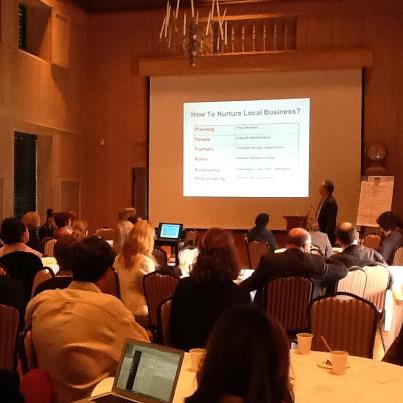
Shuman in New Orleans leading his Community Wealth Workshop

Shuman in New Orleans leading his Community Wealth Workshop

Review of “The Town That Food Saved”

The Town That Food Saved: How One Community Found Vitality in Local FoodThe Town That Food Saved: How One Community Found Vitality in Local Food by Ben Hewitt
My rating: 4 of 5 stars

While in Burlington, VT for a series of meetings and the NOFA-VT Winter Conference, I stopped at the Crow Bookstore to see what I could pick up for background on Vermont’s agricultural movement to understand its emergence as a “direct marketing” flag bearer for the alternative food community.

The book is focused on Hardwick, Vermont a small town (3200 pop.) 30 miles from the capitol of Montpelier and an hour or so from Burlington.
Hewitt starts slowly with the idea of exploring Hardwick’s reputation as a “National Alternative Agricultural Star”, which he acknowledges has been made so by outside media, including Hewitt himself and The New York Times among others.
The book profiles a few of the Hardwick’s ag economy’s “leading citizens” including Tom Stearns of High Mowing Seeds, Pete Johnson of Pete’s Greens (at the time, the state’s largest CSA, along with mucho wholesale and farmers market sales), Andrew Meyer of Vermont Soy Company, and assorted others like Jasper Hills Farms, Tom Gilbert of Highfields Center For Composting, North Hardwick Dairy, Claire’s Restaurant, Buffalo Mountain Coop, Center For an Agricultural Economy, and a few individual farmers and neighbors who take the time to give their opinion on the state of things in Vermont. He lets those interviewed tell him the pros and cons of what they and their neighbors are creating. He finds a couple of schools of thought although all sides seem to agree that this is a revolution of one type or another. Some offer their analysis of the Hardwick story from the point of view of a small, committed group building new components for achieving wealth and knowledge to share while the others believe they show it through their independent but community-connected lifestyle that doesn’t want to “win” over the other guys and exists as the opposite of what American capitalism has weakly offered most places.

This book was helpful to me. I spend my life thinking about alternative food systems and most of that time working among the disciples of it rather than those not yet sure that it serves them. To his credit, that Hewitt includes a few voices critical of this system like Steve Gorelick and Suzanna Jones in Walden is incredibly useful and incredibly rare in books of this kind. Their argument is one that I hear less often but one that I actually agree with: the new system cannot be built on the industrial model: either from its economics, its scale or its terminology. Suzanna points out her loathing of terms like entrepreneurs and food security and gave me the first laugh of the book: “People are always doing stupid things in the name of groovy ag movements.”

Hewitt makes the fair point that much of what is being touted as local food is actually being exported or simply out of the reach for the cash-restricted Hardwick citizen. Those participating will agree but make the point that they are preparing the way for the next wave of farmers and entrepreneurs and boldly testing systems and new relationships.
He also considers the hard work and commitment that these new ag leaders are putting into building their projects. All of them are thinking about how to spread their worth and influence while showcasing their (often dazzling) project success to investors and policymakers.
I found Tom Gilbert to be a particularly effective champion for both sides of the argument, probably in part because he seems to see the holes that yet exist in it.
“We have not created a new system in Hardwick; we’re just rebuilding and utilizing the infrastructure that was already here. I think we let the media get ahead of us. People read all of this amazing stuff was happening and it put everyone’s expectations on steroids…This is a building process, and we’re not ready to put the roof on, because we haven’t put the walls up yet.”
Hewitt also includes one of the most elegant, simple descriptions of local systems that I have seen in recent years in the book. It’s on Page 172 and I could write it out (because I copied it!) but I think everyone should read it within context of the arguments made.
The question of how to measure these systems is also touched upon and since that questions is so near and dear to my own heart, I wish more time had been spent discussing that with the members of the community.
Near the end, Hewitt attempts to unravel the issue of scale, which also proves that he has done his homework because it seems to me to be the Kryptonite of alternative food systems. A comment from Tom Stearns near the end shows the complicated relationship that this community has with the issue: “There is the assumption that big is bad, but maybe it’s just that big is only bad when doing bad things.”
I can only imagine what Suzanna Jones thought about THAT statement.

The Town That Food Saved as the title seems to me to be one of the only under thought-out ideas in this book. Hardwick seems saved by its size, its wealth of shared intellectual capital (sorry Suzanna!) and by being in a state that offers a safety net to all and yet seems to try to leave its citizens alone.
As for food systems, Hewitt hits on the reason why alternative food systems are growing so quickly in Vermont when he talks about the editorial that the Hardwick Gazette printed, linking food system skills to participation in democratic systems, and he himself does it on the aforementioned page 172: the idea of being responsible for your own and your neighbors’ (read community in 21st century speak) quality of life has never gone out of fashion in Vermont.
To finish that argument, my go-to guy in this story (Tom Gilbert) said it very well: ‘One of my missions is to equip people with the tools for community health and sovereignty. I‘m most interested in how whole systems can be used to combat other forms of oppression.”
Amen brother. And pass the local cider.

View all my reviews

Race, Class, and Community in San Francisco’s Mission District – “A Time of Skinny Cows”

Great article about the (negative) relationship of the food movement to gentrification and therefore culture. We have to know the entire history of our movement (including its elitist characteristics) and acknowledge how our work has positive and negative implications on the less fortunate even as we continue to push its boundaries.
Some quotes from the article that I found useful:

“We think of gentrification principally in terms of real estate, race, and class, but I more often find that food is the thermometer reading the temperature of gentrification.”

“Much of what we call food politics today—buying local, farming organic, eating vegetarian—originally came from collectives that wanted to raise awareness about industrially produced food. The People’s Food System of the mid-’70s was a network of community food stores and small-scale food collectives that organized to take back control of food from large agricultural and chemical companies; they built direct connections to farmers to establish the first farmers’ markets. Meanwhile, the Black Panthers were hosting free community breakfasts in their neighborhoods, and Alice Walters opened Chez Panisse partly as a space to talk about politics. Various collectives shared the urban farm known as the Crossroads Community (The Farm) on Potrero Avenue at the edge of the Mission.
All this activity resulted in a paradox: as radical food politics succeeded, healthy food became commodified as elite food, proving that successful social movements can be gentrified, just like neighborhoods. The best farmers’ market in San Francisco, at the Ferry Building, is also the least affordable, and Waters’ Chez Panisse, the standard-bearer of locally grown, seasonal food, has become one of the most expensive restaurants in Berkeley.”

Read more: http://www.utne.com/arts-culture/san-franciscos-mission-district-zm0z13mazwil.aspx?page=5#ixzz2LGcdfe6r

Governance case study

In 2012, I did an introductory set of case studies on market structure to begin to get some good information to markets that are struggling with their founding or expansion.
The case studies that I did were of markets that had offered to share their background and systems with me that covered some regularly used types of governance.
However, I would like to stress that often when markets ask for help with their governance, what they really need is help designing appropriate management systems. In other words, if the market community has the ability to understand and even help decide on rules and decisions and manages its organizational risks well, then I often have to conclude that the governance is fine (although sometimes the pool of available advisors to serve is too small or maybe the work is as not clearly defined as it needs to be). What is more often in flux is the design of the management job and a market’s planning for project design.
It is clear that consultants need to have more options for management to match the many types of markets that exist. On top of that, how a market decides on projects to undertake every year should be more comprehensive than a manager’s good idea and willingness of volunteers to help.
I expect to do some work on management systems and project design in 2013 and to be able to share new resources. Until then, take a look at the Market Governance Case Study Report:
HPMG-MG report

If you build it….

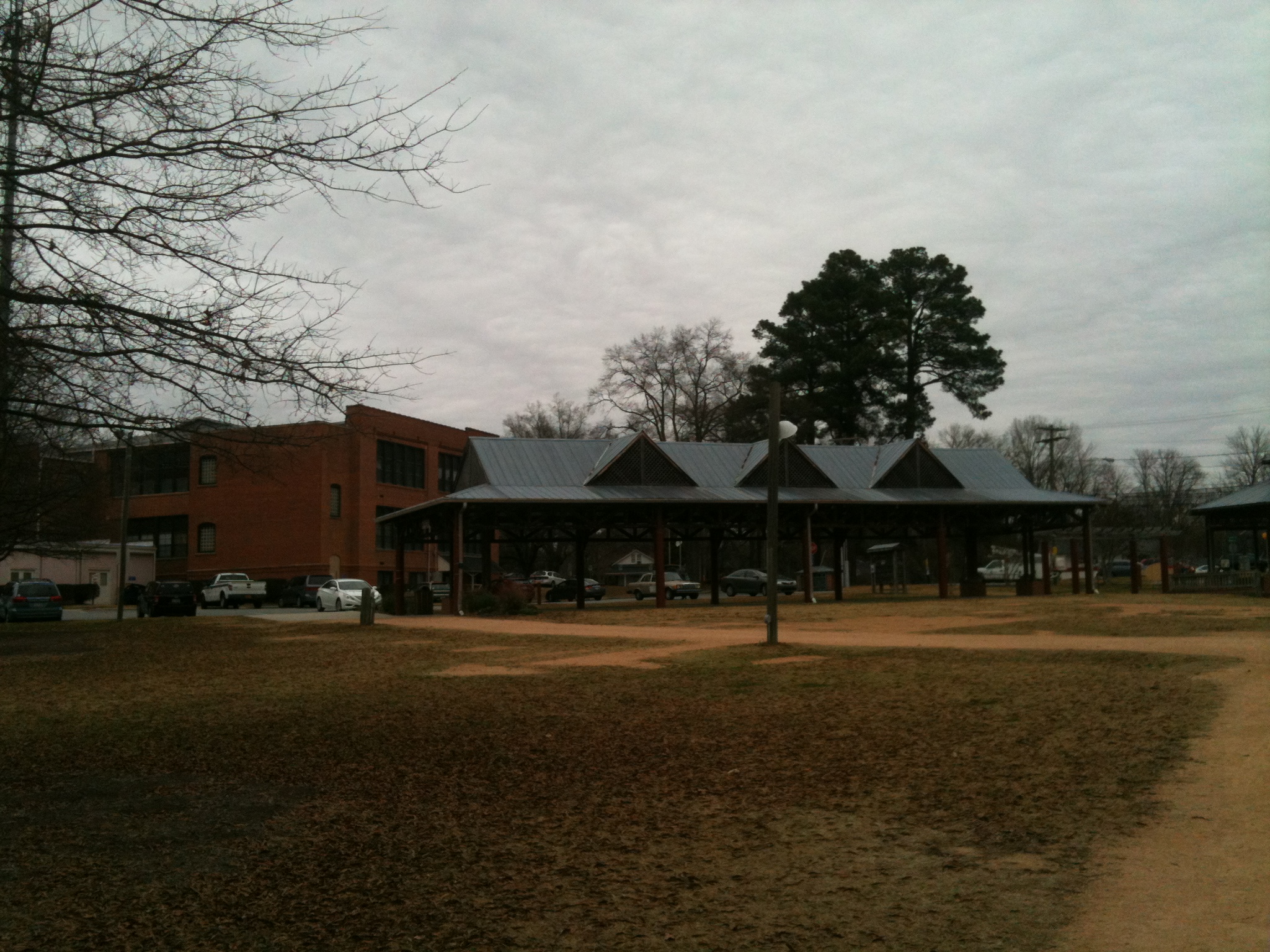
Carrboro North Carolina’s iconic farmers market has led the region in another way: In 1996, they secured a permanent location and an overhang over part of their market with electricity and drains available.Image

The Carrboro Farmers Markets is an incorporated vendor-run entity, operating twice a week in the summer and on Saturdays year-round. The Board is elected by their vendor membership and the board oversees the market staff and the market’s finances.

Recently, I asked Sarah Blacklin, Carrboro Market Manager to share some facts about their market history and structure:

1. When was the structure built? The structure secured funding from the General Assembly in 1993.  The structure was completed and built by 1996

2. Who paid for it and who maintains it? Paid for by G.A. (the Market worked with the Senator to secure that funding).  The Town of Carrboro Public Works maintains it since it’s used for other events all other times throughout the week.  Technically the Market just “rents” the space on Saturdays and Wednesdays.

3. How many vendors use the structure and how many are outside of it? (on average of course) On average, there are 32 spaces under shelter.  For Wednesdays, that’s 32 vendors and for Saturdays (since some have double spaces), that’s about 20 vendors. Out of the shelter, we’re looking at about 46.

4.  Can the vendors use the outlets for electricity? Are there drains? Some vendors have access to electricity. There are electric outlets at every other space, so some folks run an extension cord or don’t use it at all if it’s not close to them.  Yes, there are drains outside but there are some overall drainage issues in the outfield which is why we’re addressing these issues with a fundraiser project.

5.  Is it ever used for other events? Yes, it’s commonly used for other events.  The Town’s 4th of July and Halloween celebration, “Carrboro Day”, music festival, and anything in between, music festival, and anything in between.

Image

Carrboro's shed for storage and electricity.

Carrboro’s shed for storage and electricity.

Local First Webinar Series | BALLE – Business Alliance for Local Living Economies

BALLE is one of my go-to organizations, partly because their deep reservoirs of knowledge come from localized economy leaders, rather than some academic institution or a centralized big-city NGO. Therefore, their knowledge and growth seems to be thoughtful and they advance real ideas. Their webinars are done well and the next two focus on local procurement in government contracts.

Local First Webinar Series | BALLE – Business Alliance for Local Living Economies.

Phoenix mayor lives on food stamps for a week

http://www.huffingtonpost.com/2012/09/26/greg-stanton-phoenix-mayor-food-stamps_n_1915608.html

Sail alone, anchor together

A few years ago, I was watching a Charlie Rose interview with the musician, Tori Amos. She was going on tour with Alanis Morrisette and Charlie asked her how that worked, how could they combine their shows. Tori frowned in concentration and said (I’m sort of paraphrasing here):
it’s not really about merging them. Really, I’m… a pirate ship. I have a captain, I have my own mates, my own wenches…..and so does she…
That comment stuck in my mind. When I went to work the next day, I shared it Richard McCarthy,  who was then the Executive Director of Market Umbrella. We were constantly searching for metaphors for farmers market organizing to describe the way it was bending  (or could be) to becoming a true movement rather than a series of random events in towns and cities. We had collected some cool descriptions, still wondered if we had yet found the best way to describe it.
“A pirate ship. Hmmm,” he said. True to his nature as a leader who employs engaging and system-level thinking, he kept at it, coming up with a powerpoint on the pirate ship idea that he continues to refine and use in his global work with civic and food organizers.

When I’m out in the field, I find that much of what we do in markets and in food systems is duplication of the worst sort, meaning unnecessary and a time waster for overworked markets or networks, or just as bad is the an expectation that all markets or projects should operate and be measured the exact same way. Why is that, I often wondered? Why don’t markets or organizers talk more to each other, sharing more tools peer-to-peer and find the strength to resist being measured and judged by inappropriate metrics?

Well, I do know why it happens. It happens because the work of community organizing is so important to do correctly and yet so unrelenting that it is hard to find time to share. And then what should be shared and how it could be shared is often as complicated.
The Tori Amos interview spoke to that idea.

The idea that innovation and creativity is handmade and often an individual exercise, or coming from a small committed group who are learning as they go.

And that sharing is not necessarily about combining efforts, but more often about connecting when needed and not overemphasizing one set of values over another.

That individuals or small groups need some autonomy and yet, in order to build a movement there are times when building the networks is as important.

So from that Amos interview came this line that Richard and I created while standing outside of a coffeehouse:
Sail Alone, Anchor Together
Like pirate ships or if you prefer, privateer ships, markets have their own flag, their own code and their own mates. Sooner or later though, they may need to join up in order to defend themselves from other forces or come together to succeed on an issue.
How they do that is important. When they do that is important too.

The lack of a national or even a regional convening primarily for farmers markets  may be starting to hamper our efforts for long term policy changes and impair capacity building. In lieu of that, we can (and should) moor our nimble little ships to sides of elegant liner like a re-imagined public markets conference or join a strong armada such as a well-organized school food initiative when we can, but even then, when we don’t know what to share and when, it’s hard to contribute meaningfully.

We also have our own issues to talk about. What about SNAP/EBT? Disaster planning for market farmers? Training for market managers? Food safety issues? Permanent locations? Sustainable funding? Building appropriate networks for policy work? Evaluation? We need to work this stuff out together and decide how it’s appropriate to our scale.

Some market networks are lucky. They have solid food systems that they work in and grow in sustainably. But even the best need to anchor with the odd little markets and share and hear because innovation within a field often comes from unlikely sources.

And sometimes it’s as hard to get the larger, more established markets to take the time and find the right voice in which to share their ideas and plans, to do that even as they are piloting ever more complex projects.

Respect to each pirate ship must be paid by the others. Learn to spot the flags and to find ways to anchor together.

Still time to join the PPS conference…

About every two years, Projects for Public Spaces hosts a dynamic public market conference that draws a wide selection of market organizers, researchers and municipal officials. This time, this it’s being hosted by my other home town of Cleveland, Ohio. The city worked hard to get the conference to showcase their 100-year-old market West Side Market AND its vibrant alternative food system. If you haven’t been to what USED to be called “the mistake on the lake” ever or recently, you would be amazed at some of the changes around town. Those of us who have done community organizing there shouldn’t be: the long tradition of neighborhood and issue organizing on issues like housing, utility reform and brownfields has been expanded to excellent food campaigns.
I can’t wait to see my colleagues, to hear about what they are up to and to see more of the Northeast Ohio food and farming system. If you haven’t checked out PPS’ website and excellent work to support public space and markets role in them, please take the time.

PPS

The Street vendors of New York – Short documentary on Vimeo

The Street vendors of New York – Short documentary from Samuel Enblom on Vimeo.

INTERVIEW: Zoning for Food Access in New York Neighborhoods – Next American City

A must read for any food organizer. Understanding how cities are using zoning and tax incentives to encourage businesses to sell food is important. And it’s important to remember that city governments work with a “broad brush” when it comes to encouraging growth so that the most innovative entrepreneurial initiatives will most likely come from other stakeholders in food systems.
In other words, its up to us to define food system sustainability and success and for cities to remove barriers for us to do that.

INTERVIEW: Zoning for Food Access in New York Neighborhoods – Next American City.