Letter to a fellow food organizer

a colleague asked me to give her my opinion on trends and jobs in the alternative food system retail sector. Here is the beginning of my response:

Okay,
Here’s a few of my cents as requested:

As you know, the food hub conversation has taken a lot of the oxygen in the room (and a lot of the funding) away from direct farmer support and farmers markets and as a result, it feels like we are simply treading water in a lot of instances. Spread too thin. Certainly in the expansion of direct marketing farming or in getting any serious cross-sector analysis, we’re not jumping ahead much of where we were 5 years ago.

It’s not that I’m against food hubs, but some of them sound a lot like city governments’ “one-stop shops” which I am not sure has worked either. And it smacks of “scaling up” which is a suspect phrase to someone like me who has seen how long it takes a market farmer to really be ready to price at his or her comfort level and to innovate products. The Cliff Notes version of the market vendor lifespan is that it takes years of a market organizations time and “expertise” to patiently get a farmer to an economic and social comfort level where they actually tell you that they are about to go bankrupt or get divorced or get ready for a kid to go to college and so thats why their business is changing so you can help it change for the better. And that those folks are RETAIL vendors, with tables and tents and signs designed to help them sell retail, and not necessarily the same ones to approach or to change to wholesale vendors seems to be missed by some wholesale organizers.

Sometimes, it also feel that we are extrapolating the wrong lessons of what has worked to build food retail points of entry. Let me say I’m probably not “up” on all of the good work being done, although I do know and learn from original thinkers like Anthony Flaccavento’s and M. Shuman’s excellent research and analysis work. It’s just that the a lot of the scaling up and institutional buying conversation seems wildly uneven from case to case and the skills are simply not embedded into the host area to keep the thing moving forward once a founder leaves or a project fails.

What is true in the food system is that currently the public health sector rules, so therefore the conversation around low-income and at-risk end users of healthy food is the main thing being funded, which is a glorious turn around for those who always had the plan to take the food system there (meaning to everyone) no matter what anti-localvore writers try to say.<
10 years ago, the talk was all about social cohesion and dynamic Main Streets and 15 years before THAT, it was all about farmers extending seasons and growing sustainably, and it was always about doing it for everyone.

The public health sector is staying put, and learning more and more about how to use our points of entry to get results in true behavior change. That sector has changed farmers markets more than any other stakeholder (and that includes government stakeholders) because there are so many levels of public health intervention that they are willing to try wild ideas which often work and because they measure everything they do. However, I expect that the needle will move again-what will be the next issue that leads food system work- environmental impacts or immigrant issues or racial inequities or food safety or civic planning? Who knows really. Of course, it will depend on the crisis that shows up.

As for careers and jobs, it is my biased opinion that the open-air farmers market continues to rule the hearts (if not the minds) of most of the public while inside the food system, organizers favor the urban farm as the winning hand. Oddly, no one has brought these two together in any meaningful way or even examined the impacts of the two combined or separately beyond simple economic data or numbers of projects, as if quantity of projects really mean anything.

I think you know my obsession is with measuring the economic, social, human and natural capital of markets AND also with finding a way to make markets the entry point for training food organizers on all aspects of food system work. I foresee a national training program with skills trained in the first 6 months which are transferrable to all parts of the food system and beyond. Along those lines, there is already a push for a voluntary market manager accreditation system (which is beginning in places like Michigan) that might be similar in neighboring states so someone would have a leg up regionally if they have taken the training.
Add to that a yearly networking session for market managers and for those in my mythical training program and you may have the beginning of a movement, instead of rising and falling tide of new markets and projects every year.

And after all, the farmers markets remain the best fulcrum for food systems, so what happens there should matter to everyone else.

What also seems true is in the last 2-3 years the terrain has shifted a great deal, away from larger “big tent” orgs partnering on everything to much more nimble entrepreneurial types sharing knowledge on common problems and tactics. Regionality may once again become the strongest card we can use to strengthen our systems across state lines and across single issue campaigns to truly achieve success. Interestingly, this seems to also true in DC, where there is not one national policy shop office that truly represents the entire membership of most food organizers. Collaboration there has been somewhat successful.
But to leave markets for a minute (hate to do it but I will) I also believe that the wholesale food system is ready for a boost. And no, food hubs so far ain’t cutting it, as far as really reshaping buying habits of purchasers and institutions like the farmers markets HAVE been successful in re shaping the consumer’s buying habits- the 2-3 percent that listen, that is. THAT, of course, is another looming issue-98% of the public who have not used alternative food systems much. And even for the 2-3 percent, what is the actual change-one season? Farmers market shoppers become CSA members or vice versa? What about how they feel about the environment or local businesses after they stick to the market?

So research is needed in examining what is actually been done and not just the PROJECTS, but the efforts of stakeholders, the typology of successful farmers, and the efficient host organizations.
I would also say that as CFSC struggles with it’s post-strategic planning transition (speaking as a Board member for a few more months that assures you that that info is not secret but quite transparent and shared within the CFSC community) and Slow Food reexamines it’s work and searches for a new leader and FMC searches for a new leader, it may turn out all of the national organizations turn more to each other and others to collaborate more closely along with racial equity orgs like GFJI and Alliance for Building Capacity and IATP.

They might. So the collaboration points are a good place to look for work. Chapters? Maybe. Community unionism? Maybe. Or simply skill building and shared measurement in all partnerships. That would help. However, as we strengthen the regional orgs and multi-sector orgs more -since I’m sure im not the only one thinking this way- that may be where the jobs end up too.

In any case or in all cases, what seems clear to be missing in many cases is the entrepreneur’s point of view, whether its a farmer, or a baker or the neighboring business that needs that market or even the market or other food retail organization itself that seem to be considered built already and left out of the capacity building money. (I guess many feel we had our money moment, huh?) So maybe we need more innovative financing too, like CSEs or granny accounts or even to attempt the other part of a currency system-loans and massive fundraising in the market community itself, using the wooden token system as a starting point.
After all, its the entrepreneur is who needs to be encouraged. The entrepreneurs are who need to be analyzed. And entrepreneurs will be multiplying as corporations shut down and lay off more and more, and so seems like the most obvious point of expansion for work opportunities.
So to paraphrase Abigail Adams, …remember the entrepreneurs and be more generous and favorable to them than your ancestors.

Hope that helps, Darlene
artwork to illuminate

With farmers market organizing, dozens of issues need to be considered. Human needs are first and foremost. Since 2001 undocumented students in the United States have been organizing, advocating, fighting, coming out of the shadows and sharing their testimonies in order to legalize their status. Migration Now! is a portfolio of handmade prints addressing migrant issues from Justseeds and Culture Strike.

http://migrationnow.com/migr

Support the development of the food systems journal to expand applied research

This is Amy Christian and Duncan Hilchey. We are the founders and editors of the Journal of Agriculture, Food Systems, and Community Development, also known as the Food Systems Journal. We are fundraising because we are in the process of transitioning the Food Systems Journal into a nonprofit organization. We boot-strapped the Food Systems Journal three years ago with our own labor and investments, and have continued to subsidize it. Now that we’ve proved the concept of the journal, it’s time to grow and become more sustainable ourselves!

We have recently been accepted as a project of the Center for Transformative Action, an affiliate of Cornell University. The mission of the Journal meshes very well with the Center for Transformative Action’s, which is about making positive change in the world. With your support we are transforming the Food Systems Journal into a nonprofit that can receive grants and donations.

JAFCD

SEED in Oregon

http://farmersmarketcoalition.org/sowing-seeds-for-research-at-oregon-city-farmers-market

Seed in Oregon City

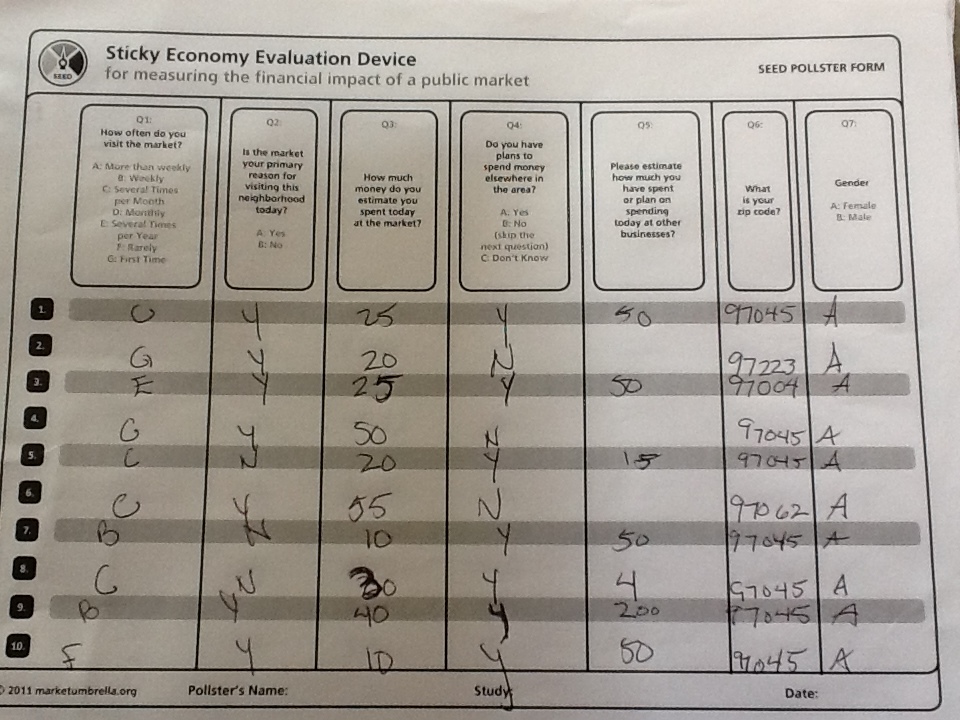
Just finished the first ever SEED http://www.marketumbrella.org/marketshare/
study in Oregon City, Oregon. Market manager Jackie Hammond-Williams puts together an amazing market every few days and has a lot of fun while she does it. Look for my upcoming FMC newsletter story about the study day and how this economic tool measures a markets impact. AND you’ll be able to read the report too – which was ready the next day. I guess we’ll let OCFM look at it first but I’m sure they will have it on their website very soon, and it will be followed by their weekday market SEED report too.

20120626-081822.jpg

How Veggie Co-ops and Ice Cream Collaboratives Could Save the Economy | Mother Jones

This entrepreneur throws some great numbers out in this excellent blog post and also entices us all with visions of local ice cream and veggies at what he, very interestingly calls a winter food bazaar. That typology term may fit in quite nicely to the project that we call Market CITY (Characteristics, Indicators and Typology)
His reference to Civic Economics and Ken Meter’s work is not surprising, since their reports (along with Michael Shuman at BALLE and Jeffrey O’Hara at Union of Concerned Scientists) make up much of the data that we are using to build the economic argument for local food systems.

How Veggie Co-ops and Ice Cream Collaboratives Could Save the Economy | Mother Jones.

Food Stamp Subsidies for Junk Food Makers, Big Box Retailers, and Banks?

As 2012 Farm Bill debate rages in Congress, a new investigative report demands SNAP program transparency

Oakland, CA, June 12, 2012 — Are food stamps lining the pockets of the nation’s wealthiest corporations instead of closing the hunger gap in the United States? Why does Walmart benefit from more than $200 million in annual food stamp purchases in Oklahoma alone? Why does one bank, J.P. Morgan Chase, hold exclusive contracts in 24 states to administer public benefits?

These are a few of the questions explored in a new report called: “Food Stamps, Follow the Money: Are Corporations Profiting from Hungry Americans?” from Michele Simon, president of Eat Drink Politics, a watchdog consulting group. This first-of-its kind investigation details how the food stamp program—originally designed to help farmers and those in need—lines the pockets of junk food makers, food retailers, and banks.

Right now, Congress is debating the farm bill, including significant cuts to the Supplemental Nutrition Assistance Program (or SNAP, formerly known as food stamps). Much attention has focused on how agricultural subsidies fuel our cheap, unhealthy food supply. In reality, the largest and most overlooked taxpayer subsidy to the food industry is SNAP, which comprised two-thirds of the farm bill budget in 2008.

“Michele Simon’s well-researched, credible investigation breaks new ground and exposes who else stands to gain from the government’s largest food assistance program,” said New York University Professor Marion Nestle, author of Food Politics. “While reauthorizing the farm bill, Congress needs to make sure that the poor get their fair share of SNAP benefits,” she added.

Food Stamps, Follow the Money examines what we know and don’t know about how much the food industry and large banks benefit from a tax-payer program that has grown to $78 billion in 2011, up from $30 billion just four years earlier, and projected to increase further due to current economic conditions.

“Transparency should be mandatory. The people have a right to know where our money is going, plain and simple,” said Anthony Smukall, a SNAP participant living in Buffalo, New York. He says his fellow residents are “facing cuts year after year, with no sustainable jobs to be able to get off of programs such as SNAP.” Smukall added, “J.P. Morgan is shaking state pockets, which then rolls down to every tax paying citizen. I am disgusted with the numbers in this report. If people knew how such programs were run, and how money is taken in by some of the world’s conglomerates, there would be outrage on a grand scale.”

As the largest government-funded agriculture program in the nation, SNAP presents a tremendous opportunity to help tens of millions of Americans be better nourished and to reshape our food system in a positive way. SNAP dollars now represent more than 10 percent of all grocery store purchases.

“Every year, tens of billions of SNAP dollars are propping up corporations that are exploiting their workers and producing foods that are making America sick,” said Andy Fisher, founder and former executive director of the Community Food Security Coalition, who is currently writing a book about the anti-hunger movement. “It’s high time we stopped this madness, and returned the food stamp program to its original purpose: providing needy Americans healthy real food grown by farmers,” he added.

“I hope Congress does not cut SNAP. Food prices have been skyrocketing while salaries remain unchanged, and many people I know have two jobs to try to make ends meet,” said Jennifer L., a SNAP participant living in Massachusetts. “As a single mom who has only recently re-entered the workforce, the SNAP assistance I receive makes a huge difference in my ability to support my children,” she added. “I am in favor of making retailers’ and banks’ information regarding SNAP public. What are they hiding?”

Food Stamps, Follow the Money offers several recommendations on how to improve SNAP in order to maximize government benefits for those in need. These include:

· Congress should maintain SNAP funding in this time of need for millions of Americans;

· Congress should require collection and disclosure of SNAP product purchase data, retailer redemptions, and national data on bank fees;

· USDA should evaluate state EBT contracts to determine if banks are taking undue advantage of taxpayer funds.

“Congress should make SNAP more transparent by mandating accurate tracking of SNAP expenditures. Why should only the likes of Walmart, Coca-Cola, and J.P. Morgan know how many billions of our tax dollars are spent each year?” said Ms. Simon.

Download report here

About: Michele Simon is a public health lawyer specializing in industry marketing and lobbying tactics. She is president of Eat Drink Politics, a consulting group that helps advocates counter corporate tactics and advance food and alcohol policy. http://www.eatdrinkpolitics.com Twitter: @MicheleRSimon

Morven Summer Institute studies farmers markets evaluation

Morven Summer Institute, University of Virgina

The University of Virginia has begun their latest set of summer courses at their Morven Summer Institute outside of Charlottesville. The Farmers Market Coalition has partnered with professors Tanya Denckla Cobb, Department of Urban & Environmental Planning and Paul Freedman, Department of Politics to present a 2-week course on farmers markets.

Farmers Markets and Applied Food Systems Research will explore the history of the modern farmers market movement, its purpose and discuss emerging evaluation techniques through guest lecturers such as Stacy Miller, Executive Director of FMC, Richard McCarthy, Executive Director of marketumbrella.org, Bernie Prince, FMC Board President and Co-Director of Fresh Farm, and yours truly, independent researcher and public market trainer. The students will also attempt some market-level research using the Indicator Matrix we are developing at FMC and marketumbrella.org’s SEED tool.
About Morven:
In 2001, philanthropist John W. Kluge gave an extraordinary gift of real estate to the University of Virginia Foundation for educational and charitable purpose. The 7,379-acre gift, valued in excess of $45 million, more than doubled the University’s land holdings. Located in southeastern Albemarle County, the properties comprised 11 farms and estates, including historic Morven Farm.

Building a matrix for measurement

I’m off to Charlottesville this a.m. to join in on the Morven Summer Institute at University of Virginia’s Farmers Market Evaluation course. Stacy Miller of FMC, Richard McCarthy of marketumbrella.org and Bernie Prince of Fresh Farm Markets and Board President of FMC will be joining me as lecturers this week. I, of course, will be talking about the Indicator Matrix and what to be aware of as far as market capacity to do measurement. The link below will take you to the story I wrote about this measurement approach last month.
I encourage any food system that is working on evaluation to take a look and to contact me if you have ideas or questions about the Indicator Matrix.

http://farmersmarketcoalition.org/building-a-matrix-for-market-measurement-an-update-on-fmcs-indicator-project

NSAC’s farm bill timeline (updated)

I rely on their farm bill information and encourage you to support their work.
The National Sustainable Agriculture Coalition (NSAC) is an alliance of grassroots organizations that advocates for federal policy reform to advance the sustainability of agriculture, food systems, natural resources, and rural communities.

Farm Bill Timeline

Chicago market location

I’d very much like to see this market in its full summer glory! The bricked block is where it’s held when outdoors… My friend who lives around the corner goes to it and enjoys it, but only goes to the outdoor summer market. Her reason? ” can’t get it together to make it to the indoor market, and I’m not sure I like it when markets are indoors…”

Huh.

20120516-195241.jpg

20120516-195259.jpg

Sourlands Trailer

Please keep your eyes and ears out for a new film called Sourlands by Jared Flesher, who also did “The Farmer and The Horse” another agricultural film many of us supported through Kickstarter.
I urge everyone to support this important movie, a documentary film starring food, energy, habitat, crazy weather, global climate change and — most important of all — the people these issues impact.

Senior Hunger in America 2010: An Annual Report

From the Meals on Wheels Research Foundation report:

14.85% of seniors, or more than 1 in 7, face the threat of hunger. This translates into 8.3 million seniors. In contrast, in Ziliak, et al. (2008) we reported that as of 2005 1 in 9 seniors faced the threat of hunger.
Those living in states in the South and Southwest, those who are racial or ethnic minorities, those with lower incomes, and those who are younger (ages 60-69) are most likely to be threatened by hunger.
Out of those seniors who face the threat of hunger, the majority have incomes above the poverty line and are white.
From 2001 to 2010, the number of seniors experiencing the threat of hunger has increased by 78%. Since the onset of the recession in 2007 to 2010, the number of seniors experiencing the threat of hunger has increased by 34%.

http://www.mowrf.org/The2010AnnualReport.pdf

Senior Hunger in America 2010: An Annual Report
Prepared for the Meals On Wheels Research Foundation, Inc.
May 3, 2012
Professor James P. Ziliak Professor Craig Gundersen University of Kentucky University of Illinois