Coming soon: .ngo and .ong domain extensions

This news is very helpful (as explained below) because the .org extension is not necessarily reserved for non-profits (NGOs). The new extensions will be and therefore it may be a little easier to see what is what online.Add to that the NGO (non-governmental organizations) name is more universal that using the term “non-profits” since that term really applies to U.S. organizations only while the NGO tag is used globally.

From Mashable writer Matt Petronzio:

The Public Interest Registry (PIR), the non-profit that manages and operates the .org domain, has formally submitted its applications to the Internet Corporation for Assigned Names and Numbers (ICANN) for the .ngo and .ong domain extensions.

Although the .org extension is often associated with non-profits and has been their go-to domain extension, it is an open domain, meaning that individuals and for-profit corporations can register under it as well. But .ngo will be administered as a closed domain exclusively for NGOs, and there will be a verification component at the time of registration.

If the .ngo extension is approved, non-profits and NGOs that currently have a .org extension won’t be required to make the transition.
Only once per year – but boy, imagine that logistics checklist!

By the middle of summer when you market managers get tired of the pop up tents and the vendor grump factor when being asked to spread out or squeeze in to the summer market spaces, take a nice shady break, grab a limeade and watch this time-lapse movie of the New Orleans Jazz and Heritage Festival setting up in April of this year. Talk about a well-oiled machine (although wouldn’t it be funny if they had misplaced a tent and you watched one move 3 feet to the right in this? well, maybe not…)
When we talk about the skills of market management, we should seek out other sectors to compare each piece; obviously the festival logistical expertise is a great one to see how we stack up to this amazing work. How do we compare to this, do you think?

A Disciplined Approach to Evaluating Ideas – Scott Anthony – Harvard Business Review

An extremely useful article for the market world. Evaluation techniques should represent what is doable in a particular field while it asks people to stretch their imagination and analytical skills. Stepped evaluation (or as it is called in the article, “Stage-gate process”) for markets really is the best idea. marketumbrella.org’s 4M worksheets use that idea, and I know they have more coming along those lines in 2012…

to see the 4M sheet, go to marketumbrella.org and then log in to the marketshare project. View it under Shares.

A Disciplined Approach to Evaluating Ideas – Scott Anthony – Harvard Business Review.

Acclerating Community Capital-BALLE

We all seek to make our capital work effectively for our home communities, and moving our money is an important step. But after we move our money, what happens to it? And how can we influence what that money does in our communities?

In this timely webinar, we’ll hear straight from the source:

What motivates these institutions to actively advance community capital;
What the differences are between credit unions and local banks, and their respective motivations and strengths;
What services each uses to build more equitable and sustainable local economies;
How businesses and network leaders can partner more deeply with these institutions to support the development of local living economies;
And how communities can replicate some of their successful programs and community partnerships.

Come learn how to make your money work for your community by partnering with local banks and credit unions.
more on topic and registration here

Utne Visionary #2

Another worthy person that Utne picked for 2011. Those of us involved in the conversation around living economies are lucky enough to listen in on this. What is money but a proxy for labor and resources? And how should we define wealth generation in our world? David Korten et al are bravely following these threads:
“Imagine an economy in which life is valued more than money and power resides with ordinary people who care about one another, their community, and their natural environment. It is possible. It is happening. Millions of people are living it into being. Our common future hangs in the balance”

Money Changer

New Economy 2.0

Occupy our time

The latest newsletter from the Farmers Market Coalition (FMC) came out last Wednesday and it strikes a whole bunch of the same notes as the orchestration being played by hundreds of thousands of individuals in Zuccotti Park and many other public spaces around the world these days.
FMC points out that economy of scale arguments (“Get Big or Get out” for those who know their post WW agriculture history) and words like efficiency and scale have (for years) been used against those of us who prefer to work towards diversity, shared wealth, sufficiency and innovation in our movement. And that human-scaled movements that work are messy and hard to quantify or even to see, but there they are, in booking places to stay or quietly sharing knowledge…
FMC inspired me and probably lots of you too while they reminded us to take the time to measure success in our world in accordance with the values we fight for and, as importantly, to keep at it. Sometimes those words are necessary even for zealots like food organizers…
FMC Newsletter

CSA=Community Supported ARTS

How nice to see the alternative food system innovation spread to other cultural institutions.
Then Altheimer had her breakthrough. On an otherwise ordinary day, she rose from her cubicle. Racing across the office, Altheimer found her boss and blurted: “We should just do a CSA!” – only this time the “a” would stand for “art.”

Springboard partnered with advocacy group mnartists.org, and just months later, in May 2010, offered shares to Twin Cities collectors in the world’s first-ever arts CSA. Since then, the model has been reproduced in Chicago and Cambridge, Massachusetts. It’s headed for arts organizations in Detroit, Miami, and Philadelphia this year; next year it’s slated for Akron, Ohio; San Jose, California; and Charlotte, North Carolina.
CSA

Leave it to them to use tokens this way…

The McDonald’s restaurant on South Claiborne Avenue in New Orleans is utilizing a token system for customers who need to use the latrine….

The bathroom door now has a token meter for which customers will have to request to use the facilities. The token is free upon request.

Token story

You know, maybe I’m thick-headed; how is giving a token out to use their bathroom going to reduce trash or encourage good behavior?

rules on street vending

Using law students to create a framework of smart guidelines is the right thing to do in this case. If we want to encourage small businesses to flourish once again in the US, then we need to allow tiers for different types of businesses. I know most markets are not skirting laws, but wouldn’t it be smart to connect with law students in every region to assist markets too?

Street vendors get lawyers

Session proposals for 2012 Main Street conference

2012 National Main Streets Conference: Rediscover Main Street

Over the past year a constant theme heard locally and nationally is the trend of retailers – including “big box” stores –moving away from strip malls and back downtown. Businesses are not alone either. Residents and visitors are also choosing more traditional locations. In Baltimore we will continue to showcase the power of preservation-based economic and community development and to provide education and networking opportunities to help businesses, governments, residents and visitors Rediscover Main Street.

The National Trust Main Street Center is seeking session proposals designed to help inform, inspire ideas, and explore methods and best practices to capitalize on this growing trend and to encourage the rediscovery of what Main Street has known for decades – preservation as economic development works! Read more about submitting a proposal for the 2012 National Main Streets Conference here
Deadline: August 26, 2011

Contact the National Trust Main Street Center:
1785 Massachusetts Avenue, NW, Washington, DC 20036
202.588.6219 | mainstreet@nthp.org | http://www.mainstreet.org/

The National Trust for Historic Preservation is a private, nonprofit membership organization providing leadership, education, advocacy, and resources to save America’s diverse historic places and revitalize our communities.

Self-checkouts may be a thing of the past soon

Consider yourself a human again. More than one industry grocery giant is experimenting with ridding their stores of the self-checkout lines. I would assume that the stores losses were climbing (from theft at those checkouts and from people just walking out with stuff since there is less personnel up there to watch), and that the complaints also went up (no friendly interactions makes shoppers feel vulnerable so they are more critical.)

And, I’ll suppose that the growth of public markets is also showing the industrial system how to regrow trust and dignity when shopping.
Story

Fleas welcome

Flea markets are fascinating to people watch at and someday we’ll figure out how they and open-air farmers markets are related.Like any public market geek, I follow the flea market news regularly and years ago, set up at a venerable old one in Ohio (Hartville for those of you in Buckeye Land). Wow, was that fascinating…. The pre-dawn culture was even more traditional than any farmers market I have watched. Of course, that market had been running for over 60 years…
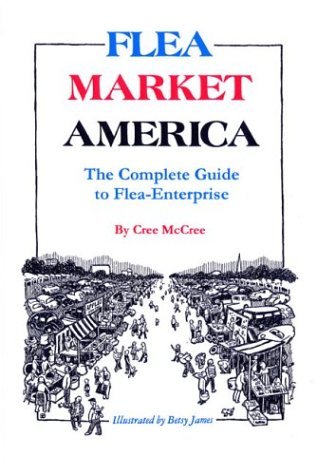
It is also my honor to count among my friends, Cree McCree author of “Flea Market America” and a regular art and flea market maven here in New Orleans. (I call her Cree McCree, Godmother of Flea).

Cree McCree's book. available for purchase everywhere


She was a prized Festivus vendor of mine (when I ran both farmers markets and a holiday fair trade market from 2002-2007 for marketumbrella.org). She is always working to find new venues and ideas to get more street vending out there.
Maybe we’ll even see a true producer-only farmers market and a criteria-based flea market in the same location with the same manager. Why not?
Their missions may be different from farmers markets, but its easy to see some similarities:
1. Many flea markets have rules about products that can be sold.This is often to keep out dangerous goods, but in any case, it speaks to the need for a manager/organizer curating the deal.
2. They have return shoppers and regular vendors.
3. There is a decidedly social air about them.
4. They attract a wide range of shoppers.

Here’s an example of one that works to engineer a total experience:

Uvalde Market Days will be open for shoppers on June 25th, 2011

It is one of the most unique open air markets in southwest Texas
June 15, 2011- Hundreds of dealers showcase their merchandize in tree shaded park. The visitors can enjoy shopping at Uvalde Market Days in the afternoons.
Visitors can enjoy music while they shop. The dealers at the market will be displaying huge variety of arts and crafts, plants, jewelry, wearable, collectibles, home décor, antiques, carpets, kitchen accessories, clothes, hats for men, women & children and lot more.
Uvalde Market Days is open for public on every fourth Saturday of the month.
It is open from 10 am to 5 pm.
It is located at:
Uvalde Plaza
Main Street And North Getty
Uvalde, Texas
Parking and admission is absolutely free.

Comparisons are important

I am amazed at how many markets have never done a price comparison or used this idea and bought fast food and then compared it to the cost of a farmers market meal.
Try it, it’s a great way to bridge your market to new people. Or just use this link on your site:

Comparisons