Designlines judges food cart design at The Stop’s Night Market

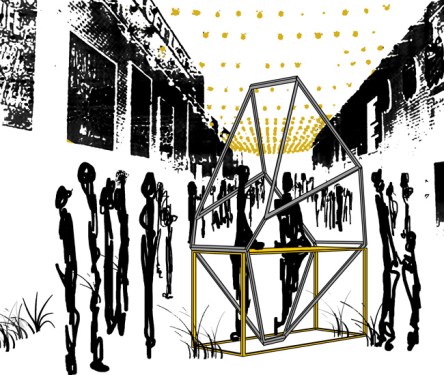
Toronto: More than a charitable event for gourmands, the Night Market is a true mesh of the design and food communities: each of the chef’s carts is crafted from upcycled materials by a mix of established and burgeoning designers. So impressive are these carts that The Stop invited Designlines to judge them for design excellence, creativity and effective representation of The Stop’s mission.

Pumped

Lemon

Falco

HokPinata

Deconstruct

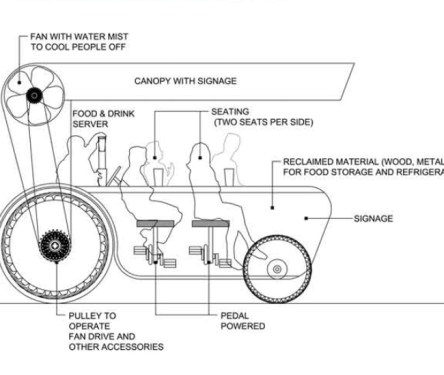
BikeSauce

What Ruins A Performance Review?

As a human resources manager in a previous work life, I can tell you that this post linked below has some excellent points to consider. As more and more markets add staff (and I mean staff and not independent contractors!), those organizations must add the skills necessary to manage that staff; if the organization is run entirely by a volunteer board, then a handbook on staff management or completing a short course should be required for the Executive Committee or at least the president of each term. If there is a paid director, then certainly basic human resources training available online or possibly through local community colleges or non-profit training centers should be required.
Over and over, I hear from market managers that most of them don’t get an annual review at all or if they do, don’t feel the review is in-depth enough or fair or designed to allow for improvement; they often report that the review contains criticism of issues that were beyond their control or their work is measured in ways that is news to the staff person. All of those are no-nos.
It does seem odd that people management skills are often lacking in non-profits and community initiatives, since that is exactly what they rely on to get the job done.

What Ruins A Performance Review? | LinkedIn.

Connecting Students and Farmers—Still Trying | FoodAnthropology

This campaign (just down the road from me) has already done amazing work to get the conversation and the organizing started for regional products to be used in the Southeastern Louisiana University campus purchasing process; FYI-this university sits within a very active farming community and many of its farmers sell to nearby New Orleans outlets. The campus student group Reconnect and their academic advisor Dr. David Burley continue to offer as much information and to open as many communication channels as they can to assist Aramark in understanding what the campus wants, but to no avail. In response Aramark has deliberately undermined their efforts with their embargo against meetings and their”food giveaway” tactic! Using markets as organizing wedges can be the best way to keep the pressure on head-in-the-sand institutions; big props to the Reconnect students and to Dr. Burley for keeping these efforts going year after year. If you have any resources or ideas to assist their efforts to put pressure on Aramark, feel free to email them.

Connecting Students and Farmers—Still Trying | FoodAnthropology.

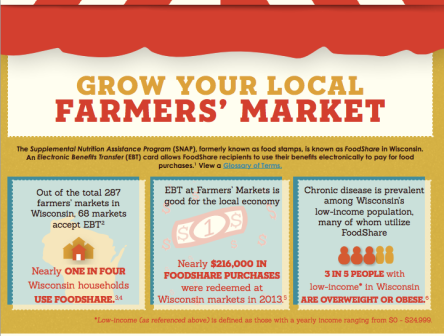
Wisconsin farmers market graphic on benefit program usage

Professor Alfonso Morales, principal investigator to the Indicators for Impact project sent this interesting graphic to the project team last week:
PDF

here is the top part for those unable to see the PDF:

WISNAP_graphictop

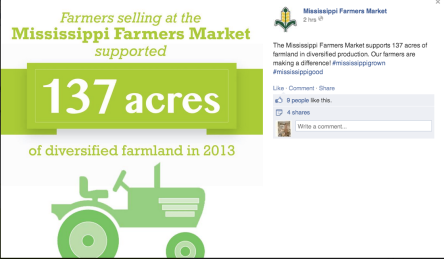
Using infographics to tell a story about multiple benefits is rapidly growing throughout the farmers market field and the Farmers Market Coalition Farmers Market Metrics project (including the Indicators for Impact research) has already devised prototypes of reports and graphics for markets which will continue to be refined. Here are some examples of how some of the FMM/FMC prototype markets have already used the graphics on FB and in print too:

JacksonFB1

AkronFB1

Jackson_print1

Chef gives back Louisiana farming community – CSMonitor.com

(Another story about a New Orleans chef!)
Huge fan of John Besh and his amazing team. There is no question he has put his money back in the community and has done amazing work.
I will say (and certainly not meant as criticism to Chef Besh and his team) that even with this excellent help, many farmers here still lack the full resources to increase their capacity. Since sustainable agriculture advocates are few and support for sales outside of the city are quite limited, many still falter with the expansion of their business. Business assistance must be matched with policy changes on production and regional connections that diversify each farm appropriately, since it is important that every farmer is not led only to intermediate and wholesale sales as their big expansion opportunity.
Still, there is no question that his foundation is a huge step in the right directional our region’s producers.

CSM Story and link:

The Foundation’s most recent initiative selects local farmers to provide with financial loans, while also delivering valuable training in marketing and business strategy. Many regional farmers have delicious products, the Foundation shares, but lack the finances or business knowledge to market those products to a wider audience. Working with Hope Credit Union, the Foundation evaluates loan applications and designs customized repayment plans. Then, MBA candidates from Tulane University’s Net Impact business advisory program, support loan recipients in setting goals and creating a long-term business plan.

Loans ranging from US$1,000 to US$20,000 are available to farmers within a 200-mile radius of New Orleans. Acknowledging the challenges farmers face in acquiring loans from traditional sources, Besh has yet to set a limit on the number of recipients. “The more we lend the better it is for these guys and gals out working to produce all the wonderful products that make my life wonderful,” Besh said. “We hope to do as many as possible.”

Chef gives back Louisiana farming community – CSMonitor.com.

Oxford Canteen

My pal Corbin Evans has made his way (going the long way from New Orleans to Philly to Brooklyn and maybe a few other stops in there since) to Oxford, Mississippi. His new lunch place there with seasonal locally sourced products is a hit this summer, which is no surprise as he is an award-winning chef and a well-liked guy everywhere he goes. He served as the Board President of Market Umbrella in New Orleans after the federal levee breaks and did tons of other unheralded support work around town to build food producers and so I was able to work with him throughout all of his New Orleans years. Chefs like Corbin are willing to give support to farmers markets in many ways and should be invited to assist whenever possible.
I think of him as a little brother while at the same time, as a teacher and leader in sustainable regional food production. This is a lovely film from the great Southern Foodways Alliance detailing his latest effort. Do take a road trip to Oxford and the Delta to see it for yourself anyway and make sure to stop and see Corbin in his alley. You’ll like him.

Oxford Canteen from Southern Foodways on Vimeo.

The Cooperative Economy | Orion Magazine

I’m returning to the idea of worker ownership and cooperatives on this blog again after reading the excellent interview in the most recent Orion Magazine shared with me by Stacy Miller, freelance researcher and project advisor at Farmers Market Coalition. I believe that the future of community food systems depends on us rescuing traditional work and community structures and creating some new ones too. We cannot expect the small businesses we work with to thrive when being asked to return to the industrial production or delivery systems of the mid 20th century that bankrupted them and helped to isolate all of us before.
Cleveland Ohio was my original home and so I follow the exciting news from there on issues like Evergreen Cooperatives, as well as the many, many other worker-owner hubs across the state (like Athens). I also appreciate that the author points out the battle for local ownership of energy grids in Colorado which has been happening in Ohio for decades, along with the expansion of aggregation for buyers to band together to purchase electricity at the community level. Those kinds of policies are allowing consumers more knowledge of real energy costs and to be actively engaged on issues of expanding renewables. All of these issues in the article show the need for citizen engagement to go beyond the voting booth and cooperatives of all kinds accelerate that action.
So as we discuss the needs for food work in our communities, let’s research and include ideas like cooperatives and worker-ownership right up front.

The Cooperative Economy | Orion Magazine.

GOP proposes waiver to schools healthy food mandate, arguing too much being thrown in the trash

Just remember, the pressure will not end. The idiocy of whining about what is thrown away when that has never been measured before and that making these changes meaningful will take a whole systems approach will need to be pointed out again and again and again and again and again….

GOP proposes waiver to schools' healthy food mandate, arguing too much being thrown in the trash | NOLA.com.

Washington Ag Today talks about farmers markets

These are excellent audio snippets from Colleen Donovan, Washington Small Farms Program Research Coordinator at WSU about some benefits of farmers markets.

Community Impact of Farmers Markets

These are so well crafted that anyone could embed them into their website to show the impact of markets and market farmers, no matter where they are located.

What is most useful about Washington’s work is that it uses the context of organizational capacity to gauge if and how those multiple benefits are being forwarded to shoppers, farmers and the larger community. For reports that offer data without explaining that a volunteer-led effort managed it or that markets are often doing complex projects with part-time labor, I recommend to them that they consider adding it to any future analysis or funder report. The Farmers Market Metrics work we are doing at FMC and University of Wisconsin right now will add that piece into any resources or templates that we design, I promise you that!
In any case, associations in Washington and Michigan are truly the leaders right now in doing excellent analysis and resource development and then spending time sharing as well. (And if it was up to me, I’d give Illinois the rising new star award.)
Colleen did a webinar with FMC in fall of 2013 on the results of this report which is found on FMC’s YouTube site. Yes that is me (talking too low) introducing Colleen:
Link to YT recorded webinar

Diana Pinckley remembered

The event listed below is to happen this week and was excerpted from my home Crescent City Farmers Market “morsel” as they call their weekly email:
Diana Pinckley passed away in 2012; she was an irreplaceable member of our community and one sorely missed for her leadership and her friendship, both always given easily to so many.
The regard for her found on any market day in New Orleans can and should be multiplied in the thousands to stand in for all of the many initiatives or events that she supported across our region. The people I know through her represent her well: willing to give their time and talent and always remembering to be joyful.
Thanks, Pinckley. I’m honored to raise a glass for you this weekend and pleased to represent farmers markets where we remember and honor our people.

Raise a Glass to Pinckley with CCFM! |
FRESH & LOCAL
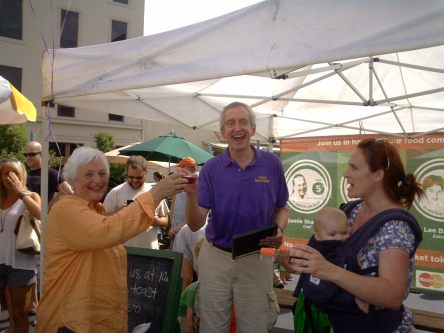
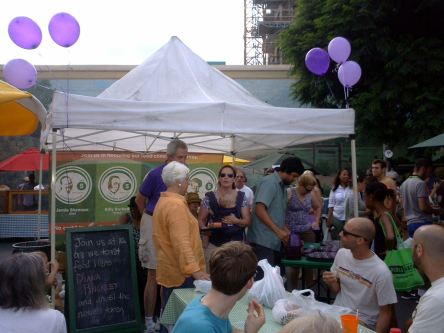
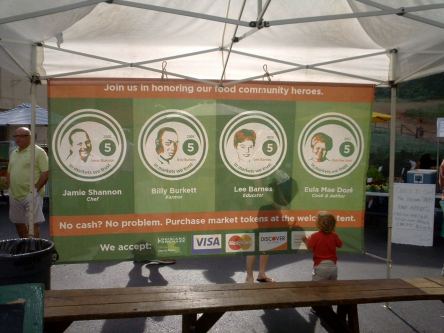
Each year we choose one of our local food heroes – a farmer, chef, culinary educator, devoted farmers market shopper or local food system champion – to be the face of our market tokens. This Saturday, we’ll unveil our 2014 market token and celebrate the life of long-time CCFM shopper and supporter, community activist and mentor to so many working to rebuild New Orleans and the Gulf Coast, Diana Pinckley. “Pinckley”, as she was known to close friends, loved mystery novels, bluegrass and the color purple. In addition to her work as a public relations executive, communications strategist and book reviewer, Pinckley shared her time and talent with many New Orleans civic organizations. She was a member of “Women of the Storm” and one of CityBusiness‘s Women of the Year in 2006. She served on the New Orleans Council for Young Children, the Committee of 21, the board of the Foundation for Science and Mathematics Education, the Edible Schoolyard New Orleans task force and was chairwoman of the board of the CCFM. She raised money for WWNO-FM and was an active volunteer at WWOZ-FM. She passed away in September 2012. New Orleans is a better place because of Diana Pinckley. Please join us, her husband John Pope and friends to raise a glass at 10am, tap your toes to the music of Lost in the Holler and celebrate the life of one of the CCFM’s most cherished friends. Purple attire encouraged.

FMC State and Network Leader Discussion continues…

State and Network Leader Discussion