Bees Aware

How Dying Bees Affects Food Supply

Is selling at a farmers market right for you?

The Dane County Farmers’ Market (yes the one held in Madison surrounding the beautiful state capital since 1972!) has had Larry Johnson as its manager for the past decade. Recently, he offered some tips for emerging vendors on market selection. I for one am always happy to see this sort of SWOT analysis so that those that are making their decision about where to invest their time and money are armed with some good perspective. Larry has been at it for a long time and offers some sound advice, among them ideas for how to know what a “good” market should have:
“… Not all farmers markets are created equal. A good market has a good organization (board or core group of volunteers and/or vendors) that lay the groundwork or rules for the vendors. Having a dedicated manager is also important, according to Johnson, for maintaining the quality of the market, by making sure rules are followed. Johnson said as manager of the Dane County Farmers’ Market, he’s very intentional about food safety, licenses and such. He even goes out to vendors’ farms to make sure they’re producing what they’re selling, in order to maintain “integrity of products.”
Important
I would recommend linking this article on your website or even printing some out for your market vendors.

http://www.agriview.com/news/crop/is-selling-at-a-farmers-market-right-for-you/article_e8782762-4a05-11e2-8180-0019bb2963f4.html

animal husbandry put to another use: Meet the Baaa-studs

just something fun to look at for today.

If you build it….

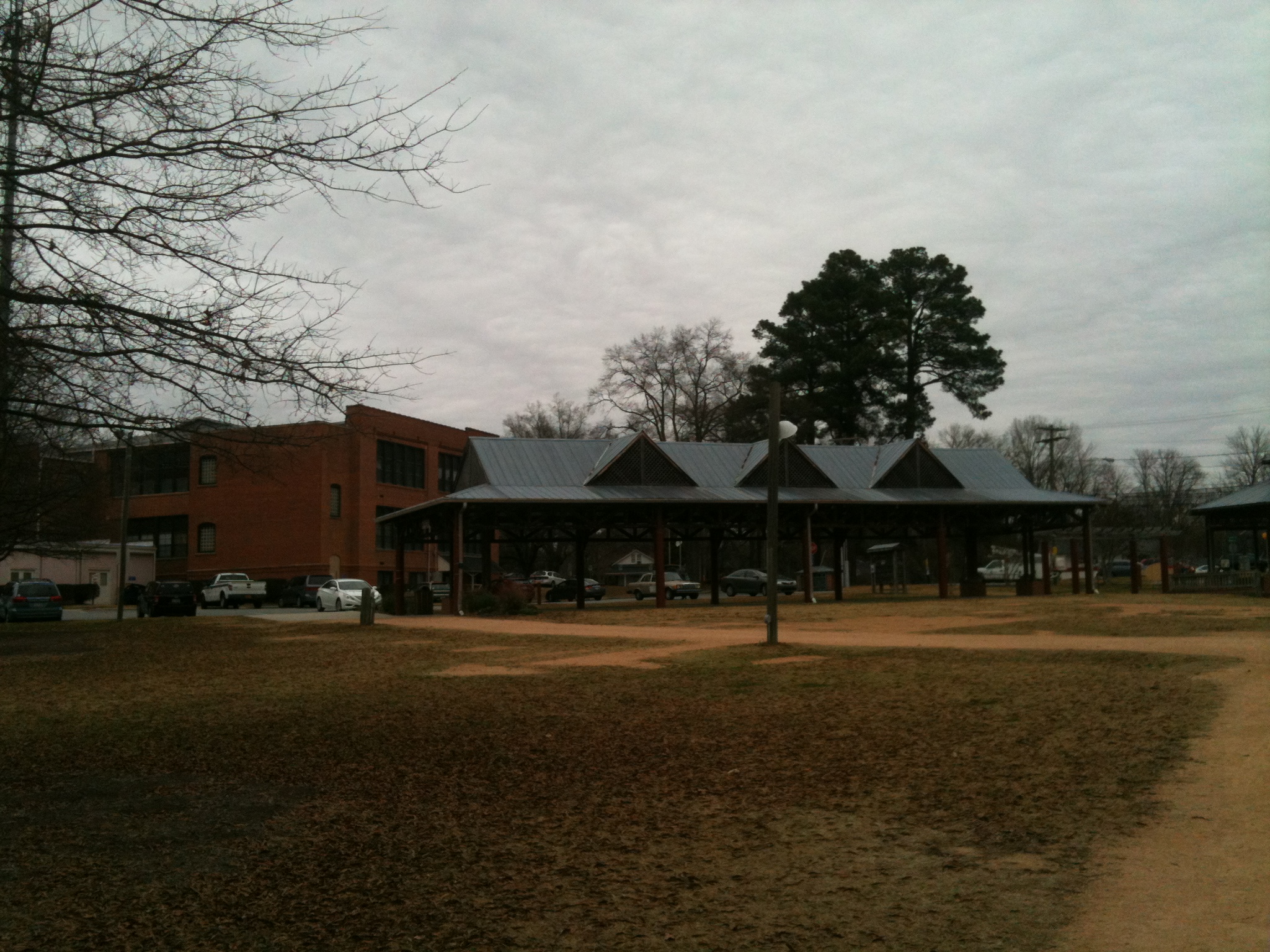
Carrboro North Carolina’s iconic farmers market has led the region in another way: In 1996, they secured a permanent location and an overhang over part of their market with electricity and drains available.Image

The Carrboro Farmers Markets is an incorporated vendor-run entity, operating twice a week in the summer and on Saturdays year-round. The Board is elected by their vendor membership and the board oversees the market staff and the market’s finances.

Recently, I asked Sarah Blacklin, Carrboro Market Manager to share some facts about their market history and structure:

1. When was the structure built? The structure secured funding from the General Assembly in 1993.  The structure was completed and built by 1996

2. Who paid for it and who maintains it? Paid for by G.A. (the Market worked with the Senator to secure that funding).  The Town of Carrboro Public Works maintains it since it’s used for other events all other times throughout the week.  Technically the Market just “rents” the space on Saturdays and Wednesdays.

3. How many vendors use the structure and how many are outside of it? (on average of course) On average, there are 32 spaces under shelter.  For Wednesdays, that’s 32 vendors and for Saturdays (since some have double spaces), that’s about 20 vendors. Out of the shelter, we’re looking at about 46.

4.  Can the vendors use the outlets for electricity? Are there drains? Some vendors have access to electricity. There are electric outlets at every other space, so some folks run an extension cord or don’t use it at all if it’s not close to them.  Yes, there are drains outside but there are some overall drainage issues in the outfield which is why we’re addressing these issues with a fundraiser project.

5.  Is it ever used for other events? Yes, it’s commonly used for other events.  The Town’s 4th of July and Halloween celebration, “Carrboro Day”, music festival, and anything in between, music festival, and anything in between.

Image

Carrboro's shed for storage and electricity.

Carrboro’s shed for storage and electricity.

Report Season is upon us

I visualize many of you working long hours this week gathering data to finish end of year reports-as your faithful food system friend who is also working close to her candle on reports, I salute you.
Maybe we need grant report songs to keep us focused and get us in the mood of writing them just like holiday songs?
(Jingle Bells tune)
grant reports, grant reports
writing all the way
oh what fun it is to think
of ways to explain and say.

However, it does put me on the road of thinking about evaluation and ways to share information. We all know about qualitative and quantitative measurement, but let’s dig even deeper if we can, when we can. What was the transformation that came from our work? Is there a way to illustrate success with a picture or a snippet of an audio interview? Maybe a field plowed and ready for planting? A quote from a new shopper or a farmer who learned a new skill?

Recently, I ran across these evaluation pages from Community Food Centres Canada which are quite simple, engaging and yet useful. Here’s one:

Community Action

Take a look at how they describe evaluation too:
Evaluation page

Anchor vendor presentation

This is a presentation that I have done for markets about seeking anchor vendors. It is a little clunky to view in this format.. There is another piece to this that I took off (for the sake of making this clear and simple) about searching for the anchor vendor primary shoppers group by group. That piece focuses on markets taking the time to understand their anchor vendors and then finding shoppers for those vendors and then attracting the vendor’s primary shopping groups in small clusters through different marketing outlets.

Slide11

History of Food Stamp Usage at Markets

I often refer to the 2010 report “Real Food, Real Choice: Connecting SNAP Recipients With Farmers Markets” that was done by CFSC and FMC. The page that I refer most to is this one, so thought I’d post it here.

20121213-111403.jpg

Link to the entire report

Saxapahaw: Gatorade next to Kombucha

What a treat I had yesterday. Sarah of the Carrboro Farmers Market has been patiently squiring me around the area, meeting to meeting, meal to meal. Hopefully, all of you have made it to this area of North Carolina and had some of their amazing food, centered by the pork, chicken -well, all meat- that they love and know how to cook in so many interesting ways.
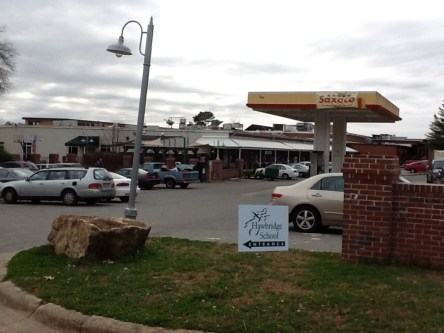
Yesterday, Sarah took me a few miles out of Carrboro to a little town called Saxapahaw (pronounced sax-paw the Carrboro native says) for lunch and for a quick meeting. That meeting easily became an afternoon, because of the fascinating Saxapahaw General Store.
20121212-081229.jpg

Here is what their website says about their beginnings:

The Saxapahaw General Store as it now exists began in June 2008 when Jeff Barney, butcher and self-taught cook, and Cameron Ratliff, teacher and self-taught biscuit maker, worked with former owner Mac Jordan to begin a new life for the convenience store and gas station that had served the community for several years. They imagined a spot where a village could gather for refreshments, meals, and basic home provisions, run by folks whose varied backgrounds have each taught them they can influence their world by collaborating with their neighbors. They hoped to serve the residents of Saxapahaw with a range of products that could allow everyone to feel welcome. They decided to become stewards of local foods, good wine and beer, nutritious snacks, and eco-conscious dry goods.

What I saw was a business model that looked right. Once I met the dynamo farmer Suzanne, I became even more sure. Suzanne took us across the street to the pastures after our lunch
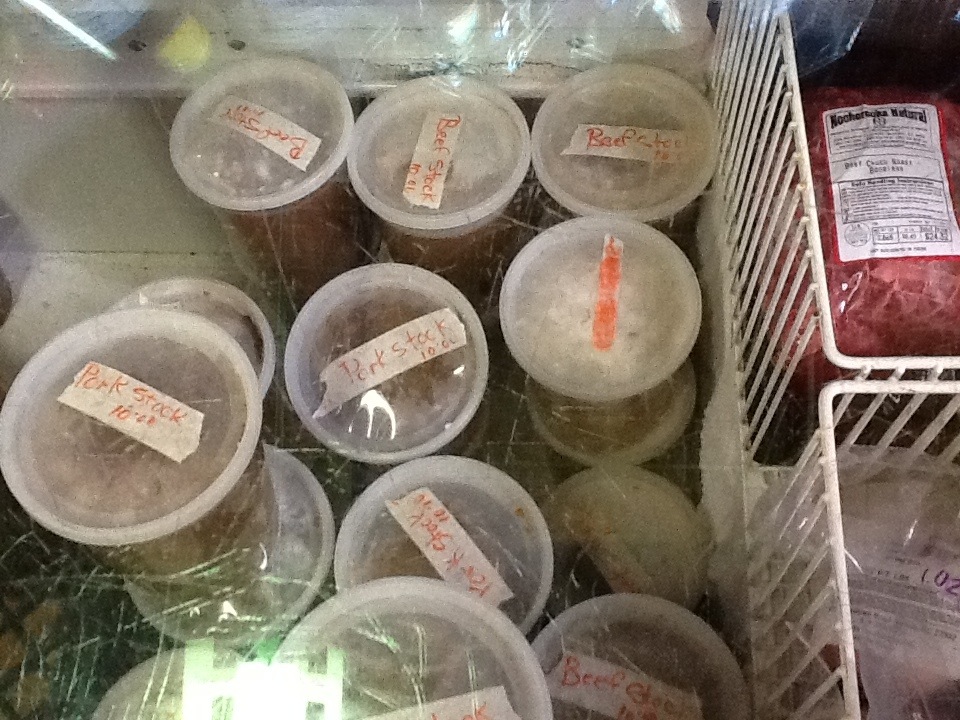
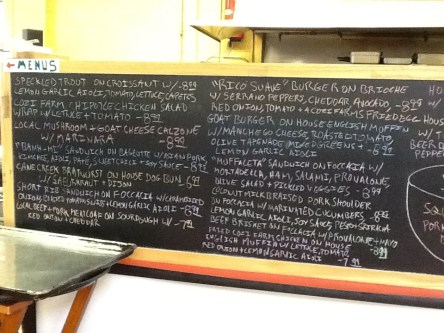
(the picture below shows what is available for lunch-all of the meat is local and much of the produce too)
20121213-051100.jpg

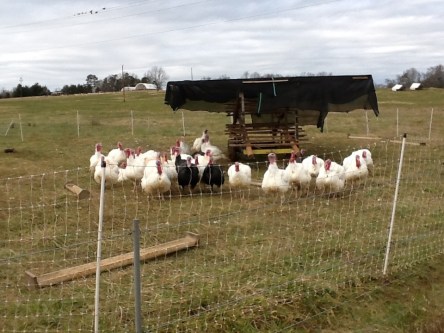
The turkeys were the last of the year, with these destined for ground turkey in the next week or so.
Much of the poultry production is done herself alongside Saxapahaw neighbors and coworkers; the humane treatment of her animals at the end of their lives is so important to this farmer that she told us she would not use many of the processing plants available to her. And that if that was the only way that they could be processed that she wouldn’t raise animals for food.
20121212-081024.jpg
She pointed out the ducks that they had only begun to raise for food and the vegetable garden, also beginning. At this point, the store is buying from the very talented growers that surround the area thanks to the Carrboro Farmers Market and its younger sister markets, but the emporia is going to grow some of its own produce across the street. The composting is carefully monitored before being shared with their animals, so as to not waste any of the precious produce.

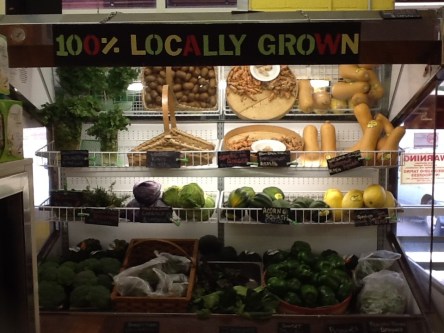
The store is set up to roam and shop after one has put their order in at the counter. Coca-cola products are lined up near pure ginger root drinks, homemade baked goods and local preserves near the small candy area. Hunting gear and motor oil can also be picked up as well along with some biodiesel or gas for your truck.

The store is both a throwback and a nod to the future. Suzanne talked extensively about the ongoing need for more equipment as well as sharing individual stories of the staff and their talents. Throughout our time there, people of varying ages and backgrounds came and went, bought food, drink and dry goods.
As public health and regional planners look for store models that can offer dignity and inclusion to food producers as an encouragement to sell there (just as the farmers market world has done) this store should become a Mecca. Using around 1500 square feet to offer as many culturally appropriate items as possible (Suzanne dreams of the day she can put out her gizzards and turkey necks next to the stock already offered) and real food choices next to convenience items still necessary to the real world, the Saxapahaw General Store is a food organizer’s dream come true.

20121212-081115.jpg

20121212-081751.jpg

20121212-084526.jpg

Dirty white gold -Monsanto’s Suicide Economy

Carrboro, here I come

I’m off this morning to visit with my wonderful colleagues in North Carolina. Sarah Blacklin of the Carrboro Farmers Market has invited me to interrupt her very busy work schedule to talk about evaluation, federal benefit programs and (maybe) assisting in convening the North Carolina markets so that they can share more fully and learn from each other’s excellent examples.
I originally went to Carrboro in 2006 when Sheila (the then market manager) invited me to take part in their Katrina gumbo fundraiser which was to benefit my own New Orleans farmers markets. It was such a great idea. They asked 5 restaurants to make their own version of gumbo and then sold each for 1 hour at a time at the market. Sold out or not, they went to the next one at the top of the hour with much fanfare (they ripped off the previous name and uncovered the upcoming with great cheers.) Of course, they almost all sold out and people hung around to get their favorites, not knowing which hour each would be sold. They raised over 6000.00 for my markets and vendors!
The market had over 5500 shoppers that day (not an unusual number for this excellent market) and their support was so genuine and warm that I have always considered the Carrboro Farmers Market (CFM) to be the sister market to Crescent City Farmers Market (CCFM) and whenever I can go and see their excellent work and the nearby Durham Farmers Market market, I go.

I am very lucky to be working with so many state and national leaders – I am honored to be asked to help them figure things out for their markets – but I will always save some of my time for those individual market leaders who inspire me with their own local vision and joie de vivre.

Purpose Defined: Developing a Market Mission

Why does a market need to define its purpose? For starters, defining purpose helps to attract partners, vendors, and assist board with management. Many markets are closer than they think to having a mission statement and this webinar will give those organizations a head start on creating a mission statement, and a clear purpose for doing so. Check out the resources and other webinars here: Why does a market need to define its purpose? For starters, defining purpose helps to attract partners, vendors, and assist board with management. Many markets are closer than they think to having a mission statement and this webinar will give those organizations a head start on creating a mission statement, and a clear purpose for doing so.

Presenter- Darlene Wolnik, Independent Researcher and Trainer — Community Food Systems
and FMC Market Programs Advisor

Moderator- Jen O’Brien, Interim Executive Director, Farmers Market coalition

Rural Co-ops Show the Way to Urban Job Growth – Politics – Utne Reader

Recently, I have worked with US Federation of Worker Cooperatives as a way to further my efforts as a trainer for markets and food systems. Thankfully, the USF0W is willing to share skills and resources from their excellent DAWN network with other sectors. Worker cooperatives differ from marketing cooperatives in that their very definition is about workers being involved in the decision-making in their workplaces. Marketing cooperatives are often a loose confederation of separately owned businesses marketing products or services together. Both types exists within the market movement, and both types need to be understood better so they can be encouraged more.
The article below talks about rural co-ops and their effect on urban job growth. Effective language and one finds some practical language for markets interested in using co-op techniques to encourage real growth, just as urban communities have done by learning from their rural neighbors.

Rural Co-ops Show the Way to Urban Job Growth – Politics – Utne Reader.