Farmers Market Coalition is kicking off a 2-year POP Club reflection and resource-share via a Community of Practice (CoP) among markets with POP Clubs, leading to a new revised Guide. This project is in partnership with the Pacific Coast Farmers Market Association (PCFMA)* which operates the club at many of their sites.
POP started in May 2011 at the Oregon City Farmers Market in Oregon City, Oregon. It was created by the market manager, Jackie Hammond-Williams in response to a grant offered by Clackamas County, Oregon for programs that improve the community’s health. The POP Club brought together families and farmers around fresh produce at farmers markets. The program’s mission was three-fold: (1) Empower children to make healthy food choices (2) Strengthen and sustain healthy communities through supporting farmers and cultivating future farmers market supporters (3) Expand farmers markets from a retail location into a place where children can try new foods and learn about healthy eating.
All current POP club members that participate in the CoP agree to share information on their POP club model and participate in at least 2 calls over the project period. They will be asked to review updates to the materials and possibly be featured in FMC’s POP Club social media posts.
For those interested in starting a new POP Club, check out the downloadable resources here: https://loom.ly/DKOHDYg
* Funding for PCFMA’s POP Club program was made possible by a grant/cooperative agreement from the U.S. Department of Agriculture (USDA) Agricultural Marketing Service. Its contents are solely the responsibility of the authors and do not necessarily represent the official views of the USDA.
FMPP offers four types of projects, 36-month Capacity Building, 36-month Community Development Training and Technical Assistance, 24-month Turnkey Marketing and Promotion, and 24-month Turnkey Recruitment and Training. Capacity Building projects range from $50,000 to $250,000, while Community Development Training and Technical Assistance projects range from $100,000 to $500,000. Each of the turnkey project options are available for a defined set of activities, with funding amounts ranging from $50,000 and $100,000.
LFPP offers four types of projects, 24-month Planning, 36-month Implementation, 24-month Turnkey Marketing and Promotion, and 24-month Turnkey Recruitment and Training. Planning projects range from $25,000 to $100,000, while implementation projects range from $100,000 to $500,000. Each of the turnkey project options is available for a defined set of activities, with funding amounts ranging from $50,000 and $100,000.
RFSP offers two types of projects, 24-month Planning and Design and 36-month Implementation and Expansion Projects. Planning and Design projects range from $100,000 to $250,000, while Implementation and Expansion projects range from $250,000 to $1,000,000. (there is a typo on the date to submit but we can assume it also meant June 27 this year!)
(VAPG are also included in this RFA but the link suggests the RFA closed in April.)
This survey is for farmers market organizations with an active federal grant and will be used by FMC and its partners to understand the situation’s scope and to help us all respond.
FMC will share what is learned from this survey on its list-serve and website.
“Chicago officials revealed Tuesday they’re considering opening public markets across the city, pivoting from their 2023 concept of creating a single municipal-owned grocery store.”
The original report recommendation was for a proof-of-concept grocery store, possibly leading to 3 new stores, all owned by the city. Fascinating to see the analysts had suggested an annual subsidy of $130,000 would be necessary for just one store location.
The article credits the Food Equity Council for the change in direction from grocery store to farmers markets. Congratulations to these grassroots leaders.
There are many questions as to how this welcome change might be successfully undertaken, what type of market is best, and how to use properly use farmers markets to address food insecurity.
I certainly hope they avail themselves of the expertise in the national field of 4500+ entities that run the 9,000 or so farmers markets in the US.
STILL, it is a monumental and bold decision, and one that will benefit farmers and neighborhoods in the Midwest’s world-class city.
“We want this to be an example that we can set for other cities who are looking to do this type of food equity work, but ultimately, for the specifics of how many; and who’s going to own and operate; who’s going to pay? We haven’t worked that out yet,” the mayor’s office spokesperson said.”
* There is an unfortunate use of the apostrophe in the article, but one might assume they mean farmers markets even though they use the term farmer’s market (does that mean one farmer?) and public market interchangeably. Yes I’m being a bit snarky, but my pet peeve is the lack of a consistent style choice in writing these terms which makes it hard for the public to understand what we mean.
**The article also suggests that only 2 cities operate markets which is far from accurate. If they mean shed (public) markets, there are quite a few and if they mean open-air farmers markets, there are also likely hundreds managed by their municipality. That is based on information from PPS, from national surveys done by my employer Farmers Market Coalition, and through my consulting for projects that include markets managed by small and large towns and cities.
I sit in a toasty French Quarter apartment, having experienced the largest snowfall ever recorded in the city yesterday which is (unofficially) 9.5 inches in one day.
I know many of you see much higher accumulations in your area on a regular basis, but for little subtropical New Orleans, it was quite a day.
Of course because of my market work, I was thinking of our growers and producers out there, many of whom saw more snow just north and upriver of the city. The next market on Thursday will likely be called off (just as Tuesday was) with the snow turning to ice with temps not coming out of the 20s for a few days. That also means tarps and tunnels will not come off until Friday or Saturday when damages will be assessed and calculations from lost sales now a reality.
So many stories like this every season. The best we can do is to be their voice and tell our shoppers and partners to be patient, and to gently remind them of this event in a few weeks or so when they see lower amounts on the tables. In other words, our work is just beginning when the weather emergency is over.
Winter also means fewer markets and more conferences and meetings for growers and market operators. In most years, I attend 8-15 conferences for markets, although this year it will be only a few, between FMC’s staff furlough and projects that are not quite ready for dissemination.
Getting out is vital because sharing examples of replicable pilots and programs is the core work we (I) do. The longer I am away from actually managing markets and instead spending my time working to create, collect, and implement replicable resources by partnering with markets and academics, the more I see how to help markets build their operations sustainably can be a tricky business. I often talk about the 4 levels of competence with markets to illustrate how it is so difficult to move to the final stage which on the graph is called unconscious competence, but could also be called organizational competence. See an earlier post about it here:
Winter is a perfect time to focus on organizational competence by attending to some of those long term projects that cannot be completed in the busy market months.
One version of this is a multi year project I am working on for NOFA-VT/VTFMA (doing this as my own consulting entity, Helping Markets Grow as this is not large enough for FMC-level work) around implementing the Legacy Folder that FMC, NOFA-VT and VLGS built out in the Farmers Market Legal Toolkit years back. The entire Legal Toolkit was a massive undertaking and we moved fast to create a significant number of resources with the grant funding we had, and then expected to work with state leaders to build implementation projects for each of the areas we had covered. That latter part has taken longer than expected (blame COVID, changes at each of our 3 organizations, more emerging risks needing to be covered in the Toolkit, state leaders’ priorities and so on) but now I find myself thinking more and more this year about how to help markets use this toolkit to implement organizational competence around risk management on market day. (And then after this one, on to an implementation plan for the 4-6 other toolkits FMC offers, see bulleted list below.)
The VT Legacy Folder* project is a perfect example of how it is difficult to move to organizational competence without a plan or without help. The NOFA-VT/VTFMA project is focusing on only this one resource, selecting a new cohort of market leaders each year, convening via Zoom over winter months. It has been rewarding to help markets collect their legacy documents, and think through how and where those are collected, stored, explained and shared. Even though it is focused on only this one resource, it helps market leaders also deal with their larger organizational weaknesses and strengths and also builds new networks around shared competencies. And even with this help, these hardworking market leaders struggle to get this done, often not completing everything they want to do to check off their Legacy Folder as done in one season.
I am hoping the next 4-5 years will offer lots more opportunity to provide direct support so we can help market leaders move from individual development to organizational competence in all of the areas we have tackled with major resources (all found on FMC’s still unwieldy website, either through links or housed on it directly:)
-Risk management
-Messaging
-Evaluation/Analysis
-Food Access
-Anti-Racism/System Change
-Disaster Recovery (still needs to be finished – any funders out there want to help FMC?)
-Appropriate Technology
(And maybe we have to build Human Resources Toolkit as the final one?)
So this is how I am digging deep over the winter. I hope to hear some of you have this work in your Winter Plan and have ideas as to how I can help and how FMC can as well.
*Legacy Binder was its pre-digital name which will be updated to Legacy Folder on the site soon
By the way, there will be a new case study on the development of this VT cohort published on the Legal Toolkit site later this winter. Check the Toolkit in the coming weeks or ask the VLGS (who manages the Toolkit) to let you know when it is up via the Toolkit’s contact page.
When Charisse was hired as FMC’s E.D. earlier this year, I was intrigued both by her background and her plan to take that big job on, AND to continue to oversee her wildly successful company Lokal Artisan Foods with its French Toast Bites brand. As someone who had also alternated between for-profit entrepreneurial work and community organizing, I was very excited to experience this type of energy from our new leader.
And what energy it was. Charisse never seemed to meet a situation in which she didn’t have the confidence to address, never lacked a joke or self deprecating aside to lessen any awkwardness, and always made sure that folks felt seen and heard, richly using their names and building a special communication with each person. I marveled at all of it. I told her so and hope that I told her so in a way that she accepted it.
She was a constant learner, which I knew had made already her kin among our market leaders, since that is the energy they also bring. I often told her that market managers were gonna love having someone like her in this role and I felt she knew exactly what I meant. Of course one of her first public outputs as our E.D. was establishing a new vendor fund because she had lived that concern, both as a PA market manager and as an entrepreneur.
I was grateful to see how much time she spent on the World FMC Academy calls, attending almost all of them (choosing the early am option of the 2 they offer, in order to make time for them before her long work day started), listening in and sending me dozens of questions and comments during and after those calls.
She jokingly reminded the FMC team on almost every call how recently she had arrived, sharing what day number she was on as FMC’s ED. (She began on June 20, so she was with us for one week shy of 7 months.)
I was humbled by her willingness to use her energy, her enormous social capital, and intellectual bank to assist FMC. To lead an overwhelmingly white staff and white culture to its hoped for future as a leader in the new anti-racist, entrepreneurial, and joyous food system for which farmers markets should lead.
I met her in person only twice, as it was normal for our staff to only meet up once or twice a year in our little remote-officed NGO with staff working at home from coast to coast to coast across the US. I was happy that our East Coast Deputy Director Willa had more face time with Charisse, as did our Philly-based admin/membership person, Meghan. It was great seeing that team begin to form. I was sorry for those staff who never had the pleasure to meet her in person.
I looked forward to seeing her much more in person in 2024.
I’m stunned at this loss.
Not only for FMC, but for her own community and family, and the loss of such promise.
I’m also angry with our world for not taking better care of black and brown (especially female) leaders. I take that indictment as my own future work as well, and promise to do better to support and honor these women.
Here’s to you, Charisse McGill. Rest In POWER.
Part of the FMc team: Willa, Meghan, me, Charisse and Bec in NYC in June at World FMC event
I’m excited to finally be able to spend the time on writing the history of the modern era of farmers markets. Thanks to all who have filled out the survey form already, but if you haven’t yet, here it is again:
The purpose of this will likely be a series of articles for market leaders, policy leaders, and researchers to better understand the importance of the farmers market in the local food movement, with its flexibility in fulfilling market day and also system level impacts while remaining the public, informal face of the entire movement. There are many external challenges ahead, and my hope is this research will offer strategies for offering support to market organizations and to center farmers, foragers, ranchers, and harvesters who are the stewards of land and water and community leaders in every sense.
If the articles turn into a book, it will also be for those general readers who are interested in community and current history, who can learn how to support their local markets more fully .
A few books from my collection. Some of you may note that only one is really what we would define as a farmers market. Even though many of the books in the above pic do not focus on the modern farmers market, I’m sure we’d all agree that knowing what we had previously is vital to understanding the recent past and the present too.
Shout out to The Dane County Farmers Market book seen above which is a treasure trove of the type of primary data that is sooo helpful. Not only does it detail the entire history of what is one of the first of our kind (opening September 30, 1972) designed as a community-led, transparently governed, open-air farmers market, but I also love that the book arranges that history in chapters by its eras of market manager! (Of course I love that because as an FMC staffer, I follow the strategic plan which prioritizes our work in directly supporting market operators.) Kudos to authors Mary and Quentin Carpenter, with equal credit to Mary’s term as market manager.
So how many of you have published histories of your market? Feel free to leave links in the comments…
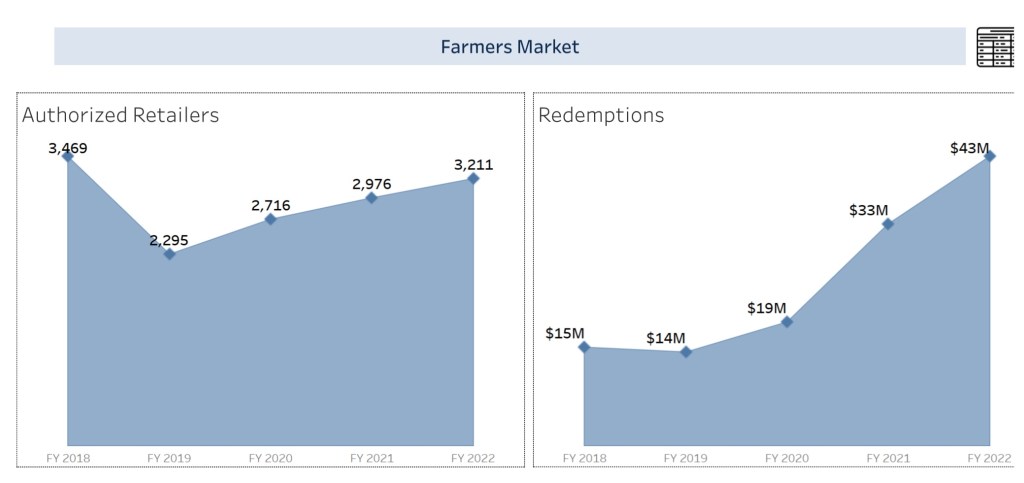
Farmers markets continue to increase their overall SNAP sales
Direct Marketing Farmers increase sales as well, although not as fast as FMs. It is also possible that DMFs are making some of these sales at farmers markets.
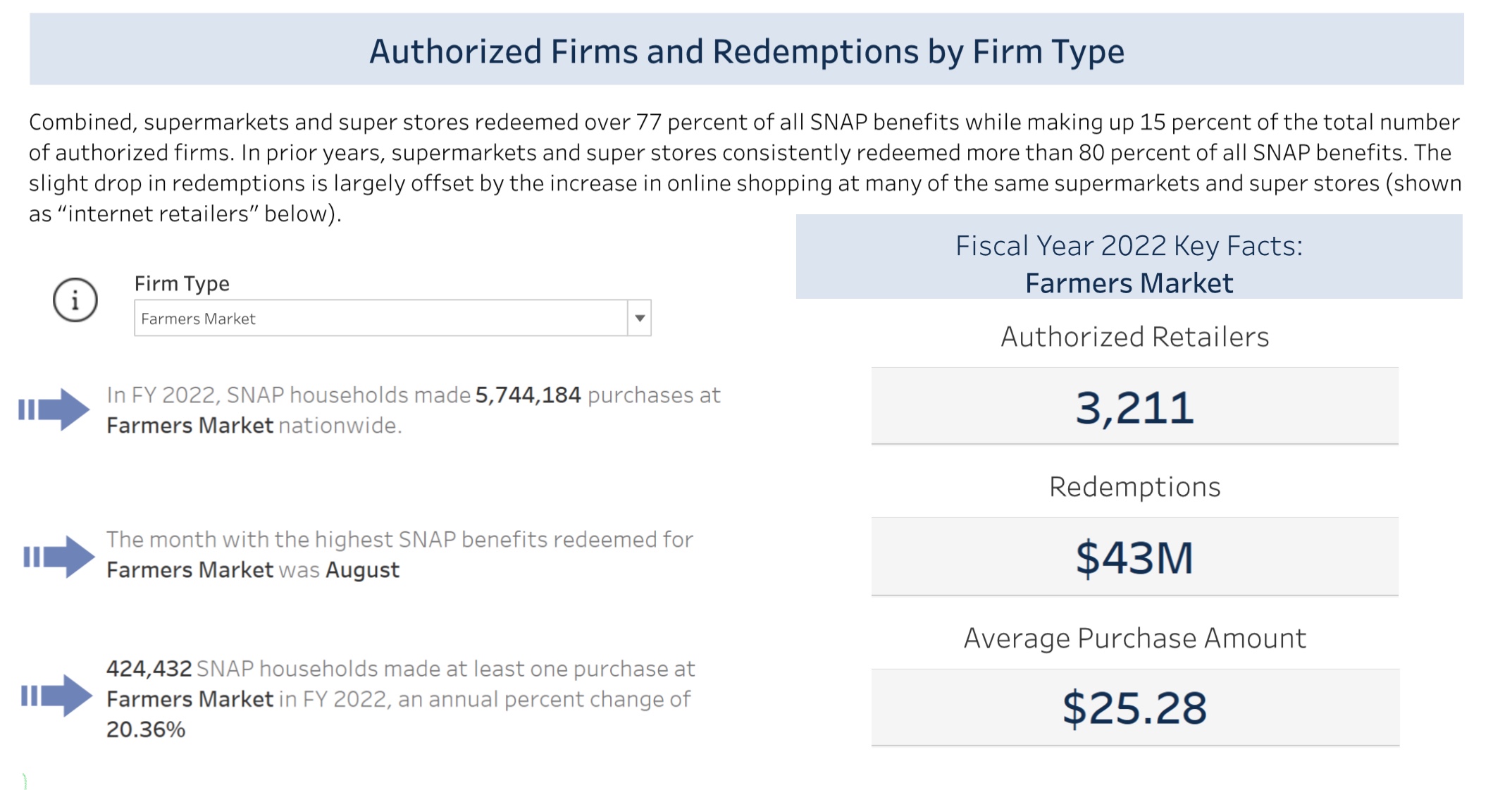
Not sure how this Average Purchase Amount is calculated; this metric may be actually be “Average Amount Debited from SNAP Card” since the total issued by the farmers market entity may not (and where matching incentives at many markets are, likely not) be the total amount spent by the shopper. And on the other end, in some cases the total issued is not always spent entirely, and instead saved for future shopping trips.
The average sale for DMFs is impressive. This metric may be more precise as an average sale per shopper, since for most DMFs the total is tallied and then the card is debited rather than the other way around as is done at most farmers markets centralized terminal models.
One thing I do each December is to think about my work year, what I wished I had accomplished and what I might do in the next year. I am sure this list is no surprise to any of the hardworking market operators and market partners that I wish I had done more for in 2022, but in these exhausting years of the COVID crisis, there has been a growing and mostly unmet need to offer organizational services such as grant writing assistance, board development and governance audits, staff Human Resources support, and product development for market vendors.
In 2023, I am determined to redouble my efforts to increase support for farmers market operators through more directed technical assistance and resource collection and creation, both in my staff role at Farmers Market Coalition and in my small role in my own time working as a consultant directly with markets across the US and with the newly emerging World Farmers Markets Coalition.
Here are some of my 2023 goals:
Continue connecting climate activists and funders to community food leaders so our work can be named, outlined, and funded in the climate mitigation work happening across the US and globe. This includes seeking funding for a disaster recovery toolkit for farmers markets;
Pick up new skills and tools including completing a course on mapping networks which I believe is an excellent tool for market leaders to know exactly where they need to deploy their limited resources for maximum effect;
I also have carried around a longer term goal to start too seek funding for an FM Anthology book; once secured, asking writers and activists to contribute pieces on the vision and history of the modern market movement that illustrate how it has contributed so much to localized health and wealth initiatives in thousands of places across the globe;
Working more on a regional effort here in New Orleans named the Pontchartrain Network to increase connections across the dozen or so Louisiana parishes and MS counties that rely on the lake watershed. That work will focus on educational efforts to all civic leaders about how to achieve increased production and consumption of food grown in the region;
At FMC, we will be seeking a new Executive Director in 2023, as Ben Feldman plans to step down after a successful run the last 3 + years (although I certainly hope he will remain as our policy person);
I expect to help the authors of the Anti Racist Farmers Market Toolkit with their goal of implementation of its strategies in markets by helping them secure funding for that work. If we get those efforts well underway, we can begin to seek leaders in the indigenous community to add their own content towards similar strategies so the modern market system can also be a more useful tool for tribal nations that are prioritizing culturally meaningful production and healthy options for their residents; to that same end, our work with USDA supporting a pilot of 1890 land-grant universities to add farmers markets to their campuses has already taught our team a great deal about how to help their efforts and we would hope to add more sites and 1994 land-grant universities and Hispanic-serving universities in future rounds of that work;
We will also be working on the new Regional Food Business Centers that USDA has added as a new level of support to regional food systems, and expecting to play a large role in the work with farmers markets across all of the centers;
Our food access team will seek to expand its funding to assist market organizations and states that are branching out past GusNIP funding for permanent incentive and benefit program support, as well as continue to support the large pool of GusNIP grantees whose work often becomes the realpolitik for food access decisions at USDA.
And with my decades of work on finding appropriate and relevant evaluation systems for community food system leaders to use (rather than funder or academic versions of what they think evaluation should mean), we will continue to create and support software and analog tools to conduct low-intensity evaluation of the many many impacts that markets have on their community, and in helping those with data turn them into infographics and analysis they can use to increase funding and awareness.
One other priority will remain: the development of FMC into serving a permanent role as the dynamic, stable, and effective go-to entity for the estimated 9,000 market communities in the US, as well as supporting our partners in similar sectors such as CSAs, farm stands, agritourism, and community gardening to be able to do the same. I am happy to report that that internal work is being ably managed by our Deputy Director Willa Sheikh and enthusiastically aided by our entire stellar FMC team which I am deeply proud to work alongside. Learn more about them here: https://farmersmarketcoalition.org/joinus/team/
So that’s my plan. I’d love to hear some of your plans around farmers market work and maybe even build a support network for those of us who do this work. If so, leave a comment.
I wrote a post on FMC’s website about my duties while attending Slow Food Nations in July, so I thought for my own blog I’d write something about a few of the people who I hung out with or heard speak, in the hope that it might offer some different context.
As for the event itself, it was definitely more focused than the previous year, with fewer locations and maybe even fewer listed events which was pleasant logistically. However in doing so, lost its pairing with the Union Station Farmers Market, which was too bad, as having the opportunity to see the actual transactions of a larger food system is rewarding for any good conference. Related to that, I’d like to see SFNations figure out a way (and they would like to as well, I am sure) to include more market leaders and small family farmers into the agenda, although the time of year is not the best for those folks to leave home. And I hope for the day when funders and partners offer support to market managers and interested farmers to attend more events like this one. It ain’t all about market day skills after all.
Those that were there were able to commune with those doing similar work around the world and to see and taste some regional products from across the U.S. in the SF Marketplace. I try to get through the Marketplace a few times during SFN because the businesses that SFUSA brings together are always impressive and great at explaining their approach and products. I’d like to have more direct marketing farmers in the US be able to see how well these businesses work as well when educating as when selling.
Now on to the peops:
==============================================================
Sofia Unanue from La Marana. During the Disaster Strikes panel, Sofia offered a powerful, real-time reality check on recovery, beginning with her sobering and yet uplifting video:
I imagined I felt her stress level and exhaustion even as she stood there calmly and pleasantly in Denver in front of a group of people who care deeply but cannot truly know what she and her community are going through over what is being lost with every passing day in the absence of a well-organized and empathetic public and philanthropic aid process. Not even those of us who have been through our own version truly know her reality, but what I do know is that recovery depends on people exactly like her being there and coming to these events to share that reality. And that her video made Richard McCarthy and I standing in the back of this room both weep and as we did, we knew we were remembering New Orleans 2005.
-Most importantly, don’t forget Puerto Rico.
Brian Coppom, Boulder County Farmers Market CEO. I first met Brian at last year’s Slow Food Nations event as I was tasked to help SFUSA with events that were scheduled at BCFM’s Union Station Farmers Market. As helpful as he was, the best thing he did was to give me access to his lead staffer, Elyse Wood, who can make good decisions lightning fast about the market space and in doing so, smoothed the events out so that featured speakers like author Deborah Madison and legendary MS farmer Ben Burkett were primed to lead lively and informative talks. If I would say that to Elyse, she’d likely shrug and smile, because in her list of things to do, it had been a simple task. I know because that’s how I would have reacted while doing very similar work in New Orleans for a guy very much like Brian (see last profile). But it isn’t so easy and the knowledge accrued by market organizers managing multiple sites, staff, programming, a network of colleagues and so on is impressive and yet few funders support this part of food work with professional development opportunities and other rewards. And I know that market directors like Brian (and Michael below) feel the same way.
Brian has quickly become a good pal and a strong voice in my list of go-to people when I search for input. He is a board member of FMC so even though he is constantly working on food and farming in Colorado, his goals are at a national level in intention and in impact. Look for those people in your travels and keep them on your speed dial.
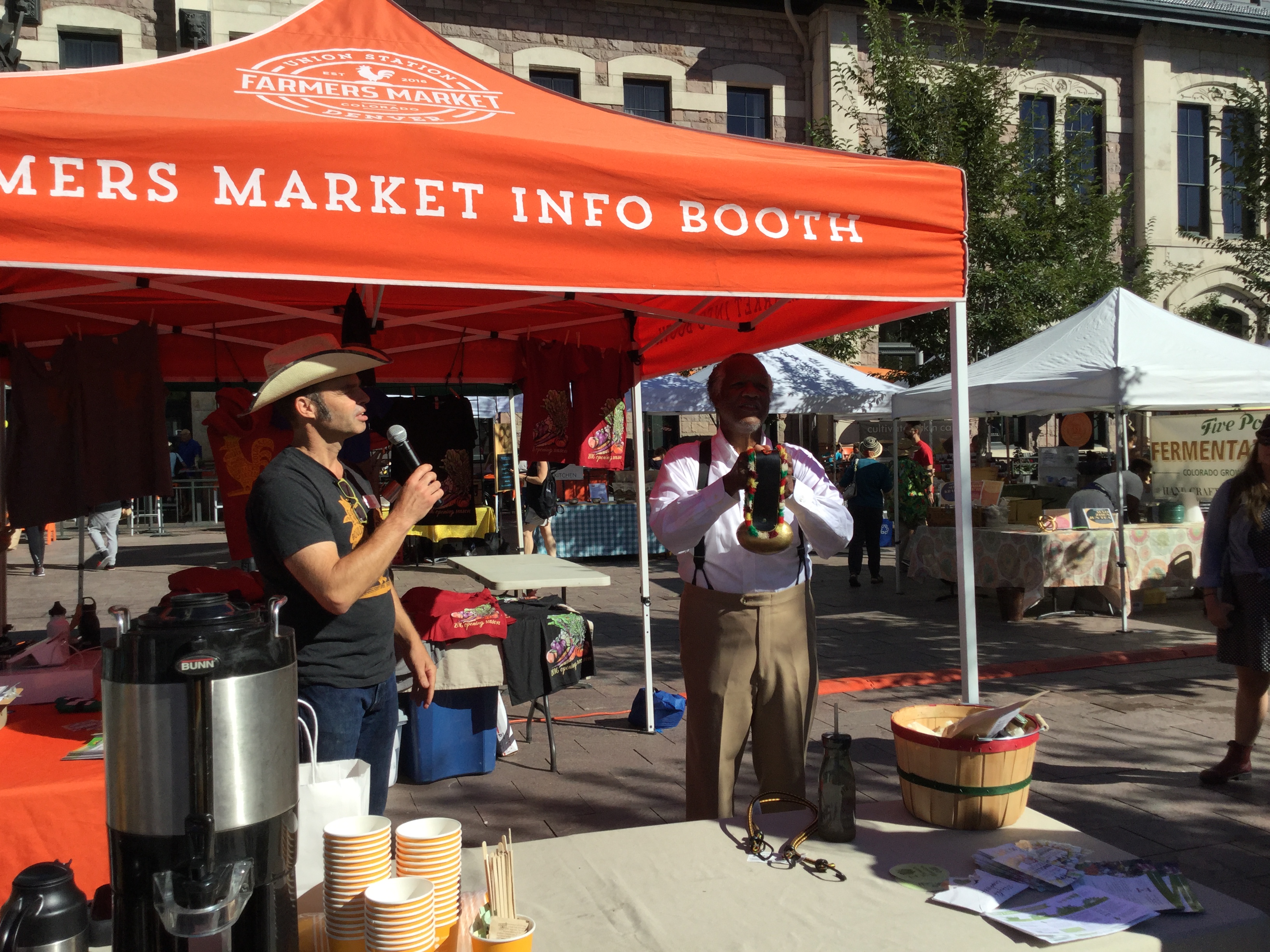
-Most importantly, he is hilarious and comfortable at a mic talking markets and in wearing hats:
Raj Patel. Well I do not share a long or rich history with Raj, but I appreciated his thoughts during this SFN so much I wanted to include him. Of course, his writing has always been illuminating as he takes on the dominant thinking around “value” which, of course, actually devalues everything worth saving. He’s included in this list for the moment he took a general question about local and elevated it to the question of justice:
“Almost all of the food that is grown and eaten in the United States today, that is bought and paid for, involves the hands of people of color…What’s important about local is you also need a robust sense of history…
-Most importantly:
You don’t fix the past with a certain type of tokenism; you fix it with a reckoning. And that reckoning is something the food movement has yet to have.”
Richard McCarthy, Slow Food USA Executive Director. It’s probably no surprise that I include Richard, as he is my former boss as well as my friend. Going through building and rebuilding farmers markets, disaster recovery, staff hires and fires, funding gaps and much more as his Deputy Director for almost a decade gave me as solid of a start in my national work as I could have wished for. Even so, I added him to this list on the strength of his enthusiasm for front line organizers and his skill in exploring how the people who are around him at an event can be connected. He throws a helluva event because he is obsessed with maximizing the results for the attendees by packing in as many informative and appealing touches as possible. It was the same back when he was the market director.
-Most importantly, I think Richard weaves a story around food and farming that is practical and aspirational to even those yet unfamiliar with what we do. Here is a podcast that I happened across that I think is a great example of that.
Poppy Tooker, Writer, host of public radio show Louisiana Eats. Like Richard, my relationship to Poppy is long and so full of amazing and sweet stories. Suffice it to say, Poppy has taught me how to share the stories of food producers with the larger world. During this SFN, I walked out to the festival area and heard my old pal’s mic’d voice doing a cooking demonstration and since her educational, wickedly funny, and precise demos are the stuff of legend in New Orleans, I immediately made a beeline in that direction. I got there just as she was wrapping up but did snag the last bean calas that she was offering. I shared it with the California couple next to me, explaining what this was and its importance to New Orleanians because that is exactly what she’d expect me to do.
Her panel introduction for the disaster panel was extraordinary. I say that as someone who stood in the back of the room and watched every chair’s occupant lean forward and the quiet descend on the room as she spoke with humor and pathos about the trivial and tragic memories Gulf Coasters carry from 2005.
-Most importantly, really truly because of Poppy (and Slow Food) we rebuilt our farmers market in two months in 2005 and saved a lot of farms and family businesses. And learned that we have others to call in across the globe in these times.
Poppy and Miss Linda (the Yaka Mein queen of New Orleans) talking at SFN about love and loss. New Orleanians can always veer from the chatty to the profound in a blink of an eye. This story Poppy was telling (as Miss Linda and I sat rapt) involved a vengeful, murderous jaguar and poor alpacas at our local zoo and then segued into a lovely story about husbands and high school sweethearts. A typical wide-ranging Poppy story with a message.
Michael Hurwitz, Greenmarket Director. As Michael tells people whenever we both show up somewhere, he and I met when he is was just two months into his job, 11 years ago. That time was at Kellogg’s Food and Society meeting and we both spent much of the down time discussing (debating) the functions and potential of markets. Even then, he had a solid grasp of the potential for greater impact and the possible pitfalls of operating what are the most well-known markets in the most competitive retail area in the U.S. That conversation has continued since. Through talking with him, I am reminded what a flagship organization can do, especially if the director trusts in his excellent staff and his vendors. What may not be evident is that the success of Greenmarket’s sites don’t happen automatically – like every other market organization, it requires constant calibration and some luck and Michael is so very honest about those facts when asked to share his lessons learned.
-Most importantly, he asks great questions of everyone, constantly learning more about the field he is in.
Michael and Richard meeting up at SFN
And with that, I’ll close the curtain on SFN 2018.
In a nutshell, the job of NFMW is to spotlight the importance of farmers markets to policymakers, to consumers and to farmers. It’s a campaign and it lasts one week per year.
With more than 8,600 farmers markets operating in the U.S., many among us may think we have made our work visible to most people.I’d beg to differ. With visitor attendance at those markets ranging from around a hundred to thousands, I’d bet that we attract around 2, maybe 3 million regular visitors each year. That sounds impressive but remember the population of the US is around 326 million. So 0.6134969325153374 of 1 percent. Or maybe 0.9202453987730062 of 1 percent.
Less than 1 percent.
Look, I’m not trying to rain on our parade. I think we do mighty things with that less than 1% with impacts that clearly stretch to the corporate food sector to making resilient places, and to meaningful citizen engagement. Local and organic and place-based foods are a HOT trend, mostly due to the work we all do and the farms that battle development and industrialization. Please congratulate yourself and your vendors, and volunteers and board.
And then, lets’ set a goal to expand that number. Maybe to 2% by 2020. That’d be 6.5 million regular visitors. Imagine doubling your attendance in 18 months.
So how to do that? for one, remember my phrases from this blog for this year:
Don’t Hide the Hard Work
Function like a Network Whenever Possible
Tell the world about your market organization, not just about individual vendors.
Talk about the history of markets in your area, acknowledging the long line of organizers.
Make your website appealing and full on information for longtime shoppers and vendors and for new ones too.
Ask shoppers to make it to more than one market this week, even if one of those markets is not managed by your organization.
Drop off some materials to your community foundation or to your local elected officials.
Ask your municipality to use our template to designate NFMW officially.
Send out tweets and instagram photos of your market using the images and people and feel free to use whatever details FMC has that work for you.
Connect with other markets and write a letter to the editor together, inviting newbies to your market.
Create a “bring a friend” incentive for this week.
Ask your loyal shoppers to tweet and post on FB about the market.
Have a postcard campaign to your legislators about how the Farm Bill needs to protect farmers markets.
This campaign week is our best chance to share those impacts and to ask for partners to increase our capacity and viability to support farmers and other artisanal producers.
One last thing to do:
On market day this week, call your team together and give yourself a round of applause from all of us at FMC. We deeply admire our innovative and enthusiastic market leaders and try to do our best to tell you that often.
Now go ring that bell.
I have a lot to tell you about my trip to Denver for the Slow Food Nations event, and to share ideas and research about vendor development at markets, and talk about the upcoming Direct Marketing Ag Summit in mid September, but instead of that, this post will focus on the immediate crisis in front of us: the recent news about the shutdown of the Novo Dia Group, which effectively will cease card processing for 1700 farmers markets and farmers during (most of the) country’s busiest market season. Since the news broke, my FMC colleagues have worked day and night listening to market leaders, asking questions of all of the players involved, explaining the problem to media and to our elected officials and strategizing with markets, farmers and partners about solutions. Now there is a single place to find all of the information and FMC will continue to update that page with the latest information.
Stacy always chooses her words carefully, works deliberately and thinks about how her actions affect others, sometimes to a maddening degree for someone like me who does not employ those restraints most of the time. What is so clear from her post (that we all demanded that she write for the newsletter!) is that that is a good personality type to be a market vendor and even more so, to describe what it’s like to become one.
Lovely thoughts about work here that Wendell Berry himself would read and nod in appreciation:
No one complains because they know they are blessed with this utmost human privilege– to work way too many hours and earn way too little in the pursuit of what fulfills you, most of us lucky enough to be well fed, if nothing else. These are the colleagues and coworkers whose shared goods and inspiration will make or break any vendor’s market experience.
and I think this might be useful for her market to use as a lead in to the vendor application?
Nervous and bleary-eyed from two consecutive late nights baking, labeling, and scrambling to generate last minute signage, I found a parking space, chased down someone on market staff, and began unloading my boxes. I forgot to write down the space number I had been assigned: E42? F24? Something like that. I have no tent, and share one with another small start-up vendor. Holy expletive. I am actually doing this.
I wish very good luck to my pal in this endeavor and encourage every market manager to encourage one of these posts from a new vendor for their newsletter.
To echo what my colleagues at FMC said in their original post accompanying the survey results, I recommend that you click through the answers below to our website and read the comments from the respondents. Do remember that the answers may not be drawn from a truly representative group of vendors and are a very small sample, but still, it is likely that each market has vendors that would agree with the majority of the statements.
Most of their comments have to do with the writing and enforcement of rules, the request for governance to be stable and for market managers having skills related to retail management, such as advertising know-how, location management expertise and product awareness. In all cases, these skills are possible for market staff to acquire, but won’t necessarily come from experience. In other words, it is time that professional development becomes a benefit/requirement of market management.
In order for markets to thrive in a competitive world full of external pressures and internal tensions, it is my contention that market managers (and boards!) who ask in other professionals to assist the market, who reach out to their peers regularly and who work constantly to balance between the vendors, the visitors/shoppers and the larger food/civic community’s needs are more likely to succeed. Professional development may mean attending a conference, taking a class on marketing, or researching product reach. However it is done, it should be built into the market managers year, even if it is only an hour or two a month.
I fully expect to get replies from managers telling me that they already work hours and hours without pay, have a list of to-dos longer than their product list or have a board that doesn’t care about their development. My reply is I know that all of these issues truly exist in real time for managers; I was one of those hard-working managers at one time and finding time to increase my skills was very difficult, but I did it. I did it partly by spending the time to find more volunteers, training them to do important work and at times, even writing my own job review in order to indicate where I needed help. I also built systems so that I didn’t have to explain how to do something each time or have to spend time recreating each time what needed to be done (designing a system for setting up the Welcome Booth that included lists of what and where items went out is an example of that as was a map of where to do outreach when flyers or postcards were ready to go). I wanted to stay in the field and so I looked for ways to become better at what I did and to become a professional market leader.
In turn, boards have to add benefits or a living wage so that they can retain trained market managers. As many experts have noted, what employees truly want is some autonomy, flexibility and appreciation.They want to feel that they are part of a purposeful place and that innovation is allowed, even encouraged and rewarded. Where better to build all of that in then a market?
I’ll also say that many advocates for markets (like FMC and AFT) also understand that the capacity of markets must be increased and that means that the job of market manager has to become a respected and long-term job. Check out this webinar about a wonderful survey of market vendors done by Colleen Donovan of Washington State University, Small Farms Program that gave excellent input on how to use the data to increase market expertise. It is also a big reason why FMC is investing in the Farmers Market Metrics project, so that good data about markets impacts can be shared and will encourage more investment.
What we know is that the number of volunteers and part-time staff must increase to assist managers and that the best way for a board to help management is to write and enforce clear and fair rules and to raise and manage money. We want markets to keep growing and to do that, management has to understand every nuance of their market and of the larger system to make their market resilient.
“To better understand the evolving needs of farmers markets and the farmers who sell at them, American Farmland Trust and the Farmers Market Coalition teamed up with C2It Marketing to complete a national survey of farmers who sell at farmers markets. Read the FMC posts here.
Over 550 farmers who sell at farmers markets nationwide responded to the survey, providing valuable feedback and ideas that should help farmers markets improve their operations. Despite the large number of responses, keep in mind these responses may not be representative of vendors from your local farmers market.
FMC recommends that markets review the issues farmers highlight in this survey, and then ask their own vendors about what would make the market more successful. Please also note that the views expressed by the survey responses do not necessarily reflect the views of FMC.
What Respondents Requested from Markets
When asked, “What could be done to help you and your farmers market be more successful?”, many farmers noted several areas where markets and supporting organizations could make improvements. The following answers provide a snapshot of the prevailing issues. Click on the links to view details on each suggestion:








 Helping Farmers Markets Grow