GOP proposes waiver to schools healthy food mandate, arguing too much being thrown in the trash

Just remember, the pressure will not end. The idiocy of whining about what is thrown away when that has never been measured before and that making these changes meaningful will take a whole systems approach will need to be pointed out again and again and again and again and again….

GOP proposes waiver to schools' healthy food mandate, arguing too much being thrown in the trash | NOLA.com.

Washington Ag Today talks about farmers markets

These are excellent audio snippets from Colleen Donovan, Washington Small Farms Program Research Coordinator at WSU about some benefits of farmers markets.

Community Impact of Farmers Markets

These are so well crafted that anyone could embed them into their website to show the impact of markets and market farmers, no matter where they are located.

What is most useful about Washington’s work is that it uses the context of organizational capacity to gauge if and how those multiple benefits are being forwarded to shoppers, farmers and the larger community. For reports that offer data without explaining that a volunteer-led effort managed it or that markets are often doing complex projects with part-time labor, I recommend to them that they consider adding it to any future analysis or funder report. The Farmers Market Metrics work we are doing at FMC and University of Wisconsin right now will add that piece into any resources or templates that we design, I promise you that!
In any case, associations in Washington and Michigan are truly the leaders right now in doing excellent analysis and resource development and then spending time sharing as well. (And if it was up to me, I’d give Illinois the rising new star award.)
Colleen did a webinar with FMC in fall of 2013 on the results of this report which is found on FMC’s YouTube site. Yes that is me (talking too low) introducing Colleen:
Link to YT recorded webinar

Diana Pinckley remembered

The event listed below is to happen this week and was excerpted from my home Crescent City Farmers Market “morsel” as they call their weekly email:
Diana Pinckley passed away in 2012; she was an irreplaceable member of our community and one sorely missed for her leadership and her friendship, both always given easily to so many.
The regard for her found on any market day in New Orleans can and should be multiplied in the thousands to stand in for all of the many initiatives or events that she supported across our region. The people I know through her represent her well: willing to give their time and talent and always remembering to be joyful.
Thanks, Pinckley. I’m honored to raise a glass for you this weekend and pleased to represent farmers markets where we remember and honor our people.

Raise a Glass to Pinckley with CCFM! |
FRESH & LOCAL
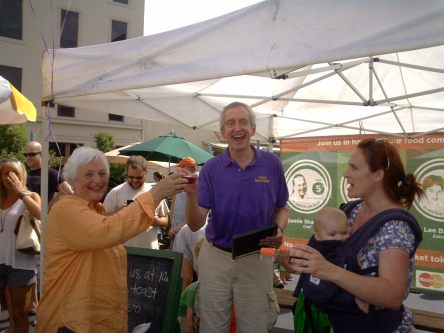
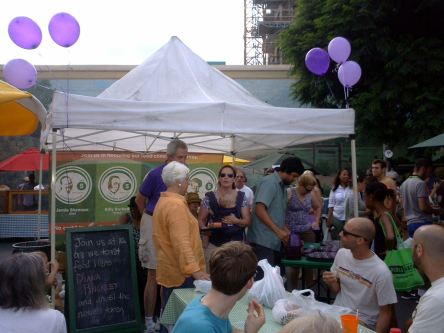
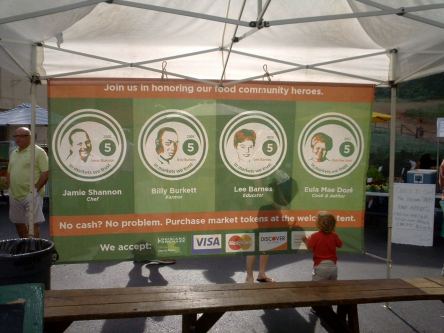
Each year we choose one of our local food heroes – a farmer, chef, culinary educator, devoted farmers market shopper or local food system champion – to be the face of our market tokens. This Saturday, we’ll unveil our 2014 market token and celebrate the life of long-time CCFM shopper and supporter, community activist and mentor to so many working to rebuild New Orleans and the Gulf Coast, Diana Pinckley. “Pinckley”, as she was known to close friends, loved mystery novels, bluegrass and the color purple. In addition to her work as a public relations executive, communications strategist and book reviewer, Pinckley shared her time and talent with many New Orleans civic organizations. She was a member of “Women of the Storm” and one of CityBusiness‘s Women of the Year in 2006. She served on the New Orleans Council for Young Children, the Committee of 21, the board of the Foundation for Science and Mathematics Education, the Edible Schoolyard New Orleans task force and was chairwoman of the board of the CCFM. She raised money for WWNO-FM and was an active volunteer at WWOZ-FM. She passed away in September 2012. New Orleans is a better place because of Diana Pinckley. Please join us, her husband John Pope and friends to raise a glass at 10am, tap your toes to the music of Lost in the Holler and celebrate the life of one of the CCFM’s most cherished friends. Purple attire encouraged.

FMC State and Network Leader Discussion continues…

State and Network Leader Discussion

What Farm-to-Table Got Wrong – NYTimes.com

Thanks to Richard McCarthy, our Slow Food USA leader for sharing this opinion piece from Dan Barber, the chef and co-owner of Blue Hill at Stone Barns. Stone Barns Center just outside of NYC proper, is easily one of the most important sites we have for learning and piloting good agricultural stewardship in the US: Read more here about their work. In this piece, Chef Barber talks about buyers needing to be more aware of the possible when working with growers, rather than just aware of the obvious. His identification of labels like Farm to Table as being limiting (and maybe even industrial) seems right on to me.

…Diversifying our diet to include more local grains and legumes is a delicious first step to improving our food system. Millet and rye are an easy substitute for rice or pasta. But that addresses only the low-hanging fruit of Klaas’s farm. More challenging is to think about how to honor the other underutilized parts of his rotations — classic cover crops like cowpeas and mustard, which fertilize the soil to ensure healthy harvests in the future.

Today, the best farmers are tying up valuable real estate for long periods of time (in an agonizingly short growing season) simply to benefit their soil. Imagine if Macy’s reserved half of its shelf space at Christmas for charitable donations. A noble idea. But profitable? Not so much. By creating a market for these crops, we can provide more value for the farmer and for our own diets, while supporting the long-term health of the land.

In Klaas’s field, I bent down and ripped off a green shoot of Austrian winter peas. I took a bite. Inedible? No, delicious! Thirty acres of the most tender and sweet pea shoots I’d ever tasted. (Harvesting the leaves would somewhat reduce the amount plowed back into the soil, but the plant’s soil benefits would remain.) In the distance I could make out a field of mustards. Klaas plants Tilney mustard, similar to the spicy green you find in a mesclun mix. I realized I wasn’t just looking at a cover crop. I was looking at a salad bowl.

What Farm-to-Table Got Wrong – NYTimes.com.

Using mp3s to make the case

I own two very simple recording devices that I use in interviews and sometimes just to get a recording of the sounds of a market when visiting. In my own work, here are the two that I use:

10058487469363201123

yhst-22632556433566_2267_40716381

They are both very useful and not that expensive, but sometimes just using a site that records short mp3s is all that is needed. This came up again this week, as we are hoping to use this technology in reporting to a funder on a project that I am working on and wanted project partners from across the country to record short sound bites. As an example, check out my recording which took 4 minutes to record and upload to my website:
HPMG mp3

And here is the link to the free mp3 site that I used

Let’s be clear: Independent Contractor or Employee?

One of the projects on which I will be working (TBA soon) may help to address some of the employment issues that I see within food systems, especially markets. Here is one of those issues, how markets employ their market staff.
This is from the IRS website:

“You are not an independent contractor if you perform services that can be controlled by an employer (what will be done and how it will be done). This applies even if you are given freedom of action. What matters is that the employer has the legal right to control the details of how the services are performed.”
——————————–
The decision is based on three areas:

Behavioral: Does the company control or have the right to control what the worker does and how the worker does his or her job?
Financial: Are the business aspects of the worker’s job controlled by the payer? (these include things like how worker is paid, whether expenses are reimbursed, who provides tools/supplies, etc.)
Type of Relationship: Are there written contracts or employee type benefits (i.e. pension plan, insurance, vacation pay, etc.)? Will the relationship continue and is the work performed a key aspect of the business?

Independent Contractor (Self-Employed) or Employee?.

Four young farmers start Stone Soup Farm Co-op, on front of worker-owned farm trend | GazetteNet.com

As a supporter of the US Federation of Worker Cooperatives, I hope that the expansion of worker cooperatives is as wide as the marketing cooperatives were in an earlier time among farmers. I would like to see market organizations spend some of their time searching for funding to add new farmers and especially encourage new cooperatives. Cooperatives might be especially useful within certain types of markets, like food security markets.

“Each person manages a specific part of the farm. Barnett is in charge of the harvest and what gets included in the CSA shares, as well as some aspects of crop production such as irrigation. DiLorenzo does the bookkeeping, office work, and creates daily and weekly plans to make sure production is on track. Harro oversees the greenhouse production and seeding, and Man takes care of the chickens, maintains the equipment and oversees the apprentices.The four worker-owners, who all live in Hadley, receive equal monthly stipends as pay and if there are any profits at the end of the year, they will get dividends. They declined to say how much their stipends are.”

Four young farmers start Stone Soup Farm Co-op, on front of worker-owned farm trend | GazetteNet.com.

Women as Brokers

I think this study about gender bias among networkers in business is important for food system employers and boards to think about, since so many women are in the position of acting as a “broker” in our sector. I have seen female market managers and other food system connectors perceived negatively by their community when discussing the role of active networking or advisor, while seeing men described as competent for managing the same activities.

Normally, women are thought to excel in the social realm — so you would think that they would be seen as good work brokers, the researchers said. But “despite the widespread notion of women as social specialists, perceptions of the network position of women will be distorted because of the expectation that brokerage is man’s work,” they wrote.

Much of this distortion may be below the level of conscious awareness, Professor Brands says, and simply bringing it to employees’ attention could help minimize the reputational bias that women incur at work.

.

pubsonline.informs.org/doi/pdf/10.1287/orsc.2013.0880.

How Do I Build a Business Plan? (Infographic) | Entrepreneur.com

1392332798-how-build-business-plan-infographic

CFA study of direct sales and agritourism shows some ups and downs

From FoodTank: “On-farm enterprises that focused their business plans on local communities were labeled community-focused agriculture (CFA). This included farms that sell their produce directly to consumers and generate farm income through agritourism. According to the report, only 6.2 percent of all farms deal in direct sales, and around one percent report income from agritourism (all study figures are based on USDA statistics from 2007, the most recent year available).

Studying CFA influence on a national and county-by-county level, researchers found some surprising results. In New England and Mideast counties, regions with well-developed urban centers in proximity to CFA, direct sales increases were associated with increases in total farm sales, as well as personal income growth. Agritourism, on the other hand, was found to have a negative effect on total farm sales.

In the Southeast, increases in direct sales were associated with overall reductions in total farm sales. However, the reverse was true for the effect of agritourism on total farm sales, which was found to be positive in this region and in the Great Lakes.”

“Linkages Between Community-Focused Agriculture, Farm Sales, and Regional Growth”
Economic Development Quarterly 0891242413506610, first published on October 18, 2013