Market Metrics: Measuring and Communicating the Health Impacts of Farmers Markets

Show some support to Farmers Market Coalition and this necessary project:

America’s 8,000 farmers markets are bringing huge health benefits to their communities, often with little cost, structure, or support. Collecting accurate data on these grassroots organizations is imperative if we’re to maximize their impacts.

News Challenge

National 2013 Food Hub Survey-NFGN

Authored by Michigan State University Center for Regional Food Systems & The Wallace Center at Winrock International
From the Executive Summary:

Findings from the survey showed that food hubs across the country are growing to broaden the distribution infrastructure for local food. From the survey, 62% of food hubs began operations within the last five years, 31% of food hubs had $1,000,000 or more in annual revenue and the majority of food hubs were supporting their businesses with little or no grant assistance—including food hubs that identified as nonprofits. Financially, the most successful food hubs tended to be for-profit and cooperative in structure, in operation for more than 10 years and working with a relatively large number of producers. The values-based nature of food hubs makes it hard to judge many of them solely on their level of financial success.
The survey also revealed a number of persistent challenges and barriers to growth that even the most financially successful food hubs faced.
For example, many food hubs indicated their needs for assistance in managing growth and identifying appropriate staffing levels for their hubs. They also often pointed to their need for capital and other resources to increase their trucking and warehousing capacity.

NFGN Report

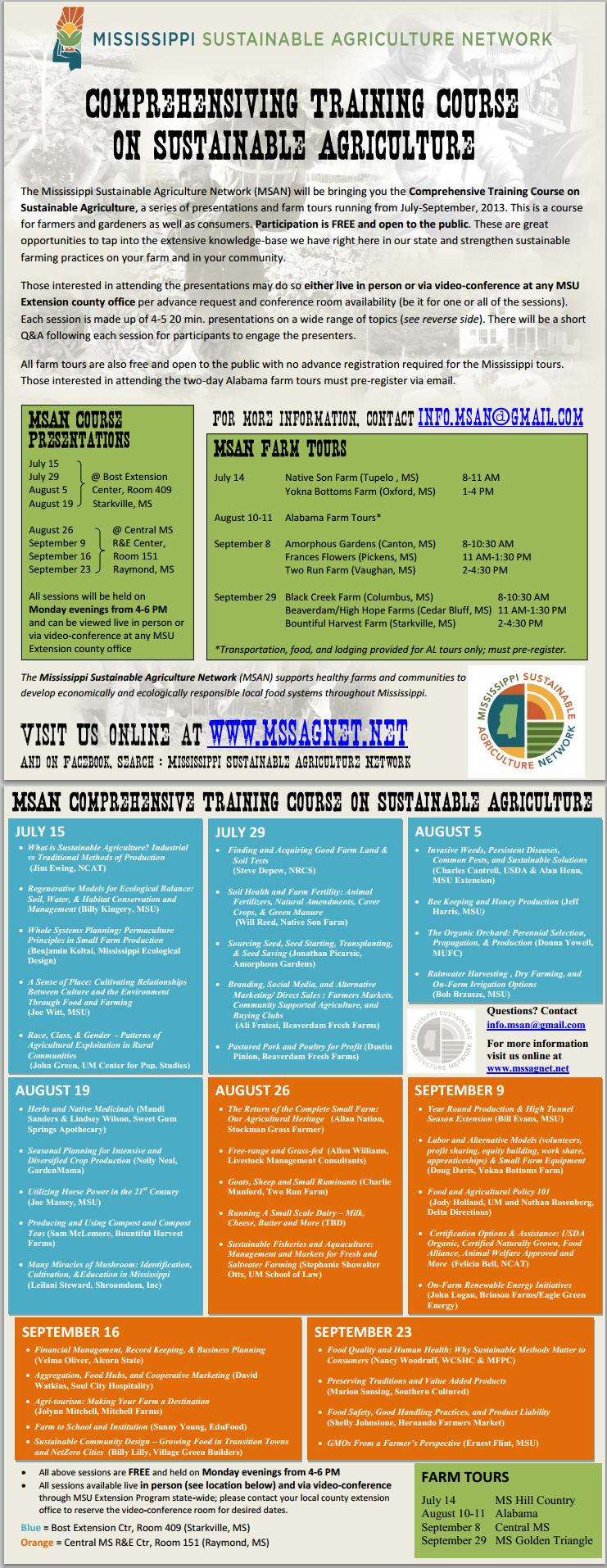
Sustainable Ag Trainings in the Deep South

Mississippi Sustainable Agriculture Network's trainings-2013

Mississippi Sustainable Agriculture Network’s trainings-2013

Book Review: Louisiana Eats

13328918-mmmainFull disclosure: Poppy is my pal. She is someone who calls me up and then shows up, with a gift, thoughtful questions and always hilarious stories.
What made me a fan of hers early on was her razor-sharp take on people and situations, sometimes devastatingly so. Yet she is enormously kind and open to those people who ring true. No one that receives her wrath  is ever underserving. If they get it, they usually have made one of two unforgivable sins: either they underestimated HER or they underestimated her city, her state or her people.

Another disclosure: I believe Poppy deserves as much credit as anyone in my region for rebuilding the New Orleans food system after the federal levee breaks in 2005. Too many stories to tell here, but come on over and if you care, I’ll tell you some of them over a drink. Or two. There are a lot of them to tell. Some of them are funny, some are sweet, some even a bit crazy.

These two points are linked since her life’s work is to actively promote entrepreneurs and real ideas that will build (or rebuild when necessary) the culture of her place, Louisiana. In doing that work, she extended her range to all authentic food systems across the globe through her Slow Food International connection that  meant that New Orleans gained the Slow Food vibe from the mid 1990s on.
Let me also say that most of the SFUSA folks understand her range, giving her much early credit for shaping the U.S. work that she built with others-that is, until she had to unleash her wrath on previous Slow Food leadership over the (mis) direction of a crucial program that she had helped shepherd. Luckily, she and SF made up.
Remember, I warned you that she is a fierce opponent when she feels it’s necessary.

When she started the Louisiana Eats show, she had already done a great deal of writing and television. Her talents really came to light when she began this show; her intense enjoyment and knowledge of the people and history of food and culture through one-on-one conversations on our local NPR station and now in this book. I remember a glorious Saturday morning on Louisiana Eats when she and Rien Fertel talked about praline sellers and another when she talked with Miss Linda Green, The Yakamein lady, and another when she talked with French bread baker John Gendusa among many others. Each time, I would stop what I was doing and literally stand there and listen intently to her intricate questions and always learn something. And her interaction with the dean of New Orleans Creole food, Leah Chase which is always touching and amazing since you get to hear two chefs with great respect for each other just banter and share stories.  And when she has on young activists or farmers (like Nick Usner who is in the book), you can hear the hope in her voice for the new energy coming along…
So this book is a reminder of many lovely Saturdays  and is indicative of the tone that I myself have adopted for much of my food activism: wild enthusiasm, critical assessment and a deep appreciation of the stories and background of those unique people that tell of our culture and food. Because of her, I know to seek them out, and maybe I’ll find some new folks from those Poppy has brought to us on her show and in this book. The book itself (lovely photos and recipes) is informative and a great companion to her show and I know that it will stand the test of time as a true record of some of the people that we have in our world. And of my pal who contributes so much to our place.

<a href=”http://www.goodreads.com/review/list/635646-blue-collar-mind”>View all my reviews</a>
 

Louisiana – New Cottage Food Law (August 2013)

Sales are limited to $20,000 per year

Cottage food operations don’t need to get a license from their health department, but they do need to check with their county to see if any zoning requirements apply to them.

Operations do not need to collect any state sales tax, but they may need to collect local sales taxes (it is different for each city and county).

Only food items in these categories are allowed:

Cakes, Cookies, Honey, Jams & jellies -Preserves.

Unlike most states, Louisiana allows custard and cream-filled bakery products.

Louisiana – Cottage Food Law.

Rules are varied

I think most if not all managers of markets understand that other markets have different rules than theirs, but do your shoppers know? And have you ever updated them, in cooperation with your vendors?
Nearby markets should share rules so that they do not make their farmers follow different sets of rules for little reason. It’s amazing how many markets don’t even attempt to compare rules which makes it quite hard for vendors to remember which of their markets has rules against packing up early or who allows foraged items and who doesn’t. One of the main areas of contention among farmers is the amount of liability insurance that they are required to carry (when a market requires it); a farmer told me about three different levels of insurance that he was asked to carry, all of the markets within a few miles of each other.

http://www.twincities.com/stpaul/ci_24036424/farmers-markets-not-all-follow-same-rules

On Being a Boss: Kristen Essig Takes Over at Sainte Marie – Eater Interviews – Eater NOLA

Below, is a link to an interview with a New Orleans chef who has embedded local purchasing into the very DNA of her kitchen.

The day I met Kristen was the day (2002? 2003?) that she interviewed to be our Crescent City Farmers Market (CCFM) Tuesday/Thursday market manager. She came to the interview with a slate of ideas and opinions backed up with a vitality that could not be denied. We were surprised that someone with her fine dining experience (and obvious ambition) wanted to work for our little organization, but she explained that she wanted to know all facets of the food system.
During her tenure, she can be credited with building our Green Plate Special program, which allows restaurants to come for a full month of Tuesdays to sell plate lunches to the shoppers at the CCFM and, of course, allows those chefs to understand the farmers and fishers better and to have long stretches to watch market vending in person.

As a chef, she came with a “shoot from the hip” framework and never stopped running the entire time she worked with us. Like anyone who has worked on the line at top restaurants, she was intimidating to some but we knew that she always led with what was in the best interest of our farmers and fishers. Through her, we understood the psyche of the chef better and started to realize that we should get to know the sous chefs and line cooks that were more often at the market and were on their way to the top position. Many of those have now become leaders of their own restaurant (why, like our friend Kristen Essig!) and almost all have become fierce supporters of those markets.

“As a line cook, you develop a relationship with vendors as they come in the back door, but actually working with the vendors at the market was a totally different thing. You’re working, really, with 20 small businesses, and they’re all trying to make certain quotas, and they all have certain amounts of product that they have to move. You develop strong relationships with these people—you learn that they have bills to pay, whose kid needs braces, etc.”

On Being a Boss: Kristen Essig Takes Over at Sainte Marie – Eater Interviews – Eater NOLA.

News & Events | VEGGI Farmer’s Cooperative

This is a new Vietnamese-led growers initiative in New Orleans. I hope we begin to see more production cooperatives among farmers, especially urban and peri-urban farmers.

News & Events | VEGGI Farmer's Cooperative.

Ask away…

To follow up on Monday’s post on excellent questions NEVER to ask farmers at a market, here is a great site full of questions once SHOULD ask a farmer. I can envision these on a laminated card at the Welcome Booth or maybe on Facebook with a few listed weekly. Questions for farmers