President’s 2014 Budget: Overview and Department of Agriculture – NSAC.
President’s 2014 Budget: Overview and Department of Agriculture – NSAC
0 CommentsLeave a comment
“Vermont is now officially, quantitatively the number one state in the union for local foods two years running, according to Strolling of the Heifers’ 2013 Locavore Index.”
Having spent some of the last 3 years working with Vermont food system organizers, I can tell you that this news was likely (again).
Sharing with your community – whether it is your talent or with your products – is embedded deep within the Vermont DNA and can account for part of their success in being #1 for local “eating”, but quite possibly a book that I am currently reading, “Fast Lane On A Dirt Road: Vermont Transformed 1945-1990,” may also shed light:
“The 24,000 farms of 1946 became 9,200 farms by 1964… and by 1990, 2400.”
superimposed over this info:
“The 1960 newcomers reversed the century-long exodus of the young and the restless and helped increase Vermont’s population from 390,000 to 445,000, the first jump of more than five percent in one decade since the 1830s.”
In other words, by the early 1960s the “halcyon” days of agriculture had given way to paved roads leading to ski lodges (in a state with over a thousand peaks over 2000 feet) and IBM jobs, yet had fewer people.
So, what may have saved the state from chasing the corporate buck and rich tourist to its economic death may have been those hippies who came a few years later looking for ways to live their values and start a new life.
And in a state now known for its progressive politics at the state and national level, it may surprise many to know that when the Republicans gave way to a Democratic governor in 1962, it ended the “longest run of one-party control in American history.” However, that change also meant more state programs and less local control which continues to affect the future of Vermont, especially in the role of agriculture and who will help decide what “local” will mean in the coming years.
What all this means to me is each state’s food organizers need to understand their demographic past and then adapt to current assets and trends just as I think Vermont has started to do quite well. In any case, congrats to the hardworking folks of the Green Mountain State.
http://www.takepart.com/article/2013/04/09/vermont-leads-nation-local-food
I have been working on some documents that I hope will help explain markets a little better to the larger food community and to market partners. Since markets remain the most efficient (and democratic) mechanism for anchoring and expanding community food systems, knowing how to build successful versions is more vital than ever.
The link will take you to one document that will share some of the background of how identifying markets by their sets of internal and external characteristics has evolved. By looking at markets structure, product mix and partnerships/projects, researchers are working to show how markets are not “one-size-fits-all” and that describing and sharing markets characteristics will allow communities to choose the most appropriate market type and also to find appropriate measurements when expanding their reach into more organizing scenarios.
And certainly, better definition will help vendors pick the best market for their business goals while also aiding markets that want to understand and work with neighboring markets.
All in all, collecting characteristics from markets is a good idea that’s time has come.
If you have other descriptions to add, send them along and I’ll be happy to discuss.
This article is now under the Market Evaluation drop down menu linked below and labeled typology/market characteristics:
http://www.helpingpublicmarketsgrow.com/market-characteristics.html
As farmers market organizers, we get busy with our logistical work and our market aches and pains that come from growing too fast. As important as it is to remember what we have in front of us in the U.S., it is as important for us to remember what the rest of the world struggles with and how they see farmers markets as a solution too.
This piece from the Nyéléni newsletter (the Food Sovereignty newsletter for the international movement) tells an inspiring story about market organizers in Columbia that should be read by all North American organizers too.
www.nyeleni.org/DOWNLOADS/newsletters/Nyeleni_Newsletter_Num_13_EN.pdf.
Recently did a quick survey for Long Beach Farmers Market in Mississippi as their organizer mulls a decision to move the market to a green space with more parking and some shade, but away from the coffee-house and asphalt.This sort of decision, as many organizers have discovered, sounds like an easy decision but never is!
Mississippi Gulf Coast markets continue to manage the after effects of Katrina (where the damage was most severe) with their cities often just now finishing rebuilding their downtowns and green spaces.
Those spaces often come last after city halls, schools and roads so the markets have been the hosts for the few vibrant public spaces along the Gulf over the last 7 years.
The amount of work that it has taken to bring back these small towns that are vital for the state and region’s economic feasibility is mostly undocumented and much of it has been driven by individuals and volunteers. Markets too can take a bow.
Here are the results of the survey:
Once again, this is where I see farmers markets influencing public policy. If this can be understood by the communities that use farmers markets, then we can begin to add supporters to the land rights movement too.

No, not THAT Tabasco. Clever market.
http://www.thesttammanynews.com/news/article_8e7cb9e2-c6ef-11e1-961a-0019bb2963f4.html
One of my ideas for building the movement is for network leaders to think about how to alternate or expand manager trainings. For experienced managers that have attended (and maybe even presented?) at their own state conference, maybe there is way to save some of that funding for those managers to be able to go visit another market instead. There are markets operating year round in every region now and so finding the appropriate market for these managers to learn from has become much easier.
For example, here in Southeastern Louisiana this early spring, we are in the middle of one of our best seasons already; strawberries, citrus, greens and generally full tables since mid January.
Covington Louisiana market this last weekend; 40 miles from New Orleans, this is a classic rural neighborhood-style market. They have about 35 vendors all of which live within 30 miles of the market. The market is held in a green space downtown in the city that is the parish (county) seat which allows plenty of parking nearby on Saturday morning; the market does almost no paid marketing and has no plans to offer credit, debit or EBT sales at all. The vendors can send their teenagers to sell or bring their toddlers because they are more comfortable with its small town air than they would be in the city. All in all, this would be a very good market to visit for a manager of a similar rural area.

Covington Louisiana, 40 miles from New Orleans. This Saturday market has thrived in recent years.
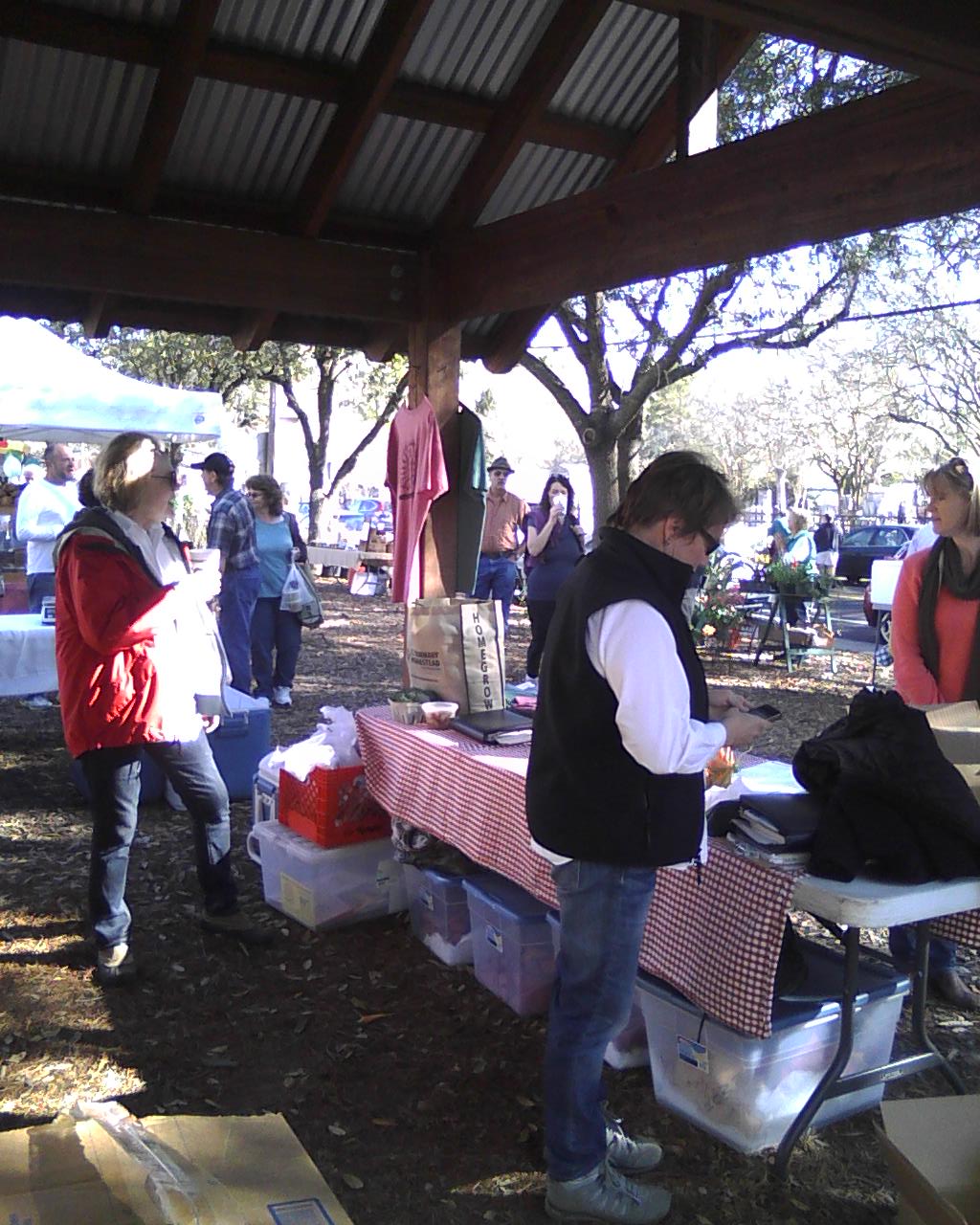
Jan (in vest) is the long time market manager and has a great attitude about her rural parish seat farmers market. Her sister Ann (in the red jacket) helps with logistics and announcements.

a few of the vendors at the St. Paddy’s weekend farmers market in Covington LA.
 Food Atlas by Darin Jensen
My rating: 4 of 5 stars
I love maps. When I travel, I study maps online to have some sense of the geography underfoot, as much to understand who the people might be as not to get lost. It’s amazing how people appreciate that bit of homework when you go to their place.
I have maps of my city (New Orleans) and of my river (Mississippi) on the wall of my house and the Slow Food RAFT map (see below) on my business card.

Slow Food RAFT map
When I came across the Kickstarter campaign for this Food Atlas, I jumped at the chance to support it. It arrived last week and I have read it while sipping my morning coffee (while reading about Strong Coffee traditions in the Middle East and “Bird Friendly” coffee origins), referred to it while writing about farmers markets (the one on SNAP and farmers markets) and studied the Texas Seafood Landings map after making flounder tacos just north of Lake Pontchartrain, home of most of the seafood catch for my bioregion. It’s a very new book and so won’t be found everywhere yet, but you can buy it from them now at
http://www.guerrillacartography.net/home
It is a wealth of maps on food production, distribution, security, exploration, identities and to pick out my favorites is to shortchange the breadth of this book.
It’s not just for activists, or “foodies” but for everyone and I think it could affect (and galvanize) people just as M. Pollan’s “The Omnivore’s Dilemna” did. I grow tired of long text articles about food (Yes, I do include myself in that finger pointing!) and would hope that this sort of map project could become a new way to educate and illuminate the small world that we live on.
I can’t wait for the editors to follow up on their promise to expand the reach of this series including to add more Asian and African food maps and to get this Atlas in hands everywhere. Its a bit heavy on maps of the West Coast and of the US, so much so that it occurs to me that having a set of food maps that show the lopsided view we have of ourselves in the US versus how others see us or experience us might be a good edition. In any case, hurrah.
..
I’ve always been very proud of the very active way that my old workplace promoted FMNP in Louisiana. Since FMNP’s inception in Louisiana, MU’s markets have been at the forefront of expanding the program’s reach and redemption levels.
The FMNP incentive idea is a great one and allows seniors to continue shopping after their booklet was spent: they bring their empty booklet to the Welcome Booth and get 24.00 more in tokens to spend throughout the year, on any item.
With amenities like senior bingo, guided trips through the market and lots of assistance from staff, senior numbers continue to grow (by more than a thousand seniors!) at all three of their markets and their Field Note shows how the staff made it happen. Medium to large markets can certainly benefit from this report.
Like most Americans, New Orleanians too celebrate St. Patrick’s Day, although here in New Orleans we also celebrate St. Joseph’s Day. There already was a parade through the Quarter in St. Joseph’s honor and March 19 (St. Joseph’s actual feast day) will be quite the day for viewing of the altars throughout the city.
The tradition, which is Sicilian in origin but carried on locally by Italian-Americans and people of all nationalities and faiths, includes baking cookies and cakes and preparing foods for the altar. According to a legend, a drought and famine during the Middle Ages caused much suffering in Sicily. People prayed to St. Joseph, the husband of Mary, and promised to thank him with food altars on his feast day, March 19, and give away the food to all. Supposedly on midnight of March 19, it started to rain and broke the Sicilian drought. Many now create altars to thank St. Joseph for their personal prayers as well.
Over the years, the Crescent City Farmers Market has done many altars, with local media legend and Slow Food Chapter founder Poppy Tooker leading the design and collection of the goods. At least 3 altars have been created to be viewed on market day and one even included 19th century prayer benches borrowed from the Ursuline nuns who are the founding order of the city and have been here since the 1720s tending to their duties which includes their venerable girls school, the oldest operating Catholic school in the US.
The altars are found in churches, businesses and homes throughout the city and when you leave after viewing, you will receive a fava bean. The fava bean will bring you luck throughout the year. Part of the tradition requires that no money be spent on the altar, so its creators must beg for all items. Once the day is over, the altar is broken down and its content donated to the poor.
St. Joseph’s Day has another connection to food: it is also traditionally considered to be the last day to plant summer tomatoes for this region.
Old friends and multiple-movement-colleagues Ken Meter and Karen Lehman lead a cooperative sing along at the Illinois Farmers Market Association with a song found in a attic of a woman organizer from the 1930s, song to the tune of Auld Lang Syne called Cooperate. A sweet moment.

 Helping Farmers Markets Grow