I’ve always been very proud of the very active way that my old workplace promoted FMNP in Louisiana. Since FMNP’s inception in Louisiana, MU’s markets have been at the forefront of expanding the program’s reach and redemption levels.
The FMNP incentive idea is a great one and allows seniors to continue shopping after their booklet was spent: they bring their empty booklet to the Welcome Booth and get 24.00 more in tokens to spend throughout the year, on any item.
With amenities like senior bingo, guided trips through the market and lots of assistance from staff, senior numbers continue to grow (by more than a thousand seniors!) at all three of their markets and their Field Note shows how the staff made it happen. Medium to large markets can certainly benefit from this report.
farmers markets
St. Joseph’s Day Festivities
Like most Americans, New Orleanians too celebrate St. Patrick’s Day, although here in New Orleans we also celebrate St. Joseph’s Day. There already was a parade through the Quarter in St. Joseph’s honor and March 19 (St. Joseph’s actual feast day) will be quite the day for viewing of the altars throughout the city.
The tradition, which is Sicilian in origin but carried on locally by Italian-Americans and people of all nationalities and faiths, includes baking cookies and cakes and preparing foods for the altar. According to a legend, a drought and famine during the Middle Ages caused much suffering in Sicily. People prayed to St. Joseph, the husband of Mary, and promised to thank him with food altars on his feast day, March 19, and give away the food to all. Supposedly on midnight of March 19, it started to rain and broke the Sicilian drought. Many now create altars to thank St. Joseph for their personal prayers as well.
Over the years, the Crescent City Farmers Market has done many altars, with local media legend and Slow Food Chapter founder Poppy Tooker leading the design and collection of the goods. At least 3 altars have been created to be viewed on market day and one even included 19th century prayer benches borrowed from the Ursuline nuns who are the founding order of the city and have been here since the 1720s tending to their duties which includes their venerable girls school, the oldest operating Catholic school in the US.
The altars are found in churches, businesses and homes throughout the city and when you leave after viewing, you will receive a fava bean. The fava bean will bring you luck throughout the year. Part of the tradition requires that no money be spent on the altar, so its creators must beg for all items. Once the day is over, the altar is broken down and its content donated to the poor.
St. Joseph’s Day has another connection to food: it is also traditionally considered to be the last day to plant summer tomatoes for this region.
Sing-along at the IFMA
Old friends and multiple-movement-colleagues Ken Meter and Karen Lehman lead a cooperative sing along at the Illinois Farmers Market Association with a song found in a attic of a woman organizer from the 1930s, song to the tune of Auld Lang Syne called Cooperate. A sweet moment.
North American Urban Agricultural Survey
We are very excited to invite you to participate in a Portland State University survey of organizations and businesses across the US and Canada involved in urban agriculture projects.
Urban agriculture is growing rapidly throughout North America, and we are interested to learn about the experiences of the organizations involved, as well as any obstacles they face. Municipalities have begun to craft new policies and regulations related to urban agriculture, and we hope that the information obtained from this study will help guide city planners and policymakers as they develop policies and programs that effectively meet the needs of practitioners.
This survey is intended for organizations and businesses, big or small, formal or informal, that are engaged in urban agriculture on any scale. The survey should take about 20 minutes to complete. Feel free to email us (urbanagsurvey@pdx.edu) or call Nathan McClintock at 503-725-4064 if you have any questions about the study.
We appreciate your time and interest. We’d also be grateful if you could forward this widely to your urban agriculture networks throughout the US and Canada – we know that there are many exciting urban agriculture initiatives that do not have a web presence, and we would like to hear from all the organizations that are doing this great work. Apologies in advance for cross-postings.
Follow this link to the Survey:
http://survey.qualtrics.com/WRQualtricsSurveyEngine/?SID=SV_9TOXJEPPQKIUSqx&_=1
Products increasing at farmers markets
The Monica family, who have been Crescent City Farmers Market vendors for more than a dozen years, continue to add new products derived from the markets products already grown and offered.
Their evolution as savvy and leading market vendors has been remarkable and a pleasure to watch.
Bivalve Project from Louisiana
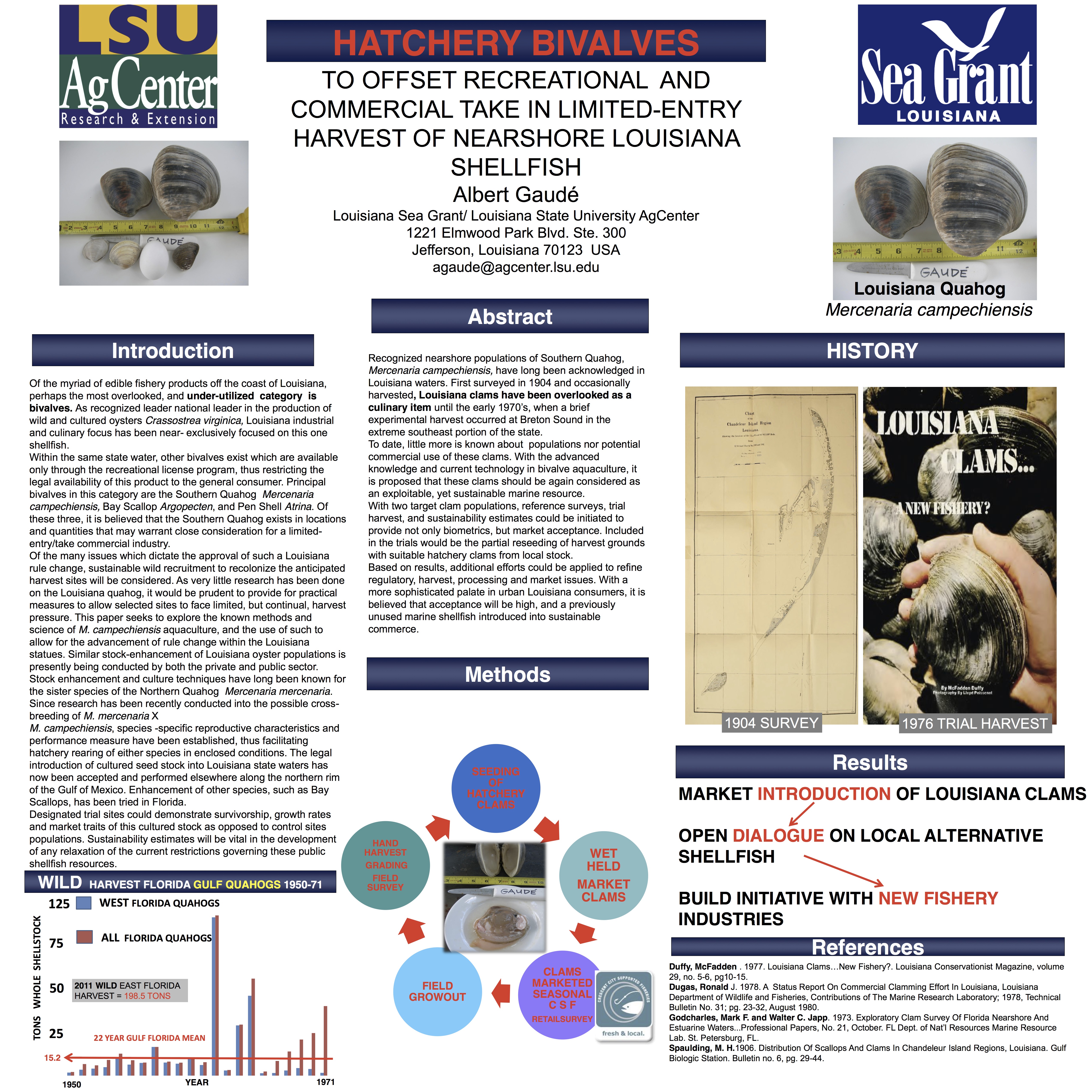
Fisheries Agent Rusty Gaude has long advocated for more production of the Southern Quahog, Mercenaria campechiensis and sees it as a possible new direction of direct marketing to offset the reduced output of oyster production in Southeast Louisiana. He has served on the New Orleans farmers market board and is advocating that the bivalve test be carried out as part of the Crescent City Supported Fisheries project. This project is done during Lent each year, where Crescent City Farmers Market shoppers can preorder a bag each week of seafood caught by the family fishers at the market.
Review of “Black, White and Green: Farmers Markets, Race and the Green Economy”
Black, White, and Green: Farmers Markets, Race, and the Green Economy by Alison Hope Alkon
My rating: 3 of 5 stars
Very well done snapshot of a piece of the Northern California local food system, especially its history. As much as I thought I knew, I learned some more about how it began from this book. I appreciated that this book was centered around these two farmers markets and their environmental and social justice leanings, which is a great lens to view multiple types of organizing, intentions and sets of outcomes.
I especially like the time she takes to link the work in each market to their larger community goals AND to the economic goals of the green economy.
here are some wonderful passages on the tensions and values of this emerging alternative system:
“One becomes an environmentalist, for example, through the consumption of green products such as organic food rather than the traditional means of voting, lobbying or attending protests. While this strategy allows supporters to inscribe their social movement goals into their everyday life practices. it also creates individuals who infuse the logic of the market into both their ordinary behavior and their desires for social change (Larner and Craig 1999)”
“The promise of the green economy is that the market can be made to value, and therefore to protect, humans and the environment.”
“In these markets, actors choose from among competing narratives to envision and emphasize the spaces where buying and selling green products leads to environmental protection and social justice.”
“Furthermore, proponents of the social change potential of the green economy attempt to redefine capitalism not as an exploitative system that must be overcome or restricted in order to protect people and the environment but as a tool to create a more just and sustainable world.”
“…Working towards these goals (environmental sustainability and social justice) becomes possible, in part, because participants in each farmers markets define environment and justice in ways that render them compatible with one another.”
“The compatibility between sustainability and justice achieved at these farmers markets is not inherent. Farmers market managers, as well as some vendors and regular customers, actively work to conceptualize strategies that speak to both goals.”
>As a community food system organizer, I believe this book is a necessary whistle stop on anyone’s travels to successful organizing around food.
Take the time to read this thoughtful book and then pass it along to your friends and comrades.
Community Wealth Workshop
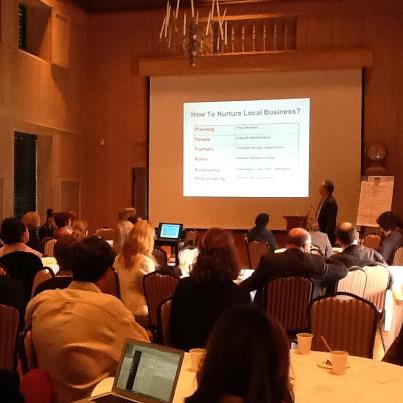
Spent most of Wednesday in a lovely room at historic LongueVue House and Gardens in New Orleans with bankers, community development coordinators and cooperative activists listening to economist/writer Michael Shuman describe different ways to encourage investment in localized systems.
His latest book, Local Dollars, Local Sense details strategies for creating investment in local systems as well as measuring the power of these systems. Michael is available to come to your community and have the same talk with YOUR investors and to expand your community’s knowledge about capital. I strongly encourage you to do that.
Review of “The Town That Food Saved”
The Town That Food Saved: How One Community Found Vitality in Local Food by Ben Hewitt
My rating: 4 of 5 stars
While in Burlington, VT for a series of meetings and the NOFA-VT Winter Conference, I stopped at the Crow Bookstore to see what I could pick up for background on Vermont’s agricultural movement to understand its emergence as a “direct marketing” flag bearer for the alternative food community.
The book is focused on Hardwick, Vermont a small town (3200 pop.) 30 miles from the capitol of Montpelier and an hour or so from Burlington.
Hewitt starts slowly with the idea of exploring Hardwick’s reputation as a “National Alternative Agricultural Star”, which he acknowledges has been made so by outside media, including Hewitt himself and The New York Times among others.
The book profiles a few of the Hardwick’s ag economy’s “leading citizens” including Tom Stearns of High Mowing Seeds, Pete Johnson of Pete’s Greens (at the time, the state’s largest CSA, along with mucho wholesale and farmers market sales), Andrew Meyer of Vermont Soy Company, and assorted others like Jasper Hills Farms, Tom Gilbert of Highfields Center For Composting, North Hardwick Dairy, Claire’s Restaurant, Buffalo Mountain Coop, Center For an Agricultural Economy, and a few individual farmers and neighbors who take the time to give their opinion on the state of things in Vermont. He lets those interviewed tell him the pros and cons of what they and their neighbors are creating. He finds a couple of schools of thought although all sides seem to agree that this is a revolution of one type or another. Some offer their analysis of the Hardwick story from the point of view of a small, committed group building new components for achieving wealth and knowledge to share while the others believe they show it through their independent but community-connected lifestyle that doesn’t want to “win” over the other guys and exists as the opposite of what American capitalism has weakly offered most places.
This book was helpful to me. I spend my life thinking about alternative food systems and most of that time working among the disciples of it rather than those not yet sure that it serves them. To his credit, that Hewitt includes a few voices critical of this system like Steve Gorelick and Suzanna Jones in Walden is incredibly useful and incredibly rare in books of this kind. Their argument is one that I hear less often but one that I actually agree with: the new system cannot be built on the industrial model: either from its economics, its scale or its terminology. Suzanna points out her loathing of terms like entrepreneurs and food security and gave me the first laugh of the book: “People are always doing stupid things in the name of groovy ag movements.”
Hewitt makes the fair point that much of what is being touted as local food is actually being exported or simply out of the reach for the cash-restricted Hardwick citizen. Those participating will agree but make the point that they are preparing the way for the next wave of farmers and entrepreneurs and boldly testing systems and new relationships.
He also considers the hard work and commitment that these new ag leaders are putting into building their projects. All of them are thinking about how to spread their worth and influence while showcasing their (often dazzling) project success to investors and policymakers.
I found Tom Gilbert to be a particularly effective champion for both sides of the argument, probably in part because he seems to see the holes that yet exist in it.
“We have not created a new system in Hardwick; we’re just rebuilding and utilizing the infrastructure that was already here. I think we let the media get ahead of us. People read all of this amazing stuff was happening and it put everyone’s expectations on steroids…This is a building process, and we’re not ready to put the roof on, because we haven’t put the walls up yet.”
Hewitt also includes one of the most elegant, simple descriptions of local systems that I have seen in recent years in the book. It’s on Page 172 and I could write it out (because I copied it!) but I think everyone should read it within context of the arguments made.
The question of how to measure these systems is also touched upon and since that questions is so near and dear to my own heart, I wish more time had been spent discussing that with the members of the community.
Near the end, Hewitt attempts to unravel the issue of scale, which also proves that he has done his homework because it seems to me to be the Kryptonite of alternative food systems. A comment from Tom Stearns near the end shows the complicated relationship that this community has with the issue: “There is the assumption that big is bad, but maybe it’s just that big is only bad when doing bad things.”
I can only imagine what Suzanna Jones thought about THAT statement.
The Town That Food Saved as the title seems to me to be one of the only under thought-out ideas in this book. Hardwick seems saved by its size, its wealth of shared intellectual capital (sorry Suzanna!) and by being in a state that offers a safety net to all and yet seems to try to leave its citizens alone.
As for food systems, Hewitt hits on the reason why alternative food systems are growing so quickly in Vermont when he talks about the editorial that the Hardwick Gazette printed, linking food system skills to participation in democratic systems, and he himself does it on the aforementioned page 172: the idea of being responsible for your own and your neighbors’ (read community in 21st century speak) quality of life has never gone out of fashion in Vermont.
To finish that argument, my go-to guy in this story (Tom Gilbert) said it very well: ‘One of my missions is to equip people with the tools for community health and sovereignty. I‘m most interested in how whole systems can be used to combat other forms of oppression.”
Amen brother. And pass the local cider.
Governance case study
In 2012, I did an introductory set of case studies on market structure to begin to get some good information to markets that are struggling with their founding or expansion.
The case studies that I did were of markets that had offered to share their background and systems with me that covered some regularly used types of governance.
However, I would like to stress that often when markets ask for help with their governance, what they really need is help designing appropriate management systems. In other words, if the market community has the ability to understand and even help decide on rules and decisions and manages its organizational risks well, then I often have to conclude that the governance is fine (although sometimes the pool of available advisors to serve is too small or maybe the work is as not clearly defined as it needs to be). What is more often in flux is the design of the management job and a market’s planning for project design.
It is clear that consultants need to have more options for management to match the many types of markets that exist. On top of that, how a market decides on projects to undertake every year should be more comprehensive than a manager’s good idea and willingness of volunteers to help.
I expect to do some work on management systems and project design in 2013 and to be able to share new resources. Until then, take a look at the Market Governance Case Study Report:
HPMG-MG report
Tet New Year Festival starts Friday at Mary Queen of Vietnam church
Here in New Orleans, we have one of the largest Vietnamese communities in the US, although few non-Vietnamese enter it. Centered in New Orleans East, it started as a refugee settlement of 2 North Vietnamese fishing villages that had resettled in South Vietnam after the Communist takeover. Those villages then left Vietnam after the fall of Saigon and were brought to New Orleans from refugee camps by Archbishop Hannan in the mid 1970s.
The largely Catholic community (the Buddhist Vietnamese community is mostly settled on the West Bank of New Orleans) runs the gamut of socio-economic statuses from low-income rentals to middle class stability all of the way to large homes in cul-de-sacs. They even have a traditional market on Saturday mornings from 6 am til 8 or so, with elders squatting behind their produce, arranged on blankets or bamboo mats on the ground with the church holding a place of honor in the middle of it all.
New Orleans East was hammered hard by Katrina, both with high winds and water. It is surrounded by water and therefore although a perfect home for the fishers who dock their boat at their door or at a commercial dock down the street, it is a cruel place during storms. Of course,the rebuilding was difficult and without a major fundraising and political push from the activist priest of the church Father Vien, the area would not have rebounded so quickly. Interestingly, Father Vien is no longer in the parish; some rumor that he was removed for too much media attention while fighting (what he called) BP’s paltry settlements that did little to rebuild the fishing communities after it was destroyed by the spill.
In any case, the community HAS rebounded and seeing it during Tet festivities is always a treat. If you get a chance to come to New Orleans, ask me the way to Alcee Fortier Blvd. so you can see the village for yourself..
Until then, here is a short video (featuring the aforementioned Father Vien) that I did while working at MarketUmbrella that tells some of the Vietnamese history in New Orleans:
Tet New Year Festival starts Friday at Mary Queen of Vietnam church | NOLA.com.
Back to Burlington
The late winter and spring are mad times for a farmers market consultant. The numbers of workshops and conferences has doubled or tripled in the last few years and every year since 2005 or so, I have been honored to be asked to present at 4 to 10 state or national convenings. I very much appreciate the opportunity to work with many market and market advocates at one time and to hear about new ideas and to meet some of those names I read from reports and posts on listserves.
In January, I spoke at NOFA-VT’s Direct Marketing Conference for the second year and I must say it’s a favorite of mine-a great mix of market organizers, farmers and agencies. Very focused and well attended. NOFA does an extremely professional job putting this on without showing the blood, sweat and maybe even tears, but knowing them its probably blood, sweat and laughs…
Part of why I went there was to conduct interviews with farmers and market operators to ensure their point of view is included within the state feasibility report that I am doing for NOFA and VAAFM (Vermont Agency of Agriculture, Food and Markets) on their EBT, WIC, FMNP systems and what steps it would take to build a comprehensive and universal system for their markets. (And no, I don’t ski or participate in winter sports so outdoor fun doesn’t factor in….)
Unfortunately, my schedule, vendors winter flu and other issues prevented me from getting enough interviews, so I decided to come back and to buttonhole some more folks at the other conference I have heard about from many Vermonters-NOFA’s Winter Conference. Workshops, TED talks, a multitude of different points of views from producers to “eaters” and a seed swap among many other things.
If you’re nearby and can make it, you might want to register and check it out for yourself. If you’re further away, you might want to download their brochure and put one on in your town.
How to Win Grants from Private Foundations
- THURSDAY, FEBRUARY 28, 2013
- 2:00 pm EST
- DURATION: 60 minutes
AFTER FEBRUARY 14: $96 EARLY BIRD: $75
As governments cut back and donors get more selective, more and more nonprofits are turning to private foundations for support.
But attracting private foundation money is very different than seeking corporate aid or federal and state grants.
To learn how you can stand out from the competition and understand what foundations are seeking, join The Chronicle of Philanthropy for a Webinar that features insights from a veteran program officer who has reviewed thousands of proposals over the last decade. Tobi Printz-Platnick of the Morris and Gwendolyn Cafritz Foundation will offer practical advice for increasing your odds of success, shed light on how foundations make their decisions, and show you how to talk about your organization’s weaknesses as well as its strengths.
You’ll also hear from a fundraising consultant and author, John Hicks, who will explain how to build strong ties to program officers, demonstrate that your work aligns with a foundation’s mission, and set your organization apart from the competition.
What Will You Learn?
- Tips for ensuring you give foundations the information they want.
- Do’s and Don’ts for your next grant proposal
- Strategies for improving your odds of winning support
Who Should Attend?
- Grant-proposal writers
- Chief development officers, development directors, and fundraisers
- Executive directors and board members


http://philanthropy.com/webinars/detail/1022?CID=WEBINARS1022E3
A mobile farmers’ market revs up – Food Features
An article about a mobile market starting up in Massachusetts is attached. After reading it (well even before reading it) I must confess I was just not sure about mobile markets as the method for adding healthy food to a community.
The purpose of the farmers market is to allow civic engagement to happen at such a regular interval that behavior change can also happen. Farmers can slowly build their business to meet their face to face customer needs, shoppers can watch others shop and compare notes and learn the seasonality of their region among other things and the neighbors get an amenity that encourages a more vibrant area. All of these things take time and sustained effort and even with the best of intentions may still fail but if it does all work, it can lead to a powerful change in a community. That is the promise of a farmers market, and it also allows everyone to be part of the decision making.
And may I add, the use of the term “market” in its title also troubles me as I think it implies a system that resembles a farmers market and yet we share almost no characteristics with mobile food initiatives.
And as someone who helps build and expand public markets, let me say this: I don’t believe that we have done enough with it yet. I think the type of market that we see in most cases is a “flagship” or “neighborhood niche” (some typology terms that are evolving in the market field) which may not fit the goals of some communities. I believe that there are many types of market types for communities that are organizing themselves. For example, there is a type of farmers market for food deserts (food security market type) that we have yet to fully understand or what the uses of those other types could be.
What worries me about people jumping completely to to the next bandwagon is that I wonder if the mobile market is actually a barrier to communities ever getting a full-fledged farmers market. Adding to that, I think farmers markets are part of a spectrum that can ultimately get communities other food retail options, including at times, full-scaled grocery stores. Can mobile markets lead to that? I’m just not sure.
However, I do see that mobile markets can offer some short termed food access answers and also gather some data about choices that a neighborhood wants. Also, that the mobile market can help some small farmers get prepared for farmers markets among other things.
I also appreciate the nimbleness of the mobile option. I did some research for a potential mobile market while working at MarketUmbrella in New Orleans after Hurricane Katrina and still believe that there is a use for it in disaster-struck communities. And having talked with the good people of Toronto FoodShare and others who are thinking about the mobile market role, I suggest that it might be a useful bridge to offer healthy prepared foods that could arrive in a neighborhood throughout dinner time and by using local fruits and vegetables in their simple recipes (meals under 4.00 for families and less than 15-20 minutes prep time perhaps?) still support local growers.
So I wonder if how communities deploy farmers markets and mobile markets separately and together could be analyzed using similar measurement (Oh I may find the time to do this myself soon!) and where there has been a successful model of a mobile market, that some in-depth research can be done of this option as an answer to food system needs.
By the way, this quote from the article struck me as a perfect example of the lack of awareness of what farmers markets do and how they do it:
“Traditional farmers’ markets, the pair argue, are often time- and labor-intensive, and have the downside of being stationary.”
Changing behavior takes time and a regular commitment and even though the idea of a moving truck sounds good as a way to get to more people, it also takes the chance away of establishing a haven that can become the start of a neighborhood getting long term amenities.
BUT I lay part of the blame on public market advocates: in order for food system organizers to know what farmers markets can do, we have to share data about what they do.
And find ways to encourage a full spectrum of answers that should well include mobile food.
A mobile farmers’ market revs up – Food Features.
Also, a link to the Greenpaper that I wrote while at MarketUmbrella:
Greenpaper