Almost anyone would say our society is capitalistic, based on competition and selfishness. But huge areas of our lives are already based on gift economies, barter, mutual aid, and giving without hope of return. Think of the relations between friends, between family members, the activities of volunteers or those who have chosen their vocation on principle rather than for profit.
Think of the acts of those who do more and do it more passionately than they are paid to do, of the armies of the unpaid at work counterbalancing and cleaning up after the invisible hand of the market and even loosening its grip on our collective throat. Such acts represent the relations of the great majority of us some of the time and a minority of us all the time. They are, as the two feminist economists who published together as J. K. Gibson-Graham noted, the nine-tenths of the economic iceberg that is below the waterline. Capitalism is only kept going by this army of anti-capitalists, who constantly exert their powers to clean up after it and at least partially compensate for its destructiveness.
Hope lies in the future, but my work on disaster and society convinced me that much that is remarkable is with us already, undescribed.
Pics from my visit today to the North Union Farmers Market held at the main campus of Cleveland Clinic. The market staff person told me it is wrapping up its 11th year; how time flies from my first visit the year it opened.
This market is a classic example of the “campus” type so named in the typology of markets that I have written about previously, and once we start to see some data from Metrics and state level data collection efforts, can begin to flesh out these types.
Some time ago, I wrote up a case study on those markets that had used FMSSG funding for focus group research to better understand the perceptions of at-risk and low-income shoppers; while researching that, I saw that this market had used their FMSSG funding to do a Frittata Project with Clinic lap band/bariatric surgery patients to adapt that simple recipe using different market veggies. I thought it was a great educational activity approach for a hospital campus market to incentivize behavior change. Very situational and intentional which is what I like about the North Union family of markets; each has its own focus and personality.
I was able to hear an update from FMC’s Policy Director Ben Feldman today and would like to give a quick overview and call to action for all of my readers:
Hidden in all of the activity on Capitol Hill this month is Congress’ inability to pass a new farm bill. As many of you hopefully know, a new farm bill is passed every five years. The House and the Senate had each worked on their own version, but were unable to get anything out of shared committee to vote on. (One main difference between the two bills was work requirements for SNAP recipients, and the inclusion of LAMP* in the Senate version which would help the Tiny but Mighty programs, but the story now is that there are many other stumbling blocks to a final bill coming out of committee.)
What that means is that in a few days (September 30th) the current Farm Bill expires. The session is likely to end without an extension of 2014’s Farm Bill either. This leaves it to the lame duck session in 2019 to either get a new bill passed or an extension of the 2014 bill, and since that short session means some members are on their way home, and others may be waiting for new jobs on committees there is little hope a new Farm Bill will come from that session. However, it is quite possible that the lame duck session will pass an extension to the 2014 Farm Bill.
The biggest problem with only getting an extension of 2014’s FB as the achievement of the lame duck session will be the lack of funding included for what is called the “Tiny and Mighty” programs which do not have baseline funding. Baseline funding is essentially a funding threshold where programs are assumed to continue either in a new Farm Bill or in an extension of an old one. Without baseline funding, the Tiny but Mighty programs need to be named and inserted in any extension which is unlikely without pressure.
These are programs that have large impacts but small funding. Here is NSAC’s list of programs that will sunset on the 30th:
Beginning Farmer and Rancher Development Program
Conservation Reserve Program – Transition Incentives Program
Farmers Market and Local Food Promotion Program (FMLFPP)
Food Insecurity Nutrition Incentives Program (FINI)
National Organic Certification Cost Share Program (NOCCP)
Organic Agriculture Research and Extension Initiative (OREI)
Organic Production and Market Data Initiative *
Outreach and Assistance to Socially Disadvantaged and Veteran Farmers and Ranchers *
Rural Micro entrepreneur Assistance Program (RMAP)
Value-Added Producer Grants Program (VAPG)
This does not mean that grants funded by these programs before September 30 are in danger; if your project received funding in 2017 or 2018 with these programs, that money is already appropriated and will be available to you for the life of your grant.
From NSAC:
The ten tiny but mighty programs of this series have made a nearly half billion-dollar investment in American food and farm systems over the course of the current farm bill cycle. These programs have represented 100 percent of the farm bill funding for beginning and socially disadvantaged farmer programs, organic programs, and rural economic development spending.
Needless to say, spending for these critical programs is minuscule relative to the cost of the full farm bill, weighing in at just a fraction of one percent of total farm bill funding. Under a three-month extension scenario, for example, Congress would need to invest only $35 million to keep these critical programs active at their current 2014 Farm Bill funding levels.
So the message here is: write to your reps and senators and remind them of the work and impact that your farmers markets, CSAs, food hubs, farmer training programs and so on have in your community, and how these funds have helped your work in the past. Ask them to get an extension passed in the short term with the 10 Tiny but Mighty programs included. And then to get busy on the new Farm Bill.
They need to hear from you. Again and again. And as Hoosier Farmers Market Association pointed out on today’s call, those of you who work at the state level or on policy councils can help by amassing data on what DTC outlets and farmers in your state or area of work have received from those 10 programs and the impacts of those awards to send along to your elected officials.
*The Senate’s 2018 Farm Bill includes language to establish the Local Agriculture Market Program (LAMP), which would provide permanent funding for local food by consolidating existing programs into a single program.
LAMP would:
Consolidate Value Added Producer Grants, Farmers Market/Local Food Promotion Program, Value Chain Coordinators, and planning partnerships into a new program administered by the Agricultural Marketing Service in coordination with Rural Business-Cooperative Service;
Maintain purpose and eligible entities for each program;
Identify Cooperative Extension Service as the lead for outreach and technical assistance;
Provide $60 million in mandatory funding and $20 million in appropriated funding;
Reserve 35% of funding for farmer or rancher grants; and
Reserve 10% of funding for projects supporting beginning, veteran, and socially disadvantaged farmers or ranchers.
During my extended visit to NE Ohio this summer, I have visited many markets, some farms and also met some excellent people thinking about their place constantly. Here is one of them.
Parking my truck on Jefferson after turning off Professor, I was lost in thought for a minute about the changes I was seeing in my old neighborhood of Tremont. Not that closed up storefronts or broken sidewalks should remain, but the saturation of shiny and new crowding this tiny corner of Cleveland was troubling. (For those who are unfamiliar with Cleveland or this part of it, Tremont is right next to what was the industrial Flats, and as such, had gone through some tough times in the latter part of the 20th century. Since the late 1990s however, its proximity to downtown and the city’s eagerness to think of the future as largely post-industrial in terms of infrastructure has meant this area has been transformed almost completely into an apartment and entertainment district.)
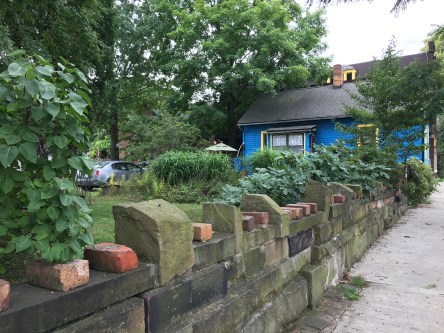
As I looked up from my musings, I noticed a healthy fig tree peeking over a beautiful, clearly handmade stone wall. I crossed the street to see it more closely and said aloud, ‘oh look at these figs! How lovely!”
A voice amid the greenery said, “please help yourself.” I looked over and saw a smiling face working on wall repairs just a few feet away. I carefully selected a few ripe figs and walked over to meet my benefactor.
Jeff Chiplis has lived on this corner with his wife Cynthia since 1980, and has seen a parade of people, ideas and development, across the spectrum of good to bad to ridiculous and back again. As an internationally known artist working with recycled neon signs, he believes in adaptation. So when he mirrors the best and protests the worst of developers’ and municipal whims in his work and yard, it should be noted by the powers that be.
For example, the utter lack of interest in reusing what was already here and the crowding of overly tall and architecturally bland buildings onto each redeveloped lot is clearly a source of frustration with Jeff. That wall that the fig tree reclines on is an example of how he honors the past while offering his neighbors beautifully framed access to the green space he owns. His dad and he originally built it, using discarded bricks and stones. Regular repair work is necessary because vandals push over the top stones or pull the flat stones to bash against the sidewalk. As we chatted, he finished his small repair job, carefully scraping the rest of the mortar from his bucket, then offering me a tour which I gratefully accepted.
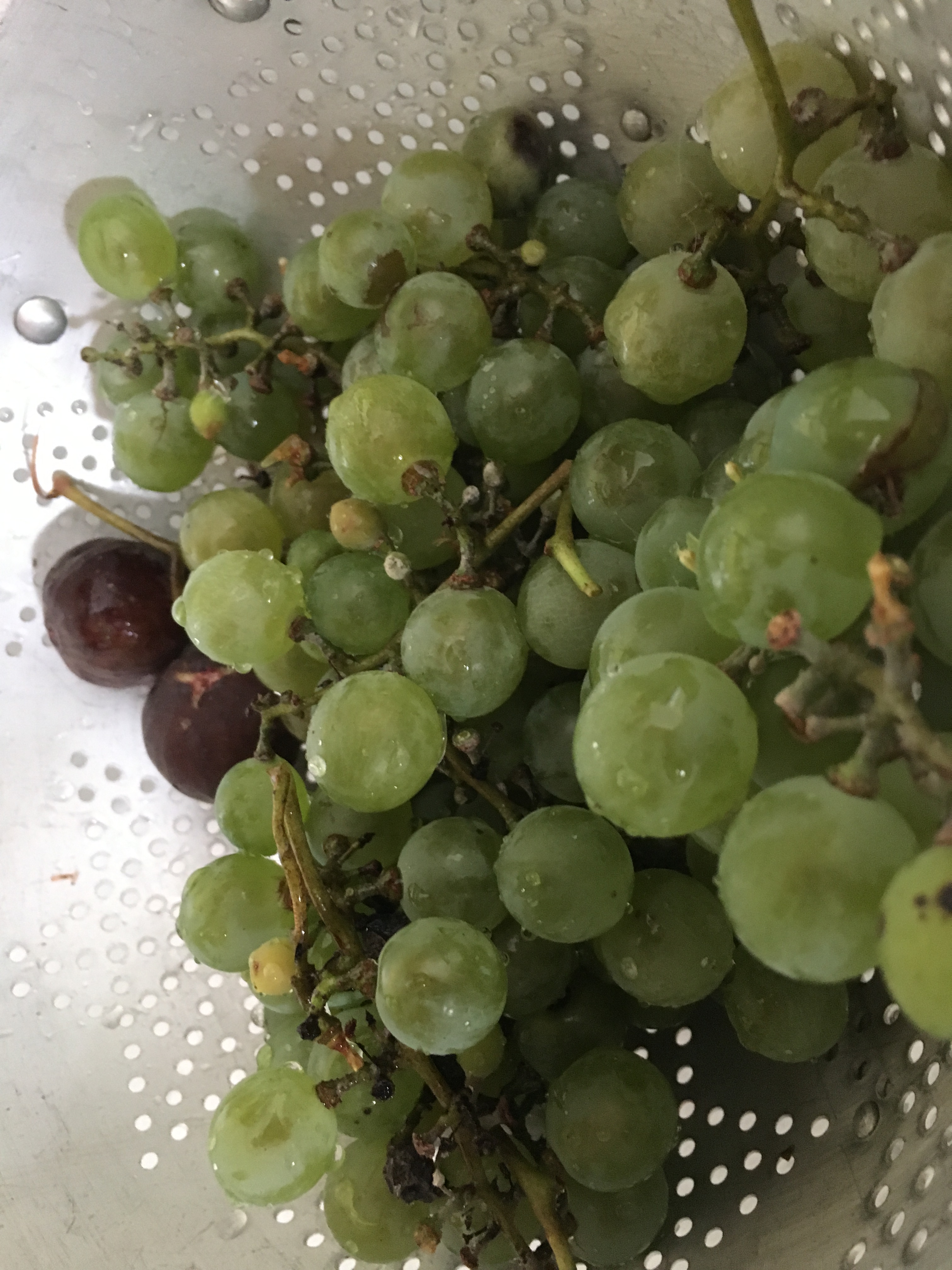
The figs and grapes line the sidewalk next to the small house “painted Superman blue” he offers (assuming I understand the Cleveland connection; I do) allowing anyone to feast as they go by. While there, I notice one 20-something ignores the bounty as she passes by twice with her large dog and smart phone at eye level.
Walking up the driveway between the Superman house and the larger brick one, he stops in his ground level studio to drop off the brickwork tools and to offer me a flyer from one of his latest installations around the city. The studio is floor to ceiling full of odds and ends, but somehow one can see that it is set up well for his use and offers comfort for anyone invited to stand among the signs, tools and materials.
As we walk the garden, I see that is organized the same way. The garden beds are bordered with found and made art, and plants are allowed to define their space as they see fit during growing season. Still, well-tended space is prominent between the areas of plantings and large trees on this corner lot.
The Harry Lauder’s walking stick tree was marvelous but unfortunately, was ailing while I was there:
although allowing him to adorn other borders with its cast-offs:
Greens were doing well alongside flowering plants.
Raspberries and currants overshot rusty fences and repurposed rebar:
This berry was replanted from his parent’s garden.
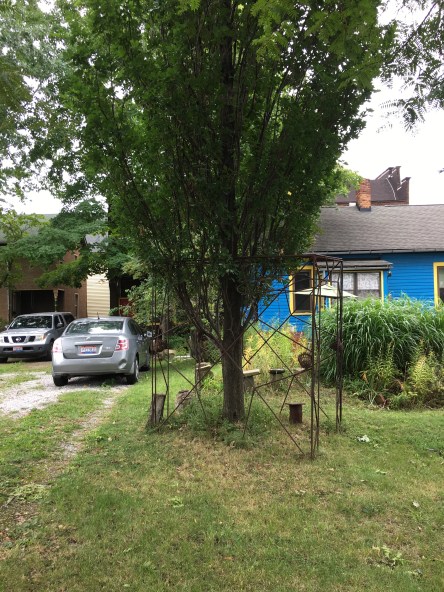
The burr oak was not only resplendent in the middle of the yard, but allowed him to place this frame that another artist had no more use for once the art piece had been completed. So Jeff found another use for it and slipped it over the much smaller oak clearly just in time:
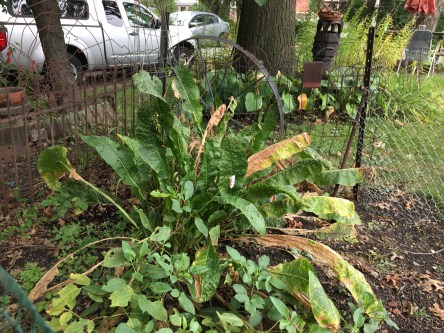
The horseradish was added for no particular culinary reason but turned out to be a good neighbor to the other plants, anchoring this corner:
I could have easily stayed longer. I almost did, but felt I needed to let him finish what is likely a long list of tasks in the studio and garden and home and neighborhood.
Just in time, that fig tree reminded me that resident’s homes like the Chiplis’ place are as necessary and as important as markets and community gardens in serving their communities.
Fascinating story about a “friends of” organization for a library that decided to close its store because of an issue over control of its decision-making. Since many markets have these type of supporting organization relationships, it’s very important that they understand how these work, especially in understanding the different types of a supporting org, according to the IRS:
Type I
A Type I supporting organization must be operated, supervised or controlled by its supported organization(s), typically by giving the supported organization(s) the power to regularly appoint or elect a majority of the directors or trustees of the supporting organization. The relationship between the supported organization(s) and the supporting organization is sometimes described as similar to a parent-subsidiary relationship.
Type II
A Type II supporting organization must be supervised or controlled in connection with its supported organization(s), typically by having a majority of the directors or trustees of the supported organization(s) serve as a majority of the trustees or directors of the supporting organization. The relationship between the supported organization(s) and the supporting organization is sometimes described as similar to a brother-sister relationship.
Type III
A Type III supporting organization must be operated in connection with one or more publicly supported organizations. All supporting organizations must be responsive to the needs and demands of, and must constitute an integral part of or maintain significant involvement in, their supported organizations. Type I and Type II supporting organizations are deemed to accomplish these responsiveness and integral part requirements by virtue of their control relationships. However, a Type III supporting organization is not subject to the same level of control by its supported organization(s). Therefore, in addition to a notification requirement, Type III supporting organizations must pass separate responsiveness and integral parttests.
The friends of entity in this story wasn’t one of those types, but instead was set up as its own 501 (c) (3) which was part of the issue.
From the story:
Friends board member Beth Schneider said the nonprofit will still raise funds for the Santa Maria Public Library. They are running a book sale from September 20–22 and donate books online through Amazon. Schneider asserts that the relationship between the library and the Friends remains: “We’re still the Friends of the Santa Maria Public Library.”
Mary Housel, library director, said that the library and the city will need to sign some form of contract in the future, although what that would entail, and why it is necessary if they are not utilizing city property to function, was not disclosed. Schneider said that they weren’t likely to take on any contract—“not as long as the city has taken the stance that it has.”
I wrote a post on FMC’s website about my duties while attending Slow Food Nations in July, so I thought for my own blog I’d write something about a few of the people who I hung out with or heard speak, in the hope that it might offer some different context.
As for the event itself, it was definitely more focused than the previous year, with fewer locations and maybe even fewer listed events which was pleasant logistically. However in doing so, lost its pairing with the Union Station Farmers Market, which was too bad, as having the opportunity to see the actual transactions of a larger food system is rewarding for any good conference. Related to that, I’d like to see SFNations figure out a way (and they would like to as well, I am sure) to include more market leaders and small family farmers into the agenda, although the time of year is not the best for those folks to leave home. And I hope for the day when funders and partners offer support to market managers and interested farmers to attend more events like this one. It ain’t all about market day skills after all.
Those that were there were able to commune with those doing similar work around the world and to see and taste some regional products from across the U.S. in the SF Marketplace. I try to get through the Marketplace a few times during SFN because the businesses that SFUSA brings together are always impressive and great at explaining their approach and products. I’d like to have more direct marketing farmers in the US be able to see how well these businesses work as well when educating as when selling.
Now on to the peops:
==============================================================
Sofia Unanue from La Marana. During the Disaster Strikes panel, Sofia offered a powerful, real-time reality check on recovery, beginning with her sobering and yet uplifting video:
I imagined I felt her stress level and exhaustion even as she stood there calmly and pleasantly in Denver in front of a group of people who care deeply but cannot truly know what she and her community are going through over what is being lost with every passing day in the absence of a well-organized and empathetic public and philanthropic aid process. Not even those of us who have been through our own version truly know her reality, but what I do know is that recovery depends on people exactly like her being there and coming to these events to share that reality. And that her video made Richard McCarthy and I standing in the back of this room both weep and as we did, we knew we were remembering New Orleans 2005.
-Most importantly, don’t forget Puerto Rico.
Brian Coppom, Boulder County Farmers Market CEO. I first met Brian at last year’s Slow Food Nations event as I was tasked to help SFUSA with events that were scheduled at BCFM’s Union Station Farmers Market. As helpful as he was, the best thing he did was to give me access to his lead staffer, Elyse Wood, who can make good decisions lightning fast about the market space and in doing so, smoothed the events out so that featured speakers like author Deborah Madison and legendary MS farmer Ben Burkett were primed to lead lively and informative talks. If I would say that to Elyse, she’d likely shrug and smile, because in her list of things to do, it had been a simple task. I know because that’s how I would have reacted while doing very similar work in New Orleans for a guy very much like Brian (see last profile). But it isn’t so easy and the knowledge accrued by market organizers managing multiple sites, staff, programming, a network of colleagues and so on is impressive and yet few funders support this part of food work with professional development opportunities and other rewards. And I know that market directors like Brian (and Michael below) feel the same way.
Brian has quickly become a good pal and a strong voice in my list of go-to people when I search for input. He is a board member of FMC so even though he is constantly working on food and farming in Colorado, his goals are at a national level in intention and in impact. Look for those people in your travels and keep them on your speed dial.
-Most importantly, he is hilarious and comfortable at a mic talking markets and in wearing hats:
Raj Patel. Well I do not share a long or rich history with Raj, but I appreciated his thoughts during this SFN so much I wanted to include him. Of course, his writing has always been illuminating as he takes on the dominant thinking around “value” which, of course, actually devalues everything worth saving. He’s included in this list for the moment he took a general question about local and elevated it to the question of justice:
“Almost all of the food that is grown and eaten in the United States today, that is bought and paid for, involves the hands of people of color…What’s important about local is you also need a robust sense of history…
-Most importantly:
You don’t fix the past with a certain type of tokenism; you fix it with a reckoning. And that reckoning is something the food movement has yet to have.”
Richard McCarthy, Slow Food USA Executive Director. It’s probably no surprise that I include Richard, as he is my former boss as well as my friend. Going through building and rebuilding farmers markets, disaster recovery, staff hires and fires, funding gaps and much more as his Deputy Director for almost a decade gave me as solid of a start in my national work as I could have wished for. Even so, I added him to this list on the strength of his enthusiasm for front line organizers and his skill in exploring how the people who are around him at an event can be connected. He throws a helluva event because he is obsessed with maximizing the results for the attendees by packing in as many informative and appealing touches as possible. It was the same back when he was the market director.
-Most importantly, I think Richard weaves a story around food and farming that is practical and aspirational to even those yet unfamiliar with what we do. Here is a podcast that I happened across that I think is a great example of that.
Poppy Tooker, Writer, host of public radio show Louisiana Eats. Like Richard, my relationship to Poppy is long and so full of amazing and sweet stories. Suffice it to say, Poppy has taught me how to share the stories of food producers with the larger world. During this SFN, I walked out to the festival area and heard my old pal’s mic’d voice doing a cooking demonstration and since her educational, wickedly funny, and precise demos are the stuff of legend in New Orleans, I immediately made a beeline in that direction. I got there just as she was wrapping up but did snag the last bean calas that she was offering. I shared it with the California couple next to me, explaining what this was and its importance to New Orleanians because that is exactly what she’d expect me to do.
Her panel introduction for the disaster panel was extraordinary. I say that as someone who stood in the back of the room and watched every chair’s occupant lean forward and the quiet descend on the room as she spoke with humor and pathos about the trivial and tragic memories Gulf Coasters carry from 2005.
-Most importantly, really truly because of Poppy (and Slow Food) we rebuilt our farmers market in two months in 2005 and saved a lot of farms and family businesses. And learned that we have others to call in across the globe in these times.
Poppy and Miss Linda (the Yaka Mein queen of New Orleans) talking at SFN about love and loss. New Orleanians can always veer from the chatty to the profound in a blink of an eye. This story Poppy was telling (as Miss Linda and I sat rapt) involved a vengeful, murderous jaguar and poor alpacas at our local zoo and then segued into a lovely story about husbands and high school sweethearts. A typical wide-ranging Poppy story with a message.
Michael Hurwitz, Greenmarket Director. As Michael tells people whenever we both show up somewhere, he and I met when he is was just two months into his job, 11 years ago. That time was at Kellogg’s Food and Society meeting and we both spent much of the down time discussing (debating) the functions and potential of markets. Even then, he had a solid grasp of the potential for greater impact and the possible pitfalls of operating what are the most well-known markets in the most competitive retail area in the U.S. That conversation has continued since. Through talking with him, I am reminded what a flagship organization can do, especially if the director trusts in his excellent staff and his vendors. What may not be evident is that the success of Greenmarket’s sites don’t happen automatically – like every other market organization, it requires constant calibration and some luck and Michael is so very honest about those facts when asked to share his lessons learned.
-Most importantly, he asks great questions of everyone, constantly learning more about the field he is in.
Michael and Richard meeting up at SFN
And with that, I’ll close the curtain on SFN 2018.
In a nutshell, the job of NFMW is to spotlight the importance of farmers markets to policymakers, to consumers and to farmers. It’s a campaign and it lasts one week per year.
With more than 8,600 farmers markets operating in the U.S., many among us may think we have made our work visible to most people.I’d beg to differ. With visitor attendance at those markets ranging from around a hundred to thousands, I’d bet that we attract around 2, maybe 3 million regular visitors each year. That sounds impressive but remember the population of the US is around 326 million. So 0.6134969325153374 of 1 percent. Or maybe 0.9202453987730062 of 1 percent.
Less than 1 percent.
Look, I’m not trying to rain on our parade. I think we do mighty things with that less than 1% with impacts that clearly stretch to the corporate food sector to making resilient places, and to meaningful citizen engagement. Local and organic and place-based foods are a HOT trend, mostly due to the work we all do and the farms that battle development and industrialization. Please congratulate yourself and your vendors, and volunteers and board.
And then, lets’ set a goal to expand that number. Maybe to 2% by 2020. That’d be 6.5 million regular visitors. Imagine doubling your attendance in 18 months.
So how to do that? for one, remember my phrases from this blog for this year:
Don’t Hide the Hard Work
Function like a Network Whenever Possible
Tell the world about your market organization, not just about individual vendors.
Talk about the history of markets in your area, acknowledging the long line of organizers.
Make your website appealing and full on information for longtime shoppers and vendors and for new ones too.
Ask shoppers to make it to more than one market this week, even if one of those markets is not managed by your organization.
Drop off some materials to your community foundation or to your local elected officials.
Ask your municipality to use our template to designate NFMW officially.
Send out tweets and instagram photos of your market using the images and people and feel free to use whatever details FMC has that work for you.
Connect with other markets and write a letter to the editor together, inviting newbies to your market.
Create a “bring a friend” incentive for this week.
Ask your loyal shoppers to tweet and post on FB about the market.
Have a postcard campaign to your legislators about how the Farm Bill needs to protect farmers markets.
This campaign week is our best chance to share those impacts and to ask for partners to increase our capacity and viability to support farmers and other artisanal producers.
One last thing to do:
On market day this week, call your team together and give yourself a round of applause from all of us at FMC. We deeply admire our innovative and enthusiastic market leaders and try to do our best to tell you that often.
Now go ring that bell.
I think farmers market leaders will need to focus on product development with their vendors in the next era of markets and this interesting post offers some excellent ideas for helping vendors expand their choices.
I have a lot to tell you about my trip to Denver for the Slow Food Nations event, and to share ideas and research about vendor development at markets, and talk about the upcoming Direct Marketing Ag Summit in mid September, but instead of that, this post will focus on the immediate crisis in front of us: the recent news about the shutdown of the Novo Dia Group, which effectively will cease card processing for 1700 farmers markets and farmers during (most of the) country’s busiest market season. Since the news broke, my FMC colleagues have worked day and night listening to market leaders, asking questions of all of the players involved, explaining the problem to media and to our elected officials and strategizing with markets, farmers and partners about solutions. Now there is a single place to find all of the information and FMC will continue to update that page with the latest information.
The Hartman Group’s research has found that 87% of consumers are inside what we refer to as the World of Sustainability. Those inside the world are impacted in their attitudes and behaviors by sustainability in some way. Most consumers are aware of sustainability as a term. However, attitudes, depth of knowledge, and engagement differ according to where they are within (or outside of) the World of Sustainability. Here are three key factors consumers consider when making purchase
If you haven’t already heard the news, Farmers Market Coalition and partners will host the United State’s first-ever National Direct Agricultural Marketing Summit this September in Arlington, VA.
The summit will be an opportunity for farmers market managers, farmers, vendors, and researchers to build relationships with leaders across the country, and learn the latest information about direct-marketing agriculture resources, technology, research, and more. Learn About Summit, Workshops, & Sessions
FMC is working to make sure a diverse group of farmers market leaders can join us at the summit:
If you would like to attend, but have limited means to do so, apply today for an FMC scholarship. FMC is awarding 15 FMC members with funds to help with conference and travel expenses. Applications are due July 9.
Summit Scholarships for FMC Members
FMC seeks to ensure that an exemplary and diverse group of market operators is able to attend the National Direct Agricultural Marketing Summit in September, and is pleased to provide a $600 scholarship to 15 FMC members. Scholarship recipients will arrive with a desire to learn from and connect with other managers and leaders in the field. Recipients will commit to attending FMC’s pre-conference workshops on Sunday, September 16th from 3pm to 6pm ET, titled, “Managing Farmers Market Risk & Integrity.”
To apply, complete the following two steps:
Complete this form by writing 4-6 sentences (under 250 words) about the mission and activities of your market, and how attending the conference will advance your goals.
Complete a Market Profile for your market on Farmersmarketmetrics.org. For detailed guidance on creating a Market Profile, click here.
My great pal Stacy Miller is always in constant learning mode, especially interested in learning through the experience and ingenuity of farmers and other entrepreneurs in her local community. This podcast is fascinating for the detail that she offers about product development, marketing concerns, trends in snack foods, and the props to farmers markets and FMC of course (and an honestly humbling plug for the Dar Bar but let’s leave that aside for now although I remain grateful that my name rhymes with bar.)
This is a great example of how a value-added business can offer authenticity to market messaging, how these innovative vendors can illustrate the market farmers story through storytelling and through lovely presentation of their ingredients offering healthy, delicious snacking. So let’s remember what those vendors offer our markets and honor them too.
“The interesting thing is to solve the problem, not escape it.”
On measuring our worth:
“What we can do is judge our behavior, our history and our present situation by a better standard than efficiency or profit or those measures that are still being used to determine economic decisions.”
On scale:
“It seems to me it all depends on our ability to accept limits. The system doesn’t even acknowledge limits. If we acknowledge the existence of limits, then the necessity of honoring them is possible to imagine an economy that takes care of the good things that we have in our immediate neighborhood.”
On globalization:
“The global economy, almost by definition, is not subject to regulation. This gives us the idea that if we don’t have something here, we can get it somewhere else. It’s the stuff of fantasy.”
This makes all the world a colony.
We should fulfill our needs and export the surplus. We should never export the necessities of our own lives.
The ultimate test is whether or not we live in beautiful places. Wherever ugliness has crept in, we have the first symptom of exploitation and exhaustion.
(Still) In distrust of movements:
“Movements tend to be specialized. There is a movement about climate change and it has become extremely specialized. And the actual solution of a problem like that is to have an economy that takes care of everything; an inclusive economy.
“Localism would cease to be an ism as soon as local people went to work locally. One of the things wrong with these great movements is that they are not telling people to go home and go to work in good ways to prove things.
Resistance and renewal simultaneously?
You are asking in addition to my insistence on the importance of local context and local work, do I believe in policy changes? Of course I do. Wes Jackson and his people at The Land Institute produced a farm policy called The 50 Year Farm Bill and what that proposes essentially is converting agriculture from the current 80% annual crops and 20% perennials to the opposite. That change would cure a lot of problems, including global warming to a large extent. That is a policy change. It would have to be applied however in different ways in different places and that relies on, to a high degree, on local knowledge and local intelligence.
In terms of describing how intellectual and ecological capital can be increased by markets, this interview from a few years back during the kickoff of the Creole Tomato Festival in the French Quarter in New Orleans is an excellent illustration of how a market manager can do just that:
NEW ORLEANS (WGNO) – It’s time to talk tomatoes! This weekend the French Market will be filled with tomato festivities for the 29th annual Creole Tomato Festival. News with a Twist Reporter, Kenny Lopez wanted to learn more about the creole tomato. What is it? How’s it different than a regular tomato? How do you pick one?
Andrew McDaniel with Crescent City Farmers Market helped answer those questions.
“It’s been debated upon what a creole tomato is. Some people say it’s a variety of tomato that was put out by LSU in the 1960’s. …the creole tomato is a tomato grown in Louisiana soil. These tomatoes are usually grown along the river parishes, the parishes that line the Mississippi River. The soil is richer, so these are the ones we consider creole,” McDaniel said.
McDaniel said that the main difference between a regular tomato and a creole tomato is the taste. “Creole tomatoes stay on the vine longer, so they’re fresher. They’re better because the tomatoes don’t have to travel across the country. The soil is what makes them sweeter,” he said.
He sure knows a lot about creole tomatoes and how to pick some good ones.
“You want them to be firm and red. If it’s for a salad then you don’t want them to have a lot of blemishes. Those kind end up slicing well. When you come to the Farmers Market, you’ll often find a basket called ‘seconds’. These kind of tomatoes are good for stewing, cooking, and making salsa. They are just as good, they don’t always look as pretty as the others, so that’s the reason they’re cheaper,” he said.
The summertime is the perfect time for creole tomatoes.
“Creole tomatoes are just a quintessential summertime food, especially when you pick them up fresh,” McDaniel said.