Some extremely important advocacy has been done by NSAC and FMC on the need for more edits to the FSMA in order for family farms and small business producers to be able to survive and thrive. Their recommendations include needed edits to the rules for farmers markets to be able to manage risk and yet to be allowed to encourage innovation to happen. Please read their updates and analysis on the FSMA and get your comments in by December 15.
Food Safety Modernization Act (FSMA) | Farmers Market Coalition.
FMC
Food Systems for Healthy Places
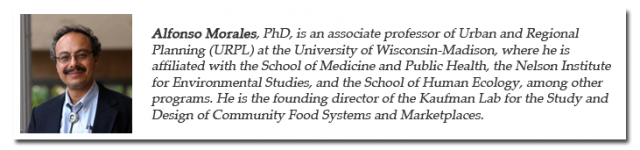
Great post by Dr. Morales on some of his current project work, including his perspective on the Indicators for Impacts AFRI-funded project that we both are working on through 2016.

Food Systems for Healthy Places | BEPHC | Georgia Institute of Technology | Atlanta, GA.
Employment with Farmers Market Coalition
Two great 40-hour/wk job postings with Farmers Market Coalition are being offered: an EBT Program Associate and an Education Program Associate. The programs for these positions have enormous potential to become pillars of FMC’s national work for many years to come, so please spread the word to as many corners of the community food system to allow them the opportunity to get the best staff possible. I can personally vouch that this organization has an excellent work environment staffed with dedicated and delightful folks.
Link to FMC website
Truth & Transparency: Farm Audits for Producer-Only Integrity | Farmers Market Coalition
Farmers Market Coalition member webinar on October 29th at 1 pm eastern, 12 pm central, and 10 am pacific.
Truth & Transparency: Farm Audits for Producer-Only Integrity | Farmers Market Coalition.
FMPP awards for 2014
Scrolling down through the list of FMPP successful proposals shows the ingenious and unique approaches that farmers markets and farmer advocates are employing across the U.S. to further community food systems.
Congratulations to everyone.
list of 2014 FMPP awardees
The “metrification” of urban life
As some may have noticed in comments on any index that I share on here, I am usually more interested in how the makers of that index collected the information and how the metrics were defined, than in the final ranking system. One of my online discussion groups “The Future of Cities” had a recent post on the fallibility of the happiness and livable indexes you see on many sites. The original post by Sam Jacob was so thoughtful, I thought I’d link it here and also send a link to the discussion. I have also added my own comment here.
His final conclusion was succinct:
We can draw on big data, on communication technologies but we shouldn’t be in thrall to it. We need to recognise the sheer difficulty of comprehending the complexity of cities and the difficulty of making them. We need a fuller understanding of the texture and depth of what life – and “liveability” – might be. We should openly acknowledge the intrinsic political dimension of the city and its fundamentally democratic nature.
My comment:
As someone who offers support to those between the formal and informal economies (in regional food systems), I appreciate the thoughtful comments above on the subjective nature of metrics in terms of indexing livability and happiness levels. I also agree that using these in terms of ranking cities or any endeavor is a marketing ploy and without real value to those in that place. However, as a food system organizer, I can assert that we are in need of well-developed and shared metrics that reflect the values that we forward, such as small business economic activity (success is not always about pure job creation in other words), social cohesion (trust between parts of the community unknown to one another before that activity like farmers and family table shoppers), ecological values (building a closed loop of sustainability) and human capital (transferring knowledge and building skills). I am working on a project that will forward a set of metrics that WILL have context as to the individual place that is being measured and not be designed to be used for ranking one place against another. We hope that this will allow for success measures that derive from the work at the grassroots level of organizers and users of that community and yet can explain the transformative nature of the community food system to policy makers as well and is therefore in agreement to Mr. Jacob’s original idea. Feel free to check out the early days of this work, done through a partnership of the Farmers Market Coalition and University of Wisconsin at FMC’s FMM page
DATA + DESIGN A simple introduction to preparing and visualizing information
A free online book to data visualization by the creators of Infoactive. I am proud to be a Kickstarter backer of this innovative company and hope we can lure them into the farmers market/food system world of data collection. This book came out of that campaign and-well, maybe just read what the author said about how the book came to be:
“It started with a message on Kickstarter:
Hi Trina! Stats dork from Chicago here….Do you have any plans to include tutorials for basic data cleaning and data selection techniques for users who may not have any statistics background?
At the time, I didn’t know that this one message would turn into a book, a community, and a global endeavor to make information design more accessible.
The message author, Dyanna Gregory, was a statistical programmer who knew the challenges of teaching university-level stats to those who don’t identify as math nerds. I was an entrepreneur building Infoactive, a web application to help people create interactive infographics and data visualizations. I was also a Reynolds Fellow at the Donald W. Reynolds Journalism Institute where my goal was to find ways to simplify the process of making data visualizations in newsrooms. I had launched a Kickstarter campaign to support Infoactive, and we had nearly 1,500 backers who were excited about breaking down barriers in data visualization.
We all believed in the vision of making data simple.
But working with data can be far from simple. Data come in all different shapes, sizes, and flavors. There’s no one-size-fits-all solution to collecting, understanding, and visualizing information. Some people spend years studying the topic through statistics, mathematics, design, and computer science. And many people want a bit of extra help getting started.”
An Introduction to MarketLink: Are you eligible to receive a free SNAP/EBT system for your market?
Farmers Market Coalition and Wholesome Wave are co-hosting a FREE webinar:
Wednesday August 13, 2014 3:00pm-4:30pm EST
The U.S. Department of Agriculture’s Food and Nutrition Service (FNS) launched MarketLink, a website that provides farmers markets and direct-marketing farmers with a one-stop-shop to become an authorized SNAP vendor and take advantage of USDA funding to obtain free or low-cost equipment and wireless services. Up to $4 million in grants for SNAP/EBT technology solutions will be available through this program for eligible markets through September 30, 2014. The quickly approaching deadline means that eligible farmers and market managers are making this important decision right now. Wholesome Wave and Farmers Market Coalition are co-hosting this free webinar to address your unanswered questions about MarketLink. Through this webinar, you will:
understand the USDA’s funding stream for enhanced SNAP benefits at markets
learn who is eligible to access USDA funding through MarketLink
learn about MarketLink, an iPhone-based EBT system that taps into $4 million in USDA funding to help new markets become SNAP/EBT accessible
hear an on-the-ground perspective on applying through MarketLink and implementing EBT
Panelists:
Rogelio Carrasco of the USDA’s Food And Nutrition Service will present an overview of the USDA’s funding for improved access to SNAP benefits at markets and the history of Marketlink
Amy Crone of NAFMNP and the Maryland Farmers Market Association will present the MarketLink program and provide an in-depth description of eligibility and application process
Sara Berney, Executive Director of Wholesome Wave Georgia, will discuss her experience applying for funds through MarketLink and recommendations for others
To register to for this webinar, please click here.
Please contact Liz at FMC at liz@farmersmarketcoalition.org, with any questions on the webinar.
Farmers Market Metrics Prototype Released
The story about the completion of the FMC Prototype Report project done from January to June with 8 markets can be found here:
A new Wisconsin NPR story about the AFRI-funded research for the Farmers Market Metrics work:
Just listened to a very informative annual member meeting presented by the leadership of our national farmers market advocate, the Farmers Market Coalition as they shared the work done over the last year, outlined priorities for 2014/2015 and answered questions from the membership.
Here is the link to the recording of the meeting:
LINK
If you are not a member of this excellent organization, do consider it: everyone can be members, not just farmers market organizations:
Join here
You Get What You Measure
I look forward to this measurement workshop, which I plan on attending. It is open to the public and the cost is very reasonable, so anyone in the Baltimore area might want to join or look at their other opportunities. I am currently involved in a few evaluation projects, at implementation (market) level and at the creation level-at least one with the Farmers Market Coalition. I hope to announce another of those projects soon on this blog (meaning as soon as the funder is ready to announce!). In the meantime, I hope many of you saw the announcement we made about the FMC/Knight Foundation Farmers Market Metrics Prototype project which is rolling merrily along:
Give the gift of the Farmers Market Coalition to your favorite market or farmer
Use the link below to donate today or to gift a membership to your favorite market. FMC membership offers your market’s organizers and farmers access to tools, programs, and support networks that will help your market thrive, and give it a voice in the national food dialogue.