The New Food Safety Rules are Bad for Farms and Food » Farmers Market Coalition

Updated:

CHANGED to Thursday October 17th at at 1 pm Eastern (12 pm Central, 11 am Pacific)

FMC is hosting a FREE webinar at 4:00pm ET on October 15 to explain how the proposed rules will affect farmers markets and direct marketing farmers, as well as how to submit comments to make your voice heard. Market managers, farmers, and customers are encouraged to attend! Register today!
Additionally, NSAC will host a webinar on October 10th for all audiences. They’ll go over the rules more broadly, and provide instruction on how to submit comments. All FMC members are welcome to join either or both webinars. Register for NSAC’s here.
Help us spread the word and #fixFSMA!
FDA is proposing standards that undermine sustainable and organic production practices, subject many farms to regulations designed for industrial facilities, and may well prove too costly for farmers to implement and stay in business. The top ten major issues with the rules are found here:

Farmers Market Coalition» Blog Archive The New Food Safety Rules are Bad for Farms and Food » Farmers Market Coalition.

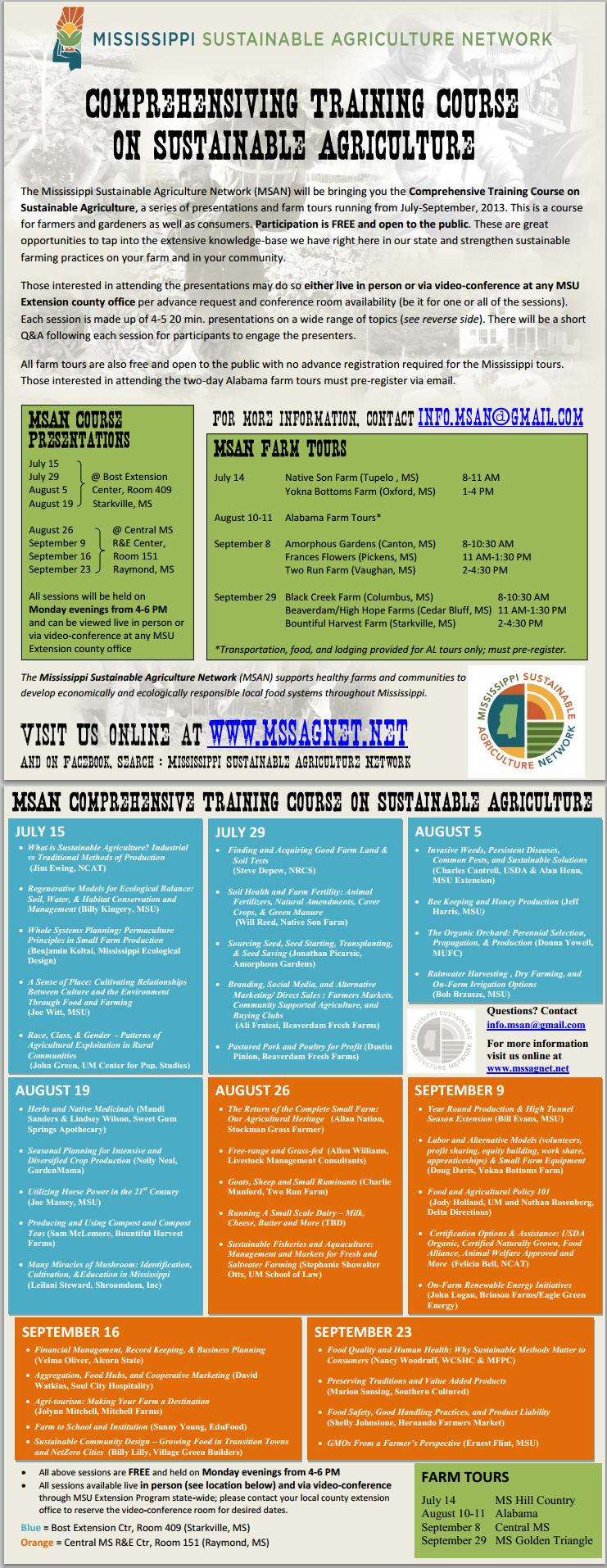
Sustainable Ag Trainings in the Deep South

Mississippi Sustainable Agriculture Network's trainings-2013

Mississippi Sustainable Agriculture Network’s trainings-2013

Louisiana – New Cottage Food Law (August 2013)

Sales are limited to $20,000 per year

Cottage food operations don’t need to get a license from their health department, but they do need to check with their county to see if any zoning requirements apply to them.

Operations do not need to collect any state sales tax, but they may need to collect local sales taxes (it is different for each city and county).

Only food items in these categories are allowed:

Cakes, Cookies, Honey, Jams & jellies -Preserves.

Unlike most states, Louisiana allows custard and cream-filled bakery products.

Louisiana – Cottage Food Law.

Vermont Law School Helps Farmers Markets and CSAs

Good overview of the new Center for Agriculture and Food Systems at Vermont Law School that Laurie Ristino is heading. I am honored to be part of one of their first grants to help markets, written in partnership with NOFA-VT. If the proposal is successful, legal resources will be written for markets and for CSAs over the next few years.

VT Law

Regulating the life out of community food systems

A link to an excellent opinion piece by Stacy Miller, project director at Farmers Market Coalition where the deep crisis of regulatory burden on small family farms is addressed. No question that the lack of clarity among cities, states and the federal government to write and administer common-sense regulation is one of the most important areas that all food system organizers and practioners need to work together to solve.

HuffPost piece

“Anti-Food Truck Meddling Ends Up Ruining Miami Farmer’s Market”

I know many markets are using food trucks as a way to get more traffic to markets, especially weekday and evening markets. Based on this and other articles that I run across, it sounds like food trucks should be specifically written into market rules to head off this sort of unwelcome publicity.
In New Orleans, we added a “Green Plate Special” many years ago so a restaurant could come and sell for a month of Tuesdays at one of our tents (it was a 10 am-2 pm market then, now it’s 9-1), as long as they had entrees under 10 bucks, sourced from the vendors when possible and followed the specific risk and vendor rules for serving prepared food.

This added amenity was to help us to draw office lunch traffic and it has done that and much more over the years, although I have to admit it killed off a lot of the prepared food items that the other vendors were selling, but maybe that was a blessing in disguise after all. It made those vendors concentrate on their fruits and veg staples and to stop trying to corner the sandwich business at the market.
And even though it was a difficult start (can I tell you the number of restaurants and chefs that I haunted in those early years?) 99% of those that participated over the years that I ran the markets asked to be able to return.

We wrote guidelines for that spot and asked them to pay double what our regular vendors paid which was still a bargain for what they received: shoppers already amassing needing food and meals, in a market with seating and local producers willing to sell items for the menu. So I recommend that markets think about how to include caterers, restaurants and food trucks into their market, but to do it without upsetting the balance of the market too much.
By the way, this article seems to suggest that this is not a “true” farmers market as most of us across the U.S.  define that term, but is more of a food and artisan market. I know Florida has many of those and they seem to be an appropriate market type and serve their shoppers and vendors well in many case but maybe we need a type to describe the market that offers prepared food as its main offering. As I often say to markets when they ask me if a rule is “okay,” it’s only important that the market can defend and explain their rules to their community. If they can, if people around there understand and most agree, then I say full steam ahead.
Okay, one story about the Green Plate. When we developed the idea, we would talk about how we wanted restaurants like Commander’s Palace to do this (often rated as the #1 fine dining restaurant in New Orleans) and although we asked them in the beginning, they quickly sent their regrets (as they are very polite folks). We were seen as a quirky little food event and hadn’t moved to “beloved institution” phase at that point…
After the levee breaks of Katrina 2005, this 100 year old+ restaurant had some damage, needed time to repair and to the great sadness of many New Orleanians, did not reopen that year. However, in 2006, they asked us if they could come to do the GPS, brought their A-team and spread the word that they would sell quarts of their famous turtle soup and a few beloved entrees. So that first day (right after we ring the bell to open the market) we hear a cheer from their tent and see the celebrated chef and owner holding a ten dollar bill over their heads while saying with great emotion, “Our first sale since Katrina!”
The next week, they brought their Maitre d’to manage the line that went out of the market.

So I’ll never forget how our little market helped this great establishment and how our original dream came true all at once. All because we always thought: “what if…”

Anti-Food Truck Meddling Ends Up Ruining Miami Farmer’s Market – Hit & Run : Reason.com.
Dirty white gold -Monsanto’s Suicide Economy

Editorial: County should not over-regulate farmers markets

This is from St.Louis which has received new proposed regulations for farmers markets from the state that to the editorial writer sound like “special event rules warmed over.” Very well put.
The need to push back on over regulating market farmers does need to go in hand in hand with a well managed risk mitigation strategy on the markets behalf. In other words, we should run ahead with good, appropriate rules rather than boo from the back.

Editorial: County should not over-regulate farmers markets.

No “Fundamental Right to Produce and Consume Foods”

In case you forget, food system organizers live and work in a parallel universe of food sovereignty . That other world is held in trust for the corporations who get to feed off our innovations and human-scaled ideas.

New Amer

City easing restrictions on farmers markets – LA Daily News

City easing restrictions on farmers markets – LA Daily News.

Santa Rosa dispute

Wow. This article gives some information on a dispute between vendors and management at a California market that has, sadly, gone to court. The article (which certainly needs more information from both sides) and the ensuing comments show that this issue has been coming for a while in this community.
Long ago, when I was learning non-profit management, I proudly related to my supervisor at the end of the day just how I had stopped an argument between 2 senior staff while the entire staff was driving to a site. I expected congratulations, but instead my excellent boss said to me: “Well, I’m glad you stopped it, but I would expect you to have seen the argument escalating long BEFORE that point and steered the conversation and tone to other directions before it got to inflammatory words that now everyone remembers throughout their day. So, next time plan ahead and try to orchestrate good interactions from the beginning. It’s your job to give everyone the best chance to succeed at their job and that also means reducing tensions that are unnecessary.”

Good advice still.

Santa Rosa Market dispute

rules on street vending

Using law students to create a framework of smart guidelines is the right thing to do in this case. If we want to encourage small businesses to flourish once again in the US, then we need to allow tiers for different types of businesses. I know most markets are not skirting laws, but wouldn’t it be smart to connect with law students in every region to assist markets too?

Street vendors get lawyers

Seven days, seven ways to celebrate farmers markets during National Farmers Market Week

Our national voice for farmers markets, Farmers Market Coalition(FMC) has launched their great Seven Days, Seven Ways campaign to celebrate the many ways markets benefit the farmers, shoppers and community. Take a few minutes to see the list of economic, social and human measurements FMC has used in their report (culled from markets own reports) and make a mental note to visit the innovative markets that FMC honored this year.

FMC story