

Over the weekend, I cracked open the eagerly awaited/just published “Kuni: A Japanese Vision and Practice for Urban-Rural Connection” authored by Tsuyoshi Sekihara and Richard McCarthy.
Sekihara is the founder and leader of the Japanese RMO (Regional Management Organization) Kamiechigo Yamagata Fan Club. This entity is tasked with creating kuni (community) in an estimated 25 villages in rural Japan, making its home in Nakanomota.
McCarthy is the founder of the regional organization Market Umbrella in New Orleans LA, and (while he and I worked there) had set its region as “Gator Alley” or “Gumbo Nation” along the Gulf Coast. In true U.S. fashion, neither description of our region was precise (or as Richard rightly describes it, “light and loose” versus Sekihara’s “grounded” region) but they came pretty close:

Mirror Images of Each Other
In its opening pages, McCarthy describes the opportune meeting with Sekihara that came via outside funders and leaders bringing he and others to Japan, and where the two recognized their common vision which can now be shared via this framework.
Yet kuni is not just another term for local or revitalization but is meant to create something that new.
Be compact but contain all of the elements needed for human life
Have the right scale
Balance between bridging and bonding activities
Choose pluralism over tribalism
Be close to nature
or as beautifully said in there: “To trade on assets adored by outsiders but curated by locals.”
Sekihara’s RMO is tasked with creating kuni’s preconditions and is partially funded by overseeing government projects as well as creating products that can be exported (although the raw materials must originate from within the RMO.) There are other RMOs in Japan, but none with the depth of the KYFC. (It may also be helpful to share that “fan clubs” are common in Japanese society for all types of organizations including corporations, many with their own mascots.)
By having McCarthy as the co-author, the application of Sekihara’s ideas can be shared through the hundreds of communities that McCarthy has worked or visited via his work with Market Umbrella, Slow Food US, Slow Food International, as president of the new World Farmers Market Coalition, or his own current global Think Like Pirates firm.
You’ll find the steps that Sekihara took to his own “J-Turn” to KYFC with descriptions of the conditions he found as well as the challenges, including the shocking level of disrepair, the challenge that he calls “the Beast,” and the many gatekeepers/dictators he encountered and their power hoarding — all of which any organizer should be able to recognize in their own communities and possibly even within their own organization.
The book is rich with lists of lessons and examples for any organizer including the brilliant Rice Covenant (which is more complex than you’d think), place polygamy, the concepts of equilibrium, circularity, and spirals, the 2 Loops theory, Richard’s pirate ship framework, examples of kuni-style organizing from around the world, and (a personal favorite of mine), explanations from both leaders as to why holding onto single proxies such as “local” or relying on national or global certifications can be entirely too limiting.
It is available everywhere with a U.S. tour by McCarthy imminent (email him through his site which is linked above) if you think you can create an event with him) to invite these visionary ideas into your work.
I am always scouring for new books that may help our markets to advance their system change work. One major lesson I work to keep in my front mind is how best to assist market operators in prioritizing working as networks rather than “silos.”
I have written on this subject, some of which can be found by searching in this blog under “networks”; for now, this is a good example : https://darlenewolnik.com/2021/12/20/local-resiliency-shouldnt-be-the-goal/
In many of those posts, I consider the effect of climate chaos and civil unrest on the still-fragile, but always-energetic pop up farmers market sector, and suggest that the success rate of reducing organizer and producer burnout and increasing engagement is almost entirely dependent on thinking regionally, or as you will hear later, territorially.
The idea of regionalism may seem already knit into the community food movement, but I see plenty of examples of food leaders misinterpreting true regionalism. One example is how few urban farmers market managers and volunteers visit their rural and exurban vendor farms regularly. Or, how few community food leaders speak up for regional planning issues which directly impact their farmers and other producers. And I talk to plenty of rural farmers market operators who bypass the replicable operational lessons that their urban sistren and brethren market operators have to share, or mistakenly feel they don’t need to focus on justice work.
And long before 2022, all organizers were struggling with the rapidly unfolding and difficult work of assessing and mitigating disruptions, either because they thought only hyper-locally or, didn’t define their region as expansively as it needs. For example, in 2005 when the federal levees broke after Hurricane Katrina ravaged LA and MS, my organization Market Umbrella struggled to find enough partners to rebuild our region – but not because we had not thought regionally previously, but because the region we HAD developed was entirely in the same situation. In other words, we had established a bioregion for our farmers markets (even going as far as defining our allowable vendor range as anywhere in the “American Alligator region” which spanned multiple states as the climate and agricultural products were shared with New Orleans) but in terms of truly creating organizational and community resilience, we would have benefited from deeper relationships north and west – and not just south and east – and in other sectors such as housing and transportation. (We also struggled because few other entities were able to work regionally which is part of what disaster exacerbates and why you have to have that approach before the bad day comes.) So I now know only so well that political, cultural, and even historic trade regions are as vital for food organizers to know for their own work. And while ensuring that racial justice is front and center in our work, simply ignoring those outside of our “blue” or “red” area will not serve our shared goals very well.
In terms of offering a global framework, the FAO report titled “Mapping of territorial markets; methodology and guidelines for participatory data collection” was recently recommended to me. The report essentially defines what the US calls “local” or “producer-only” markets (of course, neither of which are entirely precise) as territorial markets. From the report:
The Committee on World Food Security (CFS) defined these ‘embedded markets’ as ‘territorial markets’ (CFS, 2016a), characterized by the following criteria:
◗ They are directly linked to local, national and/or regional food systems (the vast majority of products, producers, retailers and consumers are from the given territory).
◗ They are more characterized than other markets by horizontal (i.e. non-hierarchical) relations among the various stakeholders.
◗ They are inclusive and diverse in terms of stakeholders and products.
◗ They have multiple economic, social, cultural and ecological functions within their respective territory, and are thus not limited to food supply.
◗They are the most remunerative for smallholder farmers (as compared to other kinds of market), as they offer the farmers greater bargaining power over prices.
◗ They contribute to structuring the territorial economy, creating wealth and redistributing it within the territory.
◗ They can be formal, informal or a hybrid of the two.
◗ They can be located at different levels within territories (local, national and cross-border).
What is especially instructive to me about this description is the work we have in front of us in the U.S. to ensure our farmer markets measure up to this and to other categorizations and our policy partners understand it too.
All of this chat about networks leads to a recommendation for a model encapsulated in a new book due out in October:
Kuni: A Japanese Vision and Practice for Urban-Rural Reconnection
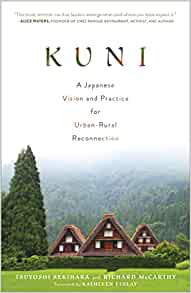
In the book, Tsuyoshi Sekihara and Richard McCarthy take turns with descriptions and illustrations of what reimagining of the rural-urban relationship might look like and what results it could offer. Sekihara is the founder of the Kamiechigo Yamazato Fan Club, a community development organization focused on the holistic revival of Japan’s rural areas, while Richard was the founder and the longtime director of the U.S. based regional farmers market organization, Market Umbrella that I mentioned above.
“Kuni” is both a reimagining of the Japanese word for nation and an approach to reviving communities. It shows what happens when dedicated people band together and invest their hearts, minds, and souls back into a community, modeling a new way of living that actually works. A kuni can be created anywhere–even a hamlet on the verge of extinction–and embodies 7 key principles:
I’ll add a bit of Wendell Berry here with how he suggested communities should also think through the appropriate scale for human centered regionalism:
“We must not outdistance local knowledge and affection, or the capacities of local persons to pay attention to details, to the “minute particulars” only by which, William Blake thought, we can do good to one another.”
Much of what Kuni (and Berry) are lifting up, we are seeing in some extraordinary US farmers markets and food work, most often led by Black, persons of color, and indigenous leaders. No surprise to me that what white-led and designed organizations are trying to figure out in the current work to become active anti-racist allies, our sisters and brothers knew already.
Chiefly among that is to eschew linear, hierarchal, purely capitalistic roles and structures for those that value the entire human, have a democratic center, and prioritize balance and inclusion. Once a community embraces that, the sky is the limit in terms of impact and organizational health. That will be the reward for listening to leaders who came to this work with system change as their goal and to those who are leading us with care and intention: that the food community thrives by establishing regional connections, valuing human-centered innovation and the realization of our shared future.
PreOrder Kuni: https://www.indiebound.org/book/9781623177317
At the end of this second year of the COVID era, I’ve been thinking a great deal about the thousands of market leaders, tens of thousands of producers, and the hundreds of thousands of our neighbors who have continued to prioritize regional food in their lives even during this horrific pandemic.
I think we had hoped that we had passed the biggest test of the COVID crisis, but it is possible that we may have a bigger one: to find the fortitude to safely withstand the succession of its outbreaks over the next few months and possibly even years while still attempting to grow the number and diversity of those able to purchase healthy food for their families. And to do that even as other shocks (climate chaos, the pitched battle over white supremacy, crumbling infrastructure) hit our communities at the same time.
People often call this being resilient.
Resilience is the ability to adapt to difficult situations. That seems straightforward, but many communities have pointed out that very adaptation can become the only action or the status quo, allowing government to rely on that resiliency rather than attempting to solve the underlying issues. Depending on the crisis or series of crises, it can be depleted and once gone, can mean catastrophe for a community by allowing outside actors to become the only arbiters of what happens during recovery.
-from the site Edge Effects:
Resiliency-based planning, however, has been opposed by grassroots organizations and activists. In 2015 in response to the City of New Orleans’s resilience strategy, posters started appearing throughout New Orleans quoting Tracie Washington of the Louisiana Justice Institute. “Stop calling me resilient,” the posters read, “Because every time you say, ‘Oh, they’re resilient,’ that means you can do something else to me. I am not resilient.” As (it) makes clear, instead of simply addressing the cause of environmental degradation such as land loss, Louisiana has apparently accepted the inevitability of this degradation–and is learning how to cope.
We should acknowledge and credit resiliency but insist on creating more participatory and dynamic solutions, focusing funding and efforts to those that are contextual to that place and its scope.
In terms of being contextual to that place, writer Jane Jacobs suggested that one of municipalities’ main activities be (I’m paraphrasing her here) actively replacing imported goods and ideas with regional goods and home-grown creativity whenever possible. To do what Jacobs suggested requires participatory structures and illustrative pilots for government to draw from. That ability to test multiple solutions at the community level would be one strategy that food system leaders can use in outlining as to why our work is so important to municipalities’ plans.
And whenever we talk about scale in food systems, the discussion often settles into a set of camps including (a) those who think the goal is to scale up food production to meet industrial food’s demands and (b) those who firmly believe that food is itself an antidote to scaling up, and (c/d) those who want to keep industrial food functioning and participating in local food production even as they work on alternatives and so on. The development of multiple systems may be best explained in the 2 Loops Theory of the Berkana Institute which I have written about previously that describes those roles to be played.
Also, whenever scale comes up, I think of this from Wendell Berry:
It is a formidable paradox that in order to achieve the sort of limitlessness we have begun to call sustainability, whether in human life or the other life of the ecosphere, strict limits must be observed. Enduring structures of household and family life, or the life of the community or the life of the country, cannot be formed except within limits. We must not outdistance local knowledge and affection, or the capacities of local persons to pay attention to details, to the “minute particulars” only by which, William Blake thought, we can do good to one another.
Within limits, we can think of rightness of scale. When the scale is right, we can imagine completeness of form.”
In other words, scale itself needn’t be the enemy; rightness of scale allows us to still pay attention to details, to measure how we do good to one another.
How do we find that rightness of scale?
Writer Ihnji Jon outlined a scale of political action that can serve either ever-expanding (globalized) or ever-narrowing (localized) as long as they are:
1) “subject to territorial conditions”,
2)”posses a degree of intensity that allows it to be influential across different systems”,
3) “are large enough to retain complexity that allows them to have interaction effects”
So as we think about farmers markets and community food systems, the right scale would keep the food system leaders able to pressure government to deal with the underlying issues, would encourage funding for localized active, inclusive democratic networks, would support communities to rebuild as slowly or quickly as they need and use local leadership in doing so, and most importantly would democratize all of the resources needed to create the new adapted normal. That would mean resiliency would be properly supported by functioning systems and would measure its spread as an opportunity to make real changes in that place, rather than celebrating it as a solution.
That could mean radically changing the emergency food system to reduce the bureaucracy of getting support when needed and increasing actual mutual aid, it could mean working to become the true center of inclusive civic spaces, it could mean engaging with the educational system to link regional food to childhood health, it could mean that regional climate initiatives become focused on food production and in championing the stewardship of local people…
All of that is possible, even if it is not yet probable. I hope to begin to outline examples of systemic thinking and scaled planning among farmers markets and their regional food system efforts on this site in 2022. Please share those you know about in the comments.
and lastly, I hope each of you takes some time the rest of this year to replenish your own reserves. Please do consider how you can engage with your community in ways that reduce the need for the reservoir of your resiliency to be emptied in each crisis and that increase your joy in the lovely way each of you does good to others in farmers market spaces.
As usual, I’d like to offer my thoughts as to what may be in store for farmers market organizers and producers in the coming year (as I did in past years: 2018, 2017…)
With the end of year passage of the Farm Bill (coming as a welcome surprise after watching the summer-long legislative shenanigans in the House), the organizing for direct marketing for 2019 is now slightly altered -as soon as the government opens up again that is! The inclusion of LAMP in the farm bill offers markets some stability for grant funding over the next 5 years and also means a better-to-great chance of FMLFPP funding being included in future farm bills. Two other changes may be significant for farmers markets: the requirement of a 25% match for FMPP proposals (it had only been required for LFPP proposals previously), and the language to “support partnerships to plan or develop regional food systems” which is funded at 5 million per year. The FMPP match requirement seems to indicate that the grants will be prioritized for those who build deep partnerships into their proposals, and seems to be born out by the added 5 million for partnership work. Getting this funding could put market organizations in leadership roles in regional policy work, especially in terms of vendor needs (more in a minute on this), disaster response planning, and climate change initiatives with municipalities- that is if the grant language (when written by AMS) directs this funding to individual markets. If it turns out that the funding is really directed more to your state and network associations, I would expect them to use it to build capacity for their markets, especially in the area of increased data collection capabilities and dynamic data-driven analysis. That would align with my 2017 mantras for markets:
Don’t Hide the Hard Work
Function like a Network Whenever Possible
Two other areas that I expect to be active among markets in the coming year and beyond is in verification of local claims and in product development initiatives. The first has been climbing the ladder of priorities since the explosion of meal kit box programs, grocery store fragmentation, and the use of “local” in marketing language by every kind of player in intermediate channels (i.e. specialty stores, restaurants.) Farmers Market Coalition has even begun to discuss this regularly in house and included this topic in the farmers market track of 2018’s inaugural Direct Marketing Ag Summit. It was ably covered in a presentation by Washington State Farmers Market Association’s Colleen Donovan whose work on market integrity is well known, and by Boulder County Farmers Market CEO Brian Coppom who is fast becoming a great national spokesperson for farmers markets on the subject. FMC also added to the conversation around brand integrity in 2018 by taking over the management of the Buy Fresh Buy Local brand.
There is much to do on local verification and protection of the brand, but my sense is the best way for markets and other local food authorities like BFBL leaders to own it is (1) going through a process to find out the community definition of local/regional that works best there, and (2) transparent verification systems that explain/illustrate geographic proximity and proper stewardship of land and water. Once those are accomplished, state legislative language protecting it may be helpful.
The product development work is a little less visible, but is happening among some innovators. I’ve had recent conversations about this work with Grow NYC and a few others and expect to hear more, especially with the increased use of Metrics by markets to collect data. That data collection has been a game changer for market organizations as the necessity of collecting data from their vendors has sometimes turned out to be a point of contention. That tension is usually because those markets have never systematically collected market day data or used longitudinal data as the basis for market day decisions, relying entirely on management levels or outside funding priorities to decide when to add vendors or market days or even when doing event planning!
In the past few years of pilots with markets, the Metrics team (which includes me of course!) has advocated that the best way to make the need for collection understandable to ones vendors is to openly and simply share market level data which can then be compared privately with their own business and product- level data, allowing for more complete business intelligence for those entrepreneurs. Building this type of partnership with vendors also levels the field, as data becomes the lingua franca of market day decision-making rather than those decisions being (or seeming to be) made willy-nilly or behind closed doors without vendors input. The more market leaders think about, research, and support development and marketing of biodiverse items at their markets, the more they will understand their vendors businesses and consumer preferences and will be able to build partnerships and find funding to add products that data shows will do well at that market. All of that will quell much of the pushback on data collection-over time.
Throughout this post, the one word I have used again and again is the one that I hope sticks with markets: partnerships. These need to be more foundational (meaning include those partners in how the market itself is managed not just about the shared program), more dynamic (check in regularly to see if they are working and why), and be more diverse (hopefully self-explanatory). These partnerships, if designed well, will absolutely reduce the wear and tear on market staff and minimize turnover and burnout.
If every market reading this post set a goal to add two more (*non-traditional) partners to their program development planning, and started to consider their vendors as partners, I think 2019 would be a banner year in farmers market development.
*non-traditional: meaning partnerships beyond those who have shared outcomes in terms of direct marketing agriculture or increasing use of federal benefit programs for healthy food (although the latter were non-traditional partners not so long ago). This could include immigration services agencies who could help with vendor and shopper development, agencies working on public transportation amenities who could help with adding walking, biking, bus-riding people to markets, social justice organizations working on civic engagement, real-estate professionals who are in contact with new residents and could direct them to their local market, and so on.
The earlier proposals also recommended leaving food with multiple ingredients like frozen pizza or canned soup off the staple list. The outcome is a win for the makers of such products, like General Mills Inc. and Campbell Soup Co., which feared they would lose shelf space as retailers added new items to meet the requirements.
But retailers still criticized the new guidelines as too restrictive. Stores must now stock seven varieties of staples in each food category: meat, bread, dairy, and fruits and vegetables….
…More changes to the food-stamp program may lie ahead. The new rules were published a day after the House Committee on Agriculture released a report* calling for major changes to the program, which Republicans on the committee say discourages recipients from finding better-paid work.
Source: Regulators Tweak SNAP Rules for Grocers – WSJ
*Some of the findings from the 2016 Committee on Agriculture Report “Past, Present, and Future of SNAP” are below.
According to research by the AARP Foundation—a charitable affiliate of AARP—over 17 percent of adults over the age of 40 are food-insecure. Among age cohorts over age 50, food insecurity was worse for the 50-59 age group, with over 10 percent experiencing either low or very low food security. Among the 60-69 age cohort, over 9 percent experienced similar levels of food insecurity, and over 6 percent among the 70+ population.
• The operation of the program is at the discretion of each state. For instance, in California, SNAP is a county-run program. In Texas, SNAP is administered by the state… Dr. Angela Rachidi of the American Enterprise Institute cited a specific example in New York City where SNAP, WIC, school food programs, and child and adult care programs are all administered by different agencies and the result is that each agency must determine eligibility and administer benefits separately.
K. Michael Conaway, Chairman of the House Committee on Agriculture. Hearing of the House of Representatives, Committee on Agriculture. Past, Present, and Future of SNAP. February 25, 2015. Washington, D.C. Find report here
From CNN this week:
The number of people seeking emergency food assistance increased by an average of 2% in 2016, the United States Conference of Mayors said in its annual report Wednesday.
The majority, or 63%, of those seeking assistance were families, down from 67% a year ago, the survey found. However, the proportion of people who were employed and in need of food assistance rose sharply — increasing to 51% from 42%.
I read Next City faithfully, because like many food system activists, I am also a student of any kind of civic engagement strategy, including urban design. So I was pleased to see this short piece about how urbanists should pay attention to the lessons of food organizing. As those who regularly read my blog know, I am always searching for lessons and templates in other sectors that we can apply to our work and that the thoughtful and inclusive work that we do is noted by other sectors in return is appreciated.
Of course, I’d prefer to not be called foodies which sounds a lot like the term “women’s libbers” that second-wave feminists were tagged with back in the 1970s. These terms can isolate the work being done by suggesting that it is restricted to a small group of people who have adopted a lifestyle, rather than according the respect due by being broad social movements.
Still, I like the piece very much and would recommend that markets link to it on their FB pages and to share with their municipal partners.
I marvel at the success of the food movement partly because it required so many changes in different parts of the food system. Farmers have had to grow their crops differently; stores and distributors have had to start offering different food for sale; new recipes had to be discovered or invented; and ultimately millions of individuals have changed the way they eat.
I also think it’s interesting that many of the key actors and institutions were entrepreneurs and small businesses. It wasn’t just activists, it was the people writing cookbooks, it was restaurants and grocery stores, farmers and manufacturers all contributing to a lasting transformation.
The sustainable food movement has changed how we eat. Will the urbanist movement change how we live?
As some may know, I am originally from Cleveland, Ohio and follow the food systems and community organizing work there with great interest. I grew up in one of the inner ring west side suburbs, often visiting the West Side Market and various small butchers and bakeries but the only “farms” I saw were the historical sites around Akron or when spotting an Amish farmer as we headed south on vacation at 65 mph. Farming was clearly the past for most modern Buckeyes, and we thought huge factories and transportation hubs were our only possible future. Or so it seemed for most of my early life since, like many Cleveland children, any trip through the Flats would include open car windows allowing in the soot and smoke of the factories and a proclamation: “smell that, kids? That smell is JOBS.”
However, the decline of manufacturing along Lake Erie in my lifetime has sent its great cities in search of other answers, and I am very proud of Cleveland’s new dedication to sustainable infrastructure and value-based employment for its citizens. A powerful example is the city’s Sustainability 2019 plan that was born from one of our most shameful moments-the fire on the Cuyahoga River in 1969, caused by the chemicals and pollution we allowed to be dumped into it.
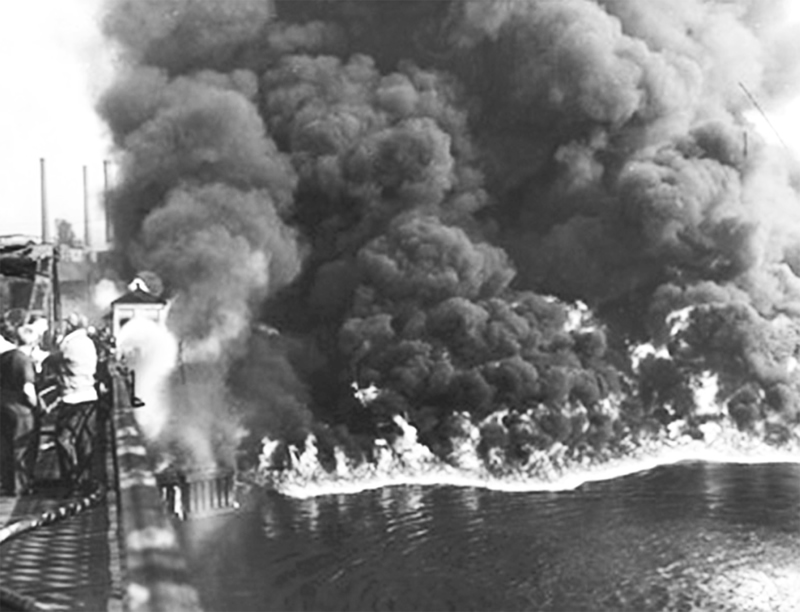
1969-Cuyahoga River on fire, Cleveland Ohio
Since the global media descends on Cleveland every decade or so to revisit that fire, it is likely they will come at the half century anniversary with renewed gusto. In preparation, the Sustainability 2019 initiative was born to reply with evidence of Cleveland as “one of the greenest cities in North America” as the city’s Director of Sustainability put it at one of their conferences. Because of that focus, I believe that Cleveland is moving faster to a hybrid model of creating post-industrial sectors that can thrive with the vestiges of whatever manufacturing that it claims (wind power anyone?).
I found this out on one of my trips home when noticing that the food system there had a slightly different hue than many others that I regularly visit. Often, when I dig to find the beginnings of citywide or regional food work, I find that it stems primarily from the cultural sector as seen in my other home town of New Orleans, or from a deep need for a new entrepreneurial answer, a la Detroit, or from a public health crisis of lack of healthy food access as in the Bed-Stuy area of NYC, or all of those needs at once, such as many First Nations and too many others. It seemed to me that Cleveland’s food work came from the deep awareness of the destruction heaped upon it from that industrial framework that had now mostly fled to warmer and less regulated places. That strong environmental underpinning was also present because of the first-rate organizing done by many 1960s-present activists including the Ohio Public Interest Campaign, where I was trained as a community organizer and worked for almost a decade.
Maybe because of that industrial vacuum, the need for jobs there seems tempered by the caution for real answers that allow workers stability and skills and not just a paycheck handed to them by a new corporate overlord. The cooperative movement afoot there seems to rise from this and from the professionally run, long-standing community development organizations embedded deep in the neighborhoods, east and west. And of course, credit must also be given to other areas in the region that started cooperative development such as Athens Ohio.
So, because of the hard work done by generations before, the development of the food work seems relatively balanced and quite ambitious. It seems to still lack regional cohesion but it is not ignoring that need either. I found a deeper awareness of the inequities and the need to work with existing both the corporate and informal sectors than in many other places that I visit and work. There is much to do there and mistakes will be made on the road to this new face for my old city, as I mentioned in a piece for Belt Magazine. Still, I am proud of the work being done there and hope you find time to read their new Roadmap and to visit too.
The City of Cleveland Mayor’s Office of Sustainability, Ohio State University Extension, Cuyahoga County,and the Cleveland-Cuyahoga County Food Policy Coalition have developed a sustainable food cluster roadmap in Cuyahoga County, with a core objective to increase regional jobs, revenue and sustainability by supporting local food and beverage businesses.
Here is a link to an excerpt on the politics of credit card systems. It illuminates how startups companies wanting to provide services face difficulties, including this:
Two pieces in the chain are particularly vulnerable to disruption: the makers of the actual hardware — basically card readers and registers — that are used to physically accept card payments at stores, and the hundreds of vendors known as merchant service providers, or MSPs, which set businesses up to accept credit cards.
The entire article (unfortunately you must pay to get it) speaks to some of the issues we are facing with MobileMarket et al in expanding technology to lower capacity markets and farmers. It also shows the need for the food movement to embed knowledge on card and currency issues so that we stay ahead or at least on the curve of changes, rather than being pawns of the very small set of multi-national players in technology and card processing. If, like me, you accessed the entire article (or others like it) and want to have a conversation, I’m interested in talking about these issues in more depth. Feel free to contact me…
Credit Card Payments Market Competition 2 – Business Insider.
an excerpt from another article on the subject raises many of the same questions:
“…with the global roll-out of mobile payment services comes uncertainty for both banks and consumers, and this is evident in the lack of standardization in mobile payments technology. Financial institutions are facing a major dilemma. When planning mobile payment services, they need to select one of the available technologies in the hope that it will become the dominant standard, or they risk being left behind.”
As we move into another year of organizing around regional food and public health in the US, we are facing opposition that has become stronger and more agile at pointing out our weaknesses and adding barriers to those that we already have to erase. That opposition can be found in our towns, at the state legislature, in Congress and even among our fellow citizens who haven’t seen the benefits of healthy local food for themselves yet.
That opposition uses arguments of affordability without measuring that fairly against seasonality or production costs, adds up the energy to get food to local markets while ignoring the huge benefits of farming small plots sustainably, shrugs its shoulders at stories of small victories, pointing past them to large stores taking up space next to off ramps and asks isn’t bigger better for everyone?
Why the opposition to local producers offering their goods to their neighbors, their schools and stores? What would happen to the society as a whole if our projects were allowed to exist and to flourish alongside of the larger industrial system?
I would suggest that very little would change, at least at first. Later on-if we continue to grow our work-it may be another matter and this fear of later is at the core of the opposition. That fear has to do with the day that democratic systems become the norm and necessary information is in the hands of eaters, farmers and organizers. And so we need to address and keep on addressing the divide that keeps that from happening.
The truth that we all know is that there is already two systems-one for the top percent and another for the rest. Writer George Packer gave his framework for this very argument in an eloquent essay written in 2011 called “The Broken Contract.” Packer argues that the divide in America began to take hold in 1978 with the passage of new laws that allowed organized money to influence elected officials in ways not seen before.
Packer points out that the access to Congress meant that labor and owners were not sitting down and working together any longer. That large corporations stopped caring about being good citizens and of supporting the social institutions and turned their entire attention to buying access in Congress and growing their profits and systems beyond any normal levels.
“The surface of life has greatly improved, at least for educated, reasonably comfortable people—say, the top 20 percent, socioeconomically. Yet the deeper structures, the institutions that underpin a healthy democratic society, have fallen into a state of decadence. We have all the information in the universe at our fingertips, while our most basic problems go unsolved year after year: climate change, income inequality, wage stagnation, national debt, immigration, falling educational achievement, deteriorating infrastructure, declining news standards. All around, we see dazzling technological change, but no progress…
…We can upgrade our iPhones, but we can’t fix our roads and bridges. We invented broadband, but we can’t extend it to 35 percent of the public. We can get 300 television channels on the iPad, but in the past decade 20 newspapers closed down all their foreign bureaus. We have touch-screen voting machines, but last year just 40 percent of registered voters turned out, and our political system is more polarized, more choked with its own bile, than at any time since the Civil War.
…when did this start to happen? Any time frame has an element of arbitrariness, and also contains the beginning of a theory. Mine goes back to that shabby, forgettable year of 1978. It is surprising to say that in or around 1978, American life changed—and changed dramatically. It was, like this moment, a time of widespread pessimism—high inflation, high unemployment, high gas prices. And the country reacted to its sense of decline by moving away from the social arrangement that had been in place since the 1930s and 1940s.
What was that arrangement? It is sometimes called “the mixed economy”; the term I prefer is “middle-class democracy.” It was an unwritten social contract among labor, business, and government— between the elites and the masses. It guaranteed that the benefits of the economic growth following World War II were distributed more widely, and with more shared prosperity, than at any time in human history……The persistence of this trend toward greater inequality over the past 30 years suggests a kind of feedback loop that cannot be broken by the usual political means. The more wealth accumulates in a few hands at the top, the more influence and favor the well-connected rich acquire, which makes it easier for them and their political allies to cast off restraint without paying a social price. That, in turn, frees them up to amass more money, until cause and effect become impossible to distinguish. Nothing seems to slow this process down—not wars, not technology, not a recession, not a historic election.
The economic divide and the lack of information about it hurts our movement since many still see us as either too small or too elitist and so delays our work getting to more people that need it. I urge everyone to find a copy of this entire essay and share it and discuss it widely.
The title of this piece was included in an end of year TomDispatch commentary, written by one of my favorite writers, Rebecca Solnit:
…Many seeds stay dormant far longer than that before some disturbance makes them germinate. Some trees bear fruit long after the people who have planted them have died, and one Massachusetts pear tree, planted by a Puritan in 1630, is still bearing fruit far sweeter than most of what those fundamentalists brought to this continent. Sometimes cause and effect are centuries apart; sometimes Martin Luther King’s arc of the moral universe that bends toward justice is so long few see its curve; sometimes hope lies not in looking forward but backward to study the line of that arc.
and near the end of her piece, this:
I don’t know what’s coming. I do know that, whatever it is, some of it will be terrible, but some of it will be miraculous, that term we reserve for the utterly unanticipated, the seeds we didn’t know the soil held….
I am going to adopt this as my new mantra (my friends and colleagues should get ready to hear it often) for the work that we are all doing in food, in recalibrating what health and wealth means in our communities and in demanding a civic (public) life that breeds empathy and justice.
Writer/activist/teacher Michael Harrington who used the metaphor of being a “long-distance runner” for community organizing and movement work would also say this in lectures:
“…you must recognize that the social vision to which you are committing yourself will never be fulfilled in your lifetime.”
Some of Harrington’s writing and the majority of Solnit’s is about how successful movements-when pulled apart and examined-are made up from a series of direct action moments and negotiations finally coming to fruition around a shared narrative of big or even scary ideas that will lead to societal transformation.
Yet Solnit’s content is most often written about the individual or about small groups using meandering/karmic ways to create this change, outside of the broken or simply too large formal structures that stopped responding to individual plights a long time ago. And that when it happens the right way, collectively and with heart-thumping goals attached (let’s say during the American Revolution or with the 18th and 19th century abolitionists or with the woman’s suffrage movement) it starts slowly with small groups of citizens and spreads to those governing us, not the other way around. And that it takes a while.
All of that is all very nice I hear some of you say. But what does this matter to my never-ending project list and non-stop funding crunch?
What I ask is while you take the time to read this, do examine your own way of working and ask yourself now (and later on too) if you are also caring for the seeds yet unseen. If you have the maturity to manage your or your organization’s relationships in your work like a long-distance runner does with his/her energy and time.
I don’t expect you to remember this post every time that you sit at your desk or head out to the community to work on food and justice. Just remember the title of this piece and remember my teacher Michael Harrington, pacing himself as best he could. He died long before he saw what he defined as success but I believe that he was genuinely glad the work outlived him. Not the injustice certainly but the connections and the ideas.
How could any of us expect to get it all done in our lifetime? My god, I hope many of the seeds and saplings that I have planted bear fruit 300 years after my passing, just like that long ago pear planter.
However you find your pace, I hope we can all find the energy and patience to stay on for the long seasons ahead, some with cloudy dusks with fallow ground and others with sunny days full of trees bearing fruit as far as the eye can see. If not, if you only want a win, to bring in a single crop, then throw it all in now by all means. We need those too. I suspect you will find more work to stick around, but if not, I will still salute your effort and your time. And I’ll come get you when the green shoots takes hold.
Solnit gets the last word:
A decade ago I began writing about hope, an orientation that has nothing to do with optimism. Optimism says that everything will be fine no matter what, just as pessimism says that it will be dismal no matter what. Hope is a sense of the grand mystery of it all, the knowledge that we don’t know how it will turn out, that anything is possible.
Complementary currencies fascinate me and recently, the crypto currency bitcoin especially. Its an example of a decentralized example designed to reduce inflation (although maybe not deflation) and the need to have a central authority. I agree with many that the bitcoin seems unlikely to be a replacement for fiat currency (government-decreed legal currency) and I also agree with the concern over the ultimate role of this currency that has a limit to how much can be “mined.” Still, important to remember that gold has very close to the same values and limits and has flourished as a protection against only using a national currency.
The reason why this should be so important to food system organizers-especially to direct marketing outlets-is that many of these outlets are operating what is essentially a debiting system with tokens, yet doing it without the robust and transparent nature of a currency system, or without a fair and openly discussed exchange rate that asks everyone possible to share the costs. In other words, we have built systems that allow people to begin to depend on the market to supply a debiting system so as not to have to stop and get cash before coming to market, or from vendors from having their own machine and costs, yet are not extending the reach of that system to find ways to pay and find support for it. What seems to be the goal for most involved is to dream of the day that we can hand these systems off to the farmers to run themselves. I would say that for many reasons this is unlikely in any near future as these systems will remain unwieldy to manage.
Those reasons for the delay or impossibility of the vendor hand off happening include (but are not limited to):
-the lack of easy-to-manage back office systems
-the wide variations of card fees and systems needed to swipe cards
-the costs for each vendor to purchase and maintain these systems. Add to that the very nature of pop up markets without access to good wifi or mobile phone signals, the low number of transactions per vendor and complication of a high number of customer transactions on any one day with many small businesses that will confuse and alert card processors.
To me, what comes first is solving these problems and extending this system’s reach to savings and loans pilots. What about allowing restaurants that source locally to accept the tokens during slow months? Or working with banks to help provide some accounting or backing? What about establishing micro loans to encourage more people to use this as a sticky currency working through a local food system? The Berkshares system in Great Barrington area is an uniquely designed currency that is experimenting with these ideas and more and has added hundreds of outlets at which their currency can be used; it is surely one that should be studied closely by our field, if nothing else.
There are examples of different token pilots at markets, such as MarketUmbrella’s Crescent Fund and Massachusetts’ pilot of electronic wallet (an example here of an electronic wallet) but these pilots are still so limited and information is not widely available. I would love to see some deep analysis of the impact of these systems and some prototyping of entire systems, especially with the emergence of these popular electronic currency such as bitcoins and vibrant complementary currencies such as the Berkshares.
A Central City grocery store that received a low-interest loan under a city-funded program to bring fresh foods to under-served neighborhoods has been closed and placed on the market.
Owner Doug Kariker said the store was too much work. “I can’t do it anymore,” he said. The store was not profitable, he said, “but in our business plan, we didn’t expect it to be” in the first year.
First recipient of Fresh Food Retail Initiative closes, puts store on market | The Lens.
Article 89 of the zoning code will create clarity and predictability for anyone interested in growing commercial food and creating farms in Boston. The development of Article 89 was made possible through the exploration of six research modules which were studied and discussed in depth throughout 2012 during monthly public Working Group meetings:
Soil safety, pesticides and fertilizers, and composting
Growing of produce and accessory structures
Rooftop and vertical agriculture
Hydroponics and aquaculture
Keeping of animals and bees
Farmers markets, winter markets, farm stands, and sales
The existing Boston zoning code does not address many types of agricultural activities. If an activity is not identified, it is considered a forbidden use and requires an appeal process through the City’s Zoning Board of Appeals (ZBA). Article 89 will identify urban agricultural activities to improve Boston’s direct access to locally produced fresh food.
Why Urban Agriculture is Good for Boston:
Community based farms can bring people together, increasing cooperation, collaboration, and neighborhood building.
Urban agriculture improves access to affordable, fresh, and healthy food.
Urban farming provides an opportunity for Bostonians to learn how to grow food and empowers entrepreneurs to operate a farm right in the City.
Local farming can be an effective tool for empowering youth by teaching young people how to grow food and run a business.
Urban farming teaches us about using land wisely, which helps us grow our neighborhoods and communities in a positive and healthy way.
Farming in the city is good for the environment because it can reduce transportation costs and carbon emissions on the buyer and grower’s end.
Urban farming is a great way to get Bostonians excited about sustainability and “greenovation,” so that we can make this a cleaner, healthier city.
Urban Agriculture – Article 89 Quick Facts_tcm3-38477
 Helping Farmers Markets Grow