A great one with Young Kim of Fondy Food Center and Peter Marks from Appalachian Sustainable Agriculture Project presenting.
2011 FMC webinar: Markets as Business Incubators: Strategies To Grow Your Vendor Base
0 CommentsLeave a comment
A great one with Young Kim of Fondy Food Center and Peter Marks from Appalachian Sustainable Agriculture Project presenting.
Dear Southern Farmers: The product is a solar cell that can be painted onto surfaces to generate and conduct electricity to power electronic devices. The paint generates the electricity and conducts it as well. The electricity generated can be used right away or stored for later use. This paint will lower the carbon footprint, energy bills, gasoline consumption, and energy dependence on international countries. Your participation would be greatly appreciated. The survey is short, easy and should take about 5 minutes!
Often, I talk about forms of capital and how it’s a great framework for defining local food systems. I use the forms of capital for the Indicator Matrix framework that I have been working on Farmers Market Coalition (FMC). I thought I would share the handout given to me that defines a great many of them; I believe this is a Ford Foundation handout done by Yellow Wood Associates, an excellent consulting firm that is focusing on the same outcomes that our market field is hoping to achieve.
Here is the list of capitals that the handout defines:
Intellectual (FMC refers to this as human)
Social
Individual
Natural
Built
Political
Financial
The 2013 conference program and registration information is now available on the Southern SAWG website. You will love the program we have put together for this year’s Practical Tools and Solutions for Sustaining Family Farms conference. There are even more sessions and pre-conference events this year!
Pre-Conference Offerings:
Wed & Thurs – Jan. 23-24
Short Courses
Our popular 1½ day pre-conference short courses are intensive learning experiences that provide comprehensive information on whole farming enterprises. With the in-class presentations and the extensive take-home materials, they give you the knowledge you most need to be successful with your enterprise.
Program info here
Mini Courses
Our ½ day pre-conference mini courses provide in-depth information on specific topics in greater depth than is possible in our regular conference sessions. Our expert presenters provide you the latest information and answer your pressing questions on the topics you requested.
Mini Courses Here
Field Trips
For those who learn best by getting out in the field, we offer five outstanding field trips this year. Our ½ day pre-conference field trips are geared toward organic and sustainable production and marketing of horticultural crops and livestock and community food initiatives. Click here to learn more about these outstanding field trips.
General Conference Info:
Fri & Sat – Jan. 25-26
Expert Presenters
Each year conference participants tell us the great line-up of presenters with their practical experience is what makes our conference program so valuable. These people know their stuff and are willing to share their expertise. One older farmer said “I sure wish I had had access to this kind of expertise when I got started. I’d have gotten a lot further a lot faster!”
Presenters Here
62 Educational Sessions
The general conference, running all day Friday and Saturday, offers more choices: 62, 1½-hour sessions on a broad range of topics for start-up and seasoned producers alike. Sessions include; sustainable and organic production and marketing information for commercial horticultural and livestock producers, enterprise management lessons, farm policy education and community food systems development information.
Registration and Fee Waivers
The Southern SAWG conference is always a great bargain, given the quality of the information to be gained and the networking opportunities that come with such a large turnout of the South’s most innovative and successful producers, organizers and advocates in sustainable agriculture. Your farming operation or local foods organization can’t afford to miss this event.
This year we have three options for those looking for a fee waiver to participate in this conference.
Fee Waivers here
Be a 2012 Conference Sponsor
Your presence as a sponsor will help hundreds of farmers, community food advocates, educators and researchers across the South, and with the visibility this event affords, it will distinguish you as a supporter of the sustainable agriculture movement.
Note to organizational and institutional leaders: We can provide letters of support to your potential funders if you are seeking funds for producers in your area to participate in the pre-conference and conference activities. Just contact us with the details.
Keep up with Southern SAWG through Facebook and Twitter. Show your support for Southern SAWG by liking and following us!
A few years ago, I was watching a Charlie Rose interview with the musician, Tori Amos. She was going on tour with Alanis Morrisette and Charlie asked her how that worked, how could they combine their shows. Tori frowned in concentration and said (I’m sort of paraphrasing here):
it’s not really about merging them. Really, I’m… a pirate ship. I have a captain, I have my own mates, my own wenches…..and so does she…
That comment stuck in my mind. When I went to work the next day, I shared it Richard McCarthy, who was then the Executive Director of Market Umbrella. We were constantly searching for metaphors for farmers market organizing to describe the way it was bending (or could be) to becoming a true movement rather than a series of random events in towns and cities. We had collected some cool descriptions, still wondered if we had yet found the best way to describe it.
“A pirate ship. Hmmm,” he said. True to his nature as a leader who employs engaging and system-level thinking, he kept at it, coming up with a powerpoint on the pirate ship idea that he continues to refine and use in his global work with civic and food organizers.
When I’m out in the field, I find that much of what we do in markets and in food systems is duplication of the worst sort, meaning unnecessary and a time waster for overworked markets or networks, or just as bad is the an expectation that all markets or projects should operate and be measured the exact same way. Why is that, I often wondered? Why don’t markets or organizers talk more to each other, sharing more tools peer-to-peer and find the strength to resist being measured and judged by inappropriate metrics?
Well, I do know why it happens. It happens because the work of community organizing is so important to do correctly and yet so unrelenting that it is hard to find time to share. And then what should be shared and how it could be shared is often as complicated.
The Tori Amos interview spoke to that idea.
The idea that innovation and creativity is handmade and often an individual exercise, or coming from a small committed group who are learning as they go.
And that sharing is not necessarily about combining efforts, but more often about connecting when needed and not overemphasizing one set of values over another.
That individuals or small groups need some autonomy and yet, in order to build a movement there are times when building the networks is as important.
So from that Amos interview came this line that Richard and I created while standing outside of a coffeehouse:
Sail Alone, Anchor Together
Like pirate ships or if you prefer, privateer ships, markets have their own flag, their own code and their own mates. Sooner or later though, they may need to join up in order to defend themselves from other forces or come together to succeed on an issue.
How they do that is important. When they do that is important too.
The lack of a national or even a regional convening primarily for farmers markets may be starting to hamper our efforts for long term policy changes and impair capacity building. In lieu of that, we can (and should) moor our nimble little ships to sides of elegant liner like a re-imagined public markets conference or join a strong armada such as a well-organized school food initiative when we can, but even then, when we don’t know what to share and when, it’s hard to contribute meaningfully.
We also have our own issues to talk about. What about SNAP/EBT? Disaster planning for market farmers? Training for market managers? Food safety issues? Permanent locations? Sustainable funding? Building appropriate networks for policy work? Evaluation? We need to work this stuff out together and decide how it’s appropriate to our scale.
Some market networks are lucky. They have solid food systems that they work in and grow in sustainably. But even the best need to anchor with the odd little markets and share and hear because innovation within a field often comes from unlikely sources.
And sometimes it’s as hard to get the larger, more established markets to take the time and find the right voice in which to share their ideas and plans, to do that even as they are piloting ever more complex projects.
Respect to each pirate ship must be paid by the others. Learn to spot the flags and to find ways to anchor together.

Just like a market, conferences bring people together and from that moment good things can begin. Things like flagship markets meeting up and sharing ideas:
(below) Leslie from the Athens OH market community chats with Chris of the Burlington VT Farmers Market. Both of these markets have existed for decades, are over 80 vendors and are year round. Their markets definitely have plans and issues that the other can truly understand!

or things like people from the same city meeting and openly sharing ideas across projects:
Toronto Food Policy Chair Helene St. Jacques and Greenbelt Farmers Market organizer Anne Freeman make friends with St. Lawrence Market vendors Odysseas and Sandra Gounalakis of Scheffler’s Deli and Cheese while they are all far from home and waiting on a “rapid” to the evening PPS conference event. Odysseas and Sandra paid their own way to the conference to learn about public markets so that they can be of assistance to the managers.

Meeting the larger market community can lead to unexpected lessons, ideas and friendships. Take the time to take a “busman’s holiday”!
As reported earlier, the first market post-Isaac on Saturday was low-keyed but a real boost to the spirits. Much of the city was still without power and starting the post-hurricane work in the form of repairing tree and house damage. My friend and I biked from MidCity through Treme to the CBD. The market was small, small enough to allow those vendors that came to be able to work off the back of their trucks, but it was well designed. The only other Saturday market that exists in the city did not open so this was the only game in town for food, conviviality and news of farmers and fishers. These vendors have been through weather drama before, so when you come to their table and raise an eyebrow, they know to come to you and give you a short breakdown of any damage. Board President Margaret Beer was not only there as always on a Saturday, but making a point to ask each vendor how they did and taking a minute to discuss with me what she was going to do to comfort the family of the recently passed Jim Core, anchor farmer. Doing her job in other words.
After shopping and talking and visiting with everyone, we went across the street to the chocolatiers/coffeehouse Bittersweet Confections. Bittersweet is the first previous market vendor that has opened a storefront near a market. The owner had applied to be a vendor many times at the farmers market, but the committee (and myself, as the acting market manager at the time) had long worried about how the chocolates would last in the heat and other challenges of an open air market, so had regretfully turned her down more than once. Lucky for her, we began a winter fair trade/handmade/ recycled goods market that we called “Festivus, the Holiday Market for the Rest of Us” in 2003, where she was finally accepted as a vendor. Her goods and retail demeanor were so outstanding that the farmers market reconsidered and allowed her to come as a vendor, which has led to an well-loved full time business. This very Saturday was the first time I had spent time in her new location which is directly across the street from the Saturday market and the crush of market shoppers having coffee and waffles in their welcome a/c was a delight to see.
One of the faces in the crowd was Robin Barnes, who has become a very dear member of the market community since her arrival in Louisiana post-Katrina. She originally came to help with recovery as VP of an organization called Seedco Financial Services, which had helped small businesses find new locations, funds and a plan in post 9-11 lower Manhattan. Her insight and deep empathy for the plight of small businesses after disaster led her to Louisiana and to the market community where she was instrumental in the recovery of most of the family fishing businesses in our lower parishes and to African-American owned businesses throughout the city. Since her early days living in a sublet out of a suitcase, she has bought a house, made a life in our city and even named her lovely orange cat Satsuma L’Hoste after one of her favorite products and market families!
Now a Executive VP at GNOInc, she continues to find ways to include market small businesses in her multi-parish fight for economic viability. Seeing her this Saturday means that these stories will be shared with government leaders and more good advice will be given to the market from one of the few regional leaders we have.
The Tuesday market was slightly bigger, and included seafood for the first time since Isaac. 4 Winds Seafood was there (1 of the seafood vendors out of the regular 3) and said she did fine. Of course, she did fine because she and her family have moved away from their pre-Katrina parish St. Bernard to a slightly higher one (St. Tammany) where they are not in the flood-prone zone in their new parish. Also, her husband Ray had docked the boat well before high winds came. She brought some shrimp that had been harvested right before the storm and kept frozen with generators after freezing directly after harvest. This is how most of our shrimp is kept: a good way to see it directly is to watch one of the short videos I made while at marketumbrella.org under the Go Fish project name:
GoFish
I also noticed that the markets were having one of their market incentive campaigns, probably for SNAP users. The organization runs their matching programs very artfully I think: they work closely with their farmers product timing and their event plan to maximize small pots of money to bring new shoppers in and get some return visits in quickly. They usually run 4-8 different incentive campaigns each year and this year, even used Groupon to raise money for one of those campaigns. The Groupon funded the kids activities at the market-how it ties into incentives is that the organization runs one of their incentive programs year-round for kids; called Marketeers, kids receive a birthday postcard in the mail and they bring it to the market booth and get a 5.00 token. The Marketeers have an event on the first Saturday of every month.
Thursday’s market was also small but as welcome as one or two of these vendors only come to Thursday’s market so it was the first time they could check in. This is the smallest of all of the markets and still struggling to get its critical mass, as it’s the most recently opened (only a few years). Still, it’s across the bayou from my house and I appreciate the chance for a 3rd market day so always try to support it.
I ended the market week with cilantro hummus, Mississippi apples, Mississippi ground lamb, St. John parish tomatoes, St. Tammany baked goods and fresh watermelon juice, Mississippi goat cheese and fresh beans, Orleans parish peppers and honey and some strong CDM iced coffee. Now back to cutting those banana trees and picking up debris from the surrounding streets..
More news will slowly trickle from the lower parishes over the next few months, but only if someone is actively seeking that information. Of course, the market community will be among those staying in touch. I’ll be sure to share here too. Meanwhile, here is some early video from the edge of America’s land, Grand Isle.
Grand Isle
By Sunday last, we were all on edge but making the hard decisions. Because by Tuesday, we had to be where we were going to wait out Isaac. Isaac: the 2012 tropical storm, then hurricane that confounded all of the experts to its future path and strength and was unbelievably destined to make landfall 7 years to the day that Katrina came. So complicated and difficult Isaac proved to be to track that they were talking about retiring its name long before it hit land, which they only do when there should be one storm of that name to remember.
Later that day (Tuesday), when it seemed to make landfall in Plaquemines Parish with more ferocity than expected, bad news seemed sure to follow. In other words, someone in our watery region was definitely now going to have a big storm over them. The city has long feared a “direct hit”, or to be more explicit, a hurricane that came up the Mississippi River side of New Orleans. Lucky for us, the core strength of Isaac remained minimal and the track actually ended up slightly west of the city and the river. Unlucky for our region, this storm stayed put. Stalled more than once, dumping rain and punishing us with 60-80 mph wind for 48 hours. Imagine that formula.
“Shelter in place” is what the mayors call it when they don’t call for evacuation and want people to stay put and not expect that the city will open shelters. We mostly shelter in place for anything less than a Category 2 Hurricane. This one wasn’t even going to surely reach hurricane strength, so the cost and strain of evacuating 500 miles or more is unlikely for most of us city folks. And for those who grow our food, it is impossible to leave since their livelihoods not to mention animals would stay while they left…
For only a few of us, electricity stayed on throughout and allowed us to keep everyone that was literally in the dark up to date. Here is what I remember:
For the first 24 hours, all the news was wind and rain and worry. Like many storms (including Katrina) the bad news can often come after the eye has passed and inhabitants feels safe. Or, bad news can be much farther out from the center with the rain bands that come off the right upper quadrant of a storm which are often the most devastating. Hurricanes also come with storm surge from its days gathering speed on open water which is often the worst of the damage when it reaches areas like Lake Pontchartrain, which is actually an inlet of the gulf and not really even a lake, so you can see why the concern…..
So, by Thursday midday when the city was mostly over the worst of it, and impatiently waiting for the electricity lottery to be started up (oh, that is a WHOLE ‘nother story), the news came in that levees below the city were compromised (not the federally managed river ones, but interior levees) and when I heard Braithewaite, my blood ran cold. Citrus vendors that have been with the Crescent City Farmers Market since its beginning were possibly in trouble.
The video of boats with rescuers using axes to rescue people from their attic was so reminiscent of Katrina, I found myself sobbing, remembering 7 years ago to the day the arrival of Katrina. (Although the levee breaks of that terrible week were not known for a day or even two after the landfall of that storm, because authorities were not paying close attention to the water protection system!)
Slight difference-this time, it looks like those stranded were (mostly) being found in time, I firmly reminded myself. By the way, Google Plaquemines Parish President Billy Nungesser to hear about what a real character and leader does during times of disaster…
That water rose to the tops of raised 2 story house down there and continued throughout the day, while gubernatorial talk of deliberately blowing holes in levees to reduce the pressure on flooded areas was seriously discussed and finally decided in favor. If you haven’t seen “Beast of the Southern Wild”, do so to see the artistic (albeit anarchistic in that case) explanation of this idea. Actually, see that film for one of the best examples of the environmental destruction that coastal people handle and still overcome to maintain and build community. Just see it please.
Then Friday we started to hear about the North Shore getting the rain and wind that they had been waiting for-those outer rain bands on the right hand side of a hurricane. Storm surge did as promised and pushed the Gulf and Lake Pontchartrain into the small rivers and creeks north of the city. This area is where the majority of our farmers live and grow the food to bring to the city and its markets. I had been texting the founder and director of the New Orleans markets Richard McCarthy throughout, who shared news as he received it from his farmers and fishers. When the dam in Percy Quin State park in Mississippi (due north of many Louisiana farmers) was compromised, the folks along the Tangipahoa River were told to leave and leave quickly. Farmers dot the towns in that parish, although most had high ground. Nonetheless, crops were no doubt being flooded and we texted our concern back and forth. News remains limited at this point, as flood waters continue to rise actually as of this writing, Saturday evening.
He also shared with me the (expected) news that they would open the Saturday market with whatever vendors could make it. “Cheese and popsicles” is what he gallantly promised. Much more than that showed up, meat, milk, cheese, honey, beans, tomatoes, squash and apples….
A lovely welcome back to those who made it to Girod and Magazine, as for those who made it to the Red Stick Market in Baton Rouge and to the Covington Farmers Market on the aforementioned North Shore on that same market day. And for those who we have not yet been seen, the market community awaits your return.
Continued soon….
How people shop is crucial for markets to understand. We cannot assume that there is only one style of market farm table or only one version of local marketing that will attract more people. I have been fascinated by retail anthropology issues for years and I think it is key that market organizers build retail knowledge into market job descriptions and helping vendors to understand so they can refine their business strategies.
Planning ahead: Consumers prefer fewer options when thinking about the future.
I had the pleasure of visiting our food community in Toronto in mid April, courtesy of the Greenbelt Farmers Market Network and its organizers, Anne Freeman and Sara Udow. Before I left, I was able to visit Anne’s well established, highly respected market (many people I chatted with throughout the city mentioned this market to me when they found I work with public markets), the Dufferin Grove Farmers Market.
The Dufferin Grove Park is a study in itself, and deserves to be used as an example by other neighborhoods that want to be a bridge for their residents and to use their space to inspire and share. I had the great fortune (thanks to Anne Freeman) to sit down with Jutta Mason who has dedicated much of her time to the evolution of this park and its activities. I could say more nice things about Jutta, how market organizers should be so lucky to have a partner like her, but she’d just find this lionizing of her quite odd probably.
But do take some time to see the wealth of resources and activities this informal group has brought to their area:
Friends of DGP
The market itself runs year-round (take that, northerners that say it can’t be done!) and has focused on organic producers, but does have farmers that represent non-organic farming as well. A good mix of small and large vendors. The wild rice vendor is a good example of the mix of season and scale of the vendors- he was sold out for the year after I bought some of his rice and would be back to his regular work until he harvested rice next year. (He told me to throw some of his rice into the swamps down in New Orleans- I might take that idea for an old creek bed on my family property…)
In any case, this is a fantastic Thursday evening farmers market that has been around for a decade already and will be there for future generations….
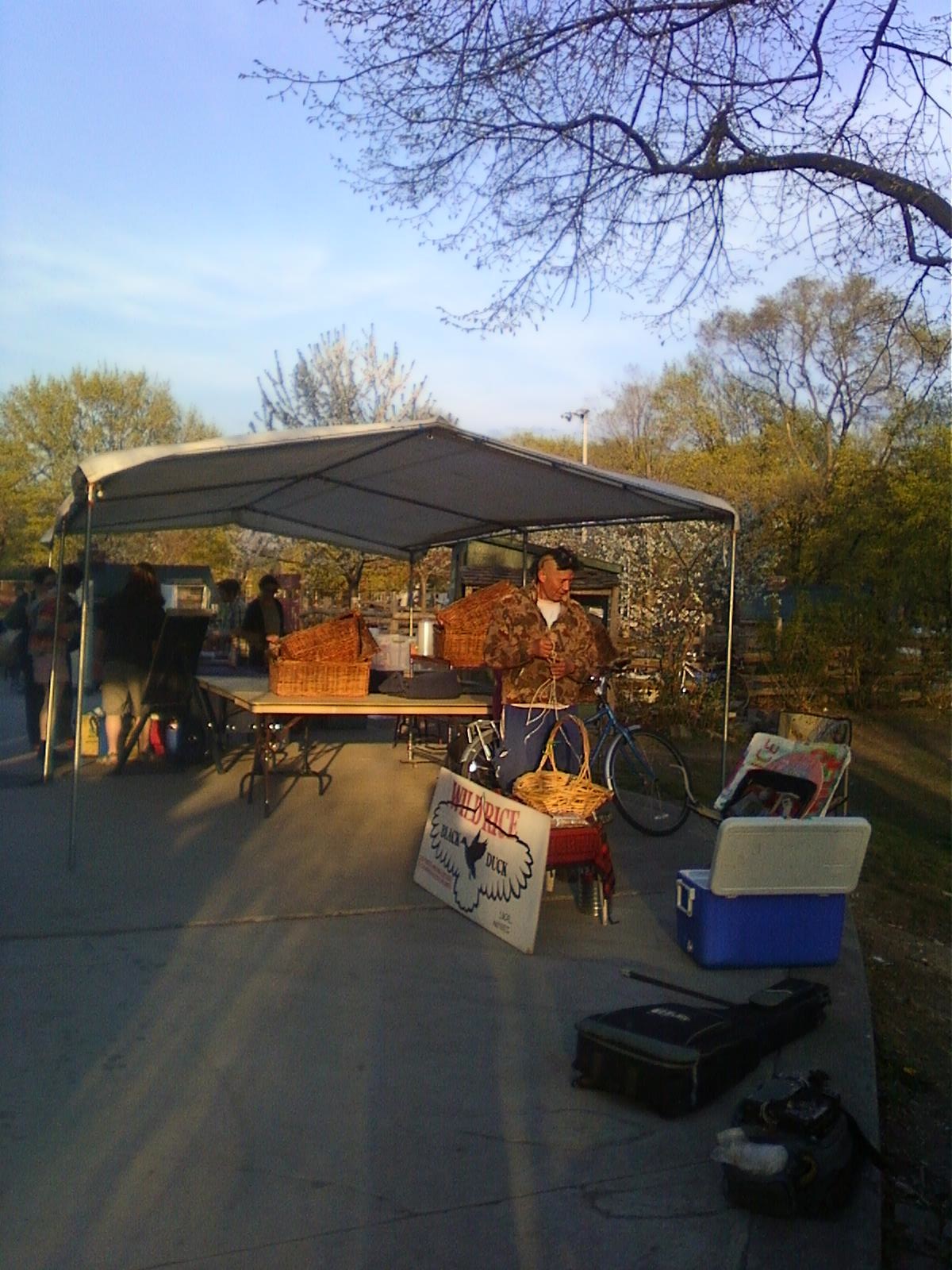
Black Duck Wild Rice-Toronto
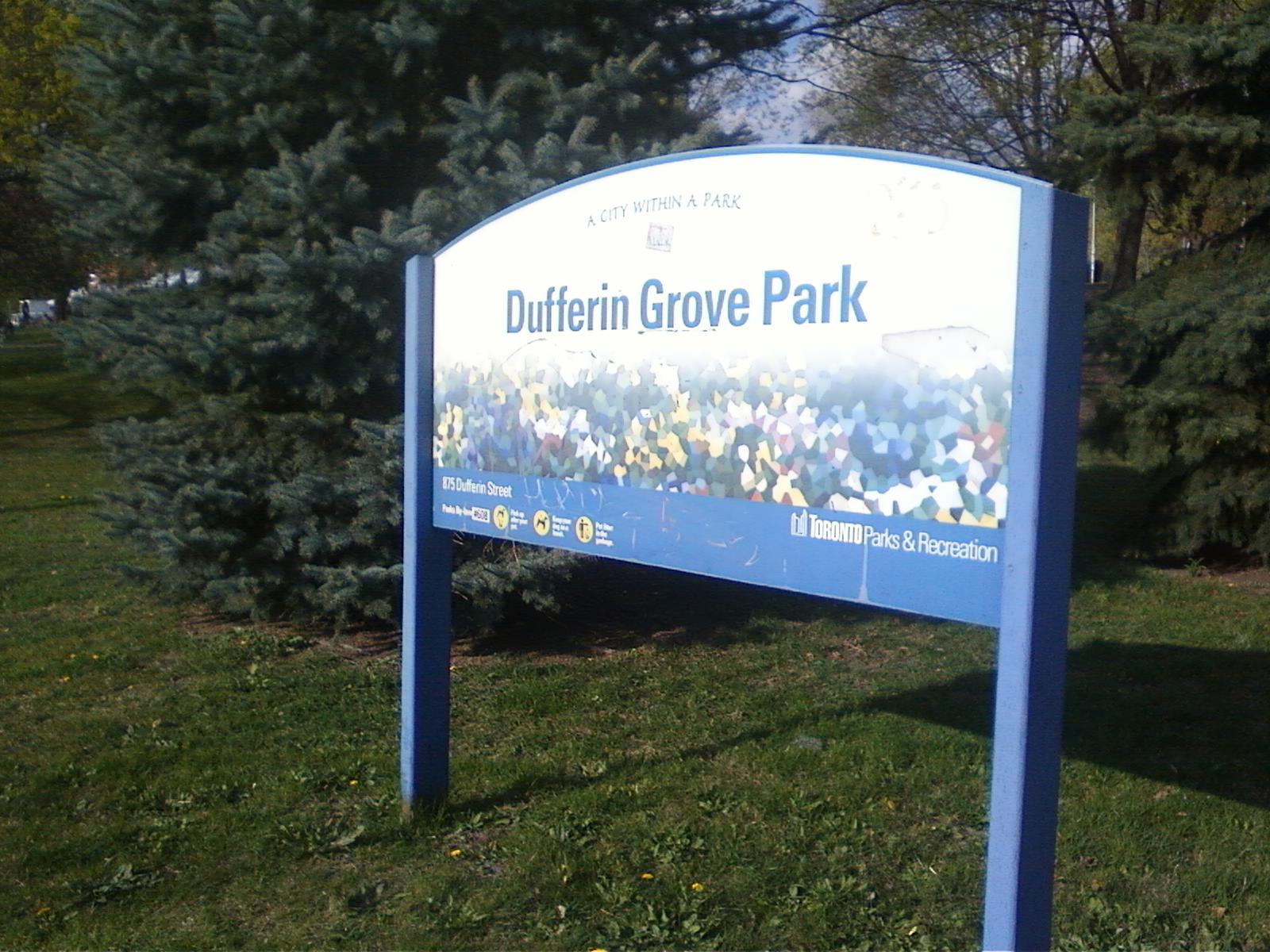
Toronto CA community park
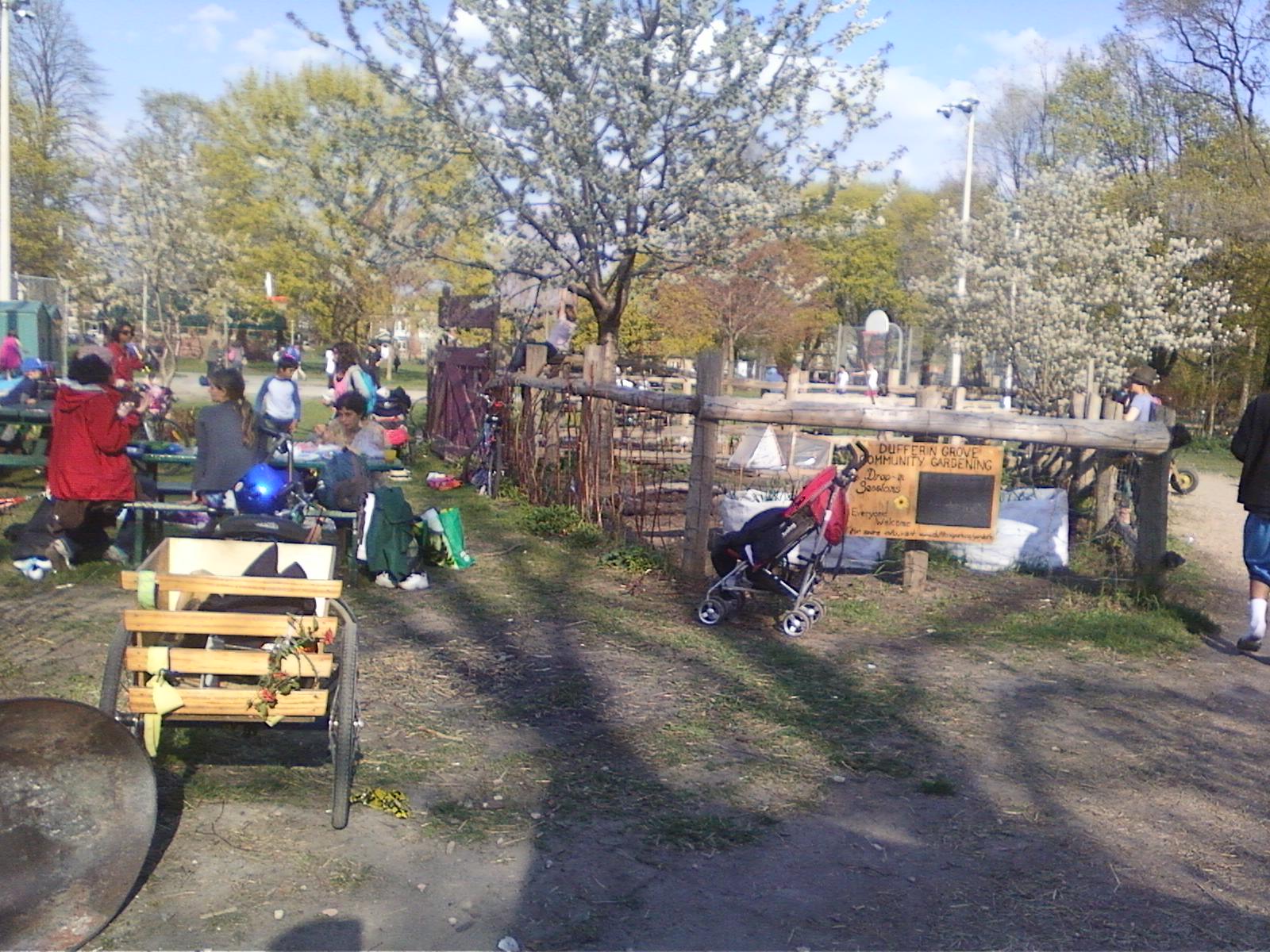
The community garden at the Dufferin Grove Park in Toronto. Sits right next to the weekly farmers market...
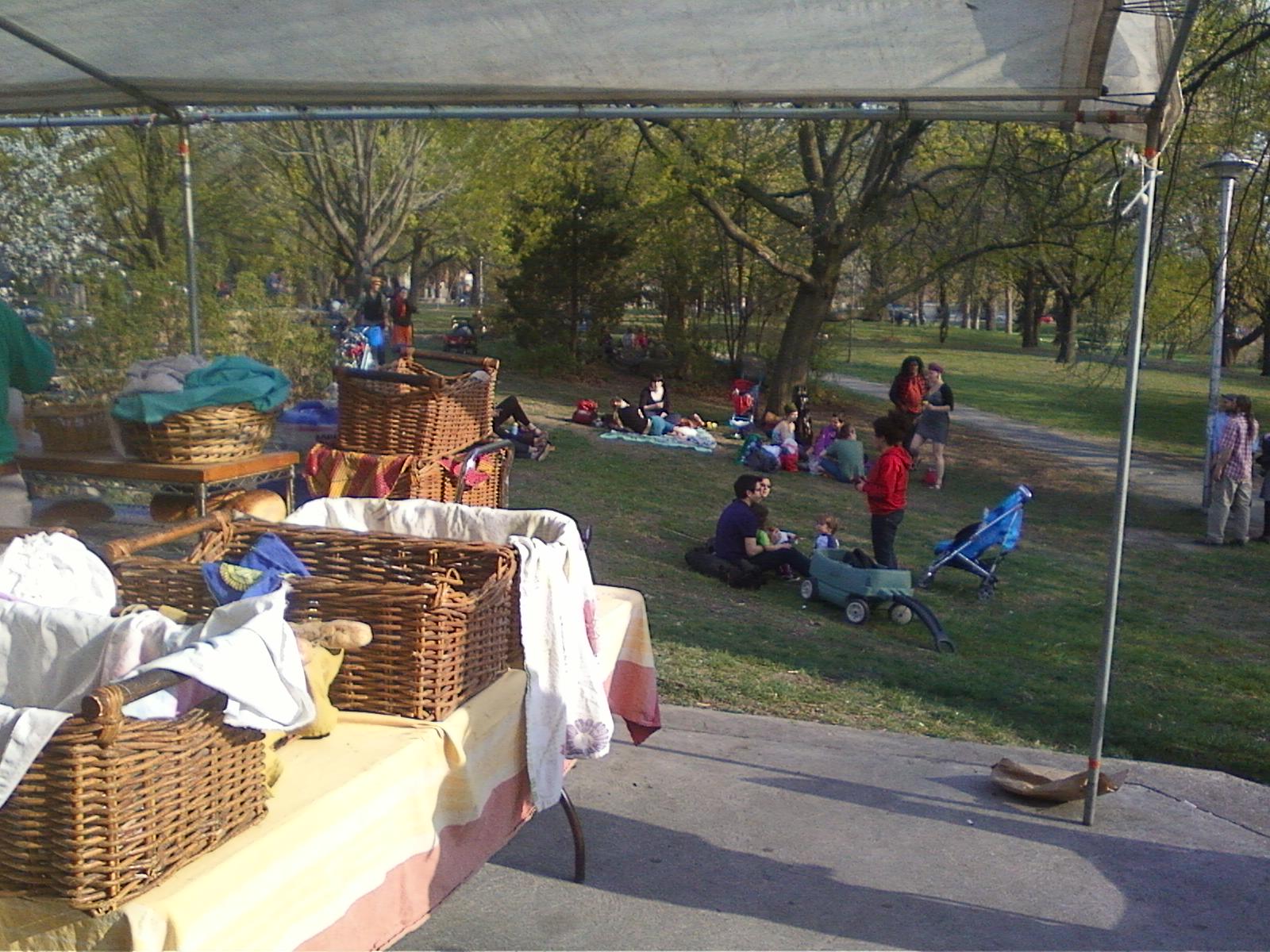
Folks sitting on the grass in Dufferin Grove Park next to the weekly farmers market.

Anne Freeman, the manager of the Dufferin Grove Park Farmers Market is seen here (in pink shirt) talking with one of her vendors in the Zamboni storage area (it is Canada after all!) where the market camps out in the winter and then spills out into the walkway for the rest of the year.

The market sets up this cleaning station for shoppers to add condiments and to clean their plates. A very attractive set up..

The market sale board for the park folks who make bread and food in their bake ovens and have a Friday night dinner as well.
I just returned from giving the keynote at the Greenbelt Farmers Market Network Market Manager Day in Toronto Canada. I know, how lucky does one person get…
Spending four days with my peers to the north taught me a great many things and confirmed some others. I will post a few different stories and highlights about the trip this week, but let me start today with some generalities:
1. The deep awareness of the importance of civil society in Canada serves the market and food system well. Those working on these issues know that in order for change to be calibrated correctly, it is important for citizens to constantly act as “civic agents.” They are not afraid to be oppositional when needed (when dealing with government especially) but also understand that they need to “assist each department in achieving their particular mandate” as eloquently stated by Barbara Emanuel, Manager of the Food Strategy at Toronto Public Health. (That civic agent term was defined again for me in an article I read on the way home in the latest Democracy: A Journal of Ideas in a series called Reclaiming Citizenship which I heartily recommend as well.)
2. Every food organizer I met on that trip understood that the farmer/producer needs to remain as the central partner in all projects. In other words, I didn’t come across lip service to the needs of the farmer. That lip service is usually found in code words or phrases such as “scaling up” or “elitist farmers markets” in food system conversations that I find myself in across North America and in other Western countries. Those code words tell you that the sayers are content to ignore the facts of the relative age and sophistication of our work and the intractable nature of the industrial food system so far.
I instead heard complex, thoughtful responses to the needs of farmers while balancing health equity needs for shoppers. I wish I found that more often in my travels.
3. A set of organizers who recognize that they all must remain at the same table. More specifically, that they all sit at the table but may not have the same menu of choices in front of them. Debbie Fields, the extraordinary Executive Director of FoodShare Toronto said as much to me about her colleague Anne Freeman (my host, the organizer of the Greenbelt Farmers Market Network and founder of the Dufferin Grove Farmers Market) “Anne and I understand that we have the same goal but have to use different avenues to get there.”
4. Internal evaluation is becoming known and necessary. I can’t wait to tell you more about the dynamic presentation (and later meeting of the mind) I experienced through Helene St. Jacques, a Food Share board member and marketing research professional showing results of the research done on behalf of the markets. . And, I look forward to doing some of that US/Canada evaluation sharing with Helene as well.
So much to tell you….
Dear colleagues,
I appreciated the time and courtesy you showed me today in the middle of your packed agenda. I am even more hopeful about the future of a healthy food system after listening in on your hard work. I thank you for all that you have done and promise to do.
As I traveled back home this afternoon, I decided to write out a few major points of what I attempted to get across today, in case some of it was missed by me or simply not clear in our short time together.
My work will continue to be focused on how to build public markets into a movement and their role in the larger food system. I hope my work will benefit you as I gather and analyze data to understand the typology of markets through their characteristics so that we can all better understand how to sustain them and build healthy systems through them.
In the meantime, I want to share what I know about farmers market activists; such as that the reasons for starting or managing a market are wide ranging. It could be economic need in that community or a desire to reconnect citizens or it might be to build an entire food system. In all cases, what each farmers market learns sooner or later is that balance is the key to success. Balancing producers, shoppers and community members’ needs and changing campaigns to meet those needs is the only way to lift barriers and keep people coming back to the same place to continue to have an evolving conversation. As I said today, all great markets have one thing in common: their ability to create and maintain extensive partnerships. The more partnerships (at the appropriate time!) the better.
In the serious work you have before you, you may ask how do farmers markets fit into this health and social equity paradigm you are creating. Here is what I would like you to remember:
•In every conversation we have about food systems, there is one constant. The profound need for successful producers able to work within the human scale of our emerging system. For that need, farmers markets are the best point of entry yet found for encouraging the farmer. A market can work for one, two, or more years with a farmer, patiently letting them find their level of comfort and their own skill set.
•The incredible set of skills within a market (in the farmers, managers, shoppers and partners) can ensure that innovative and (sometimes risky) food system ideas make it past pilot stage. In other words, we experiment well and as we learn to measure those experiments, sensible policy ideas appear.
•The open, democratic, nature of markets mean that true bridging and bonding happen when they are managed well. Can you think of another place the bank president and the bus driver are on the same footing and see each other as often?
•Entry-level positions are necessary for the food system to grow. As we continue to professionalize farmers market management, we will begin to see generations of food system activists in every region with real experience and know-how.
I hope we can all agree on those. The reason I bring them up is to encourage your food leaders to make those things happen. Here’s how:
•Support farmers markets ability to work over many seasons with their producers. Understand that a market farmer is often just beginning the thinking that will often take him or her to complete immersion into larger food system sales. But also grow sisters to your farmers market points of entry by encouraging other types of farmers that might be interested in wholesale or quasi wholesale. Promote CSAs, CSFs, investor circles like Slow Money, marketing cooperatives and other ideas. Realize that markets are encouraging retail farming for one set of farmers, which leaves a piece of the farming pie still covered. Who is encouraging direct marketing of wholesale farm goods at a respectable income level with the same set of criteria that farmers markets demand? (By the way, it might end up being farmers markets again- wholesale markets are cropping up in every region run by the very same organizations that manage the farmers markets.)
•Support action organizations like the Farmers Market Coalition, which is working to build and support comprehensive training for market managers and state associations. Advocate for markets to become members and avail themselves of the webinars, the Resource Library and its advocacy work. And, of course, support practioner/ research organizations like marketumbrella.org.
•Encourage the markets to get to their most useful form. Expect your markets to have proper governance, rules and regulations BUT make sure that all of it fits in with the characteristics of your state’s farmers markets. Each region comes at this slightly differently and policy should reflect that reality. And give it time to get there.
•Professionalize market management by advocating for it. All of the lofty ideas I put forth here are based on someone or a group of someones staying in one place and building it. Let me be clear- yes paid positions must be a priority, but board training and market project planning are just as important, as are sustainable income streams.
•Use the market to address the barriers that the industrial food system and surrounding systems have put in place. Issues like racial equity and the rural-urban divide can be addressed by connecting through food sovereignty. Where better to lead the nation on these issues but here? Look at http://www.foodsecurity.org and http://www.growingfoodandjustice.org to see how to address those issues.
Lastly, policy that will last will come from those markets and roadside stands and school gardens, especially if the measurement is built properly. In that vein, I am attaching the draft of the Indicator matrix that I am working on with the Farmers Market Coalition. It comes from markets and farmers, public health activists and planners. I’d love to hear your feedback and look for ways that you can pilot pieces of it.
In closing, I heartily recommend that you think about success first in terms of your front line – your farmers and market managers. I promise you – they will help you get to the finish line.
Sincerely,
Darlene Wolnik
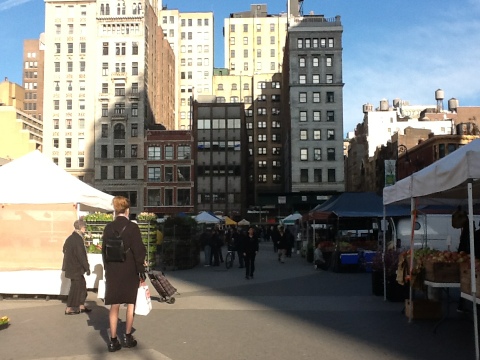
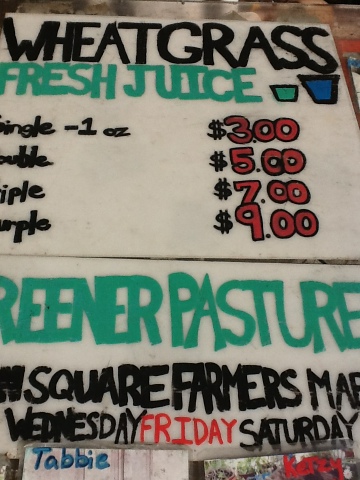
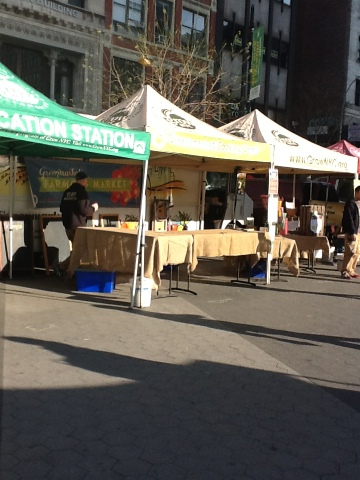
On my way to a morning meeting, I had the great fortune to be able to stop at the Greenmarket on a beautiful Wednesday morning. This is the first half hour of opening, and let me tell you, it never looks this quiet again! I didn’t get close ups of vendors this time, but will whenI go back on Friday morning!


This week in Manhattan, Diane of the Farmers Federation of New York leads an overview on EBT, WIC, FMNP and food handling for farmers working at farmers markets. The Farmers Federation works with FNS, Dept of Ag and other partners to streamline EBT acceptance for markets in New York. They facilitate the markets receiving free machines, supply each market with their own tokens, reimburse the transaction costs and train market vendors and managers. A very instructive morning for markets and vendors, courtesy of the Farmers Federation. Nice model for other states to check out.

 Helping Farmers Markets Grow
