SNAP Update:  “Twinkies can no longer be considered bread”

      “I’m disappointed that the rules don’t go as far as what was proposed early this year,” said Danielle Nierenberg, president of Food Tank, a nutrition advocacy group. “USDA has missed an opportunity to increase the availability of and access to healthier foods for low-income Americans.”

The earlier proposals also recommended leaving food with multiple ingredients like frozen pizza or canned soup off the staple list. The outcome is a win for the makers of such products, like General Mills Inc. and Campbell Soup Co., which feared they would lose shelf space as retailers added new items to meet the requirements.

But retailers still criticized the new guidelines as too restrictive. Stores must now stock seven varieties of staples in each food category: meat, bread, dairy, and fruits and vegetables….

…More changes to the food-stamp program may lie ahead. The new rules were published a day after the House Committee on Agriculture released a report* calling for major changes to the program, which Republicans on the committee say discourages recipients from finding better-paid work.

Source: Regulators Tweak SNAP Rules for Grocers – WSJ

*Some of the findings from the 2016 Committee on Agriculture Report “Past, Present, and Future of SNAP” are below.

    • Program participation nearly doubled (up 81 percent from FY 2007 to FY 2013) as a result of the recent recession. In an average month in FY 2007, 26.3 million people (or about 9 percent of the U.S. population) were enrolled in SNAP. That increased to 47.6 million people (or about 15 percent of the U.S. population) in FY 2013, owing to the fact that the economy was slow to recover and many families remained reliant on SNAP. Even now, with a 4.6 percent unemployment rate (compared to a 9.6 percent unemployment rate for 2010), there were still 43.4 million SNAP participants as of July 2016.
    • SNAP is now a catchall for individuals and families who receive no or lower benefits from other welfare programs, largely because the eligibility criteria in SNAP are relatively more relaxed. As a result, the net effect has been to increase SNAP enrollment. For example, in the welfare reforms of 1996, the cash welfare program Aid to Families with Dependent Children (AFDC) was converted into a block grant known as TANF, which has rather rigorous work and activity requirements and includes a time limit. Another program available to those who are laid off from work is Unemployment Insurance (UI). These benefits require individuals to have a work history and to be fired through no fault of their own to be eligible for assistance. UI benefits are also time-limited, typically lasting six months. A third program, Federal disability benefits, requires individuals to prove they are unable to work. For many families who have not collected SNAP in the past, SNAP is now a default option for filling in the gaps.
    • USDA data shows that spending on SNAP remains three times what it was prior to the recession ($23.09 billion pre-recession average compared to $73.99 billion post-recession in FY 2015). However, SNAP spending is now projected to be significantly lower than it was estimated at passage of the 2014 Farm Bill.
    • For FY 2017, the maximum monthly benefit in the 48 contiguous states and DC is $194 for a one-person household, $357 for a two-person household, and $649 for a four-person household.17 In determining a household’s benefit, the net monthly income of the household is multiplied by 30 percent (because SNAP households are expected to spend 30 percent of their income on food), and the result is subtracted from the maximum benefit to determine the household’s benefit.
    • Seniors have the lowest rates of SNAP participation among eligible households of any demographic. While the low participation rate has a variety of causes, a prominent explanation is the stigma associated with SNAP and welfare in general. Many factors contribute to a lack of access to food among seniors, including a lack of a substantial income, the gap between Medicaid and the cost of living, limited income with specialized diets, and mental and physical illnesses.  The issues facing these populations must be viewed holistically, with SNAP as one piece of a larger solution to solving hunger for seniors.


According to research by the AARP Foundation—a charitable affiliate of AARP—over 17 percent of adults over the age of 40 are food-insecure. Among age cohorts over age 50, food insecurity was worse for the 50-59 age group, with over 10 percent experiencing either low or very low food security. Among the 60-69 age cohort, over 9 percent experienced similar levels of food insecurity, and over 6 percent among the 70+ population.

• The operation of the program is at the discretion of each state. For instance, in California, SNAP is a county-run program. In Texas, SNAP is administered by the state… Dr. Angela Rachidi of the American Enterprise Institute cited a specific example in New York City where SNAP, WIC, school food programs, and child and adult care programs are all administered by different agencies and the result is that each agency must determine eligibility and administer benefits separately.

K. Michael Conaway, Chairman of the House Committee on Agriculture. Hearing of the House of Representatives, Committee on Agriculture. Past, Present, and Future of SNAP. February 25, 2015. Washington, D.C.  Find report here

From CNN this week:

The number of people seeking emergency food assistance increased by an average of 2% in 2016, the United States Conference of Mayors said in its annual report Wednesday.

The majority, or 63%, of those seeking assistance were families, down from 67% a year ago, the survey found. However, the proportion of people who were employed and in need of food assistance rose sharply — increasing to 51% from 42%.


CNN Money report


Louisiana Update #5: Flood victims encouraged to preregister for DSNAP benefits 

DSNAP is being activated for the August 2016 Louisiana Flood and means that rural markets should be prepared to see a influx of folks new to SNAP benefits. Unfortunately, many of our smaller, volunteer-led markets are still deciding whether to become SNAP authorized.
Here are the markets in Louisiana currently authorized as SNAP retailers (of course, some farm stands may also be authorized and are not included in this list):
Abita Springs Farmer’s Market Abita Springs
Cane River Green Market Natchitoches
Capstone Farmers Market 5007 New Orleans
Common Ground Health Clinic-Farmers Market New Orleans
Creole Market New Iberia
Crescent City Farmers Market New Orleans (4 locations)
Inglewood Harvest Barn Alexandria
Lafayette Farmers And Artisans Market Lafayette
Leesville Main Street Market Leesville
Market On LaSalle New Orleans
Marketplace at Armstrong Park New Orleans
Ruston Farmers Market Ruston
Oberlin Farmers’ Market Oberlin
Pearl River Farmers Market Pearl River
Red Stick Farmers Market Baton Rouge (2 locations plus mobile market)
Sankofa Farmers Market New Orleans
Shreveport Farmers’ Market Shreveport
Winn Farmers Market Winnfield

This list contains a few that my information indicates are not currently active and a few of these (9 of the 22) are in New Orleans which is  not near enough to the flooded zone to help most folks.
Since the state has about 80 farmers markets listed in various places, the above list shows how ill-prepared the state’s markets are to absorb these new shoppers.

Of course, some of the markets in Mississippi can also serve this clientele as many of the parishes hit hard are close to the state line; that is, if the benefit users are aware of the rules and where the markets are in MS and if those markets are prepared to accept those temporary SNAP users.

My experience as Deputy Director of Market Umbrella before and after Hurricanes Katrina/Rita (and on staff still during the BP oil spill) showed how much markets can do during disasters to offer solace, community and healthy choices to people under enormous stress. We were one of the few places in New Orleans up and running in 2005 (we reopened November 22) with EBT access, working with our fellow markets* across the area to help producers recover and doing our best to help other outlets open in our city.

From the very beginning in 1995, the founders of our markets had hoped to attract a significant number of at-risk shoppers, but as they opened in the era of EBT, the market was on the wrong side of technology for many years. As a result though, our 2004/2005 SNAP pilot strategy was relatively well thought out and predicated on the reality that our markets had not yet attracted their share of low-income shoppers but had the potential to serve that group as well as the cash shoppers we had attracted. Our token pilot led to the visit in the summer of 2005 of Bill Ludwig and the Southwest Regional FNS staff with then Under Secretary of Agriculture Eric Bost in tow to see and celebrate our early SNAP token and incentive work. Interestingly, Ludwig remarked during the visit on how helpful a token system might be during disasters. As we wrote a few years later, we remembered that comment later in 2005 and reflected on prescient he had been.
That long preparation meant we had outreach and materials to use when the levee breaks and oil spills and floods came (yeah we’re getting used to it) and the staff trained to make it happen.
So what we now know is the ability to support the citizens of towns and cities to recover from a major disaster requires organizational sophistication and preparation, which most of our newly emerging markets across the state are still working to achieve.

It is time for the national market field to create a toolkit for disaster planning, both for its vendors but also for its market organizers in order to be prepared when (not if) a situation like the one unfolding in Louisiana hits their area. USDA and FNS can be very helpful in this planning with needed policy changes such as lifting the requirement of location-specific SNAP licensing/transactions, loosening the ban on on-site hot food again (as was done in past disasters). It would also be helpful for funders like the innovative Wholesome Wave to increase their incentive work for disaster-hit areas along the lines of the incentive we created together for the Gulf Coast fishers in 2010.

Let’s get ready, folks.

How DSNAP works:
If you already receive SNAP benefits and are eligible for disaster benefits, you do not need to pre-register, as benefits will be added to your benefit card automatically.

Pre-registering does not guarantee benefits. DSNAP is only administered after a federally declared disaster and after the state receives approval from the United States Department of Agriculture, Food and Nutrition Services to activate DSNAP services.After a disaster is declared, residents who have pre-registered only need to visit a DSNAP issuance site to verify their information and identity, determine final eligibility and receive their benefit cards. Eligibility requirements and DSNAP locations will be announced at the time of a disaster.

You may name an Authorized Representative to go to a DSNAP site on your behalf. Accommodations will be made for the elderly and those with disabilities to reduce on-site wait times.The Louisiana Department of Children and Family Services  is encouraging those who have experienced loss or damage in the severe storms and flooding to preregister for benefits under the Disaster Supplemental Nutrition Assistance Program (DSNAP).

DSNAP benefits are issued for one month, but they can be used for up to 365 days.  You will get your card when you go to the site, they will be loaded on the card within 3 days.
What amount will I receive in DSNAP benefits?

Household Size DSNAP Allotment
1 $194
2 $357
3 $511
4 $649
5 $771
6 $925
7 $1022
8 $1169
Each Additional Member  +$146

Source: Flood victims in Louisiana encouraged to preregister for DSNAP benefits | New Orleans – WDSU Home

http://www.katc.com/story/32814032/what-you-need-to-know-about-dsnap-food-stamps-benefits


*Deep appreciation for our colleagues at the Red Stick, Covington and Gretna farmers markets who, in 2005, were incredibly helpful to Market Umbrella and offered temporary spots to our vendors and help to our staff as needed.

SNAP videos

Simple, clear and appealing videos on using benefits at markets that can be shared with community centers, sent to targeted social media users and can be used as a banner on news sites too. Bravo Urbana and Fond du Lac!

More about the market

And from Fond du Lac Wisconsin:

More on this market

The Link Between Food Insecurity and the Great Recession 

A report from the Hamilton Project highlights the lingering effects of the Great Recession on food insecurity…

There’s considerable state-by-state variation in food insecurity levels across the country, demonstrating once again that geography matters if you’re poor.

Here’s what Vilsack had to say about some states’ approach to the Supplemental Nutrition Assistance Program, and whether SNAP should be eliminated in favor of a block grant (as House Speaker Paul Ryan has proposed):

I’m leery about block grants, just simply because I haven’t seen governors step up.
I alluded earlier, when we came in in 2009, there were states where a little over 50 percent of eligible people were actually receiving SNAP because that particular governor, that particular administration, did not care enough to make sure that people knew about these benefits, did not care enough to make sure that their bureaucracy was getting information out in languages that people could understand, did not care enough to simplify the process, so I’m skeptical.

The Obama administration has successfully increased overall SNAP participation levels to 85 percent, but Vilsack’s comments illustrate how seemingly minor local political decisions around SNAP education and outreach can affect enrollment in a program that effectively reduces food insecurity.

The Link Between Food Insecurity and the Great Recession — Pacific Standard

A summit for us: Atlanta 2016

A whirlwind of a week in Atlanta with Wholesome Wave and its “surfers”: markets, market advocates and food system organizers. Held at the Emory Conference Center in Atlanta GA, just down the road a block or two from the CDC offices. WW did a great job with the week: well-organized, great food and drink (thumbs up for the smoothies available each day) and plenty of space for networking and meetings. Atlanta was lovely and the rare off-site food and drink I had was excellent, but I gotta say that the traffic is as unholy of a mess as I have experienced in any US city. Talk about needing a quality of life intervention!

Highlights for the Summit for me included:

The WW Georgia market shopper who turned to good food to beat her cancer; she was charming in telling a very personal story on a panel and brave to share her still-emotional reaction to using SNAP, even while sharing her appreciation for the program.

Organizing for State Nutrition Incentive Policies : all of the presenters had unique input on their state’s strategy: Ecology Center (CA), Experimental Station (IL), Maryland Farmers Market Association and New Mexico Farming Market Association. This group: Martin, Connie, Amy and Denise have a lot to contribute to any discussion of how to move the dial at the state level.  Check out their varied work on their respective websites and if you have a chance to buttonhole any of them at a conference, tell them I told you to do it. And the short answer is to have a creative and flexible strategy that includes how to pay for it and a constant champion in your statehouse.

Clinic-Community Initiatives-Pathways to Sustainability: what I got out of this session was one of those unintended consequences: the analysis that MANNA has done of their program as a handout was one that responded to a question that our new FMC Research and Education Director Alex Canepa had just been asking earlier that day: can we get data that actually indicates positive health changes from medical nutrition therapy  strategies that offset traditional medical costs? See the Examining Health Care Costs Among MANNA Clients and a Comparison Group report…

The Role of Technology in Supporting Nutrition Incentives: For those of us gamely working on technology solutions for markets that support the range of no-tech, low-tech to high-tech markets out there, this was an in-depth and honest conversation. I sincerely appreciated Darcy Freedman from Case Western Reserve University talking about how the tool is half of the puzzle; the TA is the other half.

Measuring the Impact of Vouchers at Farmers Markets: I think the title threw some people off this one as well as the description. This covered the evaluation being done by University of Delaware/CRESP and led by Allison Karpyn on the incentives and vouchers funded by WW. Her powerpoint is available to those who request it (check with them or with WW) and I’d recommend that you get a copy. Allison shared some of the early data and was game to listen to input from the attendees about what they thought about it so far.

Measuring Markets Economic, Ecological, Human and Social Capital: Of course I chose this one. FMC Project Director Sara Padilla led the show, but Jen Cheek also popped up to add some updates on how FMC is embedding this into FMSSG reporting and she managed the lively Q&A as I roamed the room and made some notes for later conversations based on those questions. We had hoped to role play some of the training materials/exercises that will be embedded within FMM in this hour, but the room, the late hour and the lack of actual market leaders attending meant a quick change to describing it only and instead spent time sharing our thoughts on the components of grassroots evaluation, which seemed to be a good choice.  As I shared later with the rest of the FMC team, I think grassroots evaluation work is evolving slowly but surely and our work in this area seems to be helpful to markets and to their partners.

The FMC team also spent some time with the WW evaluation team  (shout out to Katie and Elizabeth for finding the time between their many conference duties), continuing to find ways to streamline and support both portals without duplication. I can tell you we are all committed to that goal….

Lastly, I left feeling that I just saw and heard and met a whole bunch of people who are doing some excellent network level work in their states. It felt like it has only at a few moments in the last 10 years: that there is some sensible support for contextual strategies for increasing access at markets, and some help to use that support to change policies for markets and their direct marketing producers. But, also an awareness that there is danger in markets or networks in diving in the too-deep water before they are ready, before they have a plan for what this extra work is meant to do for their markets and how it will absorb it. Because what we know is to attempt that before examining the culture of the market or the willingness of the market leadership to invest years in this type of intervention is foolhardy*. I’d also point out how that the lack of production-side advocates in attendance to talk about how these strategies were changing regional food production (for the good and for the bad) jarred me slightly and I’ll hope for better participation at future summits.

(*…. for all of those uncertainties here is the process to change them:  market communities becoming true partners in the design of their projects, taking the time to work with their community in this process long before the funding starts, leading or sharing in the data collection process as well as in the analysis of that project and beyond that, being brave about seeking and sharing evidence of all of the market’s impacts. And if that is where your community is at, I can tell you that there are some people ready and willing to do just that, many of whom I just saw in Atlanta.)

IMG_20160112_115909

Technology session, FMC’s Jen Cheek asking another good question from the floor

IMG_20160112_131853

WW’s Katie Merritt, chatting with FMC’s Sara Padilla and Alex Canepa pictured. WW’s Elizabeth Atwell  (back of her head showing), Jen Cheek and yours truly also present

IMG_20160113_110038

Allison Karpyn’s incentive evaluation presentation

IMG_20160113_121713

FMC’s FMM presentation

IMG_20160113_122854

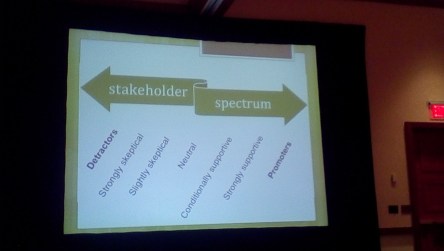
FMC’s audience involvement spectrum

IMG_20160113_144754

One of only 2 off-site meals, this one had with WW’s Gabrielle Langholtz who sang Hamilton the musical songs to the waiter. Not odd behavior if you know her…

IMG_20160113_145934

The food we ordered off that chalkboard menu; all great.

IMG_20160114_071034

The dog that came with my airbnb, Sadie, wondering why I am leaving so early on a cold day..


For Children Impoverished at Least a Year, Food Stamps Provide Critical Stability 

Ratcliffe’s research has shown that a secure environment is incredibly important. Analyzing 40 years’ worth of data, Ratcliffe found that many children cycle in and out of poverty and that 1 in 10 is persistently poor, spending at least half their childhood below the poverty line. Persistently poor children have substantially worse outcomes as adults and growing up in disadvantaged neighborhoods, moving a lot, or having parents with lower educational achievement can further affect poor children’s chances at success. SNAP and other benefits, however, can help stabilize families, priming children to break out of the cycle of poverty.

Source: For Children Impoverished at Least a Year, Food Stamps Provide Critical Stability | Community Commons

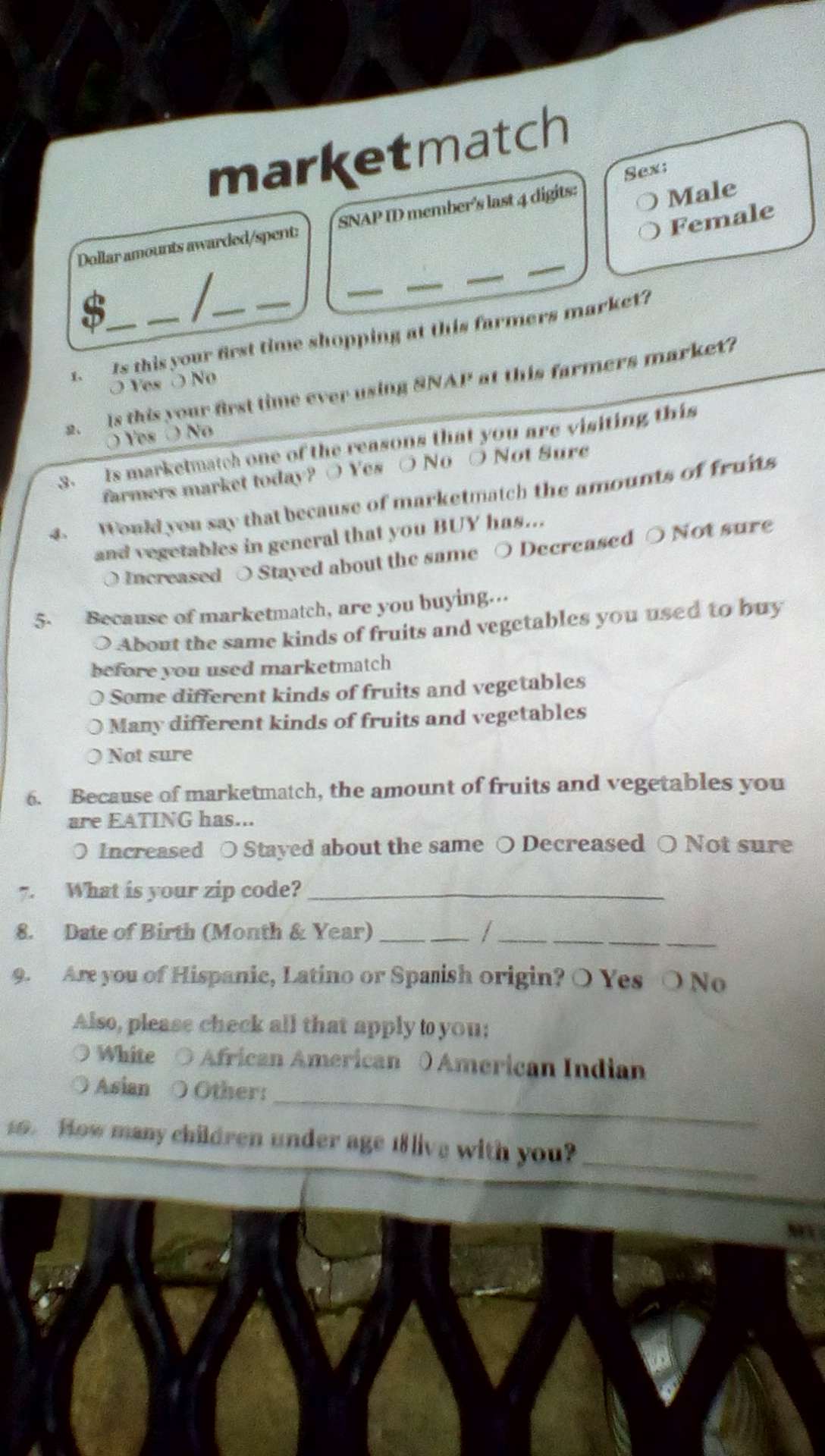
Self-administered survey-New Orleans Market Match user

This is (basically) the same system that Crescent City Farmers Market (CCFM) in New Orleans has used to gather data from incentive users (incentiv-ers?) since they began doing them some years back. They call their incentive Market Match.

As one of the staff who was responsible for doing it when it began and was part of the discussion about it, I really liked it. It is on a pad that is pulled off to have the person fill out and then each slip is added to the clipboard (or put in a container) to be entered into spreadsheets at a later time. The darker grey is filled out by the market staff person after the other part is completed by the shopper. What I know is that the system was designed with both the shopper and the market staff needs in minds, which as we all know is important and yet not always done. I’d like them to be numbered chronologically so as to know that none were lost. Maybe they are numbered, I’ll check to see.

Sorry for the wrinkles- it ended up in my market bag under the citrus. I’ll get some more pics of their system-including a better version of this and maybe the other collection forms if they will allow me to continue to peek over their shoulder.

MMtracking form_CCFM

2015 Farmers Market SNAP Support Grantees

Some very exciting projects in here. Congratulations to all of the successful organizations.

As approved by Congress in the President’s FY 2014 budget request for FNS (The Food and Nutrition Service: 2014, Explanatory Notes), these funds are intended to support “the participation of farmers’ markets in SNAP by providing equipment and support grants to new markets and those currently participating in the program.” The goals of the FMSSG program are to increase SNAP accessibility and participation at farmers’ markets, and support the establishment, expansion, and promotion of SNAP/Electronic Benefits Transfer (EBT) services at farmers’ markets. This is a new program, which may continue in subsequent years.

Supplemental Nutrition Assistance Program (SNAP)

Link to original RFA

Last Published: 10/02/2015
  1. Plant Chicago, NFP – Ensuring SNAP Success at Plant Chicago’s Farmers Market
    Chicago, IL
    Choice Neighborhood
    Estimated Federal Funding: $15,379
    Plant Chicago’s Ensuring SNAP Success project, will improve SNAP programming in the urban center of Chicago, IL by increasing SNAP-customers at the organization’s farmers market through community, bi-lingual outreach and a local marketing campaign.  Through this project the SNAP program at the market will expand to include a volunteer program for weekdays and weekends.  Plant Chicago intends to increase SNAP participation at their market by over 25% for 2017.
  2. Trust for Conservation Innovation – Making Farmers Market Purchases a SNAP in Northern California
    San Francisco, CA
    Choice Neighborhood
    Estimated Federal Funding: $123,068
    The Making Farmers Market Purchases a SNAP in Northern California project will support staffing for the SNAP at eight small-scale farmers markets in Northern California that currently struggle to provide SNAP on a regular basis. Through this project, these markets will receive EBT technical training and assistance.  Additionally, the project will increase SNAP redemptions at farmers markets through community outreach and promotion and develop best practices to ensure growth and sustainability.
  3. Morgantown Farmers’ Market Growers Association – Expanding a Targeted SNAP Program to Demographically-Diverse Member Markets
    Morgantown, WV
    Strike Force State
    Estimated Federal Funding: $36,599
    Through the FMSSG, the Morgantown Farmers’ Market Growers Association will hire an EBT coordinator to manage the growing SNAP at two farmers markets and increase redemptions by engaging in outreach specifically targeted to SNAP-participants in urban food-desert of West Virginia.  The Association will also identify best practices that can be incorporated into a long-term plan for the SNAP at other markets throughout West Virginia.
  4. Growing Places Indy, Inc. – Indy Winter Farmers Market (IWFM) “Good Eating Is a SNAP, All Winter Long”
    Indianapolis, IN
    Promise Zone
    Estimated Federal Funding: $58,740
    The Indy Winter Farmers Market (IWFM) “Good Eating Is a SNAP, All Winter Long” program will increase access to SNAP by hiring a dedicated EBT manager that will also coordinate educational demonstrations and outreach materials.  This staff member will provide farmer vendors with needed training and technical support. These activities will help to increase the consumption of farmers market products by SNAP customers and give farmers the tools they need to increase SNAP redemptions and build their businesses.
  5. Homefull – Growing SNAP Success with Southwest Ohio Farmers’ Markets
    Montgomery, OH
    Estimated Federal Funding: $113,258
    Through Growing SNAP Success with Southwest Ohio Farmers’ Markets, Homefull will reach a three-county area to bolster and increase SNAP at over fifteen local farmers markets and promote SNAP availability at the participating markets.  Homefull will achieve this through EBT training and technical assistance, outreach, EBT staffing, and market ambassadors.  The project plans to double the number and dollar value of SNAP transactions at southwest Ohio farmers markets.
  6. The Experimental Station-6100 Blackstone –  EBT Support and Outreach For Illinois Farmers Markets and SNAP Clientele
    Chicago, IL
    Choice Neighborhood
    Estimated Federal Funding: $250,000
    Over a two-year project, the Experimental Station will provide EBT support to Illinois farmers markets accepting SNAP through EBT/SNAP consulting, technical support and establishing an online community of EBT support to Illinois farmers markets.  This project will also create and disseminate outreach materials and television advertisements, to create greater awareness of the availability of SNAP at Illinois farmers markets. The Experimental Station aims to double SNAP sales at markets throughout Illinois during the life of this project.
  7. Houston Department of Health and Human Services – Expanding Opportunity for Use of SNAP at Houston Farmers Markets
    Houston, TX
    Strike Force State
    Estimated Federal Funding: $250,000
    The Houston Department of Health and Human Services through the Expanding Opportunity for Use of SNAP at Houston Farmers’ Markets project will provide staff and EBT technical support and promotional activities related to the expansion of SNAP acceptance at Houston farmers markets.  Outreach and promotional activities will be implemented in partnership with local community organizations to increase the number of farmers markets accepting SNAP to six.  The project aims to increase the number of SNAP transactions at farmers markets within the City of Houston to 8,980 by 2018.
  8. Missouri Farmers Market Association – Growing SNAP at Farmers Markets in Missouri
    Webb City, Missouri
    Choice Neighborhood
    Estimated Federal Funding: $73,160
    The Missouri Farmers Market Association will expand the SNAP at ten farmers markets throughout Missouri. SNAP-expansion will occur through a variety of marketing tools tailored to the individual market and its SNAP-customers.  The marketing tools range from radio advertising to cooking demonstrations, to banners, and brochures, all designed to best reach local SNAP-participants.
  9. Hamakua Harvest, Inc. – Hamakua Harvest Farmers’ Market SNAP/EBT Expansion Program
    Honokaa, HI
    Estimated Federal Funding: $137,174
    The Hamakua Harvest Farmers’ Market SNAP/EBT Expansion Program will support the newly-authorized farmers market in Honokaa, HI gain the support it needs to thrive. The funds will be used to promote and expand the SNAP through staffing an EBT manager, purchasing SNAP supplies, training for EBT market vendors, and outreach to SNAP-recipients.  Hamakua Harvest anticipates the impact of the project to include 36 vendors to be trained to accept SNAP.
  10. North Union Farmers Market – Increasing SNAP Benefit Use at North Union’s Cleveland Markets through Educational Outreach and Targeted Marketing
    Cleveland, OH
    Choice Neighborhood
    Estimated Federal Funding: $59,302
    North Union Farmers Market will strengthen their SNAP by hiring a part-time educational coordinator who will be responsible for expanding the market’s outreach programs and build relationships with community partners that work with SNAP-clients. The expanded outreach programs will include cooking demonstrations, family-friendly educational activities and workshops on food preservation.  The North Union Farmers Market will also implement a marketing program using print and digital media and radio advertisements.  The anticipated impact of the project is an increase in redemptions by 10%.
  11. Broad Street Events, INC. – Spotlight on Snap, Raising SNAP Awareness in Rural Michigan
    Chesaning, Michigan
    Estimated Federal Funding: $17,480
    The project Spotlight on SNAP will effectively market the SNAP to surrounding SNAP-residents and increase the amount of SNAP users at the Downtown Chesaning Market.  Funding will provide the needs to expand outreach and effectively promote SNAP through market activities, newspaper articles, television commercials, and outreach events.  Broad Street Events will partners with many local organizations and schools with high populations of SNAP-recipients.
  12. Village of Park Forest – Park Forest Farmers’ Market EBT Program
    Park Forest, IL
    Choice Neighborhood
    Estimated Federal Funding: $16,975
    The Park Forest Farmers’ Market EBT Program will increase SNAP benefit redemption at the Park Forest Farmers Market by hiring an EBT manager who will administer the program, plan and implement outreach strategies for informing SNAP participants of their ability to use benefits at the farmers market, and conduct trainings for farmer-producers new to the market on participation in the EBT program.  By expanding the EBT program, the market can continue to involve more vendors and offer greater varieties of products available to SNAP customers.
  13. Harvest Home Farmer’s Market – Farm Fresh for Every Body
    New York, NY
    Choice Neighborhood
    Estimated Federal Funding: $250,000
    Through 19 different farmers markets in food-deserts around New York, Harvest Home will increase the number of SNAP transactions processed at their farmers markets, increase the number of farmers and vendors who serve SNAP recipients, and broaden their reach into the surrounding communities. Harvest Hands will achieve these goals by creating culturally and linguistically appropriate promotional materials to reach SNAP-recipients, improve the technology needed to process SNAP transactions on-site and in real time, and conduct ongoing vendor SNAP recruitment for farmer producers.
  14. Everyone’s Harvest – Monterey County SNAP Initiative
    Marina, CA
    Estimated Federal Funding: $109,716
    Everyone’s Harvest will double its annual SNAP redemptions and grow its SNAP customer base by 70% by using a customer relationship management database and outreach to SNAP market shoppers.  The organization will achieve this by engaging Spanish-speaking community members in producing a Spanish-language promotional video focused on SNAP and creating a mailing and email outreach campaign.
  15. Eastern Market Corporation – Eastern Market: Detroit’s SNAP Food Security Blanket
    Detroit, MI
    Strong Cities Strong Communities
    Estimated Federal Funding: $249,663
    The Eastern Market: Detroit’s SNAP Food Security Blanket program will provide resources for program support staff, consulting fees, and supplies to allow for significant program improvements through increased operational efficiencies and greater program effectiveness.  This will be achieved by discontinuing the use of a paper-based system and expanding the SNAP program to an additional market.
  16. Friends of the Rochester Public Market, Inc. – Greater Rochester Farmers’ Market SNAP Collaborative
    Rochester, NY
    Estimated Federal Funding: $178,902
    Through the Greater Rochester Farmers’ Market SNAP Collaborative project the Friends of the Rochester Public Market will implement a community-wide marketing campaign that increases awareness of SNAP use at regional farmers markets.  Additionally funds will be used to develop a new SNAP Token Center at the Public Market and staff salaries for SNAP related activities
  17. Fresh Approach – SNAP Training and Outreach for Farmers’ Markets in San Francisco Bay Area Counties
    Concord, CA
    Choice Neighborhood
    Estimated Federal Funding: $190,951
    Fresh Approach will use funds to perform SNAP data collection, build a network of farmers market stakeholders, create and distribute bi-lingual marketing material, produce outreach events, create a best practices manual for farmers markets to utilize setting up a SNAP program, and train farmers market staff on SNAP program implementation.
  18. Glenville State College Research Corporation – Expansion of Acceptance of SNAP at the Gilmer County Farmers’ Market: Population of low income households in a food desert
    Glenville, WV
    Strike Force State
    Estimated Federal Funding: $42,020
    This project will use funds to design and distribute educational posters and handouts, create and execute an extensive marketing campaign including TV and radio ads, provide salary for an EBT operator and manager, and train volunteers and market staff on SNAP procedures.
  19. Southern Tier West Regional Planning and Development Board – From the Ground Up: Expand and Sustain SNAP at Farmers Markets
    Salamanca, NY
    Estimated Federal Funding: $99,813
    From the Ground Up: Expand and Sustain SNAP at Farmers Markets project will provide research and data analysis, technical assistance, educational training, volunteer training, and capacity building strategies to farmers market managers, and perform outreach to SNAP clients, develop curriculum and training materials for the Southern Tier West Regional Farmers Market Network.
  20. City of Independence – Increasing SNAP Awareness and Utilization at Independence Farmers’ and Craft Market
    Independence, MO
    Choice Neighborhood
    Estimated Federal Funding: $144,976|
    The City of Independence will use FMSSG funds to design and implement a marketing plan for the Independence Farmers market through movie, billboard, local print and bus advertisements, additionally banners and other printed advertising material will be used at the farmers market and distributed throughout the community.  City staff will also perform outreach and educational events in order to increase redemptions at the farmers market due to higher community awareness of SNAP at the farmers market.
  21. Florida Certified Organic Growers and Consumers, Inc. –  Increasing the Capacity of Fresh Access Bucks in Florida
    Gainesville, FL
    FINI & Choice Neighborhood
    Estimated Federal Funding: $250,000
    The Increasing the Capacity of Fresh Access Bucks in Florida project will use FMSSG funds to pay personnel for SNAP administration, organization to provide resources, and technical assistance to farmers market managers.  The project will also develop strategic branding and promotional materials for FL farmers markets and promote SNAP at markets through regular press releases, advertising on the radio, in newspapers, on public transit, on electric bills in each county, direct mailings, and through social media.
  22. Boulder County Public Health – Building and Growing Regional Capacity for SNAP at Farmers’ Markets in Colorado’s Front Range
    Boulder, CO
    Strike Force State
    Estimated Federal Funding: $231,460
    The Boulder County Public Health will use funds to staff a farmers market SNAP coordinator, conduct focus groups on the barriers to accessing farmers markets, develop and implement an outreach plan, train farmers and market managers on managing a SNAP program, hire bi-lingual staff for markets, and create communication tools to distribute best practices to farmers markets in the county.
  23. Appalachian Sustainable Agriculture Project – Increasing SNAP at NC Farmers Markets
    Asheville, NC
    Strike Force State
    Estimated Federal Funding: $164,625
    Through the Increasing SNAP at NC Farmers Markets project, the Appalachian Sustainable Agriculture Project will conduct outreach and promotion to and collaboration with local agencies on SNAP at farmers markets, conduct trainings for market managers and farmers on how to increase SNAP redemptions at markets, evaluate community needs through research and surveys, and provide technical assistance to market managers following their initial training.
  24. The Food Trust – Making Fresh Food a SNAP: Increasing ACCESS Sales at Food Trust Farmers’ Markets
    Philadelphia, PA
    Promise Zone, FINI, Choice Neighborhood
    Estimated Federal Funding: $150,103
    The Food Trust will conduct focus groups, staff EBT operation at markets, implement promotional events around SNAP, develop marketing plan to educate SNAP-clients on EBT at farmers markets, develop bi-lingual marketing and educational materials, train market managers on SNAP program management, and collaborate with local partners.
  25. Hub City Farmers’ Market – Expanding South Carolina’s SNAP Use at Farmers Markets
    Spartanburg, SC
    Strike Force State
    Federal Funding: $247,100
    This project seeks to create a market model that can serve as an inspiration to markets across the state, alleviate market and user barriers, and help municipalities understand the importance of supporting SNAP in markets they run. Hub City Farmers’ Market of Spartanburg will work with Eat Smart Move More South Carolina and the University of South Carolina Center for Research in Nutrition and Health Disparities to develop a set of best practices to help mentor two markets in key areas of the State.
  26. El Dorado County Trails Farm Association – Improvement and Expansion of EDC Farm Trails Association Farmers’ Market SNAP Program
    Placerville, CA
    Federal Funding: $16,057
    The project’s main goal is to boost public awareness of farmers’ market accepting SNAP benefits.  Applicant plans to partner with the Health and Human Services Department and El Dorado CNAP to conduct outreach along with media blitz and raise awareness about the program.
  27. Feed the Hunger Foundation – SNAP at Honolulu Farmers Market
    San Francisco, CA/Honolulu, HI
    Federal Funding: $243,450
    The plan for this project includes outreach to the following communities: 1) news outlets engaging communities whose first language is not English: Samoan, Tongan, Chuukese, Tagalog, Ilocano, Korean, Cantonese, Vietnamese, Thai, Lao, Cambodian, Japanese; 2) Military news at Joint Base Pearl Harbor Hickam; 3) University of Hawaii system (including community and adult education outreach colleges). 4) Coordinating with other SNAP –accessible farmers markets to collaborate on promotion.
  28. Ecology Center – California Farmers’ Market EBT Program
    Alameda, CA
    Strong Cities, Strong Communities (SC2)
    Federal Funding: $242,828
    The project’s aims to support the Ecology Center’s CA Farmers Market EBT program and will: (1) reach out to the 350 CA farmers’ markets that do not yet offer SNAP access with a compelling Case Statement on the benefits of accepting SNAP; (2) provide comprehensive technical assistance, training, shopper outreach materials, scrip, and systems to help a minimum of 120 of those markets add SNAP access; (3) update, improve, and maintain FMfinder.org, the Ecology Center’s website and mobile site designed to helps SNAP shoppers easily find up-to-the-minute information on CA farmers’ markets where they can use their benefits; (4) work with the Departments of Social Services in Los Angeles and Alameda Counties to mail over 1.3M inserts to 632,205 SNAP in order to educate them about the availability of SNAP programs at local farmers’ markets and direct the shoppers to FMfinder.org to find locations and hours of operation; and (5) through these combined efforts, increase SNAP sales at CA Farmers’ Markets by $1.23M (a 33% increase over 2014) by the end of the grant term.
  29. Kokomo Farmers Market Corp – SNAP To Kokomo Farmers’ Market: a targeted marketing, outreach and expansion project to increase SNAP user participation and benefits use at the KDFM
    Kokomo, IN
    Federal Funding: $248,770
    The project goals are to (1) increase SNAP client accessibility and participation at the Kokomo Downtown Farmers Market (KDFM) through extended hours, targeted outreach and expanded marketing, to (2) improve systems for SNAP transactions, recording, and reporting, and to (3) support SNAP recipients with cooking and preserving demonstrations at various outreach locations.
  30. Sustainable Farms & Communities, Inc. – Expanding SNAP Participation in Boone County, Missouri
    Columbia, MO
    Estimated Federal Funding:  $146,983
    Expanding SNAP Participation in Boone County, Missouri project will provide staff for EBT market management, including record keeping, token management and educational activities.  Also, the project will develop a comprehensive marketing and community outreach plan, and healthy cooking and living demonstrations.
  31. Health Education Council – Sacramento Region CalFresh Market Expansion: Connecting Families to Farmers
    West Sacramento, CA
    Promise Zone & Choice Neighborhood
    Estimated Federal Funding: $240,429
    This project will provide technical training and support to SNAP market managers, the funds will also provide EBT staffing for markets, outreach to SNAP customers at markets, marketing material, and regional meetings and trainings.
  32. Washington State University – Skagit Farmers Market Flash
    Pullman, WA
    Estimated Federal Funding: $250,000
    Washington State University will implement the Skagit Farmers Market Flash project through organizing and producing market outreach events, increase access to farmers markets for seniors, develop and roll-out a marketing campaign, and provide EBT training and technical assistance for farmers market managers.
  33. Federation of Massachusetts Farmers Markets – Massachusetts SNAP Support Project
    Waltham, MA
    Choice Neighborhood
    Estimated Federal Funding: $250,000
    Massachusetts SNAP Support Project will provide SNAP operating support to farmers market managers across Massachusetts; awarding sub-grants for time spent operating SNAP/EBT machines at market, SNAP accounting, vendor payments, reporting, and performing outreach to SNAP participants, as well as purchasing scrip and accounting software necessary for SNAP/EBT.
  34. Dianne’s Call – Optimizing Peoples’ Everyday Nutritional (OPEN) Path to Healthier Lifestyles
    Sumter, SC
    Strike Force State & Choice Neighborhood
    Estimated Federal Funding: $229,589
    Dianne’s call with expand the SNAP program at local farmers markets through training, conducting hands-on cooking classes, provide educational material for SNAP at farmers markets and implement health and behavior promotional events.
  35. Downtown Fond du Lac Partnership, Inc. – Reaching Diverse Populations through SNAP at the Farmers Market
    Fond du Lac, WI
    Estimated Federal Funding: $28,471
    This project will provide market managers and farmer EBT trainings, SNAP community outreach, extensive marketing campaign to SNAP-clients, creation of promotional videos, language translation for marketing materials, market and SNAP tours for clients, educational and cooking demonstrations, and additional SNAP signage.
  36. Village of Farwell – Farwell Farmer’s Market SNAP Project|
    Farwell, MI
    Estimated Federal Funding: $89,160
    The Farwell Farmer’s Market SNAP Project will provide staff for the farmers market, train vendors on EBT use, create marketing materials, implement marketing plan, and a social media campaign.
  37. Maine Federation of Farmers’ Markets – Building a SNAP Support System for Maine Farmers’ Markets
    Pittsfield, ME
    Estimated Federal Funding: $249,677
    The Main Federation of Farmers’ Markets will use funds to provide training for market managers and farmers on EBT, provide support and technical assistance for local farmers markets, produce and utilize SNAP-Farmers Market communication tools, update EBT training manual, implement a branding campaign in conjunction with FINI, and develop and train market liaisons.
  38. Sankofa Safe Child Initiative – Sankofa Seniors Farmer’s Market Project
    Chicago, IL
    Choice Neighborhood
    Estimated Federal Funding: $28,616
    The Sankofa Seniors Farmer’s Market Project will use funds to do community outreach, cooking demonstrations and other educational sessions targeted toward seniors, and increase access to farmers market for seniors.
  39. Farm Fresh Rhode Island – The Rhode Island Farmers Market SNAP Network
    Pawtucket, RI
    Choice Neighborhood
    Estimated Federal Funding: $250,000
    Farm Fresh Rhode Island will develop and implement extensive marketing plan focusing on SNAP at farmers markets and provide financial support to local farmers markets to maintain their EBT programs.
  40. Billings Forge Community Works, Inc. – More SNAP: Local Vegetables and Fruit for Hartford Tables
    Hartford, CT
    Promise Zone
    Estimated Federal Funding: $198,776
    The More SNAP: Local Vegetables and Fruit for Hartford Tables project will involve rolling-out promotional plan for SNAP at farmers markets, which includes various advertisements, produce a farmers market toolkit, and train market managers and farmers on EBT.
  41. CEN-TEX Certified Development Corporation – Supporting SNAP redemption at Mercado O’liva Farmer’s Markets in San Antonio
    Austin, TX
    Strike Force State, Promise Zone & Choice Neighborhood
    Estimated Federal Funding: $88,662
    This project will provide EBT staffing and administration for the Mercado O’liva Farmers Markets. Additionally the project will implement social media promotion and an advertisement campaign consisting of print, radio and TV and CEN-TEX will hold cooking demonstrations targeted to SNAP-clients at markets.
  42. Ajo Center for Sustainable Agriculture – Good Food For All – Introducing SNAP at Authentically Ajo Farmers Market
    Ajo, AZ
    Strike Force State
    Estimated Federal Funding: $223,530
    The Good Food for All project will expand and support the SNAP/EBT program at the Ajo Farmers Market, design and implement standard practices, provide training on EBT for market vendors and volunteers meeting the needs of SNAP-clients in a poor rural area.
  43. Council on the Environment, Inc. (GrowNYC) – Branding and Advertising to Boost SNAP Sales at Greenmarket
    New York, NY
    Choice Neighborhood
    Estimated Federal Funding: $186,335
    GrowNYC will create a branding and advertising campaign that promotes SNAP acceptance at Greenmarkets throughout the city and purchase marketing materials, such as banners, flyers, canopies, etc., based on the campaign.
  44. The Gleaning Network of Texas (GROW North Texas) – Expanding SNAP at Farmers Markets in Dallas
    Dallas, TX
    Strike Force State
    Estimated Federal Funding: $230,230
    The Gleaning Network of Texas will use FMSSG funds to hire market staff for four seasonal markets to run SNAP programs, provide technical EBT assistance to farmers, purchase SNAP tokens, and implement and outreach plan.
  45. Corporation for Findlay Market – Get Fresh With Us
    Cincinnati, OH
    Choice Neighborhood
    Estimated Federal Funding: $37,932
    Get Fresh With Us will use funds to train interns to help manage EBT operations at farmers markets, provide community outreach for SNAP at farmers markets, give market tours for SNAP-clients, develop and distribute SNAP outreach materials, and hold cooking demonstrations at markets in the area.
  46. Gloria Tu Gilbert – Westford Farmers Market SNAP 2015-2017: Sustainable Incentive
    Westford, MA
    Estimated Federal Funding: $27,709
    The Westford Farmers Market Project will provide staff for operating the SNAP program at the farmers market, training for EBT staff, and marketing SNAP at the farmers market and throughout the community, and supplies needed to operate a SNAP program.
  47. Main Street Monroe, Inc. – Enhancement of SNAP Accessibility and Participation at Main Street Monroe Farmers Market
    Monroe, WI
    Estimated Federal Funding: $179,051
    This project will collaborate with community partners to implement community outreach promoting SNAP acceptance at the Main Street Monroe Farmers Market, develop a transportation plan to distribute to SNAP-clients helping them overcome transportation barriers, establish procedures for operating EBT at the market, and provide training to vendors to operate EBT.
  48. Sustainable Food Center – Central Texas Farmers’ Market SNAP Expansion
    Austin, TX
    Strike Force State & Choice Neighborhood
    Estimated Federal Funding: $147,210
    This project will hire staff for running EBT at markets, develop a Neighborhood Farm Market Startup Guide and training materials, train market managers and vendors on EBT management, provide technical assistance to farmers markets, and provide community outreach.
  49. Fuller Park Community Development Corporation – Eden Place Farmers’ Markets SNAP Outreach
    Chicago, IL
    Choice Neighborhood
    Estimated Federal Funding: $111,418
    The Eden’s Place Project will develop outreach and marketing materials, targeted outreach to seniors on SNAP, on-site educational demonstrations at the market, host informational and training workshops on managing EBT at markets, and provide technical assistance to market managers and farmers on EBT.
  50. Northeast Organic Farming Association of Vermont (NOFA-VT) – Growing EBT Access and Capacity at Vermont’s Farmers Markets
    Richmond, VT
    Estimated Federal Funding: $247,048
    This project will implement a marketing campaign using direct mailings, financial and technical support for area farmers markets, provide outreach and education to community partners on SNAP acceptance at farmers markets, and provide supplies to markets for successful EBT programs.
  51. The CSU, Chico Research Foundation – Increased EBT Participation in North Valley Farmers’ Markets
    Chico, CA
    Estimated Federal Funding: $250,000
    The Chico Research Foundation will use funds to develop and implement a SNAP outreach and marketing campaign, purchase SNAP signage and other supplies, farmers market staff will be trained on SNAP operations and program strategies, host market tours to promote EBT use at the market, and cooking demonstrations will be held to encourage eating more fruits and vegetables.
  52. North Carolina State University – More In My Basket at the Market
    Wake, NC
    Strike Force State
    Estimated Federal Funding: $248,530
    This project will provide outreach and information to community SNAP-clients, marketing materials published and distributed to SNAP-clients, provide market tours to SNAP-recipients, and cooking demonstrations.

The Truth About Poor People’s Eating Habits Will Surprise You 

A recent Centers for Disease Control survey of 5,000 American children and adolescents age 2 to 19 offers proof that poor people not only don’t consume more fast food than those with higher incomes, they actually consume slightly less. The study, which looked at figures from 2011-’12, found that “no significant difference was seen by poverty status in the average daily percentage of calories consumed from fast food among children and adolescents aged 2 to 19.” In fact, the poorest children surveyed got the least amount of their daily calorie intake from fast food, at just 11.5 percent. That number rose to 13 percent for their more affluent peers.

And a Gallup poll from 2013 found “[t]hose earning the least actually are the least likely to eat fast food weekly — 39% of Americans earning less than $20,000 a year do so.” Conversely, more affluent Americans — “those earning $75,000 a year or more — are more likely to eat [fast food] at least weekly (51%) than are lower-income groups.”

Source: The Truth About Poor People’s Eating Habits Will Surprise You | Alternet

FMC’s SNAP EBT Equipment Program is Open

The United States Department of Agriculture (USDA) Food and Nutrition Service (FNS) has partnered with the Farmers Market Coalition (FMC) to provide eligible farmers markets and direct marketing farmers with electronic benefit transfer (EBT) equipment necessary to process Supplemental Nutrition Assistance Program (SNAP) benefits.

WHAT


FMC will cover the costs of purchasing or renting SNAP EBT equipment and services (set-up costs, monthly service fees, and wireless fees) for up to three years. After their application has been approved, eligible farmers and farmers markets will choose their own SNAP EBT service provider from a list of participating companies. Transaction fees (for SNAP EBT, credit, and debit payments) will not be covered.

WHEN

The application is now open. This is a first-come, first-serve opportunity, which will be over when all the funds have been allocated.

WHO

SNAP-authorized farmers markets and direct marketing farmers (who sell at one or more farmers markets) are eligible for funding if they became authorized before Nov. 18, 2011, AND fall into one of the following categories:

They do not currently possess functioning EBT equipment;
OR They currently possess functioning EBT equipment, but received that equipment before May 2, 2012.
Wondering what qualifies as ‘not currently possessing functioning EBT equipment?’ Markets and farmers do not currently possess functioning EBT equipment if:

They currently rely on manual/paper vouchers to accept SNAP,
They do not currently accept SNAP and have never possessed functioning SNAP EBT equipment,
-OR-

They do not currently accept SNAP because their EBT equipment is
:

Damaged beyond repair.
Non-operational because their SNAP EBT service provider no longer offers SNAP EBT processing in their state.
Stolen or lost.
For more information on the program, including frequently asked questions, an eligibility chart, background information and application instructions, visit HERE.

Big Data and Little Farmers Markets, Part 3

I used these examples in Part 2 of this series, but wanted to use them again for this post. To review:

Market A (which runs on Saturday morning downtown) is asked by its city to participate in a traffic planning project that will offer recommendations for car-free weekend days in the city center. The city will also review the requirement for parking lots in every new downtown development and possibly recalibrate where parking meters are located. To do this, the city will add driving strips to the areas around the market to count the cars and will monitor the meters and parking lot uses over the weekend. The market is being asked for its farmers to track their driving for all trips to the city and ask shoppers to do Dot Surveys on their driving experiences to the market on the weekend. Public transportation use will be gathered by university students.

Market B is partnering with an agricultural organization and other environmental organizations to measure the level of knowledge and awareness about farming in the greater metropolitan area. For one summer month, the market and other organizations will ask their supporters and farmers to use the hashtag #Junefarminfo on social media to share any news about markets, farm visits, gardening data or any other seasonal agricultural news.

Market C is working with its Main Street stores to understand shopping patterns by gathering data on average sales for credit and debit users. The Chamber of Commerce will also set up observation stations at key intersections to monitor Main Street shopper behavior such as where they congregate.

Market D has a grant with a health care corporation to offer incentives and will ask those voucher users to track their personal health care stats and their purchase and consumption of fresh foods. The users will get digital tools such as cameras to record their meals, voice recorders to record their children’s opinions about the menus (to upload on an online log) with their health stats such as BP, exercise regimen. That data will be compared to the larger Census population.

So all those ideas show how markets and their partners might be able to begin to use the world of Big Data. In those examples, one can see how the market benefits from having data that is (mostly) collected without a lot of work on the market’s part and yet is useful for them and for the larger community that the market also serves.

However, one of the best ways that markets can benefit from Big Data is slightly closer to home and even more useful to the stability and growth of the market itself. That is: to analyze and map the networks that markets foster and maintain, which is also known as network theory.
Network theory is a relatively new science that rose to prominence in the 1980s and 1990s and is about exploring and defining the relationships that a person or a community has and how, through their influence, their behavior is altered. What’s especially exciting about this work is that it combines many disciplines from mathematics to economics to social sciences.

A social network perspective can mean that data about relationships between the individuals can be as useful as the data about individuals themselves. Some people talk about this work in terms of strong ties and weak ties. Strong ties are the close relationships that we use with greater frequency and offer support and weak ties are those acquaintances who offer new information and connect us to other networks. The key is that in order to really understand a network, it is important to analyze the behavior of any member of the network in relation to other members action. This has a lot to do with incentives, which is obviously something markets have a lot of interest in.

From the book Networks, Crowds, and Markets: Reasoning about a Highly Connected World. By David Easley and Jon Kleinberg. Cambridge University Press, 2010. Complete preprint on-line at http://www.cs.cornell.edu/home/kleinber/networks-book/

From the book Networks, Crowds, and Markets: Reasoning about a Highly Connected World.
By David Easley and Jon Kleinberg. Cambridge University Press, 2010.
Complete preprint on-line at http://www.cs.cornell.edu/home/kleinber/networks-book/

From the foodsystemsnetwork.org website

From the foodsystemsnetwork.org website

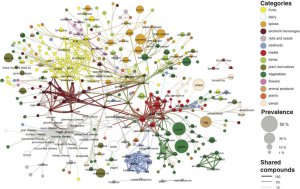
network analysis

network analysis

I could go on and on about different theories and updates and critiques on these ideas, but the point to make here is this is science that is so very useful to the type of networks that food systems are propagating. Almost all of the work that farmers markets do rely on network theory without directly ascribing to it.

Think about a typical market day: a market could map each vendors booth to understand what people come to each table, using Dot Surveys or intercept surveys. That data could assist the vendor and the market. The market will benefit in knowing which are the anchor vendors of the market, which vendors constantly attract new shoppers, which vendors share shoppers etc. The market could also find out who among their shoppers bring information and ideas into the market and who carrries them out to the larger world from the market. All of this data would be mapped visually and would allow the market to be strategic with its efforts, connecting the appropriate type of shoppers to the vendors, expanding the product list for the shoppers likely to purchase new goods and so on.

Network theory would be quite beneficial to markets in their work to expand the reach to benefit program users and in the use of incentives. Since these market pilots began around 2005/2006, it has been a struggle to understand how to create a regular, return user of markets among those who have many barriers to adding this style of health and civic engagement. Those early markets created campaigns designed to offer the multiple and unique benefits of markets as a reason for benefit program shoppers to spend their few dollars there. Those markets also worked to reduce the barriers whenever possible by working with agencies on providing shuttles, offering activities for children while shopping, and adding non-traditional hours and locations for markets. Those efforts in New York, Arizona, California, Maryland, Massachusetts and Louisiana (among others) were positive but the early results were very small, attracting only a few of the shoppers desired. When the outcomes were analyzed by those organizations, it seemed that a few issues were cropping up again and again:
1. The agency that distributed the news of these market programs didn’t understand markets or did not have a relationship of trust with their clients that encouraged introduction of new ideas or acceptance of advice in changing their habits.
2. The market itself was not ready to welcome new benefit program shoppers- too few items were available or the market was not always welcoming to new shoppers who required extra steps and new payment systems.
3. Targeting the right group of “early adopters” among the large benefit program shopping base was impossible to decipher.
4. Some barriers remained and were too large for markets alone to address (lack of transportation or distance for example).
4. Finding the time for staff to do all of that work.

Over time, markets did their best to address these concerns, which has led to the expansion of these systems into every state and a combined impact in the millions for SNAP purchases at markets alone. The cash incentives assisted a great deal, especially with #2 and #4. However, this work would be made so much easier and the impact so much larger if network theory was applied.
Consider:
Market A is going to add a centralized card processing system and has funds to offer a cash incentive. But how to spend it? And how to prepare the market for the program?

If the market joined forces with a public health agency and a social science research team from a nearby university, it might begin by mapping the networks in that market to understand the strong and weak ties it contains as well as the structural holes in its network. It might find out that its vendors attract few new shoppers regularly or that the market’s staff is not connected to many outside actors in the larger network, thereby reducing the chance for information to flow.
It might also see that younger shoppers are not coming to the market and therefore conclude that focusing its efforts on attracting older benefit program shoppers (especially at first) might be a strategic move. If the market has a great many low-income shoppers using FMNP coupons already, the mapping of those shoppers may offer much data about how the market supports benefit program shoppers already and how it might expand with an audience already at market
The public health agency might do the same mapping for the agencies that are meant to offer the news of the market’s program. That mapping might find certain agencies or centers are better at introducing new ideas or have a population that is aligned already with the market’s demographic and therefore likely to feel welcomed.

As for incentives, what markets and their partners routinely tell me is more money is not always the answer. Not knowing what is expected from the use of the incentives or how to reach the best audience for that incentive is exhausting them or at least, puzzling them.
If markets knew their networks and knew where the holes were, they could use their incentive dollars much more efficiently and run their markets without burning out their staff or partners.
They might offer different incentives for their different locations, based on the barriers or offerings for each location. (They may also offer incentives to their vendors to test out new crops.)
If connectors are seen in large numbers in a market, then a “bring a friend” incentive might be offered, or if the mapping shows a large number of families entering the system in that area, then an incentive for a family level shopping experience may be useful.
One of the most important hypotheses that markets should use in their incentive strategy is how can they create a regular shopper through the use of the incentive. Of course, it is not the only hypothesis for a market; a large flagship market might identify their role as introducing new shoppers to their markets every month and use their funds to do just that. But for many markets with limited staff and small populations in and around the market, a never-ending cycle of new shoppers coming in for a few months and then not returning may not be the most efficient way to spend those dollars or their time. So this is also where network theory could be helpful.
By asking those using their EBT card to tell in detail where and how they heard about the program and by also tracking the number of visits they have after their introduction, we could begin to see which introductions work the best. Or by asking a small group of new EBT shoppers to be members of a long-term shopping focus group to track what happens during their visit (how many vendors they purchase from and how long they stay) and after (see Market D example at the top), we could learn about what EBT shoppers in that area value in their market experience. We may also find out that the market has few long-term return shoppers from the EBT population or we may find out that connectors become easy to spot and therefore they can be rewarded when sharing information on the market’s behalf.
In all of these cases, it will be easier for the staff to know what to do and when to do it if they understand their networks both in and around the market.
And of course, mapping the larger food systems around the markets’ systems would be exciting and could move policy issues to action sooner and allow funding to be increased for initiatives to fill the holes found.

However markets do it, what seems necessary is to know specifically who is using markets and how and why they decided to begin to use them and to whom those folks are connected. Network theory can be the best and widest use of the world of Big Data, especially to accomplish what Farmers Market Coalition has set as their call to action: that markets are for everyone.

Some reading, if you are interested:

http://www.foodsystemnetworks.org

http://gladwell.com/the-tipping-point

Click to access networks-book-ch03.pdf

Click to access 827.full.pdf

Click to access kadushin.pdf

FMC’s Free SNAP EBT Equipment Program is Open

As you may have heard, the United States Department of Agriculture (USDA) Food and Nutrition Service (FNS) partnered with the Farmers Market Coalition (FMC) to provide eligible farmers markets and direct marketing farmers with electronic benefit transfer (EBT) equipment necessary to process Supplemental Nutrition Assistance Program (SNAP) benefits.

WHAT


FMC will cover the costs of purchasing or renting SNAP EBT equipment and services (set-up costs, monthly service fees, and wireless fees) for up to three years. After their application has been approved, eligible farmers and farmers markets will choose their own SNAP EBT service provider from a list of participating companies. Transaction fees (for SNAP EBT, credit, and debit payments) will not be covered.

WHEN


The application period will open at 9:00am EST Tuesday, February 17th, 2015. This is a first-come, first-serve opportunity, which will be over when all the funds have been allocated. Don’t wait!

WHO


SNAP-authorized farmers markets and direct marketing farmers (who sell at one or more farmers markets) are eligible for funding if they became authorized before Nov. 18, 2011, AND fall into one of the following categories:

A. They do not currently possess functioning EBT equipment; OR

B. They currently possess functioning EBT equipment, but received
that equipment before May 2, 2012.

Wondering what qualifies as ‘not currently possessing functioning EBT equipment?

Markets and farmers do not currently possess functioning EBT equipment if:

They currently rely on manual/paper vouchers to accept SNAP,
They do not currently accept SNAP and have never possessed functioning SNAP EBT equipment, or
They do not currently accept SNAP because their EBT equipment is
:
Damaged beyond repair.
Non-operational because their SNAP EBT service provider no longer offers SNAP EBT processing in their state.
Stolen or lost.
For more information on the program, including frequently asked questions, an eligibility chart, background information and application instructions, visit them at farmersmarketcoalition.org/programs/freesnapebt
found here.