This is one of the most detailed research papers about the campus market, which is another type of market to consider. Describing market types is an ongoing research project of mine (and others) and some of the most common market types can be found on my website by clicking here.
Typology of markets
Link to data collection slideshow
Gave this presentation recently to the University of Virginia Morven Institute’s “Farmers Markets and Applied Food Systems Research” course. Slideshow
Here is more on this exciting summer course that I am thrilled to be associated:
USDA report: Nutrition Assistance in Farmers Markets: Understanding Current Operations
I have begun to take notes on the 799 page report released by the USDA last week (authored by Westat) on nutrition assistance programs managed at markets/with direct marketing farmers.
This (FM Ops) is the first completed phase of the 3 phases of research. Next will be a FM Client Survey, followed by a survey of organizations administering SNAP at farmers markets.
First, the data collection info:
2 parts to this research of FM Ops
First, 9 markets were interviewed in depth, picked by FNs based on their FNS regions and level of population below poverty level:
Eastern Market, Detroit MI
Peachtree Road, Atlanta GA
South Boston, Boston MA
Clark Park, Philadelphia PA
Market On The Square, Mobile AL
Fort Pierce, Ft. Pierce FL
Wytheville, Wytheville VA
Sitka, Sitka AK
Overland Park, Overland Park KS
Second, 1682 farmers markets and 570 direct marketing farmers were surveyed organized in 4 groups:
1. Those that were SNAP authorized and had redemptions between July 1, 2010 and August 31, 2011-77.4% (FMS) and 68.2% (DMFs) response among this group
2. Those that were SNAP authorized but had no redemptions between July 1,2010 and August 31, 2011- 69% (FMs) and 65% (DMFs) response among this group.
3. Those that were SNAP authorized and had redemptions between July 1, 2007 and August 31, 2010, but had no redemptions after August 31, 2010 – 56.8 % (FMs) response among this group -FNS did not differentiate FMs from DMFs until 2010 so there is no individual data on DMFs.
4. Never SNAP authorized- 51.8% (FMs) response among this group. Same issue as above in tracking DMFs so no numbers for that group in this stratum.
Westat also conducted focus groups with 2 markets in DC and Maryland, with some fascinating input from the participants:
“They don’t all make you feel that way, but sometimes you come across one that makes you feel a little bit like, ‘Oh, another EBT card.’ I don’t think they all do it and it’s not every time, but few and far between. They make you feel a little embarrassed, like a second class citizen.”
Much more to come…..
Vermont Feasibility Report
Very proud to release the Vermont Feasibility Market Currency Report this week. I was contracted last fall to do this work by Vermont Agency of Agriculture, Food and Marketing (VAAFM) in partnership with Northeast Organic Farming Association of Vermont (NOFA-VT).
The focus was whether there were opportunities to merge the coupon (FMNP and incentives) and SNAP programs into a universal currency for all of Vermont’s farmers markets (and also ultimately assist CSAs and other direct marketing outlets) in order to streamline the systems now being used.
The final report covers technology issues, market capacity, costs and outreach for the Vermont farmers markets and offers recommendations for streamlining through pilots and policy and further analysis.
This link takes you to my website where the report is listed.
I am happy to talk about the report or to answer any questions.
Dar
Market Characteristics
I have been working on some documents that I hope will help explain markets a little better to the larger food community and to market partners. Since markets remain the most efficient (and democratic) mechanism for anchoring and expanding community food systems, knowing how to build successful versions is more vital than ever.
The link will take you to one document that will share some of the background of how identifying markets by their sets of internal and external characteristics has evolved. By looking at markets structure, product mix and partnerships/projects, researchers are working to show how markets are not “one-size-fits-all” and that describing and sharing markets characteristics will allow communities to choose the most appropriate market type and also to find appropriate measurements when expanding their reach into more organizing scenarios.
And certainly, better definition will help vendors pick the best market for their business goals while also aiding markets that want to understand and work with neighboring markets.
All in all, collecting characteristics from markets is a good idea that’s time has come.
If you have other descriptions to add, send them along and I’ll be happy to discuss.
This article is now under the Market Evaluation drop down menu linked below and labeled typology/market characteristics:
http://www.helpingpublicmarketsgrow.com/market-characteristics.html
Market visits
One of my ideas for building the movement is for network leaders to think about how to alternate or expand manager trainings. For experienced managers that have attended (and maybe even presented?) at their own state conference, maybe there is way to save some of that funding for those managers to be able to go visit another market instead. There are markets operating year round in every region now and so finding the appropriate market for these managers to learn from has become much easier.
For example, here in Southeastern Louisiana this early spring, we are in the middle of one of our best seasons already; strawberries, citrus, greens and generally full tables since mid January.
Covington Louisiana market this last weekend; 40 miles from New Orleans, this is a classic rural neighborhood-style market. They have about 35 vendors all of which live within 30 miles of the market. The market is held in a green space downtown in the city that is the parish (county) seat which allows plenty of parking nearby on Saturday morning; the market does almost no paid marketing and has no plans to offer credit, debit or EBT sales at all. The vendors can send their teenagers to sell or bring their toddlers because they are more comfortable with its small town air than they would be in the city. All in all, this would be a very good market to visit for a manager of a similar rural area.

Covington Louisiana, 40 miles from New Orleans. This Saturday market has thrived in recent years.
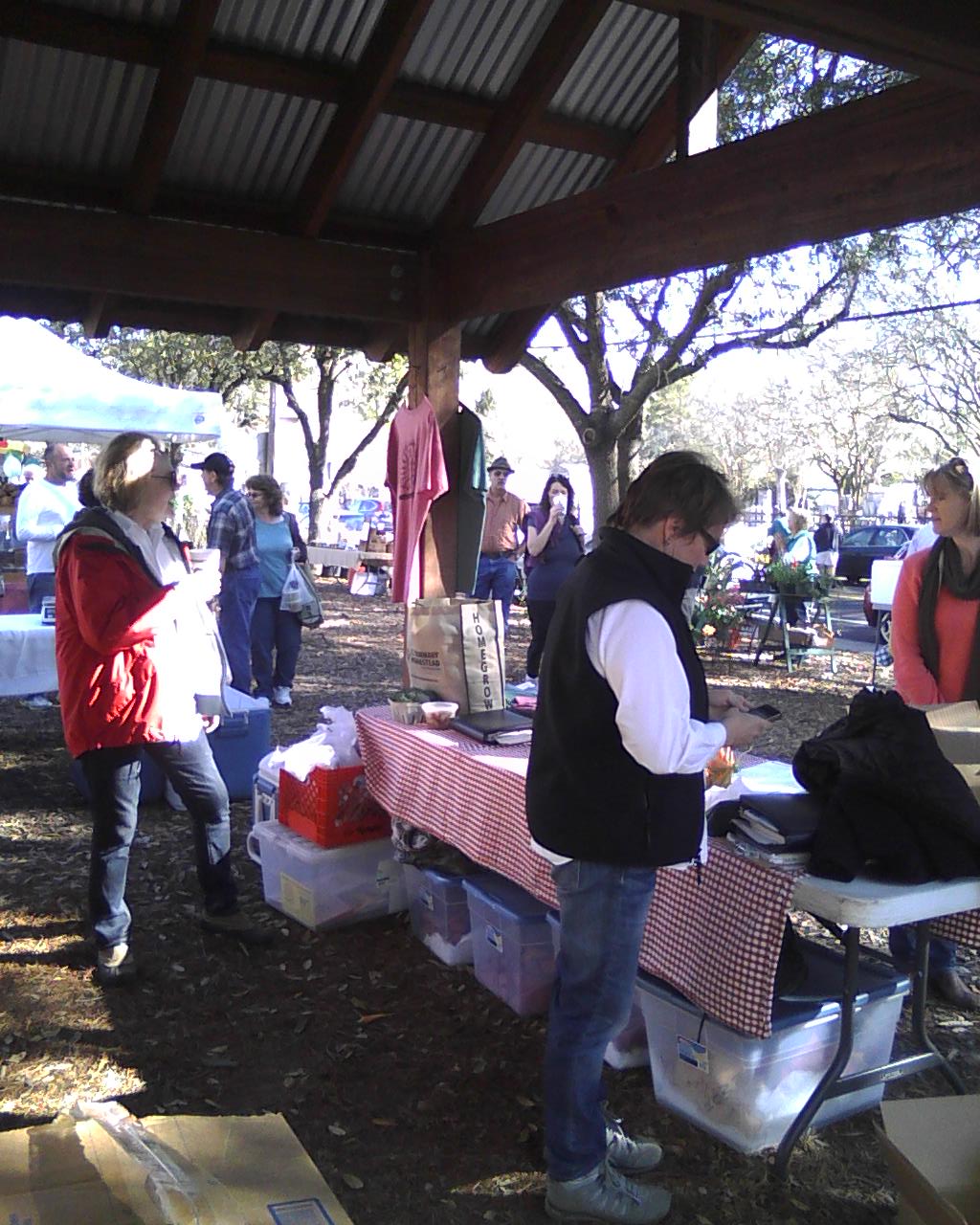
Jan (in vest) is the long time market manager and has a great attitude about her rural parish seat farmers market. Her sister Ann (in the red jacket) helps with logistics and announcements.

a few of the vendors at the St. Paddy’s weekend farmers market in Covington LA.
Governance case study
In 2012, I did an introductory set of case studies on market structure to begin to get some good information to markets that are struggling with their founding or expansion.
The case studies that I did were of markets that had offered to share their background and systems with me that covered some regularly used types of governance.
However, I would like to stress that often when markets ask for help with their governance, what they really need is help designing appropriate management systems. In other words, if the market community has the ability to understand and even help decide on rules and decisions and manages its organizational risks well, then I often have to conclude that the governance is fine (although sometimes the pool of available advisors to serve is too small or maybe the work is as not clearly defined as it needs to be). What is more often in flux is the design of the management job and a market’s planning for project design.
It is clear that consultants need to have more options for management to match the many types of markets that exist. On top of that, how a market decides on projects to undertake every year should be more comprehensive than a manager’s good idea and willingness of volunteers to help.
I expect to do some work on management systems and project design in 2013 and to be able to share new resources. Until then, take a look at the Market Governance Case Study Report:
HPMG-MG report
Anchor vendor presentation
This is a presentation that I have done for markets about seeking anchor vendors. It is a little clunky to view in this format.. There is another piece to this that I took off (for the sake of making this clear and simple) about searching for the anchor vendor primary shoppers group by group. That piece focuses on markets taking the time to understand their anchor vendors and then finding shoppers for those vendors and then attracting the vendor’s primary shopping groups in small clusters through different marketing outlets.

This slideshow is meant to give a broad framework of how to build a market. Let’s pretend this is a brand new market and the numbers are meant to be the beginning goals to shoot for in the first few months.


Carrboro, here I come
I’m off this morning to visit with my wonderful colleagues in North Carolina. Sarah Blacklin of the Carrboro Farmers Market has invited me to interrupt her very busy work schedule to talk about evaluation, federal benefit programs and (maybe) assisting in convening the North Carolina markets so that they can share more fully and learn from each other’s excellent examples.
I originally went to Carrboro in 2006 when Sheila (the then market manager) invited me to take part in their Katrina gumbo fundraiser which was to benefit my own New Orleans farmers markets. It was such a great idea. They asked 5 restaurants to make their own version of gumbo and then sold each for 1 hour at a time at the market. Sold out or not, they went to the next one at the top of the hour with much fanfare (they ripped off the previous name and uncovered the upcoming with great cheers.) Of course, they almost all sold out and people hung around to get their favorites, not knowing which hour each would be sold. They raised over 6000.00 for my markets and vendors!
The market had over 5500 shoppers that day (not an unusual number for this excellent market) and their support was so genuine and warm that I have always considered the Carrboro Farmers Market (CFM) to be the sister market to Crescent City Farmers Market (CCFM) and whenever I can go and see their excellent work and the nearby Durham Farmers Market market, I go.
I am very lucky to be working with so many state and national leaders – I am honored to be asked to help them figure things out for their markets – but I will always save some of my time for those individual market leaders who inspire me with their own local vision and joie de vivre.
Ben And Jerry’s Becomes A B Corporation | Co.Exist: World changing ideas and innovation
For-profit and non-profit incorporations are still hot topics among markets. Recently, there has been a flurry of comments on the FMC Listserve about 501(c)3s, which shows how this is still an emerging field.
The B Corp is another layer for corporations to consider. It allows for some parallel benefits to exist side by side, and Ben and Jerry’s has joined their ranks it seems:
Ben And Jerry’s Becomes A B Corporation | Co.Exist: World changing ideas and innovation.
Sail alone, anchor together
A few years ago, I was watching a Charlie Rose interview with the musician, Tori Amos. She was going on tour with Alanis Morrisette and Charlie asked her how that worked, how could they combine their shows. Tori frowned in concentration and said (I’m sort of paraphrasing here):
it’s not really about merging them. Really, I’m… a pirate ship. I have a captain, I have my own mates, my own wenches…..and so does she…
That comment stuck in my mind. When I went to work the next day, I shared it Richard McCarthy, who was then the Executive Director of Market Umbrella. We were constantly searching for metaphors for farmers market organizing to describe the way it was bending (or could be) to becoming a true movement rather than a series of random events in towns and cities. We had collected some cool descriptions, still wondered if we had yet found the best way to describe it.
“A pirate ship. Hmmm,” he said. True to his nature as a leader who employs engaging and system-level thinking, he kept at it, coming up with a powerpoint on the pirate ship idea that he continues to refine and use in his global work with civic and food organizers.
When I’m out in the field, I find that much of what we do in markets and in food systems is duplication of the worst sort, meaning unnecessary and a time waster for overworked markets or networks, or just as bad is the an expectation that all markets or projects should operate and be measured the exact same way. Why is that, I often wondered? Why don’t markets or organizers talk more to each other, sharing more tools peer-to-peer and find the strength to resist being measured and judged by inappropriate metrics?
Well, I do know why it happens. It happens because the work of community organizing is so important to do correctly and yet so unrelenting that it is hard to find time to share. And then what should be shared and how it could be shared is often as complicated.
The Tori Amos interview spoke to that idea.
The idea that innovation and creativity is handmade and often an individual exercise, or coming from a small committed group who are learning as they go.
And that sharing is not necessarily about combining efforts, but more often about connecting when needed and not overemphasizing one set of values over another.
That individuals or small groups need some autonomy and yet, in order to build a movement there are times when building the networks is as important.
So from that Amos interview came this line that Richard and I created while standing outside of a coffeehouse:
Sail Alone, Anchor Together
Like pirate ships or if you prefer, privateer ships, markets have their own flag, their own code and their own mates. Sooner or later though, they may need to join up in order to defend themselves from other forces or come together to succeed on an issue.
How they do that is important. When they do that is important too.
The lack of a national or even a regional convening primarily for farmers markets may be starting to hamper our efforts for long term policy changes and impair capacity building. In lieu of that, we can (and should) moor our nimble little ships to sides of elegant liner like a re-imagined public markets conference or join a strong armada such as a well-organized school food initiative when we can, but even then, when we don’t know what to share and when, it’s hard to contribute meaningfully.
We also have our own issues to talk about. What about SNAP/EBT? Disaster planning for market farmers? Training for market managers? Food safety issues? Permanent locations? Sustainable funding? Building appropriate networks for policy work? Evaluation? We need to work this stuff out together and decide how it’s appropriate to our scale.
Some market networks are lucky. They have solid food systems that they work in and grow in sustainably. But even the best need to anchor with the odd little markets and share and hear because innovation within a field often comes from unlikely sources.
And sometimes it’s as hard to get the larger, more established markets to take the time and find the right voice in which to share their ideas and plans, to do that even as they are piloting ever more complex projects.
Respect to each pirate ship must be paid by the others. Learn to spot the flags and to find ways to anchor together.

How Veggie Co-ops and Ice Cream Collaboratives Could Save the Economy | Mother Jones
This entrepreneur throws some great numbers out in this excellent blog post and also entices us all with visions of local ice cream and veggies at what he, very interestingly calls a winter food bazaar. That typology term may fit in quite nicely to the project that we call Market CITY (Characteristics, Indicators and Typology)
His reference to Civic Economics and Ken Meter’s work is not surprising, since their reports (along with Michael Shuman at BALLE and Jeffrey O’Hara at Union of Concerned Scientists) make up much of the data that we are using to build the economic argument for local food systems.
How Veggie Co-ops and Ice Cream Collaboratives Could Save the Economy | Mother Jones.
 Helping Farmers Markets Grow