The late winter and spring are mad times for a farmers market consultant. The numbers of workshops and conferences has doubled or tripled in the last few years and every year since 2005 or so, I have been honored to be asked to present at 4 to 10 state or national convenings. I very much appreciate the opportunity to work with many market and market advocates at one time and to hear about new ideas and to meet some of those names I read from reports and posts on listserves.
In January, I spoke at NOFA-VT’s Direct Marketing Conference for the second year and I must say it’s a favorite of mine-a great mix of market organizers, farmers and agencies. Very focused and well attended. NOFA does an extremely professional job putting this on without showing the blood, sweat and maybe even tears, but knowing them its probably blood, sweat and laughs…
Part of why I went there was to conduct interviews with farmers and market operators to ensure their point of view is included within the state feasibility report that I am doing for NOFA and VAAFM (Vermont Agency of Agriculture, Food and Markets) on their EBT, WIC, FMNP systems and what steps it would take to build a comprehensive and universal system for their markets. (And no, I don’t ski or participate in winter sports so outdoor fun doesn’t factor in….)
Unfortunately, my schedule, vendors winter flu and other issues prevented me from getting enough interviews, so I decided to come back and to buttonhole some more folks at the other conference I have heard about from many Vermonters-NOFA’s Winter Conference. Workshops, TED talks, a multitude of different points of views from producers to “eaters” and a seed swap among many other things.
If you’re nearby and can make it, you might want to register and check it out for yourself. If you’re further away, you might want to download their brochure and put one on in your town.
Where’s Dar now?
Hot topics in cold Vermont…
Living in New Orleans used to mean that I had a mild winter (if any) to deal with each year and January was about celebrating Carnival from Twelfth Night up until Fat Tuesday (Mardi Gras). Now as a market consultant, I spend the winter traveling to conferences and meetings, oddly almost all held in the northern climes!
Even with my aversion to cold, I am excited to be returning to Vermont for my third visit with NOFA-VT, and the second time I will be attending their Direct Marketing Conference held in lovely South Royalton VT.
Beginning last fall, I started work with NOFA-VT and the Vermont Agency of Agriculture to study their card and token currency systems in the markets and comparing them to other states’ systems in view of the 2020 implementation of WIC to EBT cards – as well as the new technology that is swirling around like Square and the new upcoming Novo Dia Group smart phone app for cc/debit/food stamps. Also included in this research is the need to ascertain if these systems (which of course include incentives, FMNP coupons, WIC vouchers and in some states veggie prescriptions too) are working well at market level and how to measure them.
I have been calling on my colleagues across a dozen states and networks to hear their analysis which has been shared most generously. Now, I go to Vermont to gather some case studies from farmers and market managers to round out the raw data which then will need to be crammed into a manageable report for Vermont come early spring.
wish me luck.
And, email me or call me if you have data on a network or state level that you wish to share.
Saxapahaw: Gatorade next to Kombucha
What a treat I had yesterday. Sarah of the Carrboro Farmers Market has been patiently squiring me around the area, meeting to meeting, meal to meal. Hopefully, all of you have made it to this area of North Carolina and had some of their amazing food, centered by the pork, chicken -well, all meat- that they love and know how to cook in so many interesting ways.
Yesterday, Sarah took me a few miles out of Carrboro to a little town called Saxapahaw (pronounced sax-paw the Carrboro native says) for lunch and for a quick meeting. That meeting easily became an afternoon, because of the fascinating Saxapahaw General Store.
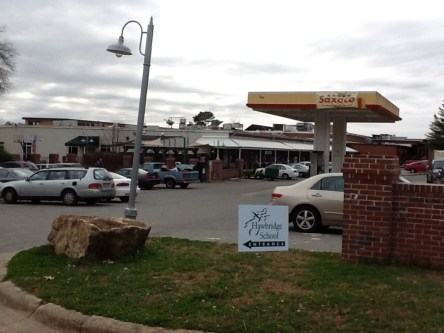
Here is what their website says about their beginnings:
The Saxapahaw General Store as it now exists began in June 2008 when Jeff Barney, butcher and self-taught cook, and Cameron Ratliff, teacher and self-taught biscuit maker, worked with former owner Mac Jordan to begin a new life for the convenience store and gas station that had served the community for several years. They imagined a spot where a village could gather for refreshments, meals, and basic home provisions, run by folks whose varied backgrounds have each taught them they can influence their world by collaborating with their neighbors. They hoped to serve the residents of Saxapahaw with a range of products that could allow everyone to feel welcome. They decided to become stewards of local foods, good wine and beer, nutritious snacks, and eco-conscious dry goods.
What I saw was a business model that looked right. Once I met the dynamo farmer Suzanne, I became even more sure. Suzanne took us across the street to the pastures after our lunch
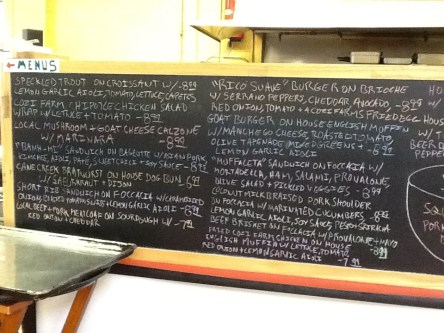
(the picture below shows what is available for lunch-all of the meat is local and much of the produce too)
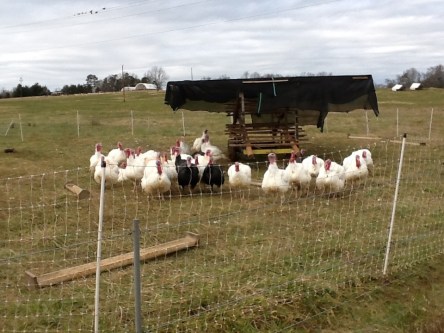
The turkeys were the last of the year, with these destined for ground turkey in the next week or so.
Much of the poultry production is done herself alongside Saxapahaw neighbors and coworkers; the humane treatment of her animals at the end of their lives is so important to this farmer that she told us she would not use many of the processing plants available to her. And that if that was the only way that they could be processed that she wouldn’t raise animals for food.
She pointed out the ducks that they had only begun to raise for food and the vegetable garden, also beginning. At this point, the store is buying from the very talented growers that surround the area thanks to the Carrboro Farmers Market and its younger sister markets, but the emporia is going to grow some of its own produce across the street. The composting is carefully monitored before being shared with their animals, so as to not waste any of the precious produce.
The store is set up to roam and shop after one has put their order in at the counter. Coca-cola products are lined up near pure ginger root drinks, homemade baked goods and local preserves near the small candy area. Hunting gear and motor oil can also be picked up as well along with some biodiesel or gas for your truck.
The store is both a throwback and a nod to the future. Suzanne talked extensively about the ongoing need for more equipment as well as sharing individual stories of the staff and their talents. Throughout our time there, people of varying ages and backgrounds came and went, bought food, drink and dry goods.
As public health and regional planners look for store models that can offer dignity and inclusion to food producers as an encouragement to sell there (just as the farmers market world has done) this store should become a Mecca. Using around 1500 square feet to offer as many culturally appropriate items as possible (Suzanne dreams of the day she can put out her gizzards and turkey necks next to the stock already offered) and real food choices next to convenience items still necessary to the real world, the Saxapahaw General Store is a food organizer’s dream come true.
Carrboro, here I come
I’m off this morning to visit with my wonderful colleagues in North Carolina. Sarah Blacklin of the Carrboro Farmers Market has invited me to interrupt her very busy work schedule to talk about evaluation, federal benefit programs and (maybe) assisting in convening the North Carolina markets so that they can share more fully and learn from each other’s excellent examples.
I originally went to Carrboro in 2006 when Sheila (the then market manager) invited me to take part in their Katrina gumbo fundraiser which was to benefit my own New Orleans farmers markets. It was such a great idea. They asked 5 restaurants to make their own version of gumbo and then sold each for 1 hour at a time at the market. Sold out or not, they went to the next one at the top of the hour with much fanfare (they ripped off the previous name and uncovered the upcoming with great cheers.) Of course, they almost all sold out and people hung around to get their favorites, not knowing which hour each would be sold. They raised over 6000.00 for my markets and vendors!
The market had over 5500 shoppers that day (not an unusual number for this excellent market) and their support was so genuine and warm that I have always considered the Carrboro Farmers Market (CFM) to be the sister market to Crescent City Farmers Market (CCFM) and whenever I can go and see their excellent work and the nearby Durham Farmers Market market, I go.
I am very lucky to be working with so many state and national leaders – I am honored to be asked to help them figure things out for their markets – but I will always save some of my time for those individual market leaders who inspire me with their own local vision and joie de vivre.
Seed in Oregon City
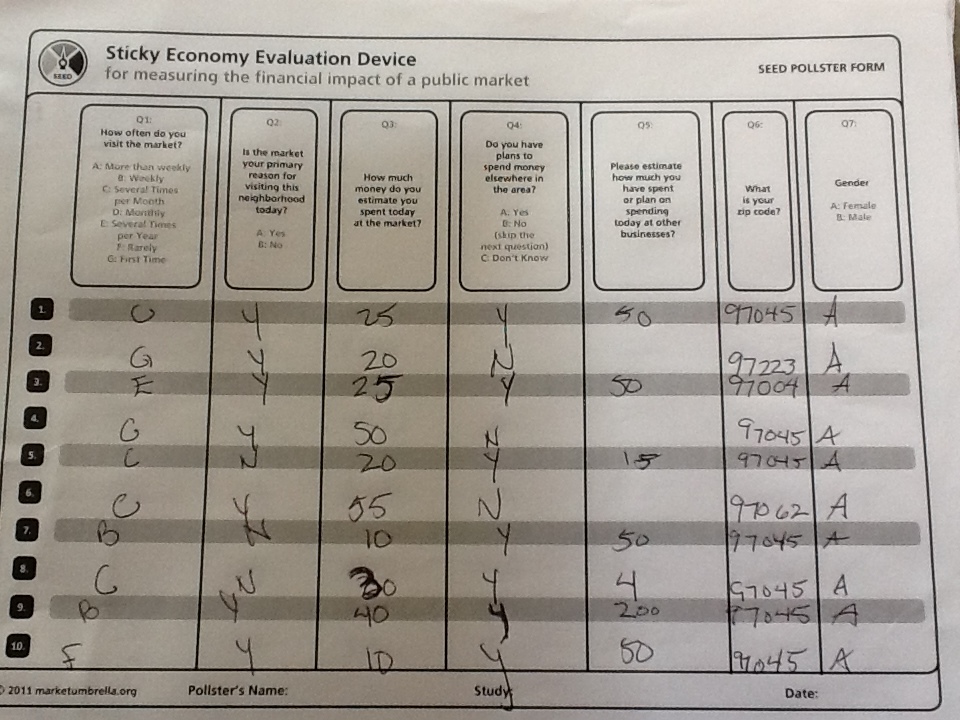
Just finished the first ever SEED http://www.marketumbrella.org/marketshare/
study in Oregon City, Oregon. Market manager Jackie Hammond-Williams puts together an amazing market every few days and has a lot of fun while she does it. Look for my upcoming FMC newsletter story about the study day and how this economic tool measures a markets impact. AND you’ll be able to read the report too – which was ready the next day. I guess we’ll let OCFM look at it first but I’m sure they will have it on their website very soon, and it will be followed by their weekday market SEED report too.
Morven Summer Institute studies farmers markets evaluation
The University of Virginia has begun their latest set of summer courses at their Morven Summer Institute outside of Charlottesville. The Farmers Market Coalition has partnered with professors Tanya Denckla Cobb, Department of Urban & Environmental Planning and Paul Freedman, Department of Politics to present a 2-week course on farmers markets.
Farmers Markets and Applied Food Systems Research will explore the history of the modern farmers market movement, its purpose and discuss emerging evaluation techniques through guest lecturers such as Stacy Miller, Executive Director of FMC, Richard McCarthy, Executive Director of marketumbrella.org, Bernie Prince, FMC Board President and Co-Director of Fresh Farm, and yours truly, independent researcher and public market trainer. The students will also attempt some market-level research using the Indicator Matrix we are developing at FMC and marketumbrella.org’s SEED tool.
About Morven:
In 2001, philanthropist John W. Kluge gave an extraordinary gift of real estate to the University of Virginia Foundation for educational and charitable purpose. The 7,379-acre gift, valued in excess of $45 million, more than doubled the University’s land holdings. Located in southeastern Albemarle County, the properties comprised 11 farms and estates, including historic Morven Farm.
Community
I am because we are.
Whiteness assigns unearned privilege in our society. Join others to learn how to undo racism in your own life, your own business, your own community.
Malik Yakini, Detroit Black Community Food Security Network
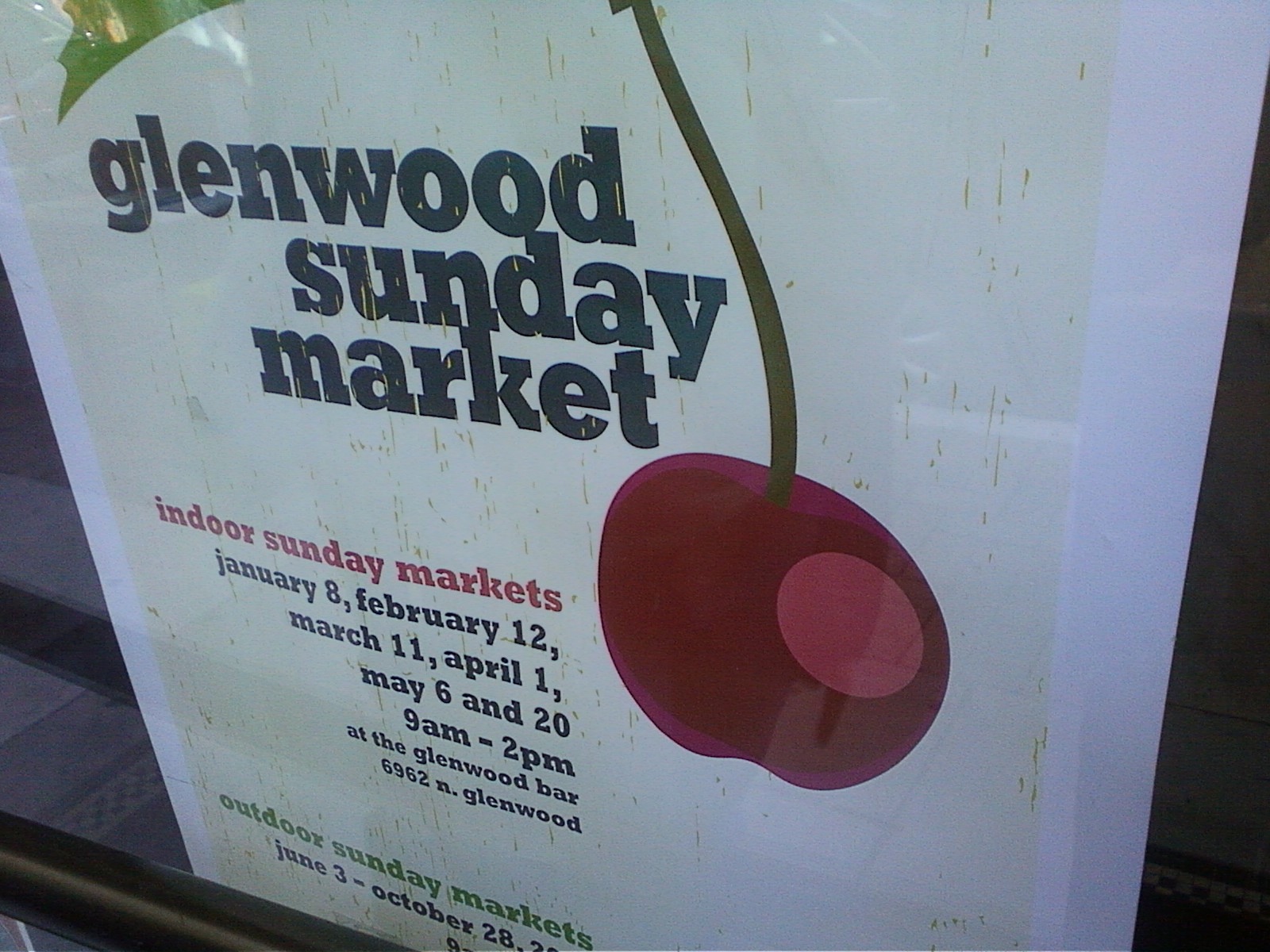
Chicago market location
I’d very much like to see this market in its full summer glory! The bricked block is where it’s held when outdoors… My friend who lives around the corner goes to it and enjoys it, but only goes to the outdoor summer market. Her reason? ” can’t get it together to make it to the indoor market, and I’m not sure I like it when markets are indoors…”
Huh.
Business Alliance for Local Living Economies Conference
I was fortunate enough to receive a Community Capital Sponsorship from RSF Social Finance for the annual conference that is being held in Grand Rapids Michigan this week. I am especially looking forward to the workshop on indicators for measuring local economies, as well as listening in on some of the case studies for funding entrepreneurial businesses.
If you have not heard of BALLE, it’s high time:
The Business Alliance for Local Living Economies, or BALLE, is North America’s fastest growing network of socially responsible businesses, comprised of over 80 community networks in 30 U.S. states and Canadian provinces representing over 22,000 independent business members across the U.S. and Canada.
BALLE believes that local, independent businesses are among our most potent change agents, uniquely prepared to take on the challenges of the twenty-first century with an agility, sense of place, and relationship-based approach others lack. They are more than employers and profit-makers; they are neighbors, community builders and the starting point for social innovation, aligning commerce with the common good and bringing transparency, accountability, and a caring human face to the marketplace.
BALLE’s mission is to catalyze, strengthen and connect networks of locally owned independent businesses dedicated to building strong Local Living Economies.
In late 2001, BALLE was officially launched with Laury and Judy as founding co-chairs and Michael Shuman and David Korten on the first board of advisors. Under Laury’s leadership, BALLE eventually spun off from SVN to become its own nonprofit organization, and held its first national conference in Portland, Oregon, in 2003. Since then BALLE has grown to include more than 80 other local business networks encompassing over 22,000 entrepreneurs in the US and Canada.
BALLE is a 501c3 non-profit organization.
Toronto trip #1
I just returned from giving the keynote at the Greenbelt Farmers Market Network Market Manager Day in Toronto Canada. I know, how lucky does one person get…
Spending four days with my peers to the north taught me a great many things and confirmed some others. I will post a few different stories and highlights about the trip this week, but let me start today with some generalities:
1. The deep awareness of the importance of civil society in Canada serves the market and food system well. Those working on these issues know that in order for change to be calibrated correctly, it is important for citizens to constantly act as “civic agents.” They are not afraid to be oppositional when needed (when dealing with government especially) but also understand that they need to “assist each department in achieving their particular mandate” as eloquently stated by Barbara Emanuel, Manager of the Food Strategy at Toronto Public Health. (That civic agent term was defined again for me in an article I read on the way home in the latest Democracy: A Journal of Ideas in a series called Reclaiming Citizenship which I heartily recommend as well.)
2. Every food organizer I met on that trip understood that the farmer/producer needs to remain as the central partner in all projects. In other words, I didn’t come across lip service to the needs of the farmer. That lip service is usually found in code words or phrases such as “scaling up” or “elitist farmers markets” in food system conversations that I find myself in across North America and in other Western countries. Those code words tell you that the sayers are content to ignore the facts of the relative age and sophistication of our work and the intractable nature of the industrial food system so far.
I instead heard complex, thoughtful responses to the needs of farmers while balancing health equity needs for shoppers. I wish I found that more often in my travels.
3. A set of organizers who recognize that they all must remain at the same table. More specifically, that they all sit at the table but may not have the same menu of choices in front of them. Debbie Fields, the extraordinary Executive Director of FoodShare Toronto said as much to me about her colleague Anne Freeman (my host, the organizer of the Greenbelt Farmers Market Network and founder of the Dufferin Grove Farmers Market) “Anne and I understand that we have the same goal but have to use different avenues to get there.”
4. Internal evaluation is becoming known and necessary. I can’t wait to tell you more about the dynamic presentation (and later meeting of the mind) I experienced through Helene St. Jacques, a Food Share board member and marketing research professional showing results of the research done on behalf of the markets. . And, I look forward to doing some of that US/Canada evaluation sharing with Helene as well.
So much to tell you….
Farmer Federation of New York farmer information day
This week in Manhattan, Diane of the Farmers Federation of New York leads an overview on EBT, WIC, FMNP and food handling for farmers working at farmers markets. The Farmers Federation works with FNS, Dept of Ag and other partners to streamline EBT acceptance for markets in New York. They facilitate the markets receiving free machines, supply each market with their own tokens, reimburse the transaction costs and train market vendors and managers. A very instructive morning for markets and vendors, courtesy of the Farmers Federation. Nice model for other states to check out.
Community markets innovating in Central Brooklyn
Am in Central Brooklyn, working with 6 great community organizations who run markets. All 6 are creating innovative projects through their market, such as senior mixed baskets, rooftop gardens, night markets, food pantries and more. They use their market as their welcome wagon and as their laboratory for all of their ideas.
Inspiring to see what low-capital, high-energy activists can do with just a little bit of encouragement and entrepreneurial drive.
If you get to NYC, take the trip to Bed Stuy to see what is going on and share some ideas of your own with these wonderful organizations:
East New York Farms
Brooklyn Rescue Mission
Hattie Catharn Community Garden
Cypress Hills Youthmarket
Brownsville Farmers Market
Bushwick Farmers Market
Our season of sharing really starts now
For those deep in the market world, the year tends to go in patterns. Starting with workshops and meetings in the winter and early spring, we then gear up for the late spring season at market, then work madly throughout the summer, and end the year writing reports and attending to administrative needs.
Whether the market is year-round or your region has seasonal markets, it makes it hard to find the time to gain or share knowledge past those we see regularly at market.
As we start our workshop/conference season, I for one am looking forward to the Southern SAWG conference in Little Rock, AK. SSAWG functions as a regional entity, working with and through hundreds of associated organizations across 13 southern states. By building partnerships, sharing information and conducting analysis, they transform isolated ideas and innovations into practical tools and approaches for widespread use.
I have presented at past SSAWG conferences and am always energized by the farmer bustle and the very detailed assistance that is available to organizers across the South from this organization. We don’t have many large organizations down here, so we value each one we get!
There is still time to register for SSAWG; the information gained would be useful even if you are not a Southern farmer or food organizer. And if Little Rock is not possible for you to visit this year, at least sign up for their Newsletter.
Oakland get together
If you haven’t been to the Community Food Security Coalition’s annual conference-well unfortunately, you’re about to miss another.
This weekend and early next week, hundreds of food activists will gather in Oakland (yes, right across from the Occupy protests) to discuss, learn and move forward.
As we grow our movement, the need to share grows as well. Spending time in hotel ballrooms can often seem like a cruel fate for active people, but that time together speeds up all of our strategy for implementation.
Do look at 2012 and see where you can put some time away from your important projects and see others important projects. And, if you can, join CFSC in listening to the movement.
About CFSC