Farmers Market Coalition
It’s officially NATIONAL FARMERS MARKET WEEK. Use hashtag #FarmMktWeek to share your markets’ happenings, and use #FMCFUN and #FMCCookingDemo to take part in FMC’s Instagram Challenges this week.
Farmers Market Coalition
It’s officially NATIONAL FARMERS MARKET WEEK. Use hashtag #FarmMktWeek to share your markets’ happenings, and use #FMCFUN and #FMCCookingDemo to take part in FMC’s Instagram Challenges this week.
“As fracking expands into areas that are home to some of the most productive farmland in the world, questions need to be raised regarding the long-term safety for the agricultural industry.”
Read more: http://www.care2.com/greenliving/how-fracking-affects-your-farmers-market.html#ixzz2b0f0EWi3
How Fracking Affects Your Farmer's Market | Care2 Healthy Living.
The Rural Advancement Foundation International-USA’s mission is to cultivate markets, policies, and communities that sustain thriving, socially just, and environmentally sound family farms. RAFI works nationally and internationally, focusing on North Carolina and the southeastern United States. RAFI is a 501(c)(3) nonprofit organization based in Pittsboro, North Carolina and incorporated in 1990.
Learned about this excellent organization on my last visit to Carrboro North Carolina while I was there working with my colleague Sarah Blacklin, (she late of the Carrboro Farmers Market and now working on statewide analysis of meat production); RAFI’s excellent deep work with farmers is one of the reasons that North Carolina are seeing entrepreneurial farming in larger numbers, and I am sure that they are more than willing to share that credit with a host of other NGOs and universities as well.
This fundraiser idea is a great one and no matter where you are in the US, you might want to look into it and support their work more closely.
The Crop Hop: Celebrating Family Farmers & Supporting Farm Advocacy.
As some of you know, I believe that the era of mission-driven farmers markets has just begun and that how we view our work needs to expand to help the farmers and buyers that we work with. In that mindset, we should begin to examine the idea of public markets entirely devoted to restaurant/grocer (then wholesale) sales of local goods, curated with the same intention and mission by those of us that currently manage retail farmers markets.
In order to do that, we should learn from wholesale terminals such as this one in Canada. I found a couple of things within this article about the Ontario Terminal fascinating. My notes are in italics.
In less than 40 seconds, DiLiso has placed his order: cabbage, cipollini onions, bean sprouts and bok choy. Na enters the data on a hand-held digital device then, with a mutual nod, moves on to another client, leaving DiLiso to gather up his vegetables.
That’s how deals are done at The Ontario Food Terminal, the giant U-shaped building on 16 hectares off the Queensway in west Toronto: friendly, no-nonsense, fast.
(Notice the ability to enter sales on a hand held device?)
———————————–
DiLiso and his small crew criss-cross the market to find sellers they trust who have the best deals on vegetables.
“It’s all about relationships,” DiLiso says.
(I dunno- it sounds like it is as much about price?)
Supporting (and understanding) strong and weak ties is a fascinating part of the work that markets do to build food systems. This story expands into another area: “familiar strangers” or people that we see on a regular basis in our daily lives. Markets obviously figure into this type of research.
What I have learned from sociologists is that strong ties are those kinship relationships that you turn to for support. Weak ties offer support through their number and through the diversity of acquaintances that can offer advice and connections, and of course, that can grow into strong ties. This change happens in community settings like markets.
The public health sector is one that relies deeply on markets work with both and with familiar strangers. The word of mouth work to encourage citizens in low-income and adverse areas to begin market shopping is based on this science. Additionally, working to encourage families and children to market as well as the work with farmers is about understanding their networks and how to add to them. Studying these ties might also be potential funding opportunities for market networks. The more that we know about how people connect to each other, the better we run markets.
“Unlike other social networks, where people interact within a circle of friends and acquaintances, we show
an often-ignored type of social link: weak, passive and indirectly enabled by daily encounters. As a result of
deep-rooted individual behavior patterns, our results also present the collective regularity of people with their recurring encounters as evidence, explaining the familiar strangers” phenomenon in daily life.”
How does the range of choices affect sales at a market? Talking with a vendor at a market last week, he mentioned that his sales have actually risen even though another vendor has joined the market with very similar items; he was dumbfounded that their sales had actually gone up. This may be the explanation that they need to understand:
“Giving consumers only one option increases their desire to search for more options. As a result, they might reject a product they would otherwise purchase.”
Market organizers always need to be carefully calibrating the levels of products because restricting sales too much may actually reduce the lone seller’s profits and too much of one item can certainly dilute those sales too much.
Another great foundation to work your magic on, folks….
Purpose: The Grassroots Organizing for Social Change Program supports non-profit grassroots, constituent-led organizations across the country that are using direct action, grassroots community-organizing strategies to accomplish their goals. We consider proposals that are aligned with the Foundation’s broad interests in social justice, environmental justice and sustainable food systems. Although we appreciate the value of direct service programs in meeting individual and family needs, we do not fund such programs.
Process: The process starts with the Letter of Interest (LOI). We fund organizations with budgets of $500,000 or less. Grant awards are up to $20,000 for a one-year period.
We have three funding cycles per year: two for new applicants and one for Renewals.
The next deadline for new applicants is September 13th, 2013 for consideration in our 1st Quarter 2014 grant cycle.

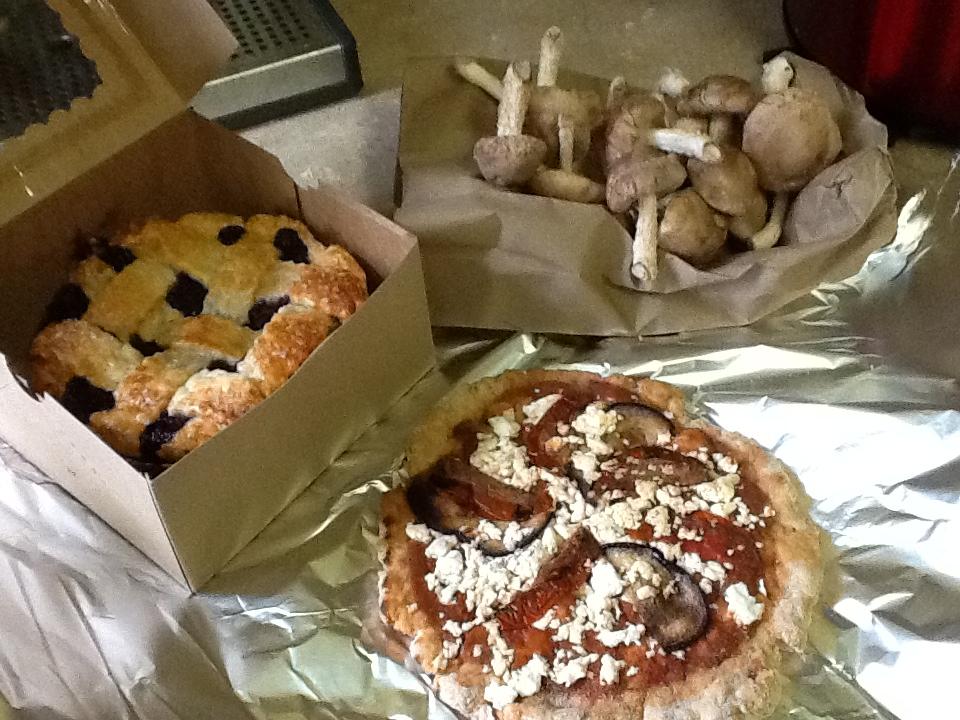
Blueberry pie from Windowsill Pies and gluten-free pizza and shrooms from the Rue family, all from Covington Farmers Market..
Take a long look at that picture. To many, it may only show another dang food picture that was posted online but to me it represents something else entirely.
All of those goods came from the Covington Farmers Market, which is a parish (to most of you outside of Louisiana, parish=county) seat market located 40 miles from downtown New Orleans and across Lake Pontchartrain in an area of what used to be called the Ozone Belt for its pine tree greenery.
The gluten-free pizza was sold to me by a teen who was selling them on behalf of her family business and could tell me what was in their pizzas and why, could take my money and offer change with a genuine smile and good wishes. The mushrooms were on their table too and collected as a side option to their prepared food sales, as well as used in their goods.
The pie was sold to me by 2 entrepreneurs that buy their ingredients locally as often as possible (literally pointing to the honey seller that provided the basis of this pie’s lack of refined sugar). This vendor’s artistic tendencies suit their product list well, all of the way to the windowed boxes for their pies and their oil cloth tablecloth and vintage aprons presentation.
What is important to me as a shopper about this picture is that it represents a (still) unusual way of buying food; I can ask each of them exactly what is in their goods and how they were made. They are working to replace industrial ingredients with natural and closer-to-home versions that offer more taste. And of course, not only did I get a chance to talk directly with the makers of these goods and to encourage them further, but that I was able to buy from young women, all just beginning farmers market sales. All of the made goods were delicious and will be bought many times again. I may buy them for myself on a week in which I know I am just not going to feel like cooking or they may be used to share with friends when they come to spend the day at the pool or may even be brought to a party I am invited to as my gift.
Market managers know that farmers markets are THE incubator for businesses that are not ready for or do not want storefronts. The chance to take a small idea and grow it slowly and carefully is a necessary step for any entrepreneur, yet the places one can do this are so limited that markets are among the only ones that regularly offer that opportunity. Many experienced market shoppers know that when they see new goods at markets that are advanced in their ingredients and presentation, they must immediately support them vigorously and talk them up to their friends. In turn, market managers need to monitor these vendors and introduce them to those shoppers (as this market’s manager did to me) as well as search for those vendors’ new shoppers, who may not already be present.
In other words, these vendors often represent a new age in a market. Its important to remember that young vendors trying items that can only be sold at farmers markets are who we want to see more of in markets. These folks cannot (or do not) sell their goods to Whole Foods or ship them worldwide; they design products for the type of person who stops and asks about their ingredients and their process. Therefore, they are an indicator species, which is defined beautifully in the Encyclopædia Brittanica as an organism that serves as a measure of the environmental conditions that exist in a given locale.
If indicator species show the health of an environment, then their low activity can alert to danger in a market’s health or when increasing, can show vitality. Encouragement of diversity of products, gender, age, ethnicity and business goals is exactly what each market must be setting as a goal daily, weekly, monthly and so on. To me, the presence of these indicator vendors and others at this little market show its emerging strength. And offers some damn tasty research at the same time.
As my readers know, I’m sort of obsessed with researching evaluation techniques and indicators to find ways to replicate successful farm and food enterprises.
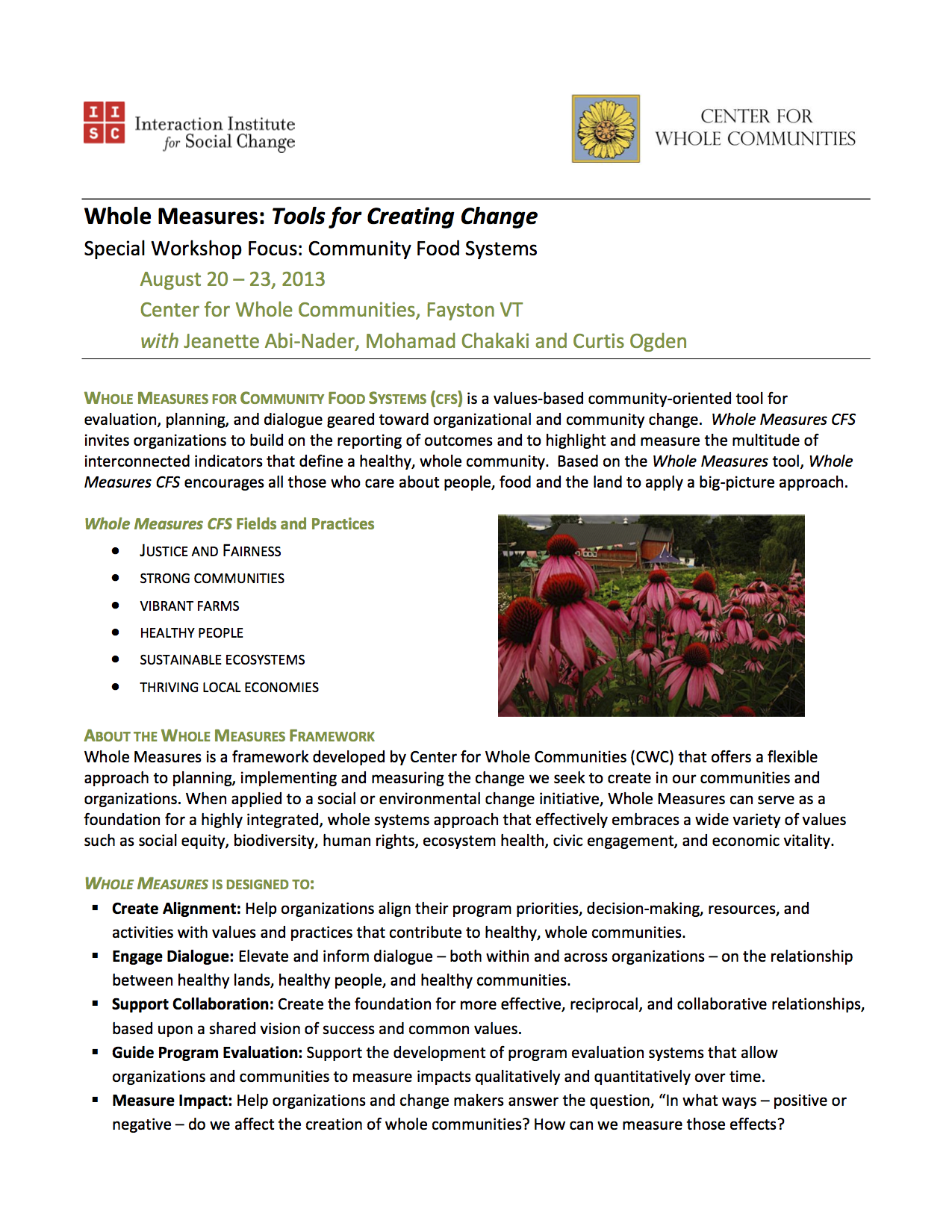
Whole Measures is one of the grandaddies of food system measures and should be considered especially when anyone is building multi-stakeholder evaluation. Whole Measures takes a long view of success, looking at system change and multiple impacts. I urge people to take a look at it especially if you have a chance to actually take a workshop from evaluation and training expert Jeanette Abi-Nader.
A fascinating report from FMC and MU about the Farmers Market Promotion Program.
Report and more information here:
The education that markets must do to encourage more direct interaction between shoppers and vendors includes things like explaining fishing seasons along and near coastal waters. I have found that many, many people in my state are unaware of the seasonal nature of shrimping and are unaware of the difference between the fleets that are fishing in the Gulf (federal waters) and the family boats using the “inside” waters (state waters).
And that the very presence of fishers in these waters allows all of us concerned with oil companies and others that are constantly extracting from our waterways to have “eyes on the street” as it were.
In short, markets must remember that information is their currency.
Officials say data collected in recent weeks by state biologists indicate increased quantity, distribution and percentage of small, juvenile white shrimp within these waters. The decision to close this area was made in an effort to protect these developing shrimp and provide opportunity for growth to larger and more marketable sizes.
<”>
This graph is also useful:
and this view from the seafood trade journal:
La Seafood and markets
This link sent to me by my Canadian colleague who said:
“It’s an astonishing figure…”
It certainly is, Helené.
And the graphic should be very useful to many markets and community organizers.
Nearly 1 in 6 Americans Receives Food Stamps – Real Time Economics – WSJ.