Mississippi Gulf Coast Farmer/Shopper Survey Project-2013/2014 – Helping Public Markets Grow

This is one of the surveys we are using with the shopper/farmer survey project along the Mississippi Gulf Coast. Sorry-only review copies are available at this point-all of the surveys will be published with the final report in 2014.

Surveys

(Found on http://www.helpingpublicmarketsgrow.com under surveys/evaluation if link does not work.)

CropMobster™ | How It Works –

Here is an interesting link that came to me through the smart people at Food Tank.

An online site to help farmers sell the produce at “come and get it” prices that is not sold through their marketing outlets.

http://www.cropmobster.com/category/deal/

Richard McCarthy and Poppy Tooker at CCFM event circa 2003 or 2004

Richard McCarthy and Poppy Tooker at CCFM event circa 2003 or 2004

A fascinating interview with Richard McCarthy,  one of the founders and the first Executive Director of Market Umbrella and therefore of the Crescent City Farmers Market, Festivus (the fair trade holiday market), Market Match, Marketshare and so many other initiatives devised and run by this disciplined little NGO in New Orleans. This interview was done as McCarthy was leaving for Brooklyn for his new job as Executive Director of Slow Food USA and so is important as a record of the people and ideas that were in place when he devised the groundbreaking work that many of us proudly did under his direction.

Poppy Tooker has been a deep supporter of the organization and as she says, remains a close friend of Richard’s. There is so much detail in this interview about the history of the organization in those days when we existed as a project of Loyola University’s social justice center Twomey Center.

To hear a market founder talk about the plans and dreams of his work and how it was put together seems useful to anyone embarking on their own version.

The Importance of Being Slow

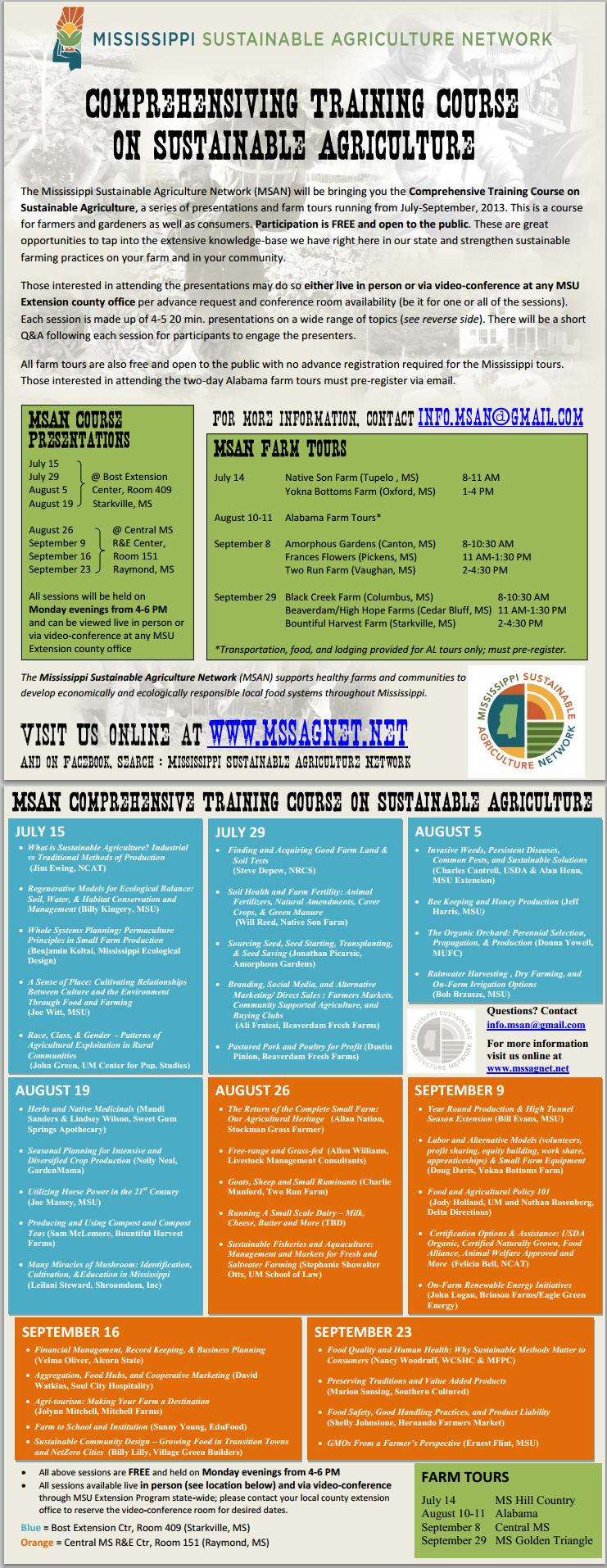
Sustainable Ag Trainings in the Deep South

Mississippi Sustainable Agriculture Network's trainings-2013

Mississippi Sustainable Agriculture Network’s trainings-2013

Book Review: Louisiana Eats

13328918-mmmainFull disclosure: Poppy is my pal. She is someone who calls me up and then shows up, with a gift, thoughtful questions and always hilarious stories.
What made me a fan of hers early on was her razor-sharp take on people and situations, sometimes devastatingly so. Yet she is enormously kind and open to those people who ring true. No one that receives her wrath  is ever underserving. If they get it, they usually have made one of two unforgivable sins: either they underestimated HER or they underestimated her city, her state or her people.

Another disclosure: I believe Poppy deserves as much credit as anyone in my region for rebuilding the New Orleans food system after the federal levee breaks in 2005. Too many stories to tell here, but come on over and if you care, I’ll tell you some of them over a drink. Or two. There are a lot of them to tell. Some of them are funny, some are sweet, some even a bit crazy.

These two points are linked since her life’s work is to actively promote entrepreneurs and real ideas that will build (or rebuild when necessary) the culture of her place, Louisiana. In doing that work, she extended her range to all authentic food systems across the globe through her Slow Food International connection that  meant that New Orleans gained the Slow Food vibe from the mid 1990s on.
Let me also say that most of the SFUSA folks understand her range, giving her much early credit for shaping the U.S. work that she built with others-that is, until she had to unleash her wrath on previous Slow Food leadership over the (mis) direction of a crucial program that she had helped shepherd. Luckily, she and SF made up.
Remember, I warned you that she is a fierce opponent when she feels it’s necessary.

When she started the Louisiana Eats show, she had already done a great deal of writing and television. Her talents really came to light when she began this show; her intense enjoyment and knowledge of the people and history of food and culture through one-on-one conversations on our local NPR station and now in this book. I remember a glorious Saturday morning on Louisiana Eats when she and Rien Fertel talked about praline sellers and another when she talked with Miss Linda Green, The Yakamein lady, and another when she talked with French bread baker John Gendusa among many others. Each time, I would stop what I was doing and literally stand there and listen intently to her intricate questions and always learn something. And her interaction with the dean of New Orleans Creole food, Leah Chase which is always touching and amazing since you get to hear two chefs with great respect for each other just banter and share stories.  And when she has on young activists or farmers (like Nick Usner who is in the book), you can hear the hope in her voice for the new energy coming along…
So this book is a reminder of many lovely Saturdays  and is indicative of the tone that I myself have adopted for much of my food activism: wild enthusiasm, critical assessment and a deep appreciation of the stories and background of those unique people that tell of our culture and food. Because of her, I know to seek them out, and maybe I’ll find some new folks from those Poppy has brought to us on her show and in this book. The book itself (lovely photos and recipes) is informative and a great companion to her show and I know that it will stand the test of time as a true record of some of the people that we have in our world. And of my pal who contributes so much to our place.

<a href=”http://www.goodreads.com/review/list/635646-blue-collar-mind”>View all my reviews</a>


#MyFarmBill campaign

This week, the USDA launched #MyFarmBill, a social media campaign emphasizing the importance of Farm Bill programs. As part of the campaign, USDA is asking people across the country to use their own voices and gadgets to make video selfies about what the Farm Bill means to them and why we need a comprehensive Food, Farms, and Jobs Bill.

Farmers can do it. Ranchers can do it. Market managers can do it. Grocery store buyers and shoppers can do it. Anyone who eats can do it.  That means you. 

There are lots of elements of the Farm Bill that affect you every day and the USDA and Wholesome Wave want to hear about it!

How can you participate? Grab your gadget and in 15 seconds or less tell the world what the Farm Bill means to you. Then post your video via Instagram, Vine, or Facebook. Don’t forget to use the #MyFarmBill hashtag so USDA won’t miss it and tag it @wholesomewave so we can see it too! USDA is posting incoming videos and comments on Storify and are even retweeting some of their favorites.

To see Agriculture Secretary Tom Vilsack’s video to kick off the campaign, click here.To see other people’s submissions, go to Twitter and search #MyFarmBill.

We all eat. We all have a voice.  Most of us have gadgets.  Please use yours and tell the world what the Farm Bill means to you.
Thank you!

The Wholesome Wave Policy Team


Louisiana – New Cottage Food Law (August 2013)

Sales are limited to $20,000 per year

Cottage food operations don’t need to get a license from their health department, but they do need to check with their county to see if any zoning requirements apply to them.

Operations do not need to collect any state sales tax, but they may need to collect local sales taxes (it is different for each city and county).

Only food items in these categories are allowed:

Cakes, Cookies, Honey, Jams & jellies -Preserves.

Unlike most states, Louisiana allows custard and cream-filled bakery products.

Louisiana – Cottage Food Law.

Rules are varied

I think most if not all managers of markets understand that other markets have different rules than theirs, but do your shoppers know? And have you ever updated them, in cooperation with your vendors?
Nearby markets should share rules so that they do not make their farmers follow different sets of rules for little reason. It’s amazing how many markets don’t even attempt to compare rules which makes it quite hard for vendors to remember which of their markets has rules against packing up early or who allows foraged items and who doesn’t. One of the main areas of contention among farmers is the amount of liability insurance that they are required to carry (when a market requires it); a farmer told me about three different levels of insurance that he was asked to carry, all of the markets within a few miles of each other.

http://www.twincities.com/stpaul/ci_24036424/farmers-markets-not-all-follow-same-rules

Lifecycle of Emergence

For those organizing networks this theory can be very helpful, to have a strategy that allows for both short and long term. Cooperation and communication must happen at the precise moment(s) that networks are ready to emerge and to grow. For organizers, that means practicing patience and fortitude.

From The Berkana Institute:

…the lifecycle of emergence: how living systems begin as networks, shift to intentional communities of practice, and evolve into powerful systems capable of global influence.

This system of influence possesses qualities and capacities that were unknown in the individuals. It isn’t that they were hidden; they simply don’t exist until the system emerges. They are properties of the system, not the individual, but once there, individuals possess them. And the system that emerges always possesses greater power and influence than is possible through planned, incremental change. Emergence is how Life creates radical change and takes things to scale.

Lifecycle of Emergence.

the two loops visual is one that many of you have probably seen me try to draw (badly); here it is done well:

Theory of Change