Farmers Markets Need Support to Collect and Use Data

For the past year and a half, I have been attempting to wrangle the last seven years of FMC’s technical assistance around market evaluation (and the last 18 for me) into some sort of timeline and “lessons learned” to present to researchers and partners interested in farmers markets and data.

The process of writing a peer-reviewed paper was new to me and my fellow authors and the entire FMC team soldiered on with me as best they could, cheering me on and adding much needed perspective and edits at different points of the process. After a year and a half of drafting and reviewing, we released the article linked below through the skill of the JAFSCD team, but also because of the support of the USDA/AMS team. I think it should be said as often as possible that the AMS team is firmly dedicated to assisting farmers markets with whatever trends that arise, and in developing programs at USDA that reflect the current conditions of markets in order to increase their ability to support family farmers and harvesters. The evaluation work is just one example of how they have watched developments and offered support where they thought applicable.
The reason for FMC to put effort into this type of academic article is to make sure that researchers see the opportunity to have market operators be part of the process around what data is collected via markets and market vendors, and how it is used. It certainly doesn’t mean that we think that all of the work to collect and clean the data should be shouldered by the markets only or that using the data is their work alone. I hope that is clear in this paper. But we DO think that market work is increasingly focused around managers and vendors making data-driven decisions, and so the way the market team spends its time and how well it analyzes and shares data also has to evolve. That isn’t our choice; that is the result of the world taking a larger interest in regional food and farming, as well as the constant pressure from the retail food sector. Many in that latter group want to cash in on the trust and authenticity we value without holding the same accountability to producers that we have. We have to fight that, and doing it with data is the best way.

Finally, we think there is still much to know about the barriers to embedding data systems for grassroots markets; this paper only covers what we have learned since 2011 and up to the beginning of 2018. Much more is constantly being learned and will be reflected in the TA we offer markets and their partners.

Please email me with comments and questions about the paper and its findings.

Dar

—————————————————————————–

FMC press release: December 18, 2018 – Collecting data at farmers markets is not a new endeavor. But until recently, the data was largely collected and used by researchers, often to understand the role farmers markets play in the broader food system. Over the last seven years, the Farmers Market Coalition (FMC) – a national nonprofit dedicated to strengthening farmers markets – has partnered with research institutions and market organizations to better understand how market organizations have begun to collect and use data.

While until recently it was rare for market organizations to participate in the collection of their own market-level data, more and more markets have reached out to FMC over the last decade for data collection technical assistance. In 2011, the organization began to identify common characteristics and impacts of market programs, and realized more research into evaluation resources and tools that could be used easily by understaffed market operators was needed.

In a new article published in the Journal of Agriculture, Food Systems, and Community Development (JAFSCD), FMC outlines the industry need behind creating the Farmers Market Metrics (Metrics) program, and a timeline of the steps and partnerships that led to the creation of the tool, as well as best practices uncovered during its development.

Key recommendations include:

Create assigned roles for the market’s data collection team, and choose training materials that set expectations for seasonal staff, volunteers, and interns to maximize time and efficiency.
Prioritize staff support to allow market leaders more time to oversee data collection.
Gain vendors’ trust in the program for sharing and storing sensitive data.
Patience and support from funders and network leaders for each market’s level of capacity and comfort with data collection.
More assistance from funders and network leaders in helping markets select metrics to collect, as well as advancing data collection training for market staff.
The use of tools such as the USDA’s Local Foods Economic Toolkit, coupled with consistent support from academic partners, will encourage market leaders to delve more deeply into economic data and to feel more confident sharing results.

“FMC’s efforts to craft a suitable set of resources and a data management system for high-functioning but low-capacity market organizations has helped many stakeholders understand and share the many positive impacts their partner markets are making,” said FMC Senior Advisor and article author Darlene Wolnik. “But our analysis concludes that there is still foundational work to be done by those stakeholders to aid these organizations in collecting and using data.”

Wolnik continued, “The good news is that market-level data collection yields important information that markets can use to improve operations, share with researchers, communicate impacts to stakeholders, advocate for and promote vendors, and more.”

Resilience: Having the courage to persevere – Farm Aid

This is so great.

Willie Nelson:

“It’s called resilience – having the courage to persevere – and we heard a lot about it in Hartford this September at Farm Aid 2018. Farmers reminded us how they love tending the earth and its plants and animals, in spite of the struggles. That love and their resolve inspires me. And I hope it inspires you, too.”
— Read on www.farmaid.org/blog/resilience-having-the-courage-to-persevere/

Farm Aid is one of the significant elders of our work, remaining focused on the needs of farmers, responding to their circumstances and amplifying possible policy solutions. The work they have done is so tremendous and grassroots, it sets the standard for all of our work.

This moment from 2018’s FarmAid concert was an obvious favorite among FMC staff:

Have you stopped at a farmers market lately?

Support the work of this important organization this year.

Reading material

Dear colleagues,

I’m sorry for the absence from this blog, but have been happily knee deep in surveys and resource development for markets. So first, if you work for an organization that runs markets and the organization has not taken the national State of the Market survey yet, here is the link. Do check to make sure someone else in your organization hasn’t already answered, as we need only ONE response per organization.

I hope the year has been productive and promising for your work and that there are big plans for 2019.

My plans for the new year include increasing my activity to connect our food system work more closely to resiliency initiatives (i.e. disaster mitigation, climate challenges, economic apartheid)  from the municipal level to the international level.

As short and long-term ecological and economic solutions are sought for water, energy, and land planning, it is vital that local food activists and practioners are at the table. I hope to be a bridge while also continuing my work with markets to increase their diversity of uses and of users and to articulate their own theory of change.

In the meantime, here are some wonderful hopeful titles on my current reading list around farming and farmers markets. I hope you find some of them interesting.


39928058


9781524761165


51iQsB9LBiL._AC_US218_


51yFnmNI5FL._SX339_BO1,204,203,200_

61fGXOb4G2L


And this list of 10 podcasts is very helpful:

Ten Food Policy Podcasts to Listen to Now


“We like to think of local today being where organic was 15 years ago”

 By Mary Ellen Shoup

BrightFarms is poised to bring its local greenhouse model to a nationwide audience with 15 hydroponic greenhouses to be built in the next three to five years as demand for locally-grown produce outweighs organic, shared BrightFarms VP of marketing and innovation, Abby Prior.

link to story

Another Fresh Food Initiative grocery store recipient may close in New Orleans

The owners received a $1 million loan from the city’s Fresh Food Retailer Initiative, a program aimed at increasing residents’ access to fresh food. According to reports at the time, $500,000 of the loan was forgivable.


Seems to be a tragic confluence of bad-faith investments, management disorder, new disruptive businesses taking away some of the sales, and the lack of resilience in the city around its increasing environmental challenges. Still, I’d like to see what else this fund ended up supporting and what those places are doing now.

Some relevant quotes from Ian’s story linked below:

One of lenders that funded the store’s reopening was First NBC Bank, the local financial institution that collapsed last spring and continues to send ripples through the New Orleans business community. Boudreaux said his loan was acquired by another financial institution which has been more aggressive.

“We opened with the finances upside down to begin with, and it got worse,” he said.

The city also provided a $100,000 Economic Development Fund grant, and the Louisiana Office of Community Development provided a loan for $1 million. The store also received $2.2 million in historic tax credit equity and $2.2 million in new market tax credit equity.


Meanwhile, Boudreaux has accused some relatives of stealing money from the family-run business.


While these issues have been ongoing, Boudreaux pointed to the August 2017 flood as perhaps the last straw for the business. That disaster, spurred by a summer downpour that revealed widespread problems with the city’s drainage systems, swamped the store and knocked out much of its food-storage equipment.

Here’s my post on the first store closure that had been a recipient.

I mention Circle Food in this piece on another public market site:

The Advocate story


Solnit on mutual aid economies

Almost anyone would say our society is capitalistic, based on competition and selfishness. But huge areas of our lives are already based on gift economies, barter, mutual aid, and giving without hope of return. Think of the relations between friends, between family members, the activities of volunteers or those who have chosen their vocation on principle rather than for profit.

Think of the acts of those who do more and do it more passionately than they are paid to do, of the armies of the unpaid at work counterbalancing and cleaning up after the invisible hand of the market and even loosening its grip on our collective throat. Such acts represent the relations of the great majority of us some of the time and a minority of us all the time. They are, as the two feminist economists who published together as J. K. Gibson-Graham noted, the nine-tenths of the economic iceberg that is below the waterline. Capitalism is only kept going by this army of anti-capitalists, who constantly exert their powers to clean up after it and at least partially compensate for its destructiveness.

Hope lies in the future, but my work on disaster and society convinced me that much that is remarkable is with us already, undescribed.

Rebecca Solnit

Farmer Fleenor for Congress

Article from Bayou Brief, written by   on October 14, 2018

Loranger, Louisiana is an unincorporated town in Tangipahoa Parish, about fifteen minutes north of Hammond and an hour east of Baton Rouge. Its most notable “sightseeing” attraction, according to Facebook, is the Methodist Church, which had been listed on the National Register of Historic Places until its building was torn down and replaced three years ago. The Southern Baptists own a small summer camp there, Living Waters, on the banks of the Tangipahoa River.

There’s a local donut shop and a Dollar General, which both earn a mention on the town’s Wikipedia.

This place is tiny.

It’s also the hometown of Jessee Carlton Fleenor, the 34-year-old Democrat challenging Ralph Abraham, a two-term Republican congressman from Alto, another tiny town on the other end of Louisiana’s vast Fifth District.

Since qualifying, Fleenor has put thousands of miles on his old Dodge pickup truck, visiting all 24 of its parishes and the small towns that dominate its landscape.

Fleenor is a vegetable farmer. He grows lettuce, bell peppers, corn, broccoli, and cucumbers, among other things. It’s seasonal work, 12 weeks in the spring and 12 weeks in the fall. For the past few years, he’s operated what he calls a “farm to door” program, delivering bags of 8-10 items, including a small selection of fruit and flowers, every week to customers across the region. In the fall, he includes organic eggs and fresh bread as well.

He’s not in it to make a fortune. Most years, he says, he earns between $20,000 to $30,000; the average household income in the district is slightly more than $37,000 a year

https://www.facebook.com/VoteJessee/

He’s a millennial, a Democrat, and a farmer. And he is running for Congress in one of the nation’s poorest districts.

Cleveland Clinic market

Pics from my visit today to the North Union Farmers Market held at the main campus of Cleveland Clinic. The market staff person told me it is wrapping up its 11th year; how time flies from my first visit the year it opened.

This market is a classic example of the “campus” type so named in the typology of markets that I have written about previously, and once we start to see some data from Metrics and state level data collection efforts, can begin to flesh out these types.

Some time ago, I wrote up a case study on those markets that had used FMSSG funding for focus group research to better understand the perceptions of at-risk and low-income shoppers; while researching that, I saw that this market had used their FMSSG funding to do a Frittata Project with Clinic lap band/bariatric surgery patients to adapt that simple  recipe using different market veggies. I thought it was a great educational activity approach for a hospital campus market to incentivize behavior change. Very situational and intentional which is what I like about the North Union family of markets; each has its own focus and personality. 

Jeff Chiplis, Tremont Placemaker

During my extended visit to NE Ohio this summer, I have visited many markets, some farms and also met some excellent people thinking about their place constantly. Here is one of them.

Parking my truck on Jefferson after turning off Professor, I was lost in thought for a minute about the changes I was seeing in my old neighborhood of Tremont. Not that closed up storefronts or broken sidewalks should remain, but the saturation of shiny and new crowding this tiny corner of Cleveland was troubling. (For those who are unfamiliar with Cleveland or this part of it, Tremont is right next to what was the industrial Flats, and as such, had gone through some tough times in the latter part of the 20th century. Since the late 1990s however, its proximity to downtown and the city’s eagerness to think of the future as largely post-industrial in terms of infrastructure has meant this area has been transformed almost completely into an apartment and entertainment district.)

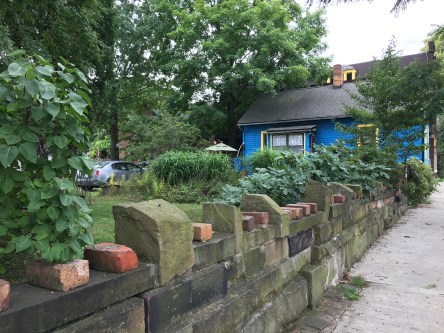
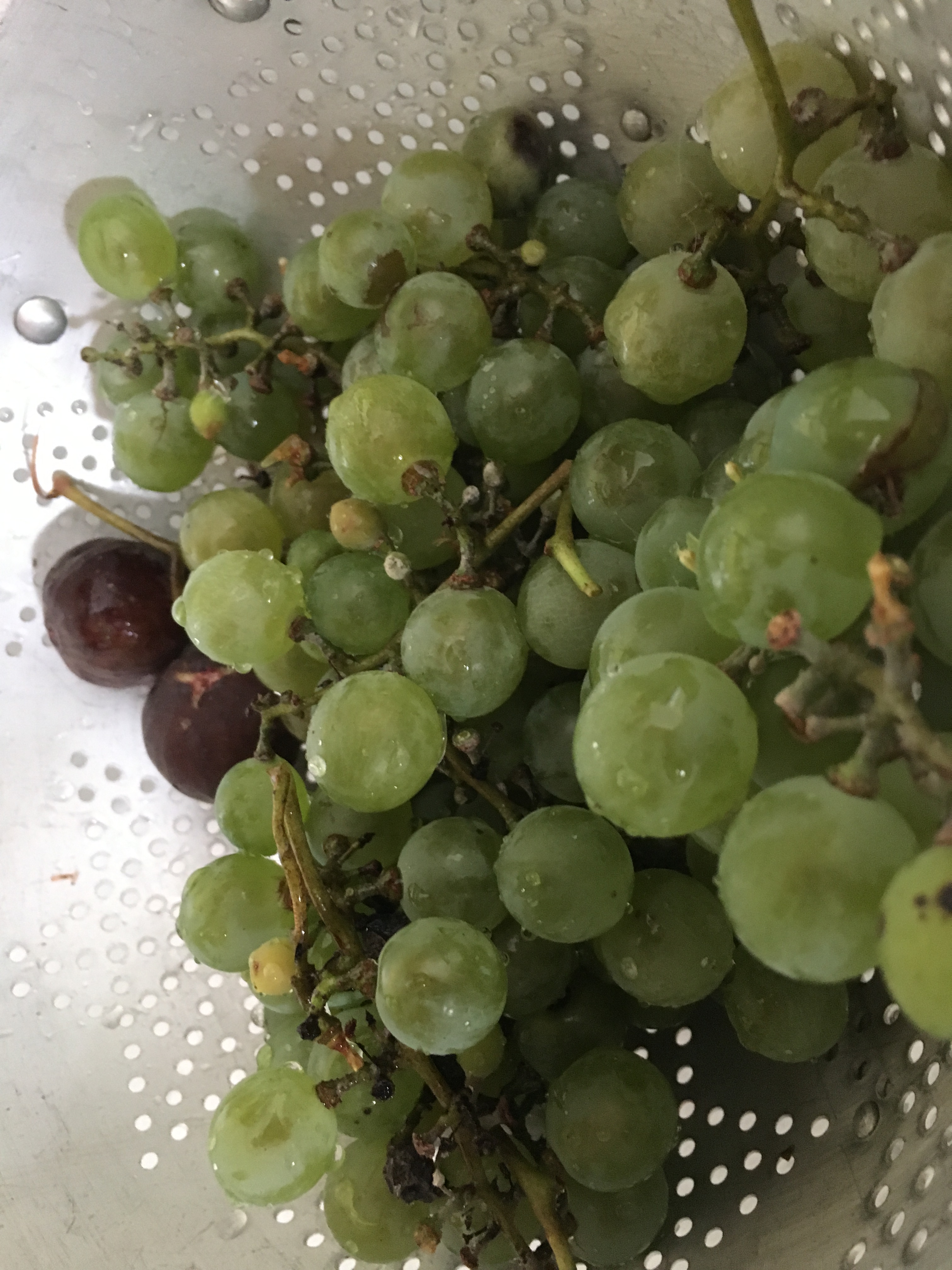
As I looked up from my musings, I noticed a healthy fig tree peeking over a beautiful, clearly handmade stone wall. I crossed the street to see it more closely and said aloud, ‘oh look at these figs! How lovely!”

IMG_1270

A voice amid the greenery said, “please help yourself.” I looked over and saw a smiling face working on wall repairs just a few feet away. I carefully selected a few ripe figs and walked over to meet my benefactor.

Jeff Chiplis has lived on this corner with his wife Cynthia since 1980, and has seen a parade of people, ideas and development, across the spectrum of good to bad to ridiculous and back again.  As an internationally known artist working with recycled neon signs, he believes in adaptation. So when he mirrors the best and protests the worst of developers’ and municipal whims in his work and yard, it should be noted by the powers that be.

For example, the utter lack of interest in reusing what was already here and the crowding of overly tall and architecturally bland buildings onto each redeveloped lot is clearly a source of frustration with Jeff.  That wall that the fig tree reclines on is an example of how he honors the past while offering his neighbors beautifully framed access to the green space he owns. His dad and he originally built it, using discarded bricks and stones. Regular repair work is necessary because vandals push over the top stones or pull the flat stones to bash against the sidewalk. As we chatted, he finished his small repair job, carefully scraping the rest of the mortar from his bucket, then offering me a tour which I gratefully accepted.

IMG_1272 (1).JPG

The figs and grapes line the sidewalk next to the small house “painted Superman blue” he offers (assuming I understand the Cleveland connection; I do) allowing anyone to feast as they go by.  While there, I notice one 20-something ignores the bounty as she passes by twice with her large dog and smart phone at eye level.

Walking up the driveway between the Superman house and the larger brick one, he stops in his ground level studio to drop off the brickwork tools and to offer me a flyer from one of his latest installations around the city. The studio is floor to ceiling full of odds and ends, but somehow one can see that it is set up well for his use and offers comfort for anyone invited to stand among the signs, tools and materials.

IMG_1275.JPG

As we walk the garden, I see that is organized the same way. The garden beds are bordered with found and made art, and plants are allowed to define their space as they see fit during growing season.  Still, well-tended space is prominent between the areas of plantings and large trees on this corner lot.

The Harry Lauder’s walking stick tree was marvelous but unfortunately, was ailing while I was there:IMG_1287.JPG

although allowing him to adorn other borders with its cast-offs:

Chiplis fence.JPG

Greens were doing well alongside flowering plants.

Chiplisgreens.JPG

Raspberries and currants overshot rusty fences and repurposed rebar:

IMG_1293.JPG

This berry was replanted from his parent’s garden.

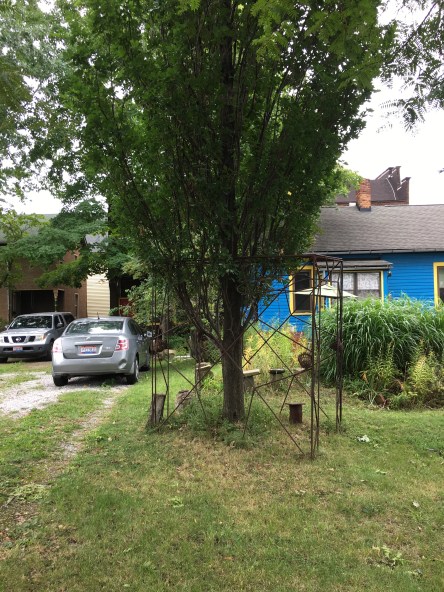
The burr oak was not only resplendent in the middle of the yard, but allowed him to place this frame that another artist had no more use for once the art piece had been completed. So Jeff found another use for it and slipped it over the much smaller oak clearly just in time:

IMG_1294

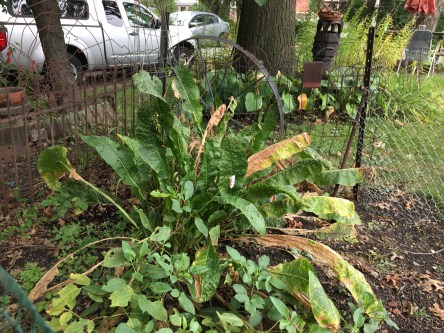
The horseradish was added for no particular culinary reason but turned out to be a good neighbor to the other plants, anchoring this corner:

IMG_1276.JPG

I could have easily stayed longer. I almost did, but felt I needed to let him finish what is likely a long list of tasks in the studio and garden and home and neighborhood.

IMG_1307.JPG

Just in time, that fig tree reminded me that resident’s homes like the Chiplis’ place are as necessary and as important as markets and community gardens in serving their communities.

Know your “friends”

Fascinating story about a “friends of” organization for a library that decided to close its store because of an issue over control of its decision-making. Since many markets have these type of supporting organization relationships, it’s very important that they understand how these work, especially in understanding the different types of a supporting org, according to the IRS:

Type I 

A Type I supporting organization must be operated, supervised or controlled by its supported organization(s), typically by giving the supported organization(s) the power to regularly appoint or elect a majority of the directors or trustees of the supporting organization. The relationship between the supported organization(s) and the supporting organization is sometimes described as similar to a parent-subsidiary relationship.

Type II

A Type II supporting organization must be supervised or controlled in connection with its supported organization(s), typically by having a majority of the directors or trustees of the supported organization(s) serve as a majority of the trustees or directors of the supporting organization. The relationship between the supported organization(s) and the supporting organization is sometimes described as similar to a brother-sister relationship.

Type III

A Type III supporting organization must be operated in connection with one or more publicly supported organizations. All supporting organizations must be responsive to the needs and demands of, and must constitute an integral part of or maintain significant involvement in, their supported organizations. Type I and Type II supporting organizations are deemed to accomplish these responsiveness and integral part requirements by virtue of their control relationships. However, a Type III supporting organization is not subject to the same level of control by its supported organization(s). Therefore, in addition to a notification requirement, Type III supporting organizations must pass separate responsiveness and integral part tests.

The friends of entity in this story wasn’t one of those types, but instead was set up as its own 501 (c) (3) which was part of the issue.

From the story:

Friends board member Beth Schneider said the nonprofit will still raise funds for the Santa Maria Public Library. They are running a book sale from September 20–22 and donate books online through Amazon. Schneider asserts that the relationship between the library and the Friends remains: “We’re still the Friends of the Santa Maria Public Library.”

Mary Housel, library director, said that the library and the city will need to sign some form of contract in the future, although what that would entail, and why it is necessary if they are not utilizing city property to function, was not disclosed. Schneider said that they weren’t likely to take on any contract—“not as long as the city has taken the stance that it has.”