

I have a goal to write each week here; I hope this is helpful for all of you.
Wanted to share my current reading list in the hopes that it may spark a discussion of what you are reading:
The Brinkley book has been fascinating, not only because I’ve been a huge fan of Rachel Carson since the 1980s (who I believe has never received her due for exponentially increasing awareness of environmental extinctions and illness’ connections to unchecked pesticide use) but also because this author has a talent for creating a compelling story around the leaders of the environmental movement which is spurring my thinking around my farmers market book currently in draft form.

This Rome travel book is because I will be joining many of my fellow market peers and attending the World Farmers Market Coalition meeting in May.

Graeber’s incredible analysis into how direct action groups collect and organize is another keeper of his for me from this late great writer.
https://www.goodreads.com/book/show/2543048.Direct_Action

This book about my home state and one of its fishing community is a new one for my bookshelf after I saw and heard its thoughtful author at a recent literary festival in New Orleans. As someone who has worked closely with a few commercial fishers and so try to keep an ear and eye out to be always learning more about their future, I am expecting this to give me great insight on what that community is facing in our current political, ecological and cultural “spend-down” time.

Jackson MS is a place that doesn’t get enough notice nor enough support from its state nor the feds for the challenges they face or enough credit for the innovative work happening there from many including from Cooperation Jackson. Also, anytime I can read in detail about food access within one community, I find it offers many lessons I can use in many places.

At the end of this second year of the COVID era, I’ve been thinking a great deal about the thousands of market leaders, tens of thousands of producers, and the hundreds of thousands of our neighbors who have continued to prioritize regional food in their lives even during this horrific pandemic.
I think we had hoped that we had passed the biggest test of the COVID crisis, but it is possible that we may have a bigger one: to find the fortitude to safely withstand the succession of its outbreaks over the next few months and possibly even years while still attempting to grow the number and diversity of those able to purchase healthy food for their families. And to do that even as other shocks (climate chaos, the pitched battle over white supremacy, crumbling infrastructure) hit our communities at the same time.
People often call this being resilient.
Resilience is the ability to adapt to difficult situations. That seems straightforward, but many communities have pointed out that very adaptation can become the only action or the status quo, allowing government to rely on that resiliency rather than attempting to solve the underlying issues. Depending on the crisis or series of crises, it can be depleted and once gone, can mean catastrophe for a community by allowing outside actors to become the only arbiters of what happens during recovery.
-from the site Edge Effects:
Resiliency-based planning, however, has been opposed by grassroots organizations and activists. In 2015 in response to the City of New Orleans’s resilience strategy, posters started appearing throughout New Orleans quoting Tracie Washington of the Louisiana Justice Institute. “Stop calling me resilient,” the posters read, “Because every time you say, ‘Oh, they’re resilient,’ that means you can do something else to me. I am not resilient.” As (it) makes clear, instead of simply addressing the cause of environmental degradation such as land loss, Louisiana has apparently accepted the inevitability of this degradation–and is learning how to cope.
We should acknowledge and credit resiliency but insist on creating more participatory and dynamic solutions, focusing funding and efforts to those that are contextual to that place and its scope.
In terms of being contextual to that place, writer Jane Jacobs suggested that one of municipalities’ main activities be (I’m paraphrasing her here) actively replacing imported goods and ideas with regional goods and home-grown creativity whenever possible. To do what Jacobs suggested requires participatory structures and illustrative pilots for government to draw from. That ability to test multiple solutions at the community level would be one strategy that food system leaders can use in outlining as to why our work is so important to municipalities’ plans.
And whenever we talk about scale in food systems, the discussion often settles into a set of camps including (a) those who think the goal is to scale up food production to meet industrial food’s demands and (b) those who firmly believe that food is itself an antidote to scaling up, and (c/d) those who want to keep industrial food functioning and participating in local food production even as they work on alternatives and so on. The development of multiple systems may be best explained in the 2 Loops Theory of the Berkana Institute which I have written about previously that describes those roles to be played.
Also, whenever scale comes up, I think of this from Wendell Berry:
It is a formidable paradox that in order to achieve the sort of limitlessness we have begun to call sustainability, whether in human life or the other life of the ecosphere, strict limits must be observed. Enduring structures of household and family life, or the life of the community or the life of the country, cannot be formed except within limits. We must not outdistance local knowledge and affection, or the capacities of local persons to pay attention to details, to the “minute particulars” only by which, William Blake thought, we can do good to one another.
Within limits, we can think of rightness of scale. When the scale is right, we can imagine completeness of form.”
In other words, scale itself needn’t be the enemy; rightness of scale allows us to still pay attention to details, to measure how we do good to one another.
How do we find that rightness of scale?
Writer Ihnji Jon outlined a scale of political action that can serve either ever-expanding (globalized) or ever-narrowing (localized) as long as they are:
1) “subject to territorial conditions”,
2)”posses a degree of intensity that allows it to be influential across different systems”,
3) “are large enough to retain complexity that allows them to have interaction effects”
So as we think about farmers markets and community food systems, the right scale would keep the food system leaders able to pressure government to deal with the underlying issues, would encourage funding for localized active, inclusive democratic networks, would support communities to rebuild as slowly or quickly as they need and use local leadership in doing so, and most importantly would democratize all of the resources needed to create the new adapted normal. That would mean resiliency would be properly supported by functioning systems and would measure its spread as an opportunity to make real changes in that place, rather than celebrating it as a solution.
That could mean radically changing the emergency food system to reduce the bureaucracy of getting support when needed and increasing actual mutual aid, it could mean working to become the true center of inclusive civic spaces, it could mean engaging with the educational system to link regional food to childhood health, it could mean that regional climate initiatives become focused on food production and in championing the stewardship of local people…
All of that is possible, even if it is not yet probable. I hope to begin to outline examples of systemic thinking and scaled planning among farmers markets and their regional food system efforts on this site in 2022. Please share those you know about in the comments.
and lastly, I hope each of you takes some time the rest of this year to replenish your own reserves. Please do consider how you can engage with your community in ways that reduce the need for the reservoir of your resiliency to be emptied in each crisis and that increase your joy in the lovely way each of you does good to others in farmers market spaces.
The first time I used food stamps, I cried. It was a predawn Saturday morning and I had purposely gone to the grocery store early to avoid pulling out the EBT card in the sight lines of people I worried would judge me. I felt like an imposter among self-paying customers.
Tension and discouragement hang dense in the air as soon as you walk into the human resources office. You’re at the mercy of a system powered by a comedy of inefficiencies. Lines form early. Waits are long. Paperwork disappears. Your life is ultimately laid bare in document form, fanned out in front of the person whose job it is to decide whether you’re optimally managing the finances of your household and whether you and your people deserve help from the government. It’s a reductive and demeaning process. The negative energy there makes even tiny babies cry.
…Poverty is crazy-making. It changes you, snatches your good common sense, and consumes your thoughts. You wake up thinking about being poor, spend your days plotting how not to be poor, and go to bed worrying about the consequences of being poor. You’re high-strung, easily provoked, always looking for answers. You snap on your children. You snap on your boos and baes. You snap on God. There are moments — long, inward-facing moments — when no scripture, no motivational meme, no inspirational quote can quell the urgency of not having enough.
The earlier proposals also recommended leaving food with multiple ingredients like frozen pizza or canned soup off the staple list. The outcome is a win for the makers of such products, like General Mills Inc. and Campbell Soup Co., which feared they would lose shelf space as retailers added new items to meet the requirements.
But retailers still criticized the new guidelines as too restrictive. Stores must now stock seven varieties of staples in each food category: meat, bread, dairy, and fruits and vegetables….
…More changes to the food-stamp program may lie ahead. The new rules were published a day after the House Committee on Agriculture released a report* calling for major changes to the program, which Republicans on the committee say discourages recipients from finding better-paid work.
Source: Regulators Tweak SNAP Rules for Grocers – WSJ
*Some of the findings from the 2016 Committee on Agriculture Report “Past, Present, and Future of SNAP” are below.
According to research by the AARP Foundation—a charitable affiliate of AARP—over 17 percent of adults over the age of 40 are food-insecure. Among age cohorts over age 50, food insecurity was worse for the 50-59 age group, with over 10 percent experiencing either low or very low food security. Among the 60-69 age cohort, over 9 percent experienced similar levels of food insecurity, and over 6 percent among the 70+ population.
• The operation of the program is at the discretion of each state. For instance, in California, SNAP is a county-run program. In Texas, SNAP is administered by the state… Dr. Angela Rachidi of the American Enterprise Institute cited a specific example in New York City where SNAP, WIC, school food programs, and child and adult care programs are all administered by different agencies and the result is that each agency must determine eligibility and administer benefits separately.
K. Michael Conaway, Chairman of the House Committee on Agriculture. Hearing of the House of Representatives, Committee on Agriculture. Past, Present, and Future of SNAP. February 25, 2015. Washington, D.C. Find report here
From CNN this week:
The number of people seeking emergency food assistance increased by an average of 2% in 2016, the United States Conference of Mayors said in its annual report Wednesday.
The majority, or 63%, of those seeking assistance were families, down from 67% a year ago, the survey found. However, the proportion of people who were employed and in need of food assistance rose sharply — increasing to 51% from 42%.
Simple, clear and appealing videos on using benefits at markets that can be shared with community centers, sent to targeted social media users and can be used as a banner on news sites too. Bravo Urbana and Fond du Lac!
And from Fond du Lac Wisconsin:
The thing about being a market consultant is it has a very specific schedule each year: the spring is packed with calls and invitations to conferences and workshops. Lots of discussion about grant opportunities and best practices.
The summer is spent at at the desk, writing or researching on behalf of those who hire us.
The fall starts to bring more travel, usually more for large-scale (non-market) conferences as well as a scramble for assistance on projects that got sidelined or tangled over the summer.
The winter is when the big ideas are usually discussed, with colleagues asking for an ear or agreeing to read something. Some of those big ideas roll right into spring grant-writing season and the year begins again.
This year my spring travel started in Alabama, then to Oregon and Washington, March in Vermont, two spots in Illinois and this last spring trip was in the Magnolia State, right in my own backyard.
I live part of the time about 40 or so miles from the Mississippi line and of course, as a past manager of a set of markets in the biggest city in the region, I had farmers from Mississippi and from Alabama that came to vend, so I am quite familiar with what is happening there and have some ideas as to what could happen there.
When I was asked to speak again this year by MS Department of Agriculture and Commerce (MDAC), I said yes immediately. Partly because I like the folks at MDAC and partly because in order to have a real food system in my place, it must be regionally organized (which means MS too of course) and we are far from that reality. And of course, because as a national market advocate, I need to see and talk to as many markets as I can. Let me say that MDAC does an amazing job supporting every actor in the food system and any criticism I give about the lack of support should not be construed as being directed at MDAC. They do more with less than most other states I know. And that MDAC is a state agency devoted to the many, not the few; market organizers and community food system initiative leaders need their own champions too.
MDAC asked me to talk about EBT outreach and about measuring markets for whatever number of the 70 or so markets listed in the state showed up. I agreed, even though I knew that the EBT outreach was probably a little too forward of what the group needed, based on the answers to the survey we sent out.
The MS markets are a strange and wonderful hybrid-they have no independent state association of markets, which is typical of most the other Southern states.
The state does have an emerging sustainable ag network, thanks to some local people (Daniel Doyle for one) and the Wallace Center which offered early funding to create the entity.
The state has offered both farmers and markets free SNAP-only machines for the last few years, predating the new FNS marketlink.org farmer terminal system. Many of you know that I am not a fan of these systems being handed off to farmers quite yet, so I do view these hybrid systems with a jaundiced eye.
Some of their markets have a closer relationship to Main Street initiatives than many other states’s markets which means that they are included in larger municipal ideas of revitalization, which can be good and bad for a market. The Main Street movement is more viable in rural communities, using its energy on facade or street improvements and some event planning. So what I find among MS managers are great event planners and city/civic leaders, with a genuine interest in assisting their vendors, but with few ideas how to do just that. The newest trend there is for public health partnerships (of course) with funding increasing there tremendously since MS is usually at the lowest rung of most health stats, with Louisiana constantly battling it for last place. Even so, since many of the markets are quite entrepreneurial and “downtown-focused,” these public health partnerships have not yet found their sweet spot.
And since most of these markets are operating with such low capacity, and no one is advocating for them full-time, they have very little data on what they do well and little experience in analyzing how they did something well. EBT and FMNP for instance-what do they want from these programs? How do markets of 5 to 20 vendors build in capacity to offer a robust benefit program system without any resources or support? Interestingly, a workshop with information about market link and on becoming a SNAP retailer was held in a room at the other end of the center for MS farmers at the exact same time as the managers were in this room. I wish this had not been the case for many reasons, but most of all I have not found that creating silos of information within a system very useful.
As we were in the room, we heard about the successful FINI proposals, one of which is substantial and will involve MS markets. There was excitement, but there was also trepidation among the market organizers. Most of them do not run central EBT systems and so have very little contact with their benefit program shoppers and almost no idea where to find these folks or how to get them to come to their markets.
Adding cash incentives is great, but there has to also be money to build the systems at market and state level to change perceptions of local food and to lift the existing barriers or that money will just act as it was pushed through a sieve.
As I stood inside and outside after my talks, I was peppered with questions, most of which showed the lack of support these markets have:
Where do I find these USDA grants?
How do I get FMNP coupons at my market?
What amount should I raise for an incentive and how should I use it?
Who offers funds for staffing a market?
What is market link?
How do I get funds to advertise?
How do I get more local goods to more people as an organizer?
The agency directors (that serve benefit program shoppers) won’t even talk to me about my market- what should I do?
How can I measure my economic impact?
and this round of questions didn’t even bring up the whole set of issues present everywhere- how do get enough farmers and producers doing well enough to keep this system moving forward? How do we do this with other initiatives breathing down our neck, competing for funding and attention?
The number of new faces at this meeting is similar to many of the other states that I visit regularly and is an indication that we have yet to find a way to offer professional jobs as market managers, instead using the typical revolving door of entry-level work that exhausts producers and means that initiatives never fully engage or sustain; markets are full of pilots but few have moved those pilots to replicable programs with funding streams, experienced staff and policy changes arising from those lessons.
The beautiful thing is that the willingness and enthusiasm among these organizers is always high, even with the many closed doors and the lack of support available to them.
So, I finish my spring conference travel right where I started it: with markets feeling the pressures from partners to offer new programs, with internal communities asking for sustainable growth, with organizers managing this work while they are paid not at all or paid a pittance or doing the equivalent of 2-3 peoples workload. But I also finish it having heard loads of great ideas from organizers and with stories of successful pilots from the last few years that will be expanded or tested again.
So let’s hope that this year that we can move the dial a little bit over the summer and fall with a successful market season and then together can start to build the system we need come winter and spring.

Porch at the auditorium for the mkt meeting at the MS Ag and Forestry Museum
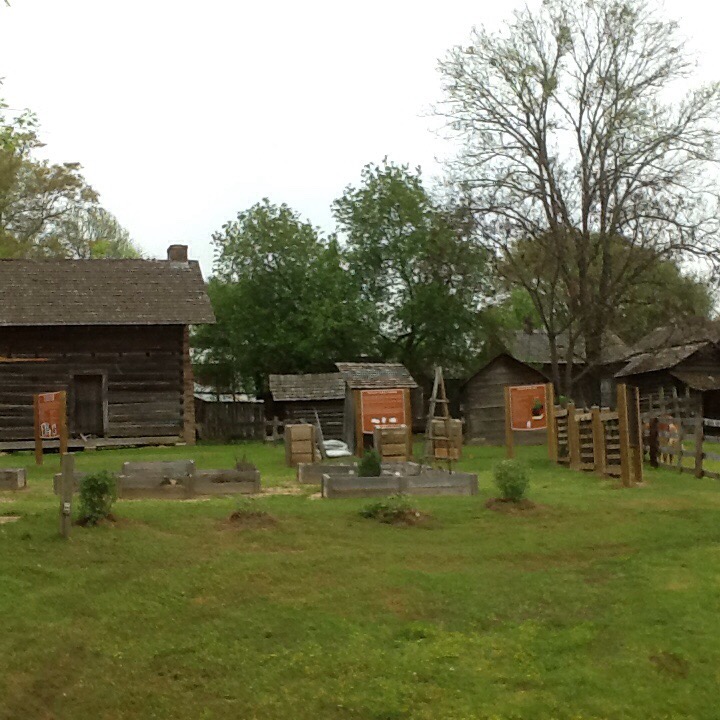
View of MS Sustainable Ag Network’s Victory Garden demonstration at the MS Ag Museum
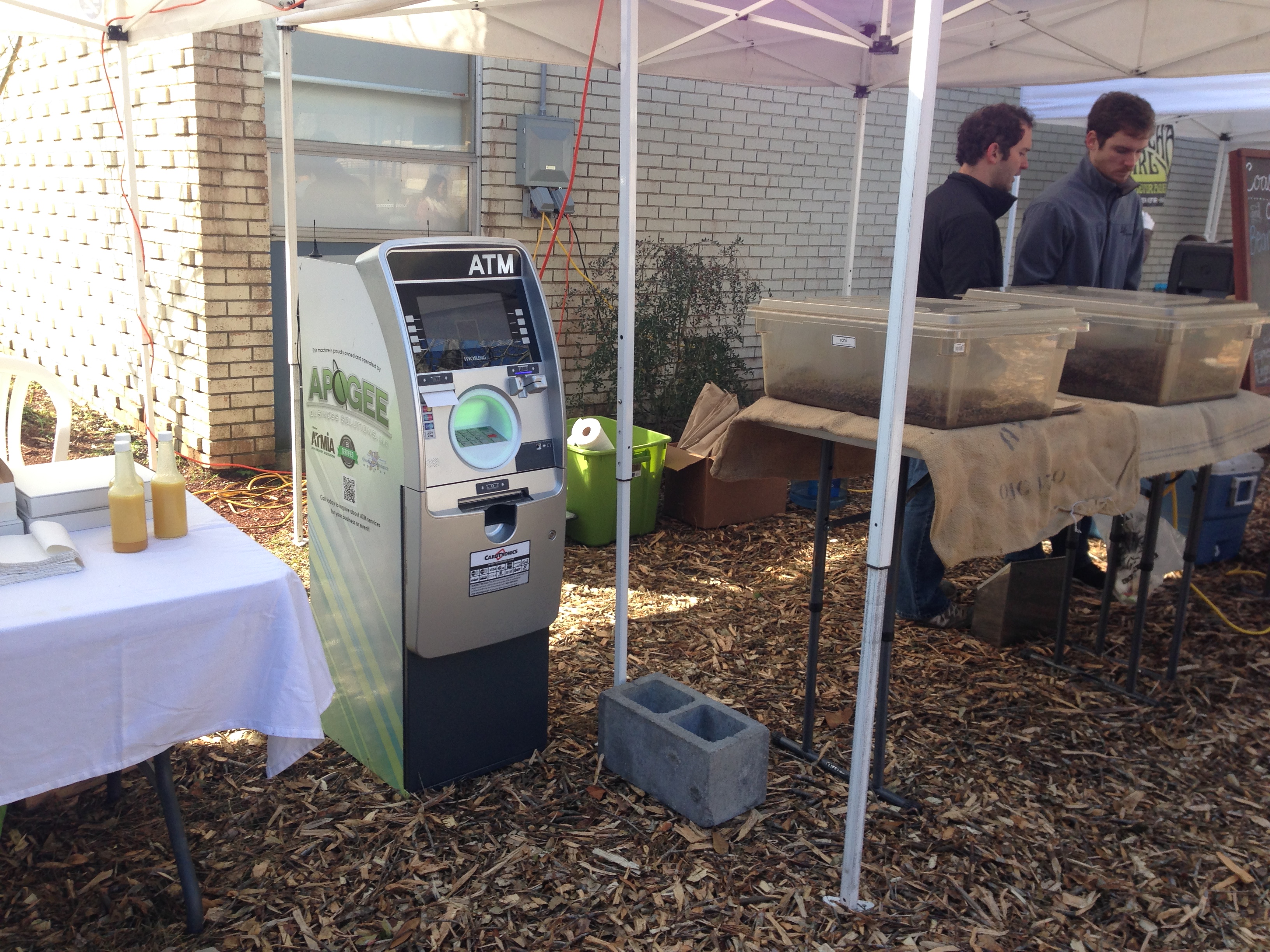
The picture is from my regular weekly, year-round Saturday market, founded in 1996 in the small town of Covington Louisiana, which is only 40 miles north of New Orleans but separated from it by Lake Pontchartrain and its 24 mile-long bridge.
The market is very ably run by sisters Jan and Ann, using very minimum staff hours but with enormous amounts of community buy-in. They have music scheduled every week, often have food trucks and during holidays have author signings or tasting events. The market has loads of seating, a permanent welcome structure with donated coffee and branded merchandise for sale. I tell you all of that to show how they balance the needs of the shoppers (by adding amenities that cannot be offered by the vendors) and the needs of their vendors (they keep the fees low by having less staff hours and carefully curate the products to showcase only high-quality regionally produced items), but also do their very best in their estimation to reduce their own wear and tear as staff.
To that end, they decided long ago to not participate in the same farmers market wireless machine/token system that we had in New Orleans; I had been the Deputy Director of that market organization and in 2006 or so had shared news of our emerging token and benefit program system with nearby markets in case they wanted to add the same; Covington told me then they didn’t see the need in their small town, even though they know and care about the large number of low-income people on benefit programs living nearby and do their best to offer a wide variety of price points and goods. I must confess that after our initial chat I was a bit disappointed by the lack of interest in expanding the reach, but soon realized this was an example of a particular type of market (rural niche) and the leadership was comfortable with the middle-class vibe they had certainly attracted. And I also realized a few years later that if they had been influenced by our complex system, it would have probably been a wrong move for the market at that time (more on that later.)
They knew, however, they at least needed the access for shoppers to get more cash and had asked the bank (a market sponsor) to have an ATM, and had also asked the municipality to add one (the market space is on city hall property), but couldn’t get anyone to move on the request. Finally, a 3rd party entrepreneur approached them to put one in and ta-daa, they finally have their ATM. It is moved in on Saturday morning and out again when the market is done, but the market will have a conversation soon with the mayor (a strong market supporter) about getting it there permanently. I was thrilled to see even that machine, as the nearest bank is blocks away and on far too many days I have grumpily got BACK in my truck to get more cash.
And in the days since those early rounds of proselytizing for (only) a centralized token/EBT/Debit system at every market, my own work has led me to the conclusion that instead there needs to be a suite of systems for markets to choose the appropriate version to process cards, rather than just the one system for everyone. Some markets can serve their shoppers with an ATM (some can own it, some can lease theirs and some can have a 3rd party offer the service like Covington), with some farmers having EBT/debit access on their own; some markets can use a phone-in system for EBT and have a Square on a smart phone at the market or farmer-level; some need the centralized system, but are figuring out electronic token systems; and yes, some do still need to bells and whistles of the centralized token system; and some markets need that system that is still developing, as technology continues to change to add more options for these systems.
What will help this multi-tiered system to happen is for markets to keep on sharing their ideas with each other and to gather data on why their system works for their community. That may be as simple as doing a regular Dot Survey/Bean Poll to ask shoppers about the interest in card use, or doing an annual economic survey like SEED, or asking their vendors on their annual renewal/application form about their use or projected use of card technology (you’d be surprised how many vendors already have Square or another version of it). And markets and vendors that do have the technology need to track the time and effort it takes to process cards and to build the entire system, which includes some outreach and marketing, and a significant amount of bookkeeping and share that information.
I keep gathering examples of innovation among markets and hope that sooner or later I (or other more able researchers) can be tasked with conducting in-depth research about those ideas to offer the market field a more comprehensive and dynamic view of all of the great ideas managed by our market systems. In the meantime, if you come to Covington your pajeon (warm Korean pancake) is on me; after all, I’ve got the cash.
 Early bird registration for the Southern Sustainable Agriculture Working Group is still open for a little bit longer (2 more days) through December 21st. Register online, or download a registration form and get it postmarked no later than Dec 21st for the lowest conference rates. They accept, via mail, checks made payable to Southern SAWG. They accept, via mail and online, VISA, Master Card, American Express and Discover credit cards. Pre-registration continues through midnight on January 7th. After that, registration will be on location in Mobile.
I will be leading two workshops and also moderating an open discussion (information exchange) this year. Find me here:
Information Exchange:
Friday, 10:45 a.m. – Noon
Using EBT, “Double Coupon” and Other Programs at Farmers Markets – Does your market employ the EBT, FMNP, Food Insecurity Nutrition Incentive Program (FINIP) or WIC programs? Do you have a double coupon incentive program for SNAP, WIC or SFNMP? Discuss technology issues and share best practices for implementing these programs at markets.
Workshops:
Saturday, 10:30 a.m. – 12:00 noon
Why Farmers Markets? Learn to Communicate Their Value to Your Community – Making the case for farmers markets to farmers, shoppers and community leaders is crucial for continued community support, yet most markets struggle with this task. Learn how to capture and communicate meaningful measures of your market’s success. Using exercises and worksheets from the Farmers Market Metrics project, this session will give you practical examples of simple and effective data collection techniques that you can use for your market. Darlene Wolnik, Helping Public Markets Grow (LA) and Sarah Blacklin, NC Choices (NC).
Saturday 3:30-5:00 pm
Farmers Markets as Business Incubators: How Market Managers Can Help Improve Their Vendors’ Businesses – Increasingly competitive market outlets for local food means that the top farmers often jump from market to market. This session will offer practical strategies for market managers and board members on identifying and understanding their anchor vendors and their needs, as well as addressing the challenges of retaining new vendors. Darlene Wolnik, Helping Public Markets Grow (LA) and Sarah Blacklin, NC Choices (NC).
2015 Conference Program — Southern Sustainable Agriculture Working Group.
This is a pre-solicitation notice to assist Department of Agriculture (USDA), Food and Nutrition Service (FNS) and State agencies to establish a process to award support grants to eligible farmers’ markets and to develop a method that offer replacement Supplemental Nutrition Assistance Program Electronic Benefits Transaction (SNAP EBT) equipment and services for farmers’ markets and direct-marketing farmers.
The solicitation package will be posted on fedbizopps on or August 22, 2014. All additional details (i.e. closing date, FAR Clauses, Evaluation Factors) will be included in the solicitation package.
The request for proposal (RFP) will have a two part evaluation. Part 1 will be evaluated using a pass/fail evaluation. Part 1 evaluation factor is Experience: Offeros shall demonstrate experience with Farmers Markets and direct-marketing farmers nationwide and associated partnership experience working with the Farmer Market and direct-marketing farmer.
Part 2 evaluation factors will be provided in the solicitation package.
Alternatively, interested parties may go to https://www.fbo.gov/ and search for the Notice by using the solicitation number AG82014.
Great interview with Michel Nischan, founder of Wholesome Wave and long time Farm To Table chef. He tells Louisiana Eats host Poppy Tooker about how and why he created his public role.
http://wwno.org/post/tradition-begs-evolution-changing-federal-policy-reviving-local-customs” title=”Interview withMichel Nischan by Poppy Tooker”
Farmers Market Coalition and Wholesome Wave are co-hosting a FREE webinar:
Wednesday August 13, 2014 3:00pm-4:30pm EST
The U.S. Department of Agriculture’s Food and Nutrition Service (FNS) launched MarketLink, a website that provides farmers markets and direct-marketing farmers with a one-stop-shop to become an authorized SNAP vendor and take advantage of USDA funding to obtain free or low-cost equipment and wireless services. Up to $4 million in grants for SNAP/EBT technology solutions will be available through this program for eligible markets through September 30, 2014. The quickly approaching deadline means that eligible farmers and market managers are making this important decision right now. Wholesome Wave and Farmers Market Coalition are co-hosting this free webinar to address your unanswered questions about MarketLink. Through this webinar, you will:
understand the USDA’s funding stream for enhanced SNAP benefits at markets
learn who is eligible to access USDA funding through MarketLink
learn about MarketLink, an iPhone-based EBT system that taps into $4 million in USDA funding to help new markets become SNAP/EBT accessible
hear an on-the-ground perspective on applying through MarketLink and implementing EBT
Panelists:
Rogelio Carrasco of the USDA’s Food And Nutrition Service will present an overview of the USDA’s funding for improved access to SNAP benefits at markets and the history of Marketlink
Amy Crone of NAFMNP and the Maryland Farmers Market Association will present the MarketLink program and provide an in-depth description of eligibility and application process
Sara Berney, Executive Director of Wholesome Wave Georgia, will discuss her experience applying for funds through MarketLink and recommendations for others
To register to for this webinar, please click here.
Please contact Liz at FMC at liz@farmersmarketcoalition.org, with any questions on the webinar.
As a member of this team, I’m pleased to share the news of this project being funded:
The Vermont Law School’s Center for Agriculture and Food Systems received funding to develop a Farmers Market Legal Toolkit (FMLT) and educate market leaders on various legal topics that affect them. The project will be conducted in partnership with NOFA- VT, who will assist them in collecting data on area farmer’s markets. The legal toolkit will include resources in three major areas: governance structure of farmer’s markets, liabilities related to use of EBT/SNAP systems, and general risk management.
Research Awards to Support Rural Communities | National Sustainable Agriculture Coalition.
(USDA Editor’s Note: The USDA press release mistakenly identified this project as the University of Vermont and the USDA research summary system mistakenly identified it as the University of Arizona, but it is in fact Vermont Law School.)
Here is a link to an excerpt on the politics of credit card systems. It illuminates how startups companies wanting to provide services face difficulties, including this:
Two pieces in the chain are particularly vulnerable to disruption: the makers of the actual hardware — basically card readers and registers — that are used to physically accept card payments at stores, and the hundreds of vendors known as merchant service providers, or MSPs, which set businesses up to accept credit cards.
The entire article (unfortunately you must pay to get it) speaks to some of the issues we are facing with MobileMarket et al in expanding technology to lower capacity markets and farmers. It also shows the need for the food movement to embed knowledge on card and currency issues so that we stay ahead or at least on the curve of changes, rather than being pawns of the very small set of multi-national players in technology and card processing. If, like me, you accessed the entire article (or others like it) and want to have a conversation, I’m interested in talking about these issues in more depth. Feel free to contact me…
Credit Card Payments Market Competition 2 – Business Insider.
an excerpt from another article on the subject raises many of the same questions:
“…with the global roll-out of mobile payment services comes uncertainty for both banks and consumers, and this is evident in the lack of standardization in mobile payments technology. Financial institutions are facing a major dilemma. When planning mobile payment services, they need to select one of the available technologies in the hope that it will become the dominant standard, or they risk being left behind.”
 Helping Farmers Markets Grow