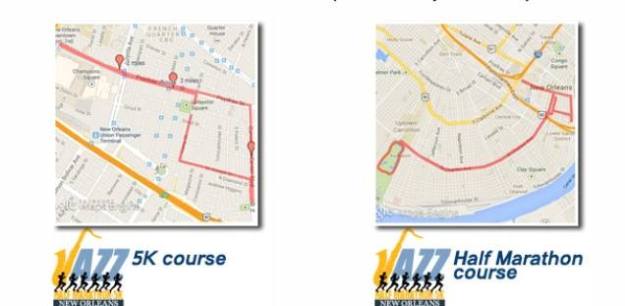
Take a look at the pic on the left-see the red square? Within that square, the 18-year old Crescent City Farmers Market sets up every Saturday from 8-12, rain or shine. I can personally attest to the traffic snarl this morning before 10 am on the streets around there, with most people unaware that their usual leisurely drive to this mostly Monday-Friday neighborhood would be upended by another superimposed civic activity, namely this race which has been run for only the last five years. No up-to-date information is shared with the market organization more than a day or two prior to this race being run (and that is only found through media sites posting it), which limits the market’s ability to tell its vendors or shoppers ahead of time about what to expect. Yet interestingly, the race supports an extremely worthy cause- The Children’s Hospital in New Orleans.
Since this race begins at 7 am (with fast runners, then slower runners and finally walkers) it’s over mostly by 10:30 am. Therefore, it might be sensible to move the start time of the market for just this week. The market does change its hours for the last Saturday of the Carnival Season, as much of that day’s activities are centered a few blocks away and so the market closes early to allow its vendors to make it out before the nearby streets are closed for hours of parades.
Or, it might be sensible for the race organizers to simply move the beginning of the race from the long street along the top of the course map that is Poydras and instead run it along the river over there on the right. Or maybe run it on Sundays. There may be other answers to this annual conundrum that should be discussed since there are other events that often impede traffic to this 4-hour market.
The main issue is that the race organizers, the city and the business district do nothing to accommodate the market at this point and ignore its very long and important economic, social and civic role. Why?
Why indeed. Certainly this market organization is adept at working with its city and neighborhoods; MarketUmbrella is a recognized leader in making the case for why farmers and markets are important. So why the cold shoulder when it comes to events?
The issue may very well be in its actual history. This market sits in this area partly because when the founders searched for the best location, this area was not yet a defined neighborhood. The founders have often shared the fact that they chose it for the first of their four (post Katrina, 3) weekly markets partly to not have neighborhood opposition back in those early days of the mid 1990s, when markets were much less understood and so they expected some pushback on a weekly event from other potential areas.
It may also be within the way that the organization has worked with its city-very cordially and with some transparency-but since all of the markets have always operated on private property, with some distance between them.
It may have nothing to do at all with the market’s willingness to work with the civic leaders, but an inability in the city to understand the importance of this weekly activity and to see its role as encouraging it to grow and to sustain itself.
My gut tells me it is a bit of all of these, but maybe a lot of the last. Well maybe its more than just my gut, since I served this market as Deputy Director for a number of years and then as its Marketshare Director. Here’s what I know.
Making the case for your market is a full time job and will be on the to-do list for as long as your market exists. New events will pop up in previously barren areas, new mayors and other leaders will decide to ask for parking fees on Saturdays, developers will build grocery stores and restaurants next to your market and assume that using your empty lot for parking is their right. How markets become “beloved institutions” in their community has something to do with how well they play with others. How they deal with external pressures also says a great deal about market organizations’ resilience and professionalism. The way that you can accomplish that goal is varied. You may create a feedback loop so as to activate your shopping base to be constantly making your case for you, or you may begin to work more closely with your elected officials over time to help them understand why they need you or you might simply move to another location that needs your market to anchor that area’s renaissance. In all these and more possible scenarios, the main actor should be the entity that runs the market since its the one that must handle situations like these in a way that allows sales to continue and mitigates the uncertainty for its community. By the way, I have written about markets and municipalities before here.
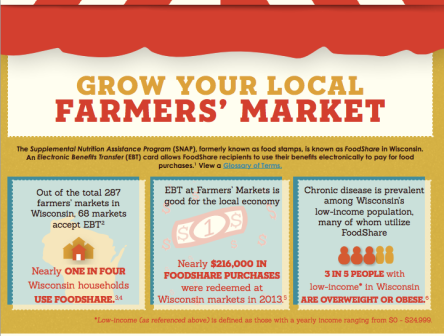
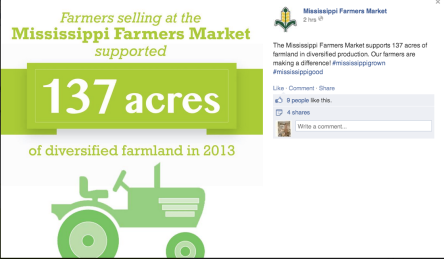
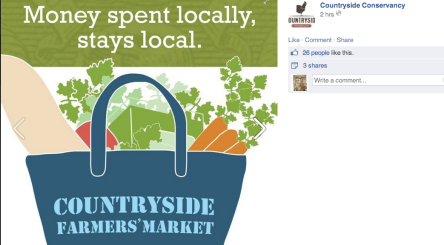


 Helping Farmers Markets Grow