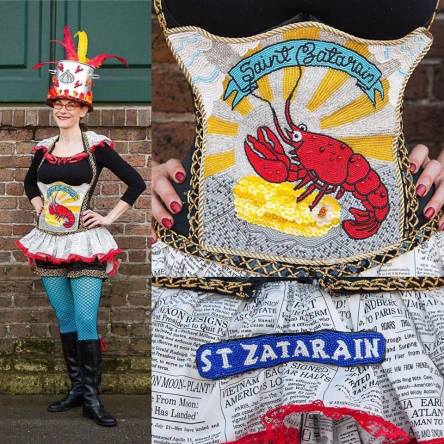
Patron saints of food, Mardi Gras style

Monday the 27th and Tuesday the 28th of February are the final days of two months of Carnival in New Orleans this year, which means it has been a particularly  long season! The season always begins on the Feast of the Epiphany, January 6th and ends the day before Ash Wednesday, known as “Fat Tuesday” or in French as Mardi Gras. This is because New Orleans essentially remains a Catholic city and takes Lent (more or less) seriously. Lent of course is the religious season to prepare for Easter.  The date of Easter changes because it is literally a “moveable feast ” (feast meaning religious observance, not food party!), linked to Passover which changes based on when the Passover (Paschal) full moon falls. (Wonderful to  see how many religious and secular traditions are based on the natural world’s rhythms..)

Today,  I am highlighting the local work of Dames de Perlage (Women of Beadwork) who used the theme of “Patron Saints of New Orleans” for their 2017 krewe. Each member spend their nights and “off-time” throughout the year designing and beading a new beaded corset and headdress and making the relevant costume based on the theme they choose after the previous Carnival. Each corset takes 150 or so more hours to make each.  This krewe marches with brass bands in a few parades and are a delight to see in person.

Great podcast with one of their krewe members describing the work they do and how parading works for those unfamiliar with them. Many of the riders and marching groups craft their throws and costume work in community get-togethers over the year. Pride in handmade items remains a vital part of the New Orleans culture as does the tradition of handing down skills.

These are some of the “saints” beadwork that I chose because of the connection to food and farming:

unnamed-2

Dan Gill, our longtime Extension Agent for Orleans Parish (county) and now a writer and radio host. answering everyone’s horticulture questions.

16831069_1258086530926946_2376355837903722700_n

This is amazing beadwork and costuming highlighting a Carnival/spring tradition: crawfish boils!

unnamed

The great chef Leah Chase is honored for her many contributions to New Orleans food and 7th ward culture. That is an excellent likeness of this great woman.

unnamed-1

This is my favorite one, and just coincidentally made by my pal Rachel. This is St. Satsuma which honors the citrus we see at markets starting in October and ending this week or next.

16830699_10208536597954412_5970393066501924615_n

16807049_10154507338621795_7552535683466588009_n

16807213_10208536596834384_6269194852156135913_n

Chef Paul Prudhomme, patron saint of jambalaya!

Structural racism and farmers markets, Part 1

With the recent uptick in the national conversation about racism and inclusion, I think it is important to talk about the inequities of food specifically in our communities. Those of us working for a just food system for all should be commended for the work we are doing, even as we are reminded of what remains unfair and unjust.
In my tenure in managing farmers markets in a city that has a majority of people of color, I had to acknowledge that the markets did not always reflect that reality. My organization, then called ECOnomics Institute, was founded on social justice principles and housed at a university center devoted to civil rights work so it was extremely important to us to advance its values. We certainly spent a great deal of time discussing how to reflect our community and to diversify our producers and were lucky enough to have activist farmers like Ben Burkett of the Mississippi Association of Cooperatives as part of the founding group. Even so, in the early years we were like many of markets back then: largely created and used by middle-class white community members or by educated back-to-land white farmers, both groups valiantly trying to expand good food and ecological stewardship for everyone but not always succeeding. Since then, the diversity has been increased both in vendors and visitors to those markets, as has the work being done by the entity now called Market Umbrella. The leadership continues to share their pilots with other markets and to increase access for local food to more residents of all socioeconomic strata – not just at their markets but at grocery stores, farm stands in low access areas of the city and in schools.

Part of the issue in the early days was the choice of locations. Often markets were given underused spaces in parts of town without much recent foot traffic or street-level retail, yet found themselves soon enough near or at the center of a gentrification push. Was it intentional or coincidental that markets chose gentrifying areas? Hard to know at this late date, but probably the promise of added nearby amenities and retail potential were vital for market organizations with little capital and few partners back then. Since those early days, the choice of locations has expanded so that markets now serve food deserts and areas with low supermarket access in thousands of places across the U.S.

In simplest terms, gentrification is the renovation and redevelopment of a populated area with one result most often being the displacement of folks from other socioeconomic strata, most often working-class families and people of color who had been left behind to those neighborhoods when the white flight began in the 1950s. In the last 15 years, deindustrialization, decentralized economies and the urge of young people to distance themselves from the values of their suburban parents have led to more urbanites with enormous purchasing power returning to downtown zip codes. An engrossing read on the subject can be found in the book: From The Edge Becomes the Center: An Oral History of Gentrification in the 21st Century by DW Gibson.

It seems important here to note that the food system’s “urban pioneers” of the 1970s do not reflect the term gentrifiers as they were interested in living among the existing population and did not have the economic power to submerge what was there previously. Those pioneers include many market leaders who were able to do good community work around food. To this day, I would argue that most markets continue to focus on what the present community wants in terms of market design, and have spurned developers displacement tactics. Still, markets can also be a victim of surrounding gentrification plans, especially if the municipality does not yet have a plan for equitable development that includes food. And many do not.
An example of how there may be no better example of how that right impulse can evolve into food seen as a gentrifier in and around San Francisco than this excerpt from Street Food by Adriana Camarena from March/April 2013:

“The Free Farm Stand was started by Dennis “Tree” Rubenstein. Tree was one of the founders of the Kaliflower Commune and the Free Food Conspiracy of 1968, in Haight-Ashbury. After the Haight became recognized as cool, the area quickly got too rich for conspiracies, and Tree and his Kaliflower communists were pushed out to Shotwell and 23rd. The Stand is now in the midst of the working poor of San Francisco’s Mission District, a testament to the idea that radical food politics will sprout where they are needed. Much of what we call food politics today—buying local, farming organic, eating vegetarian—originally came from collectives that wanted to raise awareness about industrially produced food. The People’s Food System of the mid-’70s was a network of community food stores and small-scale food collectives that organized to take back control of food from large agricultural and chemical companies; they built direct connections to farmers to establish the first farmers’ markets. Meanwhile, the Black Panthers were hosting free community breakfasts in their neighborhoods, and Alice Waters opened Chez Panisse partly as a space to talk about politics. Various collectives shared the urban farm known as the Crossroads Community (The Farm) on Potrero Avenue at the edge of the Mission…In recent years, urban farming has undergone a spirited revival in order to approach the issue of food security—the availability and accessibility of food—in its own way. There are five community gardens in the Mission, including one managed by the Free Food Stand, and seven more within walking distance. There are also edible gardens at schools, including Cesar Chavez Elementary School. Still, most community garden plots in the Mission are tended by middle-class urbanites, perhaps well-read in food politics, but mostly involved in community food security; and more and more, urban gardening takes place on private plots. So even as radical urban farming resurfaces, a critical piece of the radial community garden or urban farm—people coming together to work in collectives and cooperatives—is lost…”

(By the way, Alison Hope Alkon’s “Black, White, and Green; Farmers Markets, Race, and the Green Economy” also does an excellent job writing the history of 2 markets in the Northern California area:  one in Berkeley founded on environmental values and the other the Oakland market determined to address factors of economic apartheid under an authoritative police presence and continue the food organizing of Black Panthers, showing that markets can manage a very contextual organizing mission to serve their communities. )

As evinced in the Camarena excerpt, even though the SF organizers had not consciously intended to support the gentrification agenda, the growing number of users during the 1980s and 1990s were white urbanists with time and cash to spend. As gentrification grew, markets included younger, more affluent childless couples who did not take active roles in pushing for a broad range of services. The larger backdrop, of course, is that the U.S. has a tiered system of access in ALL sectors: housing, education, technology, healthcare and so on-industrial food has been no different.
(Added to that, the digital divide around the USDA’s 1990s move to an electronic card for benefits such as food stamps meant that the most at-risk neighbors could no longer use those benefits at their market. It took markets piloting the wireless technology once it arrived around 2004-5 and designing the token systems on their own to be included once again in the distribution of those dollars. Since then, the SNAP dollars spent at markets has surpassed the food stamp era and now is past the 20 million dollar a year mark.)

So, like other movements before it, community food has had to consciously address the social determinants that encourage or discourage inclusion by those without influence (read money). What is tricky about that, of course, is that the goal of the markets ARE money transactions as the producers cannot afford to give away their hard work and the cost of the travel continues to grow as farmland is gobbled up in expanding layers of gentrification. The delicate balance of creating wealth for the vendors can often feel as if it is in conflict with the needs of the at-risk population. One strategy has been the work to bring back’s partners the most at-risk residents through the incentive and voucher programs. Those programs have begun to add regular shoppers among those who previously were unsure or felt left out. Still, the number of programs and different currencies being used by funders are taxing both the market leaders and the vendors; let’s hope the technology gets to the point that it actually reduces the work needed to offer these programs rather than add to it as it does now.

Even with the incentive programs attracting more at-risk or lower-income shoppers,  it is easy for any organizer to grow impatient with those who do not immediately appreciate the programs offered and therefore for the market’s partner to have expectations of failure. The successful models devote time in study of the demographics of their market cities comparing those to shopper zip codes to continue to seek out the generations and neighbors who have not been made comfortable in these new markets. They do so without showing impatience or burning out our small businesses by constantly introducing new shoppers and not retaining enough of them as return shoppers.
They also realize the need for their market staff and vendors to reflect the community they serve. I have had some market board members or leaders telling me when asked if their market serves the entire community that they aren’t sure, or they recount how they have “tried to reach out to some of those neighbors but they just don’t want to come.” I do not doubt the willingness of the market community to include everyone, but the strategies can be tinged with assumptions that need to be challenged up front. Or to put it another way, to expect that the only way we will gain shoppers of people of color is through benefit or voucher programs is another assumption that we must challenge in ourselves.

Those assumptions are at the heart of the recent activism around the US:  the challenge among people of color to white allies to consider and rid themselves of their privilege. Whether it’s not having to be taught added steps of how to talk to police when stopped, or not having buzzers and locked doors on our corner stores or even not being a world-class African-American tennis player who has people post about her body shape in ugly, racist terms the day after she achieves a historic win, we do not know what we have not experienced until we ask and we listen. In order for us to understand the unearned advantage pale skin gives us, we need to examine our place in the world and our blanket statements or fears about those we do not resemble or live among. Challenging privilege does not mean that white organizers or farmers have to feel bad about themselves or their hard work, but that they need to look closely at how their community really operates for others who also work hard and cannot succeed.

One method used by markets has been to spend time in strategizing how to attract newly arrived or socially disadvantaged producers. Sometimes it is simple as having the application available in more than one language or having paper copies on hand and time for a chat with someone asking. Or through expanding the bylaws of the market to include cooperatives, foraged foods or a wider selection of culturally appropriate items. Sometimes it requires markets find partners to help those new to farming gain advanced knowledge of how to create a crop plan or how to price competitively. There are many examples of markets using these tactics successfully to increase diversity of users, both as vendors at first and then in shoppers.

We can help our own cause by remembering that we can choose the values and the community that our markets serve by how we design it or how we choose an inclusive mission or bylaws. This short chronological history below is something I attempt to add to whenever I work with markets and so am glad to hear from any of you on it. What it shows me is the intention of the work that has been done over the last 40 years and that when we expand to new ideas, we find the right message and partners to make it possible.  As always, this is somewhat off the top of my head so forgive any obvious omissions and feel free to email me directly with additions or corrections. (Exceptions to this timeline are to be found in every era; often those were led by a coalition of local voices who had their act together earlier than the rest of us.)

1970s-1980s: Back-to-land farmers, civil rights leaders, and ecological advocates begin markets. Their organizing principle is “Grow it HERE to sell it HERE” which was a provocative statement at the time, asking for a commitment up front from both the growers and the buyers. These markets opened in places such as Madison WI, Carrboro NC, Athens OH, Berkeley CA, Montpelier VT-a lot of university towns actually.

1990s: Community leaders, aware of the first markets, begin to open markets in cities adding educational programming to the grow it to sell it mandate. Cities like San Francisco, Seattle, New Orleans, Portland, Cleveland, D.C. were the recipient of this work. Interestingly, many became the founders of larger networks, including Farmers Market Coalition. Social cohesion was an important value beginning in these years, because of these leaders.

1990s-2000s: Main Street markets in smaller towns and in rural communities began to add markets to their revival initiatives in towns like Ocean Springs MS, Natchitoches LA, Durham NC. These markets added value-added items and encouraged new non-farm vendors, focusing on incubating new businesses and supporting nearby Main Street initiatives.

2000s:  As technology advanced to allow at-risk populations to access markets with their EBT card, public health strategies became useful and the field of practioners and agencies in that field began to partner with and sponsor new markets to expand good food by getting markets in new places and adding public health incentives. This certainly includes Kaiser-Permanente’s work to add markets to their own hospital campuses and markets such as Crossroads Farmers Market in Takoma Park MD.

2000s: Deeply embedded organizers add food initiatives to their portfolio of activities, utilizing the community assets of residents. Markets in and around central Brooklyn NY like Brooklyn Rescue Mission, East New York Farm and Sankofa Market in New Orleans LA  create multi-faceted centers of organizing with embedded markets to offer residents the opportunity to be both the buyers and vendors.

So my (flawed and incomplete) history shows a deep attention to entrepreneurial activity, food sovereignty and to farmland reclamation, and that we are beginning to address how food organizing needs to happen at community/market level and across systems at the very same time.

Today, we are all more conscious about the implication of creating programs that offer the real opportunity for diversity in front of and behind the tables. I have great hope for this work to be part of the solution and to continue to assist in tearing down the structural elements that divide us.

Part 2

Structural racism and farmers markets, Part 2

Recently, I wrote the first post about where markets began and some of the barriers we have encountered along the way to healthy food for all. I hope that those who read it understood the distinction I was making between individual, institutional and structural racism. The point was and is that any organizing done at the grassroots level can address individual and some institutional examples of racism, but that partnerships across sectors and systemic strategies are necessary to address those structural examples that reduce the effectiveness of these interventions. Markets are just being allowed into those conversations in the last decade and so have much work to do to achieve their goals.

In Part 1, I gave my version of the chronological history of markets in order to show the intentional and thoughtful work done by leaders so far. One of those milestones was the work with public health advocates, starting in the early 2000s and one of the examples I use of that is Kaiser Permanente’s creation of farmers markets. This began around 2003 when ob/gyn Dr. Preston Manning had an idea to put a farmers market on the Oakland  KP campus and begat a movement of “market champions”around the U.S. during their shift to wellness rather than crisis care. This report on their markets came out a few years ago and has some very interesting analysis of market interventions.  The evolution of the “campus” market type in the emerging market typology spectrum is illustrated in there as is some data on the marked increase in the consumption of fruits and vegetables among surveyed marketgoers, and (what I remember as the surprising outcome to the KP folks) of the increase in social capital for their staff.

The KP markets marked one of the first long-term partnerships with a health care provider interested in them as interventions for their target audience. In other words, it seems to be the beginning of the era of partners realizing markets were more nimble than they had previously seemed and so could be added into new communities for multiple reasons, including those with complex public health goals. The KP/market relationship seemed strained at times -(full disclosure: back then, my organization was in discussion to help KP with their market strategy, but the New Orleans levee breaks of 2005 took precedence for our time. We did continue to discuss markets with them and even included their staff in some of Market Umbrella’s trans•act research into market evaluation)- even with the tension between market leaders and their team,  KP remained thoughtful about how they supported markets and constantly offered some good critical thinking about the capacity of markets and what success measures that they thought were appropriate.

I became fond of saying that the relationship between markets and public health was a match made in heaven as markets had been all energy with little discipline and public health discipline with little energy. These health partnerships have led to many things, like the incentive strategy and the expansion of the voucher programs. There is no doubt that markets have adopted a wider view of good food and done an amazing job at encouraging those with benefit program dollars to come to their markets.
Most importantly, markets gained a better understanding of the social determinants of health paradigm.

Social determinants
The CDC definition:

“the conditions in the environments in which people live, learn, work, play, worship, and age that affect a wide range of health, functioning, and quality-of-life outcomes and risks. Conditions (e.g., social, economic, and physical) in these various environments and settings (e.g., school, church, workplace, and neighborhood) have been referred to as “place.” In addition to the more material attributes of “place,” the patterns of social engagement and sense of security and well-being are also affected by where people live.

http://www.cdc.gov/socialdeterminants/data/index.htm

It is important to address the safety, transportation needs, housing etc of a person who is at-risk in order to offer solutions to repair their health, but without also addressing how that environment ended as less safe or without decent places to live, that individual will remain at risk. What is also important to note about these indicators is that they rely on community wealth being available. Before we tied our market balloon to these pillars of health, many of our initiatives were seen as elitist and obsessed with a construct of local that had no relevance to the larger world. Now, of course, it is clear to markets and their partners that addressing inequities cannot be completed by outside funders swooping in, and that entrepreneurial activity is a necessary aspect for empowerment; efforts across the globe in micro-investing or Slow Money here in the U.S. have shown the trend is appealing even to big-time money folks. So economic power at the local level is key to this shift and in food systems, and currently, no one does that better than farmers markets.

Kellogg Foundation’s shift about the same time to a continuum of health for families encapsulated beautifully at one of their conferences as”first food, early food, school food, community food,” allowed them to lead the discussion on this overarching strategy. The foundation focuses on “three key factors of success and their intersections: education and learning; food, health and well-being; and family economic security. Lots of good language to seek out as well viewing some of the work from Kellogg and its partners. Check out their resources.

—————————————

So place and civic engagement could be the two buckets to consider. How do markets address either of these? Place is pretty simple, isn’t it? Let’s say that your market is working to add at-risk shoppers using an incentive and EBT program and finds that one chief barrier is the lack of public transportation options around your location. It may help to advocate for a bus to alter its route for the market day. Or to add more bike parking to encourage non-drivers or to set aside a few parking spaces close to the entrance for drop-offs, shuttles, jitneys or uber. One great way to look at the place around you is to use PPS’ Placemaking audits and tools and see how inviting your area is.

Clearly, civic engagement is another area that markets are using to do amazing work. The Power of Produce (POP) program offered by FMC is a lovely way to offer this. Some success has been noted by markets work with newly arrived citizens through expanding language choices or adding more culturally significant products. Shady seating for visiting and constant community information is also good. But how about market leaders showing up to a housing meeting in their city? Or working on a micro-investment strategy with shoppers and local banks to encourage new producers or other community solutions?

So, the work to include all of the social determinants into our food work is not fully realized. That issue of where we are currently in health and wealth work at the local level is at the heart of these 2 posts and why (I think) the divide between whites and people of color seems wider and deeper than ever. It is commendable for us to rid our language and actions from individual racist attitudes, and to add institutional partners and programs that add access, but we must go beyond that. If we use our power and privilege to explore and address inequities within the larger physical and political environment, we will start to see better outcomes, and the social determinants framework is as good of a way as any to do that in organizing terms.

Star assessment of community health


Related statement from National Young Farmers Coalition.


Planning For the Future


Many market people have heard my elevator pitch about the eras of farmers markets, circa 1970-2010. This timeline was derived from founders recounting their experiences, and my realization that each era had a specific set of leaders and a guiding organizing principle. Here is a quick version:


(1970-85) Back-to-land farmers. Organizing Principle: Gotta grow it to sell it; direct sales lead to real, transformative relationships between producers and eaters


(1990-2000) Neighborhood organizers. Organizing Principle: Educational events deepen and lengthen the interaction; the “new” town square is here.


(1995-2005) Main Street leaders. Organizing Principle: Small businesses incubation; regional impact is a necessity.


(2005-) Public health collaboratives. Organizing Principle: Good food for all, attention to the social determinants of health, incentivizing participation.


One of the questions that I end this with is what’s next? Who do we think will be the next set of leaders to add a new round of markets, and what issue will be foremost for them? One of my own guesses for the next era of leadership has been the planning community. For a long time, they mostly eschewed the informal and often temporary spaces that our markets occupy. That began to change over the last few years with more cities and regions “focusing on the spaces between the buildings” as writer Rebecca Solnit suggested to planners at a conference in and about New Orleans after the 2005 levee breaks.

So you could be sure I was pleased to see this thoughtful and detailed post from the Congress for a New Urbanism (CNU), which indicates that the work we do aligns with their evolving efforts. Even more important is that the post focuses on the application of planning on the effects of loneliness.

Here is the key excerpt that spells out the health issue:

Aside from the question of whether having confidants or not affects happiness, living alone affects physical health. According to recently published research at Brigham Young University (2015), living alone increases mortality by 32 percent even for those who self-report that they are not lonely. This is on par with being obese.[15]

The suggestion in the post is that the response requires both structured and informal design solutions, which sounds to me like the market field’s sweet spot. Of course, even before reports like these were out, markets were working with at least one group likely to suffer from this – senior citizens. That strategy was based on the obvious isolation that the modern world forced upon them, which one could easily see led to rapid physical decline. And for low-capacity market leaders, encouraging shoppers who already had a deep knowledge base for the traditional foods our markets do so well made them an ideal demographic as “early adopters.” However, even though it was an obvious choice it wasn’t always easy to keep them coming: open-air market weather issues, physical accessibility, frustration with market’s insistence of seasonality (any market out there NOT have a senior ever ask why they don’t carry bananas?) lack of transportation and more made the work to keep seniors coming challenging but ultimately rewarding. This early work with seniors gave markets a lot of experience with working with at-risk populations, especially when leveraging available benefit programs like FMNP. In many cases, those FMNP programs led to successful SNAP strategies, as well as the Veggie Rx programs that are offering more ways for markets to add new shoppers, especially for F&V farmers.

So who’s next?

Well, as this post and the linked reports make clear, the effect of isolation are only growing more alarming and shared by rural and urban people across a widening age group. More of us work from home or conversely, spend a great deal of time alone in a car than previous generations. Even with my own happy job that I do sitting at my little desk, I have to guard against its effects. The FMC team actually “meets” each week using Google Hangout to have us chat and update via live video and our Executive Director does her best to get as many staff to the outreach we do as often as possible but still, I am grateful for the four or five markets per week in my town that get me among others regularly.


From the CNU post:

Humans don’t generally congregate in the middle of empty fields. We are drawn to social spaces defined by walls, trees, or facades of buildings—spaces limited in size. We like those places because—whether we choose to or not—getting to know people there looks doable. Neighborhood main streets are usually just one to three blocks long. Historically, these social centers usually constituted 5 to 10 percent of the area of a neighborhood. For as long as humans have settled, the marketplace was where social life was most robust. Commerce is more than just the exchange of goods and services for money—commercial centers can also be places of cultural, social, intellectual, and emotional exchange. For communities with strong physical identities, the commercial streets are still the beloved public face. With the automation, digitization, and auto-orientation of commerce in recent decades, much of the social content of our commercial centers has been stripped out. People may be attracted to convenience and inexpensive goods, but the social satisfactions are weak. Nevertheless, creative urban design can revive a forgotten main street, or convert a dead shopping center into a walkable town center. Every community, whether new or historic, needs to proactively take charge of its own social destiny by developing plans for new walkable social spaces and safeguarding its historic centers.


So, I hope this post does a few things: First, that my simple history of what our founders put in place for us is helpful to you. Second, you gain some practical ideas and language for engaging in design opportunities with City Hall or regional planners, using your experience in working with isolated shoppers (and vendors!) and creating social spaces for everyone.

Lastly, that you and your market community feel a sense of camaraderie with the activity around health and happiness bubbling up around the world.


Now go see some people.


The full post from Steve Price

Farm apprentices: a good idea?

Researchers at Case Western Reserve University and the U.S. Department of Commerce found that registered apprenticeship programs lead to greater productivity due to a decrease in employee errors, reduced employee turnover, and improved employee engagement. Apprenticeships may also reduce employers’ hiring costs and increase employee loyalty. International studies suggest that for every dollar spent on an apprenticeship, employers may get an average of $1.47 back in increased productivity, reduced waste, and front-line innovation.

In Europe, apprenticeships are so widespread, they’re not seen as a lesser choice. In fact, the average age of someone entering an apprenticeship in Europe is 17, says Seleznow, compared with 28 in the United States….

…Harper College is one of the many community colleges partnering with DOL through its Trade Adjustment Assistance Community College and Career Training (TAACCCT) grant program. TAACCCT has awarded $1.9 billion to 256 grantees to create registered apprentice programs in conjunction with local employers and driven by their staffing needs….

…A Jobs for the Future initiative called the Pathways to Prosperity Network is looking at ways to re-envision high school education to prepare students for youth apprenticeship programs. Nancy Hoffman, a senior advisor at the organization, encourages parents to keep an open mind about apprenticeship. “If you’re not sure your child will get a job with a four-year degree and your child is going into debt for that degree, you might want to look for options with more security,” she says….

Why Apprenticeships Are Back – CityLab

(Webinar) Success with SNAP: Equipment and Outreach Essentials for SNAP Programs

PLEASE NOTE THE NEW TIME: Thursday, February 2, 2017, at 2 PM EST, 1 PM CST, 11 AM PST.

More than 6,000 farmers markets and farmers across the country now accept SNAP. When farmers markets accept SNAP, it helps increase revenue for small and beginning farmers, while making it possible for low-income families to access healthy, affordable food: the ultimate win-win. To assist markets with this strategy, Farmers Market Coalition will be hosting a webinar on Thursday, February 2, 2017, at 2 PM EST, 1 PM CST, 11 AM PST.

Join the webinar, as we discuss equipment and outreach essentials for SNAP Programs at your farmers market. We will provide information on how FMC’s Free SNAP EBT Equipment Program can help you accept (or continue to accept) SNAP benefits at your market, and highlight successful outreach initiatives to attract and retain SNAP customers.

Click here to register and contact info@farmersmarketcoaltion.org with questions or for more information. A recording of the webinar will also be available to view online for those who are interested but unable to attend on January 26.

2016 SNAP retailer report

Fascinating.
 This is from the 2016 SNAP retailer data report from USDA/FNS, found here. This is the kind of data that we need to pore over and gather data at the market level to compare and contrast.
Some quick data and my thoughts:
• 53 percent of the 366,972 households that shopped at a farmers’ market or direct marketing farmer made one purchase; another 18 percent made two purchases; and 29 percent made three or more purchases within the year. These percentages have remained relatively unchanged over the last five fiscal years.
So 53% only made a single purchase using their benefit card… This may correspond with the analysis from my 2013 VT Market Currency report that markets were then using a whole bunch of money and time to attract shoppers who are either at the end of their time on the SNAP rolls, or are new to SNAP and need more assistance in using their benefits, or that markets have not yet made enough changes to be welcoming for that shopping base to use their benefits at markets. So this data should be crunched with what part of that 53% has been enrolled on SNAP for ___ period of months.
The other way we should analyze this would be compared to our cash/credit shoppers too, which means we need to collect that data too in the same way. That is the kind of comparison that would tell us what the best initial strategy is for SNAP shoppers.

• In fiscal year 2016, program recipients made 1,095,107 purchases at farmers’ markets and direct marketing farmers nationwide. The average purchase amount was $18.60.

Almost 1.1 million purchases has a nice ring to it. Of course so does 10 million.That would be a great goal for the market field: 10,000,000 purchases at markets and with dmfs in a single FY by 2019. Sometimes the obsession over only measuring total dollar amount spent limits the strategy for increasing actual uses of benefits in ways that are more useful in retail terms…

•  366,972 SNAP households made at least one purchase at a farmers’ market in fiscal year 2016. Households shopping at farmers’ markets spent $55.51 on average over the course of the year.

 • More SNAP benefits were redeemed at farmers’ markets and direct marketing farmers in fiscal year 2016 during August than any other month of the year.


Some of this data needs to be released per state, as the August spike is likely not true in the Southern states. It’d also be great to see here which week or days of the month it spiked as well.

Helen Hill

Today is the sad anniversary of organizer/writer/filmmaker Helen Hill’s murder. New Orleanians, Canadians, South Carolinians, Californians and a slew of other oddballs and creative types are thinking of our dear Helen today.

Helen was daughter, sister,  mother, wife, friend. Her murder sent shock waves through dozens of communities that many will never recover from, partly because there was not a more loving or angelic human (although with a sensible streak of mischief when needed) than Helen. Partly because in true New Orleans fashion, the police never even turned up a suspect. Partly because her work was stopped, work so important that it has since been added to the Library of Congress’ National Film Registry.

Helen and her husband Paul came to me because of food, so that’s why this is here. I became active in the local Food Not Bombs actions which they had helped to “organize” or more appropriately, to encourage.  I had many fascinating conversations with them about tactics we might employ to be able to wrest food scraps from stores, including from Whole Foods. That conversation was ongoing because I worked there part-time, along with my other then part-time job at the farmers market. (That’s not as odd as it seems now because that WF location’s beginning actually predates the Austin behemeth’s ownership, back when it had been a New Orleans-only coop called Whole Foods Company. Even after the corporation bought it, it remained a funky local treasure, so my working there and at the market at the same time for a short time was not that farfetched.)

Their vegan potlucks were legendary, as were her vegan tea parties. Paul and Helen also knew my market boss, fellow vegetarian activist Richard McCarthy, and through him had begun to bring their pig Rosie to our market events. I remember once Helen called me before a scheduled visit to ask details as to where Rosie would be set up; turns out she was worried that Rosie would be within sight of meat vendors and would be distressed. I was at first amused, thinking she was slightly joking, but of course she was not. Sobering up, I assured her that every precaution would be taken for Rosie to be happy and comfortable that day. Forever after, Helen treated me as Rosie’s protector.

I was thrilled like many others when news came of their return to New Orleans after Katrina. Helen had asked many to send postcards to Paul to convince him to return. Happily, he did; sadly, that return was so very short.

This link is to a film Helen made for Rosie about her genealogy. This one is about the life of chickens, a motif  she often used  in her art.

From her award-winning film Scratch and Crow:

HelenHillDustyAngels.png

There are dozens and dozens of tributes to Helen, but viewing her films and hearing about her Poppy growing up under the wise and gentle hand of his father is the tribute she’d like  most of all. So please enjoy and share her lovely films whenever possible.


Winter/Spring 2017 FM Conferences

This is the best list that I could muster from researching online for a few hours. It only includes published events that have a specific farmers market management track or focus as described in their materials.  If your meeting meets that criteria,  is not listed and will be held before May 2017, email me at dar wolnik at gmail.

Missouri FM Association: January 20, 21 • St. Louis
Arkansas Farmers Market Association 2017 Annual Meeting:  January 20 • Little Rock
Wisconsin Farmers Market Association Conference: Jan 22 – Jan 24: Wisconsin Dells
Maine Farmers’ Market Convention: January 29 •Hinckley
Washington State FM Association: Feb 2-4 • Blaine
Pick TN: February 16 – 18 • Franklin Tennessee
Oregon Small Farms Conference: Saturday, February 18 • Corvallis
Oklahoma FM and Agritourism Conference: February 23 • Oklahoma City
2017 Alaska FM Conference: MARCH 2-4 • Homer
2017 Ohio Farmers’ Market Conference: March 2 and 3 • Dublin

British Columbia FM Association: March 3-5 • New Westminster

2017 Michigan Farmers Market Conference: March 7 and March 8 • East Lansing

2017 KANSAS :Farmers’ Market Conference: March 16 and March 17 • Wichita
Colorado FM Association Annual Meeting: MARCH 17 and MARCH 18• Longmont

One business shares a gratitude index

In what has to be the most common topic in this blog for 2016, I offer another illustration of how data collection can be simply managed, yet offer meaningful data for a wide variety of audiences.
The elegant metrics from a small value-added business in Charlottesville VA are below. It seems important to note that Stacy was my comrade for the original creation of the FMC Farmers Market Metrics work (and FMC’s founding executive director before our current excellent Jen Cheek) , and did a incredible consulting  job in 2016 assisting FMC with metric refinement, data collection research and devising the workbooks that are at the core of the FMM program. Those tasks are in addition to what the output shows in the metrics below, her devotion to fitness as a student and a leader and (along with her ever cheerful husband Joe) raising their energetic son.

2016 was good phyte foods’ first full calendar year of operation, after our first humble sale at Charlottesville City Market in May 2015. Since January this year, the business has made from scratch and sold 57,024 crackers, 1,003 bars, 157 pounds of granola, 978 pumpkin muffins, 533 kale cookies, and a motley assortment of odd-looking experimental snacks. In so doing, we have bought sustainably grown (and often certified organic) vegetables and herbs from at least twelve farms² in Central Virginia. We are grateful not only to our loyal and patient customers at City Market, but to our enduring local partners at The Juice Laundry, Random Row Brewing, Blue Ridge Country Store, and ACAC Downtown. Thank you. Thank you. Thank you. It is a humbling honor to be part of this evolving local food economy.

And for those who think cottage industry producers only care about their own cash flow:

In the coming year, we want to expand our reach to more retail partners, reinvest in new equipment, train some cracker apprentices, experiment with early summer cracker flavors, and give back to community organizations that are helping kids eat more vegetables. I have recently been appointed to the Advisory Council of the Urban Agriculture Collective of Charlottesville, which, among other things, teaches children of limited economic means how to grow, use, and appreciate fresh organic vegetables.

Go Stacy Miller; Keep the goodphyte going.

Source: getting specific: gratitude counts in our 2016 index

Health issues topped the list of scientific studies reaching wide audiences in 2016

In general, health-related studies… had more reach on social media and other online platforms than other scientific studies. Seven of the top 11 most-discussed scientific studies for the year focused on health, as did fully 59 of the top 100. Together, these studies covered a wide spectrum of health-related subjects.

The second-most-discussed health article after the one by Obama was about the prevalence of hospital medical errors, a problem the authors determined was the third leading cause of death in the U.S.

The fifth ranked article was a historical analysis claiming the sugar industry had sponsored research dating back to the 1950s aimed at downplaying the possible links between sucrose and coronary heart disease.

 ft_most-read-journal

Hark!

“Be not forgetful to entertain strangers: for thereby some have entertained angels unawares.”

Dear Market community,

The work that all of you do to offer physical comfort as well to create deeper connections may not be noted every week but I hope that you are sure that it results in great things. Those great things revolve around the market’s vital role as the town square which we talk about often on this blog but still may take in stride too easily. No matter how you feel about recent events, it is clear that democracy is in fragile shape. What too many Americans think of as their only duty as citizens begins and ends on election day; After that is done, the other activity is focused on name-calling and silly memes on social media. If that is the sum of one’s civic engagement, the result is often naive cynicism, an unhealthy view of others and a further tearing of the fabric of democracy.

How else can we help democracy prosper but by thoroughly shaking out and airing ones citizenship in public regularly? And when we talk about doing this in public, we cannot mean those narrow retail aisles where one or two corporations have decided that only some are welcome,  valued mostly by the largeness of their purchases. In these restricted places, too many of our neighbors are left out. Those neighbors need to be allowed in AND allowed to find real ways to engage as citizens too.

Because citizenship is not the same as consumerism, even though many confuse the two.

Or as Wendell Berry says, “I think an economy should be based on thrift, on taking care of things, not on theft, usury, seduction, waste, and ruin.”

In answer to that, you’ve designed markets to not only be about the buying and selling of well-made thrifty items, but also about the sharing of ideas and talents used for the safeguarding of our shared and precious resources; an economy of taking care of things and of each other.

That makes you the mayors and leading citizens of your village, creating an town square of good, busily entertaining strangers who may be some of those angels unaware.

So here’s to your health in the New Year to able to do even more of it.

Book review: The Invention of Tradition

41l9wlbmwrl

I find this to be a fascinating subject. The traditions that we follow offer clues as to which tribe we want to join or those to which we already belong; they also indicate which authorities we follow.

As pointed out in the excellent introduction, tradition is a different matter than customs. Tradition is what has become unvaried or fixed, while customs “serve the double function of motor and fly-wheel.” Customs have more to do with the delicate give and take of civil society, and can become tradition and often do. For example, the author points out that much of what judges do is included under customs, but what they wear is tradition.

This collection covers some great examples of invented traditions from different colonial systems, the British monarchy and the European industrial age after 1870 to the start of World War 1. The term invented tradition in this book includes those constructed to assert authority or dominance, and those that simply emerged over a brief period of time. With those definitions, one can easily see how knowing how to untangle which is which (and devised by whom) is vital before adopting or defending them.  For example, it seems that recently the singing of the national anthem has become a place of protest at sporting events. While writing about the issue, many reporters began to examine this tradition and found it only became the custom around WW2,  with the song itself protested by citizens from its adoption as our anthem in 1931. Even Jackie Robinson wrote of his inability to stand and sing the song in his 1972 autobiography.  No matter how one feels about the protesting, one can see how it has been hardened into tradition that is now so dearly held by some that the flouting of it is seen as an unpatriotic act.

Upon investigation, it may  turn out that some of these dearly held traditions began from pure myth or even from the cooptation of another culture. But knowing which invented traditions are problematic may be difficult to uncover and in many cases,  may not really matter.  After all,  all traditions are manufactured by people and their meanings changing with the times.

In terms of community food systems, it seems to me that its invented tradition and customs should be at least understood before adopting. The adoption of some customs (old-timey signage for example) may presume an allegiance to a past that not everyone is excited about repeating or even remembers. Or the tradition of Saturday morning markets meant a smaller audience for our farmers than the modern world could offer us, yet still felt appropriate for the first founders to honor it by adopting it. Since then, by acknowledging that tradition and finding ways to pay homage without being wedded to it, the market field has vastly expanded its number of days and therefore its reach. Another example may be the traditional audience of the farmers market field: in almost all cases, our markets serve family tables and not larger entities. Could we invent a new tradition where we use the  weekly open-air market model to build another that serves intermediate and wholesale customers exclusively? As long as we made sure to  build transparency and  payment options for bulk purchasers, restaurant, grocery and wholesale customers couldn’t  the market serve the same role as curator and connector that it does in the traditional model?

In any case, installing meaningful traditions and customs into food system work is vital. After all, a generation is around 30 years in span;  this means that the kids and grandkids of the original visitors and farmers are using this new tradition of markets, and assuming the customs and routines of it. The more that those traditions are made to fit the values of the people that are using them, the more that we can clearly indicate the role we want the places of good food to play in civil society.

Book availability