First New Orleans recipient of Fresh Food Retail Initiative closes, puts store on market | The Lens

A Central City grocery store that received a low-interest loan under a city-funded program to bring fresh foods to under-served neighborhoods has been closed and placed on the market.

Owner Doug Kariker said the store was too much work. “I can’t do it anymore,” he said. The store was not profitable, he said, “but in our business plan, we didn’t expect it to be” in the first year.

First recipient of Fresh Food Retail Initiative closes, puts store on market | The Lens.

Egads.

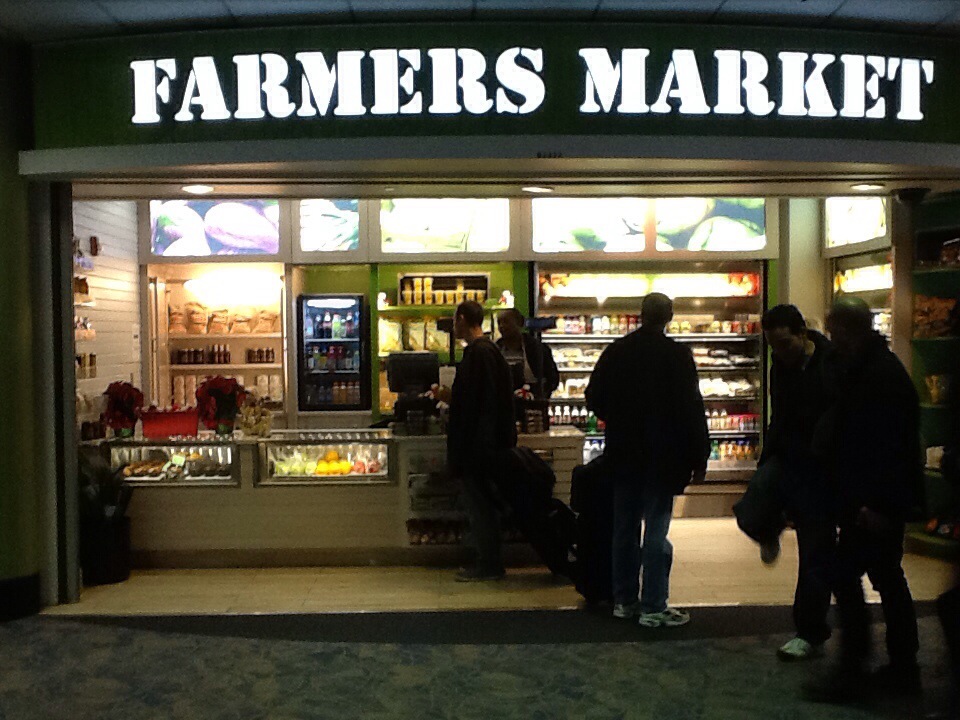
This picture is for anyone that believes that we have effectively gotten our message of how farmers markets stand for local and direct across to the other 97% of America. Clearly, we need to keep on defining our message so as not to be co-opted completely. This, by the way, is the Charlotte, NC airport.

20131202-101107.jpg

Nashville’s beloved farmers market faces some tough rows to hoe | City Limits | Nashville Scene

This article is from the beginning of the year:

“The idea of bringing in a private company to run the operation comes less than a year after a review from Metro’s finance department that was critical of the market’s finances and management. Then-market director Jeff Themm stepped down from the role in June of last year, shortly after the review, and Nancy Whittemore, director of Metro General Services, has been serving as interim director ever since.

Comer says the market board has worked with General Services to address most of the issues brought up in the report, including better enforcement and compliance with civil service rules, and more thorough housekeeping and maintenance. She says they’re still working through the report, and part of that means looking at “all possible options” when it comes to making the market financially sustainable.”

Between an ongoing deficit and privatization talk, Nashville's beloved farmer's market faces some tough rows to hoe | City Limits | Nashville Scene.

I have not heard or seen any updates to this since this article and RFP were published.

Why are consumers less likely to buy a product when it’s the only option?

How does the range of choices affect sales at a market? Talking with a vendor at a market last week, he mentioned that his sales have actually risen even though another vendor has joined the market with very similar items; he was dumbfounded that their sales had actually gone up. This may be the explanation that they need to understand:

“Giving consumers only one option increases their desire to search for more options. As a result, they might reject a product they would otherwise purchase.”

Market organizers always need to be carefully calibrating the levels of products because restricting sales too much may actually reduce the lone seller’s profits and too much of one item can certainly dilute those sales too much.

Study

Saxapahaw: Gatorade next to Kombucha

What a treat I had yesterday. Sarah of the Carrboro Farmers Market has been patiently squiring me around the area, meeting to meeting, meal to meal. Hopefully, all of you have made it to this area of North Carolina and had some of their amazing food, centered by the pork, chicken -well, all meat- that they love and know how to cook in so many interesting ways.
Yesterday, Sarah took me a few miles out of Carrboro to a little town called Saxapahaw (pronounced sax-paw the Carrboro native says) for lunch and for a quick meeting. That meeting easily became an afternoon, because of the fascinating Saxapahaw General Store.

20121212-081229.jpg

Here is what their website says about their beginnings:

The Saxapahaw General Store as it now exists began in June 2008 when Jeff Barney, butcher and self-taught cook, and Cameron Ratliff, teacher and self-taught biscuit maker, worked with former owner Mac Jordan to begin a new life for the convenience store and gas station that had served the community for several years. They imagined a spot where a village could gather for refreshments, meals, and basic home provisions, run by folks whose varied backgrounds have each taught them they can influence their world by collaborating with their neighbors. They hoped to serve the residents of Saxapahaw with a range of products that could allow everyone to feel welcome. They decided to become stewards of local foods, good wine and beer, nutritious snacks, and eco-conscious dry goods.

What I saw was a business model that looked right. Once I met the dynamo farmer Suzanne, I became even more sure. Suzanne took us across the street to the pastures after our lunch
(the picture below shows what is available for lunch-all of the meat is local and much of the produce too)

20121213-051100.jpg

The turkeys were the last of the year, with these destined for ground turkey in the next week or so.
Much of the poultry production is done herself alongside Saxapahaw neighbors and coworkers; the humane treatment of her animals at the end of their lives is so important to this farmer that she told us she would not use many of the processing plants available to her. And that if that was the only way that they could be processed that she wouldn’t raise animals for food.

20121212-081024.jpg
She pointed out the ducks that they had only begun to raise for food and the vegetable garden, also beginning. At this point, the store is buying from the very talented growers that surround the area thanks to the Carrboro Farmers Market and its younger sister markets, but the emporia is going to grow some of its own produce across the street. The composting is carefully monitored before being shared with their animals, so as to not waste any of the precious produce.

The store is set up to roam and shop after one has put their order in at the counter. Coca-cola products are lined up near pure ginger root drinks, homemade baked goods and local preserves near the small candy area. Hunting gear and motor oil can also be picked up as well along with some biodiesel or gas for your truck.

The store is both a throwback and a nod to the future. Suzanne talked extensively about the ongoing need for more equipment as well as sharing individual stories of the staff and their talents. Throughout our time there, people of varying ages and backgrounds came and went, bought food, drink and dry goods.
As public health and regional planners look for store models that can offer dignity and inclusion to food producers as an encouragement to sell there (just as the farmers market world has done) this store should become a Mecca. Using around 1500 square feet to offer as many culturally appropriate items as possible (Suzanne dreams of the day she can put out her gizzards and turkey necks next to the stock already offered) and real food choices next to convenience items still necessary to the real world, the Saxapahaw General Store is a food organizer’s dream come true.

20121212-081115.jpg

20121212-081751.jpg

20121212-084526.jpg

Kits for shoppers

In the arc in the maturation of a market shopper, it is clear that one type of shopper quickly adopts the grower mentality and begins to supplement their purchases with items they grow themselves, often with advice from the market vendors they buy from. A savvy market would do well to capitalize on that thirst for knowledge with products that allow backyard growing or canning or preserving. One of my favorite examples (although not a market vendor!) is the oyster starter kit that Taylor’s Seafood sells out of their store front in Puget Sound. Designed for people with waterfront property, it teaches these folks to harvest a small amount and offers basic understanding to those with this valuable real estate of the need for a balanced ecosystem.
This mushroom kit is a great idea and versions of it should be available in markets across the US. Another example might be a box of slightly damaged fruit with ingredients and instructions for making a pie, or culled tomatoes with small bunches of herbs and instructions for sauce.
We spend a great deal of time attracting new shoppers to our markets, but need to take the time to keep the longtime ones too.

Our Story – Back to the Roots | Mushroom Kit – Yields up to 1 1/2 lbs in 10 Days.

Planning ahead: Consumers prefer fewer options when thinking about the future

How people shop is crucial for markets to understand. We cannot assume that there is only one style of market farm table or only one version of local marketing that will attract more people. I have been fascinated by retail anthropology issues for years and I think it is key that market organizers build retail knowledge into market job descriptions and helping vendors to understand so they can refine their business strategies.

Planning ahead: Consumers prefer fewer options when thinking about the future.

74% of these respondents favor farmers markets

MSN poll I saw on Sunday showed these results. Not bad. Price concerns seem to have lessened…
Has anyone done a poll just like this in their local paper I wonder?

WHAT DO YOU THINK?
More and more people are purchasing their fresh, organic fruits and veggies at a local farmers market. Do you shop at the farmers market near you?

35 % Yes, they have the best stuff. 17,764 votes
26 % No, it’s too expensive. 12,999 votes
39 % Sometimes, when it’s convenient. 19,908 votes

Total Responses: 50,671
Not scientifically valid. Results are updated every minute.

I also have this link so that you can see the most updated results of the poll:

msn poll on farmers markets

INTERVIEW: Zoning for Food Access in New York Neighborhoods – Next American City

A must read for any food organizer. Understanding how cities are using zoning and tax incentives to encourage businesses to sell food is important. And it’s important to remember that city governments work with a “broad brush” when it comes to encouraging growth so that the most innovative entrepreneurial initiatives will most likely come from other stakeholders in food systems.
In other words, its up to us to define food system sustainability and success and for cities to remove barriers for us to do that.

INTERVIEW: Zoning for Food Access in New York Neighborhoods – Next American City.

Letter to a fellow food organizer

a colleague asked me to give her my opinion on trends and jobs in the alternative food system retail sector. Here is the beginning of my response:

Okay,
Here’s a few of my cents as requested:

As you know, the food hub conversation has taken a lot of the oxygen in the room (and a lot of the funding) away from direct farmer support and farmers markets and as a result, it feels like we are simply treading water in a lot of instances. Spread too thin. Certainly in the expansion of direct marketing farming or in getting any serious cross-sector analysis, we’re not jumping ahead much of where we were 5 years ago.

It’s not that I’m against food hubs, but some of them sound a lot like city governments’ “one-stop shops” which I am not sure has worked either. And it smacks of “scaling up” which is a suspect phrase to someone like me who has seen how long it takes a market farmer to really be ready to price at his or her comfort level and to innovate products. The Cliff Notes version of the market vendor lifespan is that it takes years of a market organizations time and “expertise” to patiently get a farmer to an economic and social comfort level where they actually tell you that they are about to go bankrupt or get divorced or get ready for a kid to go to college and so thats why their business is changing so you can help it change for the better. And that those folks are RETAIL vendors, with tables and tents and signs designed to help them sell retail, and not necessarily the same ones to approach or to change to wholesale vendors seems to be missed by some wholesale organizers.

Sometimes, it also feel that we are extrapolating the wrong lessons of what has worked to build food retail points of entry. Let me say I’m probably not “up” on all of the good work being done, although I do know and learn from original thinkers like Anthony Flaccavento’s and M. Shuman’s excellent research and analysis work. It’s just that the a lot of the scaling up and institutional buying conversation seems wildly uneven from case to case and the skills are simply not embedded into the host area to keep the thing moving forward once a founder leaves or a project fails.

What is true in the food system is that currently the public health sector rules, so therefore the conversation around low-income and at-risk end users of healthy food is the main thing being funded, which is a glorious turn around for those who always had the plan to take the food system there (meaning to everyone) no matter what anti-localvore writers try to say.<
10 years ago, the talk was all about social cohesion and dynamic Main Streets and 15 years before THAT, it was all about farmers extending seasons and growing sustainably, and it was always about doing it for everyone.

The public health sector is staying put, and learning more and more about how to use our points of entry to get results in true behavior change. That sector has changed farmers markets more than any other stakeholder (and that includes government stakeholders) because there are so many levels of public health intervention that they are willing to try wild ideas which often work and because they measure everything they do. However, I expect that the needle will move again-what will be the next issue that leads food system work- environmental impacts or immigrant issues or racial inequities or food safety or civic planning? Who knows really. Of course, it will depend on the crisis that shows up.

As for careers and jobs, it is my biased opinion that the open-air farmers market continues to rule the hearts (if not the minds) of most of the public while inside the food system, organizers favor the urban farm as the winning hand. Oddly, no one has brought these two together in any meaningful way or even examined the impacts of the two combined or separately beyond simple economic data or numbers of projects, as if quantity of projects really mean anything.

I think you know my obsession is with measuring the economic, social, human and natural capital of markets AND also with finding a way to make markets the entry point for training food organizers on all aspects of food system work. I foresee a national training program with skills trained in the first 6 months which are transferrable to all parts of the food system and beyond. Along those lines, there is already a push for a voluntary market manager accreditation system (which is beginning in places like Michigan) that might be similar in neighboring states so someone would have a leg up regionally if they have taken the training.
Add to that a yearly networking session for market managers and for those in my mythical training program and you may have the beginning of a movement, instead of rising and falling tide of new markets and projects every year.

And after all, the farmers markets remain the best fulcrum for food systems, so what happens there should matter to everyone else.

What also seems true is in the last 2-3 years the terrain has shifted a great deal, away from larger “big tent” orgs partnering on everything to much more nimble entrepreneurial types sharing knowledge on common problems and tactics. Regionality may once again become the strongest card we can use to strengthen our systems across state lines and across single issue campaigns to truly achieve success. Interestingly, this seems to also true in DC, where there is not one national policy shop office that truly represents the entire membership of most food organizers. Collaboration there has been somewhat successful.
But to leave markets for a minute (hate to do it but I will) I also believe that the wholesale food system is ready for a boost. And no, food hubs so far ain’t cutting it, as far as really reshaping buying habits of purchasers and institutions like the farmers markets HAVE been successful in re shaping the consumer’s buying habits- the 2-3 percent that listen, that is. THAT, of course, is another looming issue-98% of the public who have not used alternative food systems much. And even for the 2-3 percent, what is the actual change-one season? Farmers market shoppers become CSA members or vice versa? What about how they feel about the environment or local businesses after they stick to the market?

So research is needed in examining what is actually been done and not just the PROJECTS, but the efforts of stakeholders, the typology of successful farmers, and the efficient host organizations.
I would also say that as CFSC struggles with it’s post-strategic planning transition (speaking as a Board member for a few more months that assures you that that info is not secret but quite transparent and shared within the CFSC community) and Slow Food reexamines it’s work and searches for a new leader and FMC searches for a new leader, it may turn out all of the national organizations turn more to each other and others to collaborate more closely along with racial equity orgs like GFJI and Alliance for Building Capacity and IATP.

They might. So the collaboration points are a good place to look for work. Chapters? Maybe. Community unionism? Maybe. Or simply skill building and shared measurement in all partnerships. That would help. However, as we strengthen the regional orgs and multi-sector orgs more -since I’m sure im not the only one thinking this way- that may be where the jobs end up too.

In any case or in all cases, what seems clear to be missing in many cases is the entrepreneur’s point of view, whether its a farmer, or a baker or the neighboring business that needs that market or even the market or other food retail organization itself that seem to be considered built already and left out of the capacity building money. (I guess many feel we had our money moment, huh?) So maybe we need more innovative financing too, like CSEs or granny accounts or even to attempt the other part of a currency system-loans and massive fundraising in the market community itself, using the wooden token system as a starting point.
After all, its the entrepreneur is who needs to be encouraged. The entrepreneurs are who need to be analyzed. And entrepreneurs will be multiplying as corporations shut down and lay off more and more, and so seems like the most obvious point of expansion for work opportunities.
So to paraphrase Abigail Adams, …remember the entrepreneurs and be more generous and favorable to them than your ancestors.

Hope that helps, Darlene
Growing trend: Nighttime farmers markets – Video on msnbc.com

Growing trend: Nighttime farmers markets – Video on msnbc.com.

Chicago Outdoor Produce Stands Serving Underserved Areas Approved By City Council

Hopefully, many of you are planning on heading to the Midwest for the PPS September International Public Market Conference on September 21-23, 2012. If you do, it might be worth an extra few days to drive or take the train to Chicago and see their growing local food presence. Every time I go, I find another sustainable project or food system piece to check out. It certainly has to do with the current federal administration’s own interest (and connection to the new mayor) in their home city, and probably also has to do with the last mayor’s interest in greening the city; Daley was the one who put the rooftop garden on city hall after all.

The cart approach that Mayor Emmanuel is offering in the press release attached here has its supporters and detractors. I, for one think before we use these less balanced fixes to try to address food insecurity and sovereignty issues, the farmers market movement needs to be better at knowing how to identify the types of markets that work in these different situations. Or, at least, make sure that the powers that be have farmers needs in mind and have time to build food producers’ long range direct marketing plans. Those types of markets would be collected using the research that myself and others are working on: identifying characteristics, indicators to get typology of markets. My project, using the acronym Market CITY, will be bringing together researchers, practioners and stakeholders to start to build the typology framework. More on that later.
But, do start to plan your Midwestern fact-finding trip and I hope you can find time to seek out these regional farming initiatives when you travel.

Chicago Outdoor Produce Stands Serving Underserved Areas Approved By City Council.