Embrace Difference to Achieve Health Equity

Health equity is gaining prominence in public conversations about community well-being…

…Every community has its own culture and assets on which to build. These can direct efforts to achieve health equity by addressing the avoidable and unjust social, economic and environmental conditions that lead to health inequities. Active Living By Desig (ALBD) considers Community Context to include the residents, location, history, policies, systems and resources and the interplay of these factors. Those various factors have a unique influence on health in each community and must be understood and accounted for at every stage of the healthy community change process. This includes the selection of strategies and the order in which those strategies are implemented. To support this process, ALBD helps communities tailor their approaches using the Community Action Model as a guide through community change.

Source: Embrace Difference to Achieve Health Equity | Joanne Lee | LinkedIn

Can Hospitals Heal?

Read a great report today by The Democracy Collaborative that should be a must read for all food system organizers. It is vital that markets build their capacity to anchor their food systems, and hospital partnerships have evolved tremendously to assist with that. Hospitals can offer space for campus and other  market types, fund incentivizing healthy eating, change their purchasing to offer farmers another sales outlet, conduct research with markets, offer trained health professionals to assist with strategy and outreach and much more.

More on the campus market: this is one of the early types that came from Market Umbrella’s trans•act work; I have continued to use it as a framework when working with new market partners. I think campus markets can work in more cases, but the governance, products and partnerships have to be aligned closely to the goals of the market: So in this example, since the shopping population is usually drawn entirely from inside the campus,there may be a natural ceiling on sales for the vendors. Yet, the well designed campus market may find other ways to incentivize or reward these vendors including offering more exclusives on product offerings, rewarding consistent vendors with reduced fees, putting them first in line for institutional purchases, offering a pre-sold market box to campus members to bolster sales or even allowing those vendors to access the services for free on the day they come to sell at market!

The market may even hire its manager from the campus and should include campus market champions (using Kaiser-Permanente’s early language) on their board. Since the shopping base is more or less a controlled population, projects could focus more on sharing information for the campus and creating a welcoming and attractive respite or reward of hospital work or appointments.


The University of Wisconsin Population Health Institute found that over 40 percent of the factors that contribute to the length and quality of life are social and economic; another 30 percent are health behaviors, directly shaped by socio-economic factors; and another 10 percent are related to the physical environment where we live and make day to day choices—again inextricably linked to social and economic realities. Just 10 to 20 percent of what creates health is related to access to care, and the quality of the services received.

Some call this new approach to health “the anchor mission,” meaning that a hospital not only provides charitable and philanthropic support for the community, but begins to re-orient its institutional business practices to benefit the place in which it is based.

Big Data and Little Farmers Markets, Part 3

I used these examples in Part 2 of this series, but wanted to use them again for this post. To review:

Market A (which runs on Saturday morning downtown) is asked by its city to participate in a traffic planning project that will offer recommendations for car-free weekend days in the city center. The city will also review the requirement for parking lots in every new downtown development and possibly recalibrate where parking meters are located. To do this, the city will add driving strips to the areas around the market to count the cars and will monitor the meters and parking lot uses over the weekend. The market is being asked for its farmers to track their driving for all trips to the city and ask shoppers to do Dot Surveys on their driving experiences to the market on the weekend. Public transportation use will be gathered by university students.

Market B is partnering with an agricultural organization and other environmental organizations to measure the level of knowledge and awareness about farming in the greater metropolitan area. For one summer month, the market and other organizations will ask their supporters and farmers to use the hashtag #Junefarminfo on social media to share any news about markets, farm visits, gardening data or any other seasonal agricultural news.

Market C is working with its Main Street stores to understand shopping patterns by gathering data on average sales for credit and debit users. The Chamber of Commerce will also set up observation stations at key intersections to monitor Main Street shopper behavior such as where they congregate.

Market D has a grant with a health care corporation to offer incentives and will ask those voucher users to track their personal health care stats and their purchase and consumption of fresh foods. The users will get digital tools such as cameras to record their meals, voice recorders to record their children’s opinions about the menus (to upload on an online log) with their health stats such as BP, exercise regimen. That data will be compared to the larger Census population.

So all those ideas show how markets and their partners might be able to begin to use the world of Big Data. In those examples, one can see how the market benefits from having data that is (mostly) collected without a lot of work on the market’s part and yet is useful for them and for the larger community that the market also serves.

However, one of the best ways that markets can benefit from Big Data is slightly closer to home and even more useful to the stability and growth of the market itself. That is: to analyze and map the networks that markets foster and maintain, which is also known as network theory.
Network theory is a relatively new science that rose to prominence in the 1980s and 1990s and is about exploring and defining the relationships that a person or a community has and how, through their influence, their behavior is altered. What’s especially exciting about this work is that it combines many disciplines from mathematics to economics to social sciences.

A social network perspective can mean that data about relationships between the individuals can be as useful as the data about individuals themselves. Some people talk about this work in terms of strong ties and weak ties. Strong ties are the close relationships that we use with greater frequency and offer support and weak ties are those acquaintances who offer new information and connect us to other networks. The key is that in order to really understand a network, it is important to analyze the behavior of any member of the network in relation to other members action. This has a lot to do with incentives, which is obviously something markets have a lot of interest in.
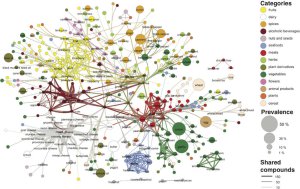
From the book Networks, Crowds, and Markets: Reasoning about a Highly Connected World. By David Easley and Jon Kleinberg. Cambridge University Press, 2010. Complete preprint on-line at http://www.cs.cornell.edu/home/kleinber/networks-book/

From the book Networks, Crowds, and Markets: Reasoning about a Highly Connected World.
By David Easley and Jon Kleinberg. Cambridge University Press, 2010.
Complete preprint on-line at http://www.cs.cornell.edu/home/kleinber/networks-book/

From the foodsystemsnetwork.org website

From the foodsystemsnetwork.org website

network analysis

network analysis

I could go on and on about different theories and updates and critiques on these ideas, but the point to make here is this is science that is so very useful to the type of networks that food systems are propagating. Almost all of the work that farmers markets do rely on network theory without directly ascribing to it.

Think about a typical market day: a market could map each vendors booth to understand what people come to each table, using Dot Surveys or intercept surveys. That data could assist the vendor and the market. The market will benefit in knowing which are the anchor vendors of the market, which vendors constantly attract new shoppers, which vendors share shoppers etc. The market could also find out who among their shoppers bring information and ideas into the market and who carrries them out to the larger world from the market. All of this data would be mapped visually and would allow the market to be strategic with its efforts, connecting the appropriate type of shoppers to the vendors, expanding the product list for the shoppers likely to purchase new goods and so on.

Network theory would be quite beneficial to markets in their work to expand the reach to benefit program users and in the use of incentives. Since these market pilots began around 2005/2006, it has been a struggle to understand how to create a regular, return user of markets among those who have many barriers to adding this style of health and civic engagement. Those early markets created campaigns designed to offer the multiple and unique benefits of markets as a reason for benefit program shoppers to spend their few dollars there. Those markets also worked to reduce the barriers whenever possible by working with agencies on providing shuttles, offering activities for children while shopping, and adding non-traditional hours and locations for markets. Those efforts in New York, Arizona, California, Maryland, Massachusetts and Louisiana (among others) were positive but the early results were very small, attracting only a few of the shoppers desired. When the outcomes were analyzed by those organizations, it seemed that a few issues were cropping up again and again:
1. The agency that distributed the news of these market programs didn’t understand markets or did not have a relationship of trust with their clients that encouraged introduction of new ideas or acceptance of advice in changing their habits.
2. The market itself was not ready to welcome new benefit program shoppers- too few items were available or the market was not always welcoming to new shoppers who required extra steps and new payment systems.
3. Targeting the right group of “early adopters” among the large benefit program shopping base was impossible to decipher.
4. Some barriers remained and were too large for markets alone to address (lack of transportation or distance for example).
4. Finding the time for staff to do all of that work.

Over time, markets did their best to address these concerns, which has led to the expansion of these systems into every state and a combined impact in the millions for SNAP purchases at markets alone. The cash incentives assisted a great deal, especially with #2 and #4. However, this work would be made so much easier and the impact so much larger if network theory was applied.
Consider:
Market A is going to add a centralized card processing system and has funds to offer a cash incentive. But how to spend it? And how to prepare the market for the program?

If the market joined forces with a public health agency and a social science research team from a nearby university, it might begin by mapping the networks in that market to understand the strong and weak ties it contains as well as the structural holes in its network. It might find out that its vendors attract few new shoppers regularly or that the market’s staff is not connected to many outside actors in the larger network, thereby reducing the chance for information to flow.
It might also see that younger shoppers are not coming to the market and therefore conclude that focusing its efforts on attracting older benefit program shoppers (especially at first) might be a strategic move. If the market has a great many low-income shoppers using FMNP coupons already, the mapping of those shoppers may offer much data about how the market supports benefit program shoppers already and how it might expand with an audience already at market
The public health agency might do the same mapping for the agencies that are meant to offer the news of the market’s program. That mapping might find certain agencies or centers are better at introducing new ideas or have a population that is aligned already with the market’s demographic and therefore likely to feel welcomed.

As for incentives, what markets and their partners routinely tell me is more money is not always the answer. Not knowing what is expected from the use of the incentives or how to reach the best audience for that incentive is exhausting them or at least, puzzling them.
If markets knew their networks and knew where the holes were, they could use their incentive dollars much more efficiently and run their markets without burning out their staff or partners.
They might offer different incentives for their different locations, based on the barriers or offerings for each location. (They may also offer incentives to their vendors to test out new crops.)
If connectors are seen in large numbers in a market, then a “bring a friend” incentive might be offered, or if the mapping shows a large number of families entering the system in that area, then an incentive for a family level shopping experience may be useful.
One of the most important hypotheses that markets should use in their incentive strategy is how can they create a regular shopper through the use of the incentive. Of course, it is not the only hypothesis for a market; a large flagship market might identify their role as introducing new shoppers to their markets every month and use their funds to do just that. But for many markets with limited staff and small populations in and around the market, a never-ending cycle of new shoppers coming in for a few months and then not returning may not be the most efficient way to spend those dollars or their time. So this is also where network theory could be helpful.
By asking those using their EBT card to tell in detail where and how they heard about the program and by also tracking the number of visits they have after their introduction, we could begin to see which introductions work the best. Or by asking a small group of new EBT shoppers to be members of a long-term shopping focus group to track what happens during their visit (how many vendors they purchase from and how long they stay) and after (see Market D example at the top), we could learn about what EBT shoppers in that area value in their market experience. We may also find out that the market has few long-term return shoppers from the EBT population or we may find out that connectors become easy to spot and therefore they can be rewarded when sharing information on the market’s behalf.
In all of these cases, it will be easier for the staff to know what to do and when to do it if they understand their networks both in and around the market.
And of course, mapping the larger food systems around the markets’ systems would be exciting and could move policy issues to action sooner and allow funding to be increased for initiatives to fill the holes found.

However markets do it, what seems necessary is to know specifically who is using markets and how and why they decided to begin to use them and to whom those folks are connected. Network theory can be the best and widest use of the world of Big Data, especially to accomplish what Farmers Market Coalition has set as their call to action: that markets are for everyone.

Some reading, if you are interested:

http://www.foodsystemnetworks.org

http://gladwell.com/the-tipping-point

Click to access networks-book-ch03.pdf

Click to access 827.full.pdf

Click to access kadushin.pdf

Washington Ag Today talks about farmers markets

These are excellent audio snippets from Colleen Donovan, Washington Small Farms Program Research Coordinator at WSU about some benefits of farmers markets.

Community Impact of Farmers Markets

These are so well crafted that anyone could embed them into their website to show the impact of markets and market farmers, no matter where they are located.

What is most useful about Washington’s work is that it uses the context of organizational capacity to gauge if and how those multiple benefits are being forwarded to shoppers, farmers and the larger community. For reports that offer data without explaining that a volunteer-led effort managed it or that markets are often doing complex projects with part-time labor, I recommend to them that they consider adding it to any future analysis or funder report. The Farmers Market Metrics work we are doing at FMC and University of Wisconsin right now will add that piece into any resources or templates that we design, I promise you that!
In any case, associations in Washington and Michigan are truly the leaders right now in doing excellent analysis and resource development and then spending time sharing as well. (And if it was up to me, I’d give Illinois the rising new star award.)
Colleen did a webinar with FMC in fall of 2013 on the results of this report which is found on FMC’s YouTube site. Yes that is me (talking too low) introducing Colleen:
Link to YT recorded webinar

Four young farmers start Stone Soup Farm Co-op, on front of worker-owned farm trend | GazetteNet.com

As a supporter of the US Federation of Worker Cooperatives, I hope that the expansion of worker cooperatives is as wide as the marketing cooperatives were in an earlier time among farmers. I would like to see market organizations spend some of their time searching for funding to add new farmers and especially encourage new cooperatives. Cooperatives might be especially useful within certain types of markets, like food security markets.

“Each person manages a specific part of the farm. Barnett is in charge of the harvest and what gets included in the CSA shares, as well as some aspects of crop production such as irrigation. DiLorenzo does the bookkeeping, office work, and creates daily and weekly plans to make sure production is on track. Harro oversees the greenhouse production and seeding, and Man takes care of the chickens, maintains the equipment and oversees the apprentices.The four worker-owners, who all live in Hadley, receive equal monthly stipends as pay and if there are any profits at the end of the year, they will get dividends. They declined to say how much their stipends are.”

Four young farmers start Stone Soup Farm Co-op, on front of worker-owned farm trend | GazetteNet.com.

The Crunchy Cities Index – Support Farmers Markets

This is an exciting piece on the explosion of farmers markets, but I must confess that based on my own knowledge, I find the data to be less than precise. The USDA list of markets is not checked for accuracy and as it is up to market organizers to list and to de-list their own markets, most estimations believe that the list is far from accurate, even though the USDA does everything within its (limited) time to make it right. Even the definition of what can be listed as a market is loose; this may seem like nitpicking (after all more “markets” is good news isn’t it?) but since we know how the capacity of markets remains low partly because of low support among funders and policy makers, the lack of clarity may hurt chances to expand well-managed farmers markets or public markets that support local entrepreneurs.
What is also true is that many retail operations masquerade as farmers markets without directly supporting farmers or managing those involved in direct sales; regular operation, transparent governance and some direct sales for regional producers should at least be the minimum to being listed on this list. Don’t get me wrong; I like the idea of auxiliary and ancillary food initiatives that get regional food into more communities being listed somewhere and to be tied to efforts at flagship or sister market organizations, but we should get better at describing each of them with their own type so we can allow more to flourish.

The Crunchy Cities Index – Buy Local by I Support Farmers Markets.

Market Benefit and Incentives PPT-Vermont 2013 – Helping Public Markets Grow

Since I’m back in Vermont for the 2014 Direct Marketing Conference, I decided to upload the Power Point from the 2013 Wholesome Wave convening that Erin Buckwalter of NOFA-VT and I gave about the 2013 Vermont Market Currency Report. I’ll add notes for each slide sometime in the next month or two but the data will still be helpful to many.

Market Benefit and Incentives PPT-Vermont 2013 – Helping Public Markets Grow.

Rules are varied

I think most if not all managers of markets understand that other markets have different rules than theirs, but do your shoppers know? And have you ever updated them, in cooperation with your vendors?
Nearby markets should share rules so that they do not make their farmers follow different sets of rules for little reason. It’s amazing how many markets don’t even attempt to compare rules which makes it quite hard for vendors to remember which of their markets has rules against packing up early or who allows foraged items and who doesn’t. One of the main areas of contention among farmers is the amount of liability insurance that they are required to carry (when a market requires it); a farmer told me about three different levels of insurance that he was asked to carry, all of the markets within a few miles of each other.

http://www.twincities.com/stpaul/ci_24036424/farmers-markets-not-all-follow-same-rules

As some of you know, I believe that the era of mission-driven farmers markets has just begun and that how we view our work needs to expand to help the farmers and buyers that we work with. In that mindset, we should begin to examine the idea of public markets entirely devoted to restaurant/grocer (then wholesale) sales of local goods, curated with the same intention and mission by those of us that currently manage retail farmers markets.
In order to do that, we should learn from wholesale terminals such as this one in Canada. I found a couple of things within this article about the Ontario Terminal fascinating. My notes are in italics.

In less than 40 seconds, DiLiso has placed his order: cabbage, cipollini onions, bean sprouts and bok choy. Na enters the data on a hand-held digital device then, with a mutual nod, moves on to another client, leaving DiLiso to gather up his vegetables.
That’s how deals are done at The Ontario Food Terminal, the giant U-shaped building on 16 hectares off the Queensway in west Toronto: friendly, no-nonsense, fast.

(Notice the ability to enter sales on a hand held device?)

———————————–

DiLiso and his small crew criss-cross the market to find sellers they trust who have the best deals on vegetables.
“It’s all about relationships,” DiLiso says.

(I dunno- it sounds like it is as much about price?)

Ontario Terminal story

Indicating health

Windowsill Pies, New Orleans LA pie makers

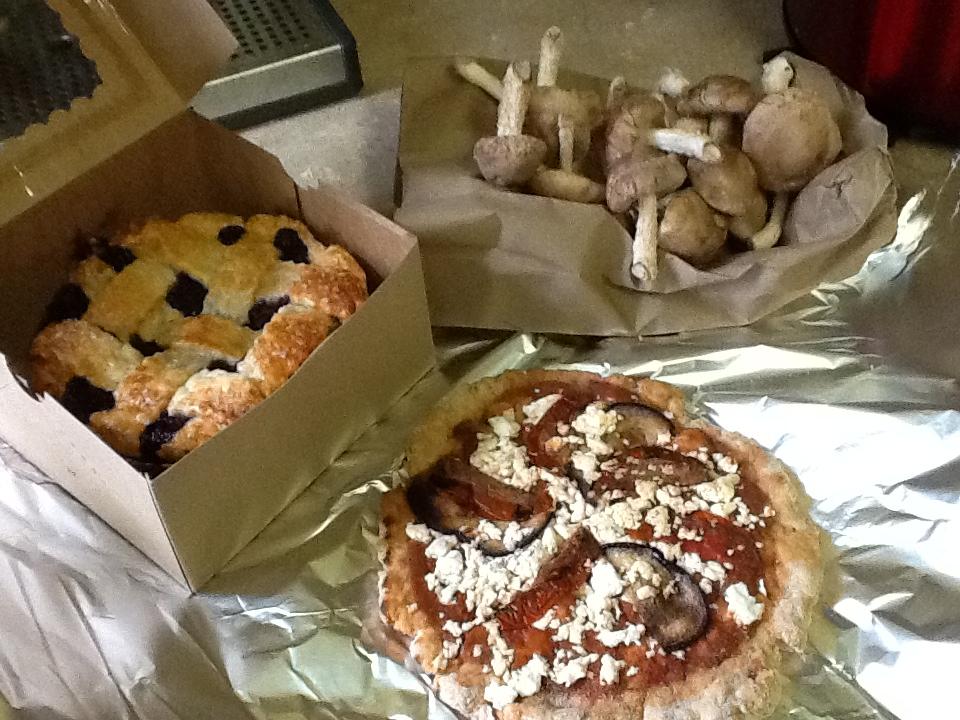
Blueberry pie from Windowsill Pies and gluten-free pizza and shrooms from the Rue family, all from Covington Farmers Market..

Take a long look at that picture. To many, it may only show another dang food picture that was posted online but to me it represents something else entirely.
All of those goods came from the Covington Farmers Market, which is a parish (to most of you outside of Louisiana, parish=county) seat market located 40 miles from downtown New Orleans and across Lake Pontchartrain in an area of what used to be called the Ozone Belt for its pine tree greenery.
The gluten-free pizza was sold to me by a teen who was selling them on behalf of her family business and could tell me what was in their pizzas and why, could take my money and offer change with a genuine smile and good wishes. The mushrooms were on their table too and collected as a side option to their prepared food sales, as well as used in their goods.

The pie was sold to me by 2 entrepreneurs that buy their ingredients locally as often as possible (literally pointing to the honey seller that provided the basis of this pie’s lack of refined sugar). This vendor’s artistic tendencies suit their product list well, all of the way to the windowed boxes for their pies and their oil cloth tablecloth and vintage aprons presentation.
What is important to me as a shopper about this picture is that it represents a (still) unusual way of buying food; I can ask each of them exactly what is in their goods and how they were made. They are working to replace industrial ingredients with natural and closer-to-home versions that offer more taste. And of course, not only did I get a chance to talk directly with the makers of these goods and to encourage them further, but that I was able to buy from young women, all just beginning farmers market sales. All of the made goods were delicious and will be bought many times again. I may buy them for myself on a week in which I know I am just not going to feel like cooking or they may be used to share with friends when they come to spend the day at the pool or may even be brought to a party I am invited to as my gift.

Market managers know that farmers markets are THE incubator for businesses that are not ready for or do not want storefronts. The chance to take a small idea and grow it slowly and carefully is a necessary step for any entrepreneur, yet the places one can do this are so limited that markets are among the only ones that regularly offer that opportunity. Many experienced market shoppers know that when they see new goods at markets that are advanced in their ingredients and presentation, they must immediately support them vigorously and talk them up to their friends. In turn, market managers need to monitor these vendors and introduce them to those shoppers (as this market’s manager did to me) as well as search for those vendors’ new shoppers, who may not already be present.
In other words, these vendors often represent a new age in a market. Its important to remember that young vendors trying items that can only be sold at farmers markets are who we want to see more of in markets. These folks cannot (or do not) sell their goods to Whole Foods or ship them worldwide; they design products for the type of person who stops and asks about their ingredients and their process. Therefore, they are an indicator species, which is defined beautifully in the Encyclopædia Brittanica as an organism that serves as a measure of the environmental conditions that exist in a given locale.

If indicator species show the health of an environment, then their low activity can alert to danger in a market’s health or when increasing, can show vitality. Encouragement of diversity of products, gender, age, ethnicity and business goals is exactly what each market must be setting as a goal daily, weekly, monthly and so on. To me, the presence of these indicator vendors and others at this little market show its emerging strength. And offers some damn tasty research at the same time.

The Dallas Farmers Market is no longer controlled by the city. What happens now?

The Dallas Farmers Market is an interesting version of a public market. Almost a decade ago, I was invited to Dallas for a set of public meetings (along with DC/Fresh Farm founder Ann Yonkers) to help the chefs, farmers and food entrepreneurs get to the next step in reorganizing this market.It seemed then that a lot of competing ideas were on the table and that to get it moving, they would need both deep design options and mission development. This news may signal that they have taken the necessary next step.

The Dallas Farmers Market is no longer controlled by the city. What happens now? (And what becomes of Pecan Lodge?) | City Hall Blog.