Data Matters in the Next Farm Bill

My colleague, Laurie Ristino up there in Vermont wrote a great blog about the need for data in terms of the farm bill. I remind every market and every food service organization that collecting data now is necessary for your state or national advocates to help build our farm bill agenda.

Data as a policy issue seems both prosaic and nerdy. But the absence of usable, quality data precludes the American public from reaping the value of their investment of billions in the farm bill. It’s time to unlock the ability to measure the farm bill’s impact and enhance the return.

Data is the currency of our modern economy. While often associated with the fortunes of Silicon Valley, big data is harnessed by companies that loom large in the agriculture sector to create new services and products key to their business strategies.

Professor Laurie Ristino is the founding director of the Vermont Law School Center for Agriculture and Food Systems (CAFS) and an associate professor of law. Professor Ristino is also the faculty adviser to the VLS Food and Agriculture Law Society.

Morning Consult

Dipping in to JazzFest

Sometimes being a consultant and researcher needs to be combined with more hands-on experience in actually making something or serving customers to remind me what market vendors or staff have to do and how I can help to find or create resources for them. When I feel that way, I take myself to a market or to a farm or an artist’s workshop or store to help. This last week, I was able to do just that and to experience the first weekend of the massive New Orleans Jazz and Heritage Festival’s 47th year, 45 of them held at the Fairgrounds in the Gentilly neighborhood. For just a little while, I became a dipper for La Divina Gelateria.

I first met gelato wizards Katrina and Carmelo when they applied to become vendors at the Uptown farmers market in 2006 or so. We knew that they weren’t likely to stay forever as vendors, but their locally sourced ingredients, business savvy and wide set of connections around New Orleans made them a good choice to become a short-term vendor, especially in those post-levee break times. See, many of our vendors had not returned yet but we did have thousands of repairing residents and first responders greedy for any sort of authenticity and regular activity flocking to our Tuesday market. We thought LDG’s energy would be helpful in those months, and it was.

They quickly moved from their umbrella spot to a few storefront locations around town, but remained regular shoppers at the markets and supporters of the organization, even selling our market t-shirts in their stores for a while. I follow them on social media and try to catch up with Katrina whenever possible, so when they let the universe know they were searching for volunteers to work their stand set up next to the Fais Do-Do stage, I emailed her. She wrote me back right away offering me a spot on the first weekend for 2.5 hours and the chance to attend the rest of the day for free (JF costs 80 bucks a day to just get in the door!) along with the use of their own locked port-a-let and tent area for crew members to hang out when not working (don’t laugh-people would pay large amounts of money to get those added items if they could.)

Food

The festival has dozens and dozens of selections of the best food in town, some of which is only available during these 2 weekends.That is because even when some of the city’s classic restaurants close, they hold on to their spot out at the fairgrounds to continue to sell their items to appreciative audiences; it helps that the festival actually has a “no carnival food” policy to guide their choices and maintain the quality.
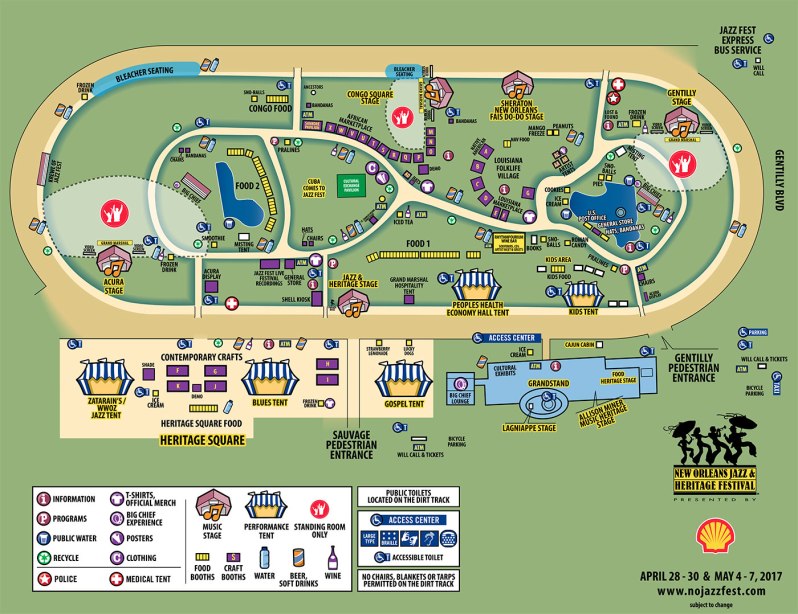
2017-Fantasy-Map.jpg

The yellow booths all over the map are the food booths

I well know how the festival food staff was instrumental in 2006 + in getting some of their hardest hit vendors back to the festival, doing what they could to help those struggling by finding them kitchens to work from and (rumor has it) even assisting with resources when possible. I heard about the encouraging calls from the festival staff that made a great deal of difference to many of those who lost their homes and businesses and were done without any expectation of a return by those vendors or to gain any publicity for their actions.

What everyone does know is that the presentation, food handling and prices are managed extremely well by the festival’s food staff and by the vendors who work from the extensive rules and suggestions of the festival staff. If you follow me on Facebook, you might have seen my post last Saturday about the connections between the market and the festival:

…The relationship between JF and CCFM has a long history, starting with the excellent food handling experience that the Fest food staff shared with the market (which allowed the market to write one of the best risk management systems of sampling, temperature controls and product handling of any market that I have seen) and also included a few staff who worked at both the Fest and the markets, and a whole era of food demonstrations in the Grandstand area from market vendors back in the day. …

(I maintain a tattered hope in finding a funder interested in letting me uncover best practices of fairs and festivals to build the professional skills and organizational capacity of farmers markets in areas such as production, sponsorships and educational activities- if so, certainly this festival’s experience would be one of those selected.)

Anyone can see that being a food vendor at a festival that attracts 60,000* people per day on a slow day and double that on a big day and runs for 7 days over 2 weekends requires some planning, effort and some sleepless nights.

So LDG’s tent became my workplace for a little while last week. They offer 8 kinds of gelato under a double tent, close to the main walkway that meanders around the infield.
IMG_5037.jpg

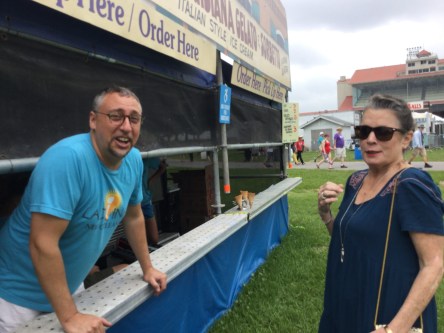
This is owner Carmelo on Day 1 at his tent, telling food writer, radio and tv host Poppy Tooker that the espresso machine was malfunctioning and the affogato was not ready to go yet. She was clearly horrified but gracious about the lack of espresso since she gladly came back the next morning.


Once I got in the tent, Katrina gave me a 2-minute tutorial on where to stow items, what each person would be doing and what was being offered that day.  The flavors were: Milk chocolate, butter pecan, cookies and cream, creme brulee, red cream soda, strawberry balsamic, azteca (spicy) chocolate, and salted caramel. She told me to pull 3 full scoops each time and how to know if it was to be in a cup or cone. She explained the precise actions that would happen for each order.

I was assigned as a dipper, standing next to the other (more experienced) dipper on a tiny platform (that I almost stepped off 2 or 3 times without noticing ) with my back to the cashiers but within earshot and sight of my expediter. The platform is necessary cuz the cooler is raised off the ground (per food storage guidelines),  allowing the machinery to work better on the grassy infield which also means water intake from flooding is less of an issue in case of rain (as happened on the first Sunday, delaying opening of the festival for 3.5 hours.**)
IMG_5049.jpg

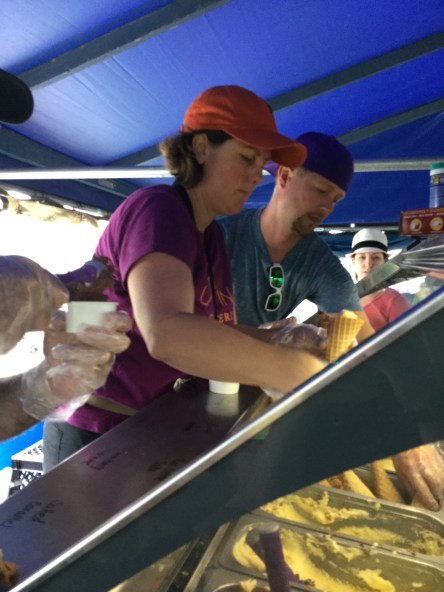
Owner Katrina working as a dipper when it got very busy during a shift changeover.

The other dipper did 60-70% of the orders as her cashier was nearer to the list of flavors and mine was sitting in a camp chair which made her hard to see when you walked up. However, she made up for it with a flair for customers and energetic calls to those standing out front and for orders ( “Come on up folks! Order here.” “AFFOGATOOO AzTECa please!”  “Twooooo milk chocolate cones please!” )

My expeditor was a young woman visiting New Orleans, there to be an intern for a season for local community initiatives. She was excited about the opportunity to get into JazzFest, able to help a local business and was a hard worker.

I did fine for the first 2 hours keeping up with my minimal orders without problem. Then, the crowds came. Interestingly, even though the gates open at 11 or 11:30 each day, thousands of attendees don’t arrive until well after 3 pm even though the stages shut down by 7:25 pm with no exceptions. The biggest names draw those who only come for their show and who don’t care to wander the grounds seeing what else is available at the 11 other stages and the dozens or so craft and demonstration areas. (I know- it makes locals crazy.)

So my last half hour the orders came fast and thick and still, for the most part I kept up. The other dipper had explained how to place a cup or cone as each order was called at the flavor asked for and then dipping each and handing to the expediter. All went well until a slew of affogato-style cups came which meant each time the expediter had to leave the area and walk across the tent to the espresso machine, waiting for the shot to be added, then to walk it back to the customer. As a result, I had to dip each regular cup or cone, step off my platform and hand it to the customer myself. It mostly went fine but I give my expeditor lots of credit for helping me catch up when she got back.

Other more experienced staff were also on hand to help,  watching levels of gelato, switching out them quickly between orders and cleaning the scoopers as needed in the 3-part set up for washing, rinsing and sanitizing.

Still, except for a few that I missed hearing and delayed in getting out for a minute or two, my expeditor and I  did fine and the good news is once that person gets their gelato in hand, all delay is forgiven.
When Katrina thanked me and let me go, I was grateful to have done the shift and even more grateful that I had not impaired them too badly on my initial run. I learned the complexity of a simple gelato cup and the teamwork it takes to make great food happen on a grassy area of a festival.

(Next week: I’ll be holding down the fort at my pal’s St. Charles Avenue shop while she vends at the Contemporary Crafts section of JazzFest.)unnamed.jpg

*From Wikipedia: Record single day attendance was 160,000 for the Dave Matthews Band and Mystikal on Second Saturday, 2001. Elton John in 2015 probably drew 130,000+, and that’s the only other time they’ve passed 100,000.  The old record was 98,000 on Second Saturday in 1998, when Jimmy Buffett headlined.  Typical attendance is 60,000 on a weekday, 80-90,000 on a weekend.


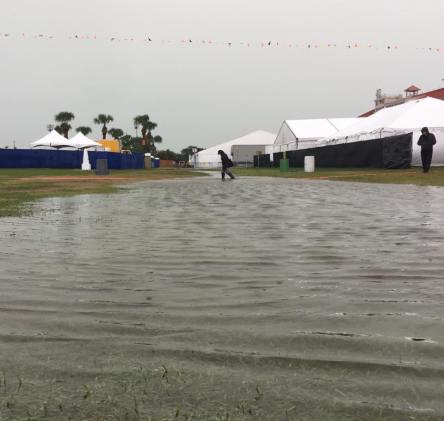
** Sunday: torrential rain and tornado warnings delayed the opening of JF until 3 pm and left the vendors camped out in the Grandstand building, hoping the water would not make it in their tents. Some of these folks were not so lucky..18222686_10154661461639366_739334513336050751_n.jpg18194856_10154661461674366_793755088390801239_n.jpg
FINI report, Year 1

In Year one, FINI supported incentive programs at almost 1,000 farmers markets, representing 4,000 direct marketing farmers in 27 states. These farmers market programs alone generated almost $8 million in SNAP and incentive sales spent on produce. Program evaluation conducted by grantees indicated uniformly high redemption rates, strong support for the program among stakeholders, and a great deal of collaboration from both public agencies and private program partners. These collaborations were particularly important in conducting outreach to SNAP recipients.


FINI_FarmersMarkets_Year1_FMC_170413

Federal Reserve Bank of Chicago’s Tool Maps Peer Cities 

Let me share one of my (not so) secret goals for FMC’s Farmers Market Metrics program – to be able to assist markets by using the profile data to build dynamic peer networks through matching typology of those markets.
This would mean that a market searching for information about trends or ideas for programs would be connected to a market that has the same type of programs, location, governance and vendor makeup. As it stands now, too often markets that are simply near to each other are unfairly compared, or markets will try to adopt programs managed by markets designed very differently from their own.

I also hope that we can also do the same for direct marketing vendors at some point, using the business characteristics to match them to peers, resources and to help select the right outlets and success measures for their business.

In the meantime, check out this tool to find data on cities similar to your own.

The Peer City Identification Tool is like a DNA test for civic data, allowing users to tell at a glance where certain cities’ specific interests and challenges align, and where they deviate—in effect, who their real siblings, cousins, and other relatives are.

Source: CityLab

Counting public gatherings in 2017-Washington Post article

The point of this post is to show how complex and grassroots public gatherings can be counted and measured. The two main researchers quoted in these Washington Post articles are Erika Chenoweth and Jeremy Pressman, both respected analysts of the details of large-scale civil movements and gatherings. As a data junkie, I have followed this effort with a great deal of interest (and have even counted some of these gatherings in my own town to check others’ counts) and look forward to more of the analysis of both the methodology and the actual count data. The analysis included not just the number who gathered but who and what was being protested or being supported, where these events were held, what symbols were used, how many arrests were made.

For March 2017, we tallied 585 protests, demonstrations, marches, sit-ins and rallies in the United States, with at least one in every state and the District. Our conservative guess is that 79,389 to 89,585 people showed up at these political gatherings, although it is likely that there were far more participants.

Certainly, food and farming systems should note some of the systems used for collection and analysis. For example, the Crowd-Counting Consortium may be something that national entities involved in any grassroots data collection systems like food systems should discuss creating for their own use.

Here is their counting method:

We arrived at these figures by relying on publicly reported estimates of march locations and the number of participants involved in each. We started a spreadsheet and called for crowdsourced information about the location and number of participants in marches. Before long, we had received thousands of reports, allowing us to derive low and high estimates for each event. We carefully validated each estimate by consulting local news sources, law enforcement statements, event pages on social media, and, in some cases, photos of the marchers. When reports were imprecise, we aimed for conservative counts; for example, if observers reported “hundreds” of participants, we reported a value of 200 (“thousands” was 2,000, “tens of thousands” was 20,000, etc).

An example of their public data set.

https://www.washingtonpost.com/news/monkey-cage/wp/2017/04/24/in-trumps-america-whos-protesting-and-why-heres-our-march-report/?utm_term=.ce99baecf0b6

Visit to Hub City

I just returned from a trip across the South, traveling from Louisiana through Mississippi, Alabama,  Georgia to South Carolina. Spartanburg was my destination, allowing me to experience the lovely Hub City Farmers Market community there. I’ll leave most of the detail for those who brung me (my inelegant way of saying I’ll keep it for the report) but a few pics may offer a quick snapshot of its hardworking and dedicated market community supported by the lovely intentions of its stakeholders and everyone’s practical knowledge and patience for how to make it so.

In town after town, I am reminded of how much has actually already been accomplished by the food and farming community and how much more we  hope to accomplish. Kudos Hub City.

IMG_4926

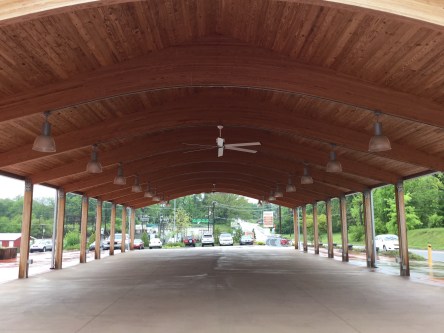
The lovely Harvest Park in the Northside neighborhood of Spartanburg home to the Saturday HCFM, The Urban Farm and the Monarch Cafe and Butterfly Foundation.

IMG_4952

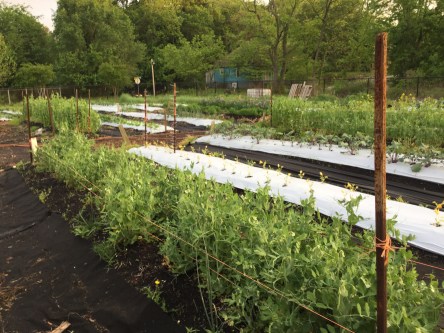
HCFM’s Urban Farm was alive and flourishing with a wide selection of items under HCFM staffer Meg’s care.

IMG_4929

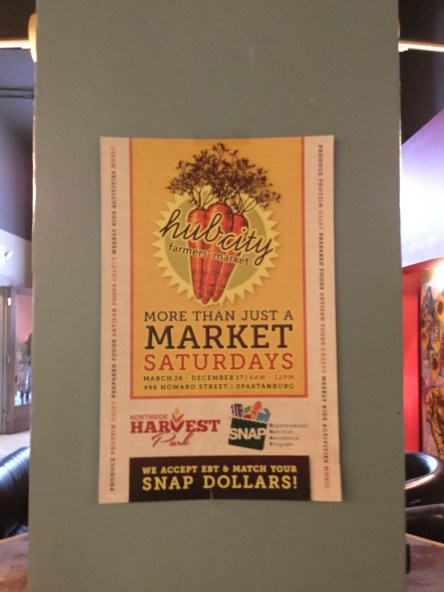
HCFM poster in the Little Coffeeshop next to the non-profit Hub City Bookshop

IMG_4975

The Writers Project at the HCFM is producing an impressive set of titles on the area including an upcoming partnership with the market and Monarch Cafe to benefit all.

IMG_4976

A corner of the Hub City Bookshop, a non-profit space that has accomplished a great deal in just over two decades.

Meet up with APA-FIG at the National APA Conference May 6-9, 2017

The Food Interest Group, a group of APA members and allied professionals, is dedicated to advancing food systems planning at the local, regional, state, or national level.

Here’s a sneak peak of the food system sessions happening: Incentivizing the Sale of Healthy and Local Food; Incentivizing the Sale of Healthy and Local Food; Growing Food Connections for Community Change; Developing Vermont’s Food System through Planning; Safe, Active Routes to Healthy Food. If you come early, check out the mobile tour on May 5—Hudson Valley Local Agriculture and Foodshed.

Meet up with APA-FIG at the National APA Conference May 6-9, 2017! – APA-FIG

 The Art of Noticing, and Then Creating 

A wonderful interview for anyone interested in community and creativity. So anyone working in markets, food and farming.


MS. TIPPETT: And I want to — I want to bring in the word tribes that you used, because that’s another way, you’re using a word that we associate with something primitive. Right? That we think, that we thought modernity was about outgrowing.

MR. GODIN: Right.

MS. TIPPETT: You are actually really affirming that… We choose who and what we belong to. It’s not just about survival. It’s about connection and flourishing.

MR. GODIN: So, you know, in the desert or the jungle, the tribe was defined by geography alone. That you were in the tribe based on where you were born. And then if we fast-forward to, I don’t know, Mark Twain. Mark Twain would show up in a city and a thousand people would come to hear him speak. And everyone who came was in his tribe. They were in the tribe of, you know, slightly satirical, slightly jaundiced people who were also intellectuals who could engage with him. And he had never met them before, but within minutes, they were part of a congruent group who understood each other. And so if we fast-forward to today — you can take someone who hangs out in the East Village or Manhattan who has 27 tattoos — they go to Amsterdam, they can find someone in Amsterdam who talks their language and acts like them, because they’ve chosen the same set of things that excite them, and that they believe in. And we divide tribes as small a group as we want. But what the Internet has done is meant that we don’t have to get on a plane anymore to meet strangers who like us.

That — the Linux operating system, which is on a billion computers around the world, was written by a group of strangers who have never met, who are part of the same tribe. And so the challenge of our future is to say, are we going to connect and amplify positive tribes that want to make things better for all of us? Or are we going to degrade to warring tribes that are willing to bring other groups down just so they can get ahead?

================================================

So, you know, on the way into the studio today, I passed a 1934 Rolls Royce. And in those days, if you were really rich, you bought a fancy expensive car like that. So we went through this era where you would value something that was physical. But now the things we pay extra for are connection. Right? The things we pay extra for are what are other people using — what networks can we be part of — what conference can we go to — who can we be with? And the people we choose to be with, the products and services we choose to talk about are all interesting and unique and human and real, as opposed to industrial and cheap and polished and normal.

Seth Godin — The Art of Noticing, and Then Creating – | On Being

Visitor count article

Farmers markets across the U.S. use many different methods of counting their visitors. Some of these methods are best used for planning programmatic activities at different points of the day, while others are more reliable ways to estimate an average number per market day. The current methods most researchers accept as accurate use strategically placed staff (paid or volunteer) to count those entering or everyone within the market at a set time. These methods require defining entrances, the time span to count and who should be counted or not, such as children or groups of people. The entry count method may be difficult at those markets that stretch for blocks or have many entrances; for those there are also new methods such as capturing the number of mobile phone “pings” within a market space or using drones to snap overhead photos to count quadrants that may offer accurate data.  In order to satisfy researchers who need credible data while still acknowledging the collection capability of low-capacity markets, Farmers Market Coalition’s materials currently recommend the 20-minute timed entry count offered by the Rapid Market Assessment (RMA) toolkit.


Link to full article in FMC Resource Library

Communicating community

Hopefully, all of you who read this blog are okay with my use of Vermont as one of this blog’s recurring examples of food system work. I will caution my readers to refrain from assuming that the Vermonters think they have it all figured out just because their residents are rightly proud of its glorious revival of small-acreage farming and its rep as an organic stronghold. I’d say the state food and farming leaders are very honest about the issues that they continue to face and their assessment of what remains to do. For example, there are still no full-time market managers at all and the average market manager makes less than 10,000 per year (really, it’s likely much less but I am trying to not overstate it here) and, in a state with only 625,000 residents (the most rural state in the union with 82.6 percent of its population living in either rural areas or small cities, and many of them poor*), the 80 or so markets are always struggling with maintaining attendance and sales amid strong competition from co-ops and other well-regarded outlets. And of course, like everywhere else, the state’s farmers are pulled in so many directions trying to serve every outlet at once while dealing with weather and regulatory woes and the typical small business challenges that many are not profitable.

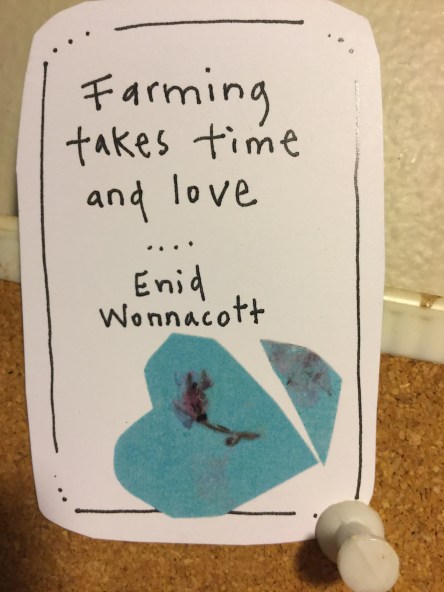
What is exciting is that they all try to work collaboratively at the network level to seek appealing ways to showcase producers and organizers’ hard work. The pictures below are an example of that. My home team there (NOFA-VT) has an artist who does lovely work that hang on their walls and whose art is used by NOFA in many other ways. During my last visit, Erin Buckwalter showed me this bowl in their office of farming “affirmations” from that artist some of which also include actual data. She encouraged me to take a handful and so I have been asking people at markets to reach in to my bag of cutouts and take one. What a simple way to display the difference in our system from the one that reduces everything in a store to a place for purchased advertising. So if you see me, ask to dip in and see what you get…

IMG_4714.JPGIMG_4855.jpg

IMG_4854.jpg

This one, from NOFA-VT’s imaginative and thoughtful Executive Director, will remain on my board to inspire me.


• Income and Poverty in Vermont

iMedian household income (in 2015 dollars), 2011-2015 $55,176 (US $53,889)
iPer capita income in past 12 months (in 2015 dollars), 2011-2015 $29,894 (US $28,930)
iPersons in poverty, percent Warning Sign 10.2% (US 13.5%)
Fifteen states have more than half their populations living in rural areas or in towns under 50,000 population.

Social Profit

25245277.jpg

This is a good primer on how non-profits can up their game by using qualitative assessment “rubrics” to figure out what they do well in terms that non-profits are better off using, rather than just ROI or other limited economic measures. 

Thanks to Erin Buckwalter of NOFA-VT for recommending it (and lending it)  to me.

I’m a big fan of the Whole Measures system that is covered in here and have used it for many years and so was pleased by it being included. I certainly recommend that all food system measurement systems review Whole Measures to see if it can be used by your organization.

As I have covered in other recent posts, I look forward to the day that more non-profits focus on creating leaders and devising better jobs as one of the main measures of success. This book will be helpful to many for thinking through these questions and I’ve already recommended it to two executive directors.  


http://www.socialprofithandbook.com/


How Morale Changes as a Startup Grows

However, this startup cultural utopia invariably hits a rough patch for about 70% of startups in years three to four, regardless of how happy the team was before. We call this the “cultural chasm.”
In fact, the faster the startup grew, the deeper the cultural chasm was that they had to overcome.

Founders who rate the importance of culture lower than a 10 on a 10-point scale are 70% more likely to have higher employee turnover rates compared to founders that rank the importance of culture a 10.

Link to story

Texas – HB 1926: The Homemade Foods Bill

HB 1926 allows home preparation of previously disallowed foods such as tamales, canned vegetables, fermented foods, and perishable (potentially hazardous) baked goods. Sales would be allowed anywhere in the state, including through mail order and internet sales, as long as the producer and consumer are both in Texas.

Source: Texas – HB 1926: The Homemade Foods Bill – Farm-to-Consumer Legal Defense Fund

The four stages of market management

Spoiler alert: The stages correspond exactly to the  four stages of competence learning model:

  • 1. Unconscious incompetence
    The individual does not understand or know how to do something and does not necessarily recognize the deficit. They may deny the usefulness of the skill. The individual must recognize their own incompetence, and the value of the new skill, before moving on to the next stage. The length of time an individual spends in this stage depends on the strength of the stimulus to learn.
  • 2. Conscious incompetence
    Though the individual does not understand or know how to do something, he or she does recognize the deficit, as well as the value of a new skill in addressing the deficit. The making of mistakes can be integral to the learning process at this stage.
  • 3.Conscious competence
    The individual understands or knows how to do something. However, demonstrating the skill or knowledge requires concentration. It may be broken down into steps, and there is heavy conscious involvement in executing the new skill.
  • 4. Unconscious competence
    The individual has had so much practice with a skill that it has become “second nature” and can be performed easily. As a result, the skill can be performed while executing another task. The individual may be able to teach it to others, depending upon how and when it was learned.

I have been thinking about how the role of market manager can be organized to reduce the learning curve, and to encourage managers to have a team around them, rather than to feel they must do everything on their own. If we do those two things, we may very well lessen the numbers who burn out and leave the job just as they reach unconscious competence phase.

My experience (from my corporate training in human resources, my own management of markets, supervising market managers and observing them for the last 15 years) is that the market job takes about 14 months to 30 months to move through these 4 stages. The length of time it takes has a lot to do with the organization’s structure for training and for providing feedback.

Unlike other entry-level jobs, market managers are asked to master the most difficult work right away: to confidently manage dynamic logistics for a group of small businesses working side-by-side with their direct competition. And in far too many cases, there are no manuals, no detailed history recorded, or clear written process when dealing with risks or crisis.  Few managers are offered performance reviews or even clear, written deliverables or goals so they can correct as they learn. (I feel compelled to point out that I find it startling how few nonprofits understand that their success is based almost entirely on the skill and labor of its people and how rare it is to find supervisors spending any time becoming more adept at that part of their job. )

So those months can be quite stressful and without a clear training plan, a negative feedback loop can be created, especially among watchful vendors who are rightfully expecting high productivity.

Often, the most difficult phase is #2 when the community doesn’t view the manager as new any longer and becomes impatient with every mistake- and yet as you can see from this timeline, mistakes are to be expected in the “conscious incompetence” phase. Mistakes are often caused by someone bravely trying something new or testing a varied way to do a task that needs updating. It is a process of learning but one that does need positive correction from the supervisor to okay the adjustment and to acknowledge the validity of it as a learning process.

So markets can do a better job preparing the community for a new manager by allowing the manager to ease into some of the more difficult tasks, “permission” to make little mistakes and even better, time and space to formalize a system for dealing with risks so there won’t be guesswork:
A copy of every market map should be kept, filed and noted with weather, no-shows or risk issues written so new managers can review past years. These are also helpful in cases of slip and falls or property damage suits, as legal proceedings may come much later and the data from that day may very well help your team defend your market and at least remind you what happened and why. Sets of laminated pictures of the market set up, the storage area, the table layout, a FAQ for market day for new managers to know what is desired during set up can also make it easy to have volunteers to take over those duties so the manager can then move on to new tasks.
THAT is also a vital stage of this process: that the manager moves to creating systems for the routine tasks as soon as they can, allowing others to step into support roles.

On the subject of conflicts, is usually a good idea for markets to have an off-site process for any hot button issue, new manager or not:  Disagreement between vendors or about a rule should not be hashed out on market day. Instead,  a temporary solution for that day is all that should be offered.  Have the manager quietly ask those involved if the discussion can happen that next week by phone, in person or via a video conference call if possible. Not only does this allow everyone to simmer down (including the manager) but it also allows some time for the manager to get some input from senior vendors or board members. Most importantly, it sets a tone for future issues.

Other suggestions:

• The new manager should have an hour of weekly reading from the files and by scanning some of the most important articles and magazines on community food while on the clock.

• They should be introduced in ever widening circles to the members of the community – even if they are local – as the manager by board members, anchor vendors and volunteers.

• If a market hires a new seasonal manager annually, have a market business card with a line for the manager to write in their name, and also allow board members to do the same.

• Asking new managers to keep a journal of the day also helps get them through these early stages. I used to ask my new managers to write me an email on their smart phone even if I had been onsite with them all day. Some of them drafted it all day when they had a minute, and then sent it to me as they got in their vehicle to go home, while others sent it from their laptop first thing on the next work day from their scribbled notes. That email was broken down into logistics, vendors, shoppers, other and helped them analyze their day.