Funny graphics from Sarah Cooper from her site The Cooper Review. Offered in good fun, as of course some meetings are actually productive!
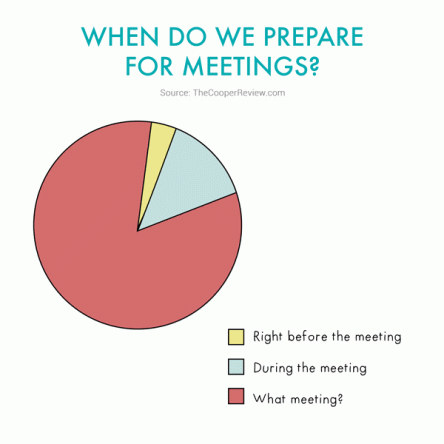
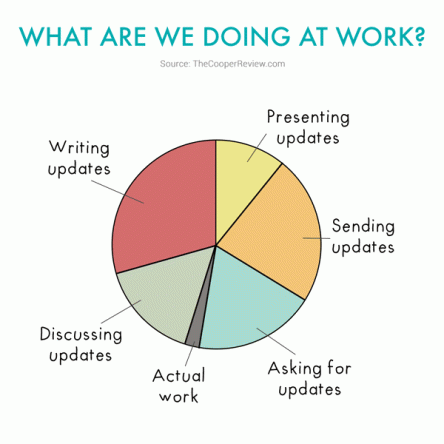
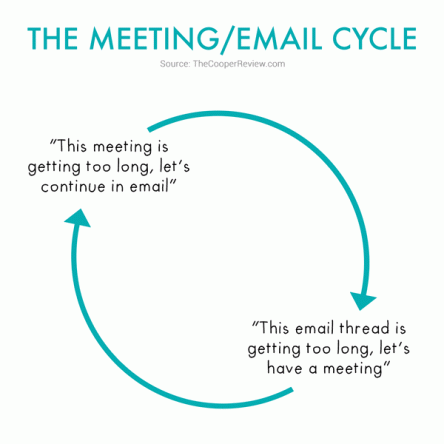
Funny graphics from Sarah Cooper from her site The Cooper Review. Offered in good fun, as of course some meetings are actually productive!
This new generation of young farmers is helping to build what amounts to an alternative food economy. That new economy is comprised of farms supplying local markets; farms employing organic and other sustainable methods; and farms raising animals outdoors, as well as producers of artisanal foodstuffs of all kinds and new distribution models such as the farm subscriptions known as CSAs, or community-supported agriculture. No one knows quite how large this new food economy is, but we do know it is growing much faster than the old one, which has stalled. Its rise is the direct result of consumers and producers working together to shorten the food chain in order to radically simplify the answer to the “Where does my food come from” question.
Source: A decade after ‘The Omnivore’s Dilemma,’ Michael Pollan sees signs of hope – The Washington Post
On another note, Ellingsworth said the program had assisted many participants in finding land while others have bought their homes with the aid of their farming businesses. She added that one of the participants had recently sold nearly $900 worth of produce to a single restaurant which was a lot of money for the family especially during the winter months.
Apart from gaining valuable farming and business insight with the program, the participants also find companionship and form strong bonds with other members despite their differences in languages and ethnicity. Ellingsworth says that sometimes a farmer from Myanmar may become best friends with a farmer from Somalia, and they find a way to communicate with each other
Source: Kansas Teaches Refugees The Business Of Farming To Help Them Rebuild Lives – 60abc
How many markets are doing outreach to their community colleges?
According to a survey on economic insecurity among community college students released last year by the Wisconsin HOPE Lab, one in five students went hungry in the last 30 days due to lack of money and 13 percent were homeless in the last year, despite most of these students having financial aid and jobs.
More than 10.5 million students attend community colleges.
Source: Hungry, Homeless and in College
The video below contains a quick overview of how and when collective action is most effective. It includes the the very important lesson that many collective action solutions require only some to contribute. In other words not every single person must shop weekly at farmers markets for markets to become game-changers in their community or for necessary policy changes to be enacted. (Network theory is probably the best set of tools to understand who the connectors are in our communities and how to engage them deeply for those first tier changes to happen.)
Social norms, legal sanctions and tax incentives are used in this video as examples of encouraging collective action; obviously much of our food work focuses on the first of these at this point.
Even as our networks search for the right mix of approaches to reach larger groups, we need to remember to keep our work as local as possible since each market or initiative can become a place of dynamic collective action with great potential for innovative ideas to mature and to actually take hold within people’s lives.
Floating Food Forest Prepares for Debut Voyage in New York
That garden is Swale, a food forest that sits atop a 120-by-35-foot barge. All of the food grown on Swale will be free and available to anyone who wants to hop on board. Patrons will be able to forage for dozens of perennial plants, such as persimmons, Swiss chard, strawberries, and asparagus.
While Swale will serve the community as a free food service, it will also be an artistic space. Biome Arts, a collective of artists and ecologists, is hosting its EcoSummit 2016 aboard Swale in the summer, with plans to build an installation, host performances, and offer free skill-sharing workshops.
Food produced on Swale will be free to the public.
Source: All Aboard: Floating Food Forest
Hospital Greenhouse in New Jersey
The greenhouse is hydroponic, and officials say it’ll produce the same amount of fresh vegetables that five acres of farmland would. The about 10,000 pounds of food that will come out of the Beth Greenhouse each year will be available to residents at “affordable prices” at a weekly farmer’s market, according to Barbara Mintz, the hospital’s Vice President of Community Engagement and Healthy Living…
…We will lose money off of this greenhouse, that’s the point,” said Darrell K. Terry, the President and CEO of Newark Beth Israel Medical Center and The Children’s Hospital of New Jersey….
The greenhouse is the latest step in what Newark Beth Israel officials say is the hospital’s transition from focusing on treating illnesses to preventing them. It will work in tandem with the hospital’s other major wellness efforts – KidsFit, a school-based curriculum to prevent a treat childhood obesity, and The Beth Challenge, a community weight loss and fitness program. The greenhouse builds on the indoor farm and farmers market the hospital started in 2011, and will double the farm’s previous production.
http://www.nj.com/essex/index.ssf/2016/05/teaching_a_man_to_garden_hospital_opens_urban_gree.html
Health equity is gaining prominence in public conversations about community well-being…
…Every community has its own culture and assets on which to build. These can direct efforts to achieve health equity by addressing the avoidable and unjust social, economic and environmental conditions that lead to health inequities. Active Living By Desig (ALBD) considers Community Context to include the residents, location, history, policies, systems and resources and the interplay of these factors. Those various factors have a unique influence on health in each community and must be understood and accounted for at every stage of the healthy community change process. This includes the selection of strategies and the order in which those strategies are implemented. To support this process, ALBD helps communities tailor their approaches using the Community Action Model as a guide through community change.
Source: Embrace Difference to Achieve Health Equity | Joanne Lee | LinkedIn
The Farmer Veteran Fellowship Fund announced a record $320,000 in new awards this week. The awards, ranging from $1,000 to $5,000 went to 140 veterans who have already launched, but are still developing, their farm businesses. The grants are paid to third-party vendors on behalf of the veterans for things such as livestock, bee supplies.
Source: FARMER VETERAN COALITION
So the story of the flameout of Dinner Lab is something to ponder. As a New Orleanian who watched it up close, I was mystified by what they were trying to sell; turns out, they were too. Even with 10 million bucks in venture capital available.
This type of badly managed tech “solution” often seems the food system equivalent of living in Tornado Alley: A high probability of sudden and uncoordinated disruptions with widespread destruction left behind. Of course, there are many excellent tech innovations that have also helped organizers too; just make sure that you investigate the goals, backers and the operation before encouraging farmers or markets to join up.
At each meal, Dinner Lab had guests provide detailed feedback on that night’s menu. The company thought it could make money off that data, but they learned there was no market for the information.
Since closing, Dinner Lab has ignored numerous messages from NOLA.com | The Times-Picayune about whether paid members would receive a refund.
Likely they will wait as long as the GoodEggs vendors waited for recompense for the orders they had prepared for delivery when that business closed without warning in mid week last August: forever.
Source: Dinner Lab autopsy: ‘Juice wasn’t worth the squeeze,’ CEO tells Forbes | NOLA.com
I could see how this tool can be helpful to food system organizers, although I certainly know we need other key indicators too. Clearly though, this type of mapping will assist the typology work that will help organizers to know why, where and what to throw in the mix to build the appropriate type of market best for that community.
Rejoice in the Storefront Index and see how your hometown’s storefront index stacks up against neighboring cities.
For example, when customers insert a chip-based debit card into a new terminal, they may be offered only Visa’s network as the choice. Or they may see two options: “Visa debit” or “U.S. debit.” Since most consumers don’t know what “U.S. debit” is — it’s actually is a link to smaller networks like NYCE — they usually pick Visa.
Instead of being prompted to enter their PINs, shoppers are asked for a signature, and the merchant is charged from 1 percent to 2 percent per transaction when a card is issued by a smaller bank. About a third of all debit cards come from financial institutions with less than $10 billion in assets, whose fees aren’t capped under an amendment to the U.S. Dodd-Frank Act.
By contrast, most PIN-based debit-card transactions, such as those over the NYCE network, have average fees of about 25 cents — and slightly more for cards issued by smaller banks. Visa and MasterCard have PIN-based debit networks too, but many of the new terminals are set up to favor their more expensive signature systems.
The main issue is that under the amendment sponsored by Senator Richard Durbin of Illinois, an ally of the retail industry, merchants must be given at least two options for routing transactions. However, many processing companies and vendors haven’t upgraded their clients’ terminals with software designed to steer transactions to the least-expensive debit network. In many cases, the choice is preset, or it’s shoppers who are making the decision when they are prompted to choose a network.
It might be helpful to increase the size of your screen to read this. For my Mac, I can hold down the control key and hit the + key to easily increase the text size. Cuz I’m old.

I’ve wondered if some market networks might begin to accept mobile wallet payments.
Also, the title may be slightly misleading. The article goes on to say:
Stephanie Ericksen, a Visa executive who works on security solutions for new payment technologies, says the sluggishness of the chip is largely a perception issue. The actual transaction time behind a mobile payment and a chip card is the same.
But with the chip, most merchant terminals require you to leave the card inside the reader until the transaction is complete and wait for a screen to tell you that you can remove the card. With the mobile payments, you can just tap the phone, and there is no extra screen telling you to remove the phone, which partly explains why the transaction appears to move along more quickly.
Visa is addressing the perception of sluggish transactions with Quick Chip. It is basically a coming software upgrade that will allow the terminals to instruct the customer to dip the card and remove it right away.
A new proposal by MBO Partners, which provides back office services to independent workers out of Herndon, Va., aims to alleviate those concerns. Under the proposal, released this morning, independent workers would be able to seek a special certification signifying that they have formally declared their status as independent workers and have opted out of the protections given to traditional employees. Companies who hired the certified workers would be safe from having the workers reclassified as employees.
“We’re not trying change any laws that exist today,” said Gene Zaino, founder and CEO of MBO Partners. “We want to create a safe harbor for people who acknowledge they don’t need the rights of an employee. For those people who don’t want to go through the process, the current laws still exist.”
There are some potential challenges with the proposal, he acknowledges. One is the potential for employers to pressure freelancers to get the certification–or lose out on potential work. To prevent the most vulnerable workers from being exploited, MBO Partners has proposed that only workers who earn $50 an hour or more could be certified.
Source: Will This New Labor Classification Save Gig Workers’ Careers? – Forbes
 Helping Farmers Markets Grow