I’m a big fan of the entity that operates this project in Central City. What is interesting on a sytem level is that, just like another neighborhood in town, there are actually two different projects focused on food access there. (In the other neighborhood you can view St. Roch Market and Mardi Gras Zone to see what I mean. And compare the NOLA Food Coop for good measure, as all three are within 8-9 blocks of each other.)
On OCH, the Roux Carre project shares the street with another project that I wrote of recently, the Dryades Public Market. On paper, it might seem that these two have a lot in common, but in reality I think how they were formed, and by whom and what items they sell are quite different. I plan on spending some time there this month to check them both out and will post some pictures.
And how do you like the term “food port”?
Caribbean, Latin and Southern-inspired food court on Oretha Castle Haley Boulevard
Each vendor has a 175-square-foot “pod” to set up its operation, and a retractable window opens into the space from where they can sell their food. A large, industrial-size communal kitchen includes ovens, a flat grill, stoves and prep space and storage.
By getting low-cost and low-overhead entry, aspiring restaurant owners are able to build a following for their food while receiving training in food service, retailing, accounting and payroll. There is no limit to how long a vendor may stay at the location, although Cassidy suspects most want to take off on their own eventually.
“It’s really an incubator for these small businesses,” Cassidy says. “They’re all really good cooks; we want them to learn how to really run a restaurant, so, if they want, they can leave here and do that.”
Here’s a sneak peek inside Paris’ massive market with 450 types of cheese and more.
You’ll also notice a box of carrots, scrubbed clean, but then sprinkled with a fine dusting of dirt for aesthetic reasons — to reflect the increased demand for organic products. “Parisians buy with their eyes,” one vendor explains.
You can find everything at Rungis, even exotic foodstuffs like ostrich, zebra and crocodile. Interestingly, you’ll never see prices displayed at Rungis as they’re negotiated based on the buyer-seller relationship.
Traceability is really important — you know exactly where your products are coming from — and trailblazing initiatives include an impressive recycling program which provides energy and heating for Orly airport.
Beyond the magnificent goods, you’ll marvel at the work culture. Just under 12,000 people work at Rungis and it’s a jovial, jolly place. Folks love what they do, and you can see merchants socializing over coffee or verres de vin (glasses of wine) in the early morning hours. In fact, the café Saint-Aubert outside the poultry pavilion sells the most cups of coffee in France: 3,000 a day.
Ratcliffe’s research has shown that a secure environment is incredibly important. Analyzing 40 years’ worth of data, Ratcliffe found that many children cycle in and out of poverty and that 1 in 10 is persistently poor, spending at least half their childhood below the poverty line. Persistently poor children have substantially worse outcomes as adults and growing up in disadvantaged neighborhoods, moving a lot, or having parents with lower educational achievement can further affect poor children’s chances at success. SNAP and other benefits, however, can help stabilize families, priming children to break out of the cycle of poverty.
Great article linked below along with a salient excerpt about placemaking which is something all market organizations should know a little about.
We essentially believe that a creative placemaking project needs to have four basic parts:
First, the work needs to be ultimately place-based, meaning that there is a group of people who live and work in the same place. It can be a block, a neighborhood, a town, a city, or a region, but you need to be able to draw a circle around it on a map.
Next, you need to talk about the community conditions for all of the people who live in that place and identify some community development change that that group of people would like to see: a problem with housing that needs to be fixed; an opportunity with a new transportation infrastructure that needs to be seized; a problematic narrative around public safety that needs to be changed. (There are ten categories of community development changes that we currently track.)
Third is when the “creative” comes into play: how can artists, arts organizations, or arts activity help achieve the change that has been articulated for this group of people?
And, finally, since these are projects that explicitly set out to make a change, there needs to be a way of knowing whether the change has happened. Some people call this “project evaluation.” We simply say it is important to know when you can stop doing something, cross it off your list, and move on to the next thing.
The Farmers Market Coalition announced a new opportunity for farmers markets to meet their educational missions through the POP Club: Power of Produce. FMC has teamed up with Chipotle to sponsor POP Clubs at 75 Farmers Market Coalition member markets nationwide.
The POP Club empowers children to make healthy food choices by engaging them in educational activities at the farmers market, and putting buying power directly into their hands. The program gives children at least $2 in market currency to spend on fresh produce every time they participate in a POP Club activity. POP Club provides a fun opportunity for children to engage in the local food system through conversations directly with farmers, educational games and demonstrations, and exposure to new fruits and vegetables. You can learn more about the POP Club here.
FYI- this is Florida and not northern California..
A few issues that I would like more information about from this story: one, if the market and the county had communicated in the past and two, how many local people think that flea market goods have too much room at this market and if they agree that a farmers market should not contain those goods. I’m not advocating for flea market goods at markets (my own markets were very strict about any non-food goods) but whether it is true that flea market goods are taking up most of the space in this market and whether those flea market goods have a place in farmers markets should be up to the local community, which certainly includes the municipality in question, but doesn’t mean the commissioners should decide these issues alone. It is important to note that in many cases across the Americas, staple markets have a place in many communities and can be a very useful type of market for small rural communities or for immigrant communities.
Lastly, the rule to only allow open-air markets to operate only 28 days per year seems awfully restrictive. I wonder when that was passed in Florida and how many counties have that rule? And is it to restrict flea markets but ends up restricting farmers markets too? I do know from my pals in farmers markets in Florida that the use of the term farmers market is all over the place across the state; resellers use the term in normal practice and of course, in a state like Florida that has massive agricultural exports, small farms and direct marketing are not likely to be valued as highly as in other states. Of course, California does have a thriving farmers market system, but also has a very different political climate and history.
For all of these issues, this is why I advocate for formal rules that allow for constant transparency and clarity in market governance. Rules that explain why, when, how and for whom a market operates can help reduce these issues before they get to crisis stage. In addition, this is also why I hope Farmers Market Coalition and their partners are successful in building a simple and usable data collection system; If all markets could gather a few comparable metrics each year, these issues might be more easily diverted or at least, add facts to lessen a charged situation.
The controversy started when Collier County commissioner Tom Henning used the word “gypsy” to describe vendors at the Golden Gate Community Center market. Commissioner Henning wanted to protect a business that complained the farmers market shoppers were taking up his parking spots….
While county commission retracted their initial vote to shut the market down, their problems aren’t over.
County laws say open-air markets can only operate 28 days a year. But vendors at the farmers market want to stay open all year. A petition with 1,300 signatures will be presented at a county commission meeting on Tuesday.
this from another
Taylor said the county’s issue is that it’s not a farmer’s market, but more of a flea market and it appears to be disrupting local businesses.
As of this week, markets in my city are once again open four days per week with local farmers and fishers selling directly to family-table shoppers and to restaurant buyers. That is important to note as it was the weekend before the federal levee breaks of August 2005 that it was last true.
On that long-ago weekend, CCFM closed its Saturday market early and told its community that most of the next week of markets would also be cancelled, meaning the Tuesday, Wednesday and Thursday markets. Our lead market staff was away so I was directly supervising the market that Saturday. I remember well sadly hugging my vendors as they packed up and knowing some would not immediately return, depending on where the storm would hit. Little did we know that it would be the market locations and the market shoppers that would be its victims and we would not reopen a market at all until November 22, 2005* which at the time seemed like forever but now seems unbelievably speedy.
Hard to believe that it has been nine years since the entire slate of markets were open. Much has happened within the market organization and to the region in those nine years, an almost dizzying amount of changes really. What is gratifying as a market shopper, as a French Quarter resident and as a market advocate is that the new leadership of the organization has decreed that we must return to that weekly market schedule.
Huzzah and pass the satsumas.
The Wednesday market opened originally at the French Market on Wednesday March 19, 2003 which coincided with St. Joseph’s Day and therefore with a beautiful display and event coordinated (as usual) by Poppy Tooker, then our regional Slow Food Leader and now a noted cookbook author and tv/radio personality. Like all of the markets we opened (and that includes a short-lived one at Loyola University in 2001 as well as 5-years of Festivus, our fair trade market and our many White Boot Brigades (thanks again Poppy), we had to create a new set of circumstances for the Wednesday market to exist and to thrive in. In fact, in the two years that market was open, until the aftermath of Katrina shut it down we rebuilt it almost entirely just as we had with in the early days of the Tuesday and Thursday markets.
Here's what I learned from this market's opening that may be replicable to other markets, especially those with a similar chronology:
1. Be sure that you can handle all of the markets with the staff size that you have and can handle. That seems obvious, but running four markets suddenly required new or greatly expanded systems and not just another market bag and tent! Three markets from two was not that different as there was still a day in between and some vendors could do three markets per week but four was a very different matter. And since the systems we had set up for three markets expected our very hardworking staff for a least a half day of market planning and a half day of post-production per market (that is, without the large events which we were known for back then) it meant that two managers or two on-site coordinators were now absolutely necessary to do it right and that meant a very different organization, especially one within a slow-moving university system as we were then.
2. Every market needs anchor vendors. Those anchor vendors have to view that market as key to their weekly business (not a secondary market in other words) and commit to making it work for a period of time. This was definitely a problem on and off in our region as businesses with the skills and products to really anchor a market are not that easy to come by and so end up anchoring way too many at once, and then dropping markets rather quickly. Learn who your anchor vendors are (hint-it’s not always the biggest or even only farm goods!) and build the market initially on their strengths and for their shoppers.
3. Know the similarities and difference of your market neighborhoods and demographics. The third and fourth markets opened in downtown neighborhoods of the city, which has a very different demographic than the neighborhoods in which the first two operate. They also were physically smaller in potential size (could fit about half of the vendors of the first two markets) and had little or no parking available, which was also not true of the first two markets. Shoppers downtown were less likely to shop our other markets (as we learned from surveys) and more likely to want value-added goods which meant a different market vibe and outreach plan.
4. Acknowledge the barriers that truly exist. The French Market was and is hallowed ground for any New Orleanian, but also ground spoiled by long time bureaucracy (which by the way, turned out to be more intractable that even we thought). That long memory among residents made our work difficult, especially without any other changes in the existing market behind us. People insisted on telling us everything that had been wrong with the French Market, and their resentment was felt by our farmers and fishers, who since they also felt the same were easily deflated and dejected at market. If we had recognized that barrier was insurmountable to many of our long time farmers market shoppers (which is why they were so loyal to us in the earliest days!) and to some of our vendors, we could have spent more time working to build new shoppers and vendors. The shoppers we began to attract the last 6 months included new residents without the attachment to the FM history, seniors who loved the hours and the downtown location and the ease of shuttle delivery and pickup, the waiters and bartenders and second-shift workers, the French Quarter denizens who love to see and be seen, the chefs who believed in the market no matter where it was and so on. The vendors who began to do well loved their new enthusiasm and were able to refine their product lists to suit those new shoppers. Those who did not or could not adapt packed up or in some cases, stayed to try to make it and fumed at us and sometimes at the shoppers, knowing there were not enough yet and often too new to markets to purchase enough to sustain their extensive business needs. If we had started with that strategy, we would have wasted less of our and less of our vendors valuable time that first years and a half.
5. Something I knew before opening that market but we needed to make more clear to everyone: it takes 2-3 years for a market to stabilize. Don’t sweat the ups and downs of the first few years, just learn quickly and build for the day that it does thrive. And don’t punish the first group of shoppers by changing everything within six months to attract “better”shoppers-ask questions, survey those that come and keep on adding appropriate amenities and products to attract more of that community, to have them spend more and to add other like-minded shoppers.
With all of that in mind, I believe the market organization as it exists today has the embedded institutional skills and the partners (like the new leadership at the French Market) to regain the food system primacy that dissipated in those dark months and years of rebuilding, dissipated partly because of circumstances such as the need to reorganize the organization (2008), the BP spill (2010), Hurricane Isaac (2012), the end of the “Katrina economy” (2013-2014) and maybe most of all, the development of the “new New Orleanians” (2010-). From my view, the organization’s interest in finding the right answers for local farmers and fishers for the next iteration of New Orleans has rightly began with the organization’s original farmers market blueprint. However, I hope that they will also push past that history to make an even bigger and better future for themselves and their market community and when it comes, they know I’ll be there with tokens in hand.
Scrolling down through the list of FMPP successful proposals shows the ingenious and unique approaches that farmers markets and farmer advocates are employing across the U.S. to further community food systems.
As some may know, I am originally from Cleveland, Ohio and follow the food systems and community organizing work there with great interest. I grew up in one of the inner ring west side suburbs, often visiting the West Side Market and various small butchers and bakeries but the only “farms” I saw were the historical sites around Akron or when spotting an Amish farmer as we headed south on vacation at 65 mph. Farming was clearly the past for most modern Buckeyes, and we thought huge factories and transportation hubs were our only possible future. Or so it seemed for most of my early life since, like many Cleveland children, any trip through the Flats would include open car windows allowing in the soot and smoke of the factories and a proclamation: “smell that, kids? That smell is JOBS.”
However, the decline of manufacturing along Lake Erie in my lifetime has sent its great cities in search of other answers, and I am very proud of Cleveland’s new dedication to sustainable infrastructure and value-based employment for its citizens. A powerful example is the city’s Sustainability 2019 plan that was born from one of our most shameful moments-the fire on the Cuyahoga River in 1969, caused by the chemicals and pollution we allowed to be dumped into it.
1969-Cuyahoga River on fire, Cleveland Ohio
Since the global media descends on Cleveland every decade or so to revisit that fire, it is likely they will come at the half century anniversary with renewed gusto. In preparation, the Sustainability 2019 initiative was born to reply with evidence of Cleveland as “one of the greenest cities in North America” as the city’s Director of Sustainability put it at one of their conferences. Because of that focus, I believe that Cleveland is moving faster to a hybrid model of creating post-industrial sectors that can thrive with the vestiges of whatever manufacturing that it claims (wind power anyone?).
I found this out on one of my trips home when noticing that the food system there had a slightly different hue than many others that I regularly visit. Often, when I dig to find the beginnings of citywide or regional food work, I find that it stems primarily from the cultural sector as seen in my other home town of New Orleans, or from a deep need for a new entrepreneurial answer, a la Detroit, or from a public health crisis of lack of healthy food access as in the Bed-Stuy area of NYC, or all of those needs at once, such as many First Nations and too many others. It seemed to me that Cleveland’s food work came from the deep awareness of the destruction heaped upon it from that industrial framework that had now mostly fled to warmer and less regulated places. That strong environmental underpinning was also present because of the first-rate organizing done by many 1960s-present activists including the Ohio Public Interest Campaign, where I was trained as a community organizer and worked for almost a decade.
Maybe because of that industrial vacuum, the need for jobs there seems tempered by the caution for real answers that allow workers stability and skills and not just a paycheck handed to them by a new corporate overlord. The cooperative movement afoot there seems to rise from this and from the professionally run, long-standing community development organizations embedded deep in the neighborhoods, east and west. And of course, credit must also be given to other areas in the region that started cooperative development such as Athens Ohio.
So, because of the hard work done by generations before, the development of the food work seems relatively balanced and quite ambitious. It seems to still lack regional cohesion but it is not ignoring that need either. I found a deeper awareness of the inequities and the need to work with existing both the corporate and informal sectors than in many other places that I visit and work. There is much to do there and mistakes will be made on the road to this new face for my old city, as I mentioned in a piece for Belt Magazine. Still, I am proud of the work being done there and hope you find time to read their new Roadmap and to visit too. The City of Cleveland Mayor’s Office of Sustainability, Ohio State University Extension, Cuyahoga County,and the Cleveland-Cuyahoga County Food Policy Coalition have developed a sustainable food cluster roadmap in Cuyahoga County, with a core objective to increase regional jobs, revenue and sustainability by supporting local food and beverage businesses.
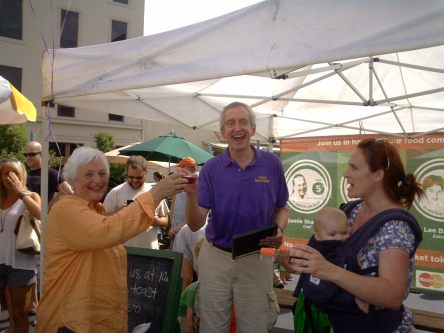
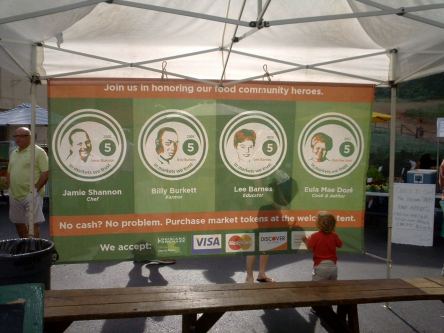
When markets discuss what the centralized card swiping systems add to their market, they often talk of shoppers not needing to stop for cash on an early Saturday morning or about being able to reintroduce markets to their low-income neighbors who want to use their electronic benefit program funds. Both reasons are extremely important but I often share the story of Crescent City Farmers Market’s use of the wooden token systems to highlight community. One of the loveliest examples of their system is the honoring of late local heroes on their tokens: founding CCFM farmer Billy Burkett, chef Jamie Shannon of Commander’s Palace, cultural cooking educator Lee Barnes and Tabasco company cook, farmer Jim Core and author Eula Mae Doré have been remembered this way.
Diana Pinckley, local community force and early CCFM board chairperson joined the others this year; her tragic passing in 2012 was a blow to many across the region who depended on her for advice, support and a pithy comment warmly offered.
Appropriately, Memorial Day weekend was chosen to offer the newest token and Diana’s husband and close friends toasted her with beet lemonade and proudly used “the Pinckley” to get their strawberries and shrimp.
I am reminded every time a token is unveiled how sweet it is for the honoree’s family and friends to see how the market community remembers them and how local currencies can do many things for a market besides offering a shortcut to sales. I am proud to see our New Orleans market lead in this way.
This is a good article, but I wonder why the writers of these feel the need to use that condescending tone towards farmers markets to talk about intermediate sales for growers?
I do feel like this is market organizers issue as well; that we need to embrace the need for the food system to grow past our boundaries and to understand what our markets offer and what they do not: Markets bring family table shoppers and producers interested in direct sales together; that action allows a great deal to begin and to grow and the work to properly manage those efforts is harder than organizers get credit for. That the many benefits of markets should be understood and shared with fellow food system organizers to better replicate and expand models into new arenas. That markets need to work with food hubs, micro-farms and Farm To Institution initiatives to allow some of our growers to supply those chains, and to safeguard the values of health and wealth equity and to keep inviting new people into the system.
There’s no template for food hubs, and every one is different. Some focus on working with retailers, gathering food from local farms, branding it and then selling it to grocers. Others partner with growers. The Agriculture and Land-Based Training Association in California’s Salinas Valley, for instance, began by consolidating produce from growers and coordinating distribution to stores in 2001, later adding farmer services like education and crop planning. By 2011 it had sales in excess of $3 million. Others still are expanding into light processing. Last summer, Eastern Market began buying excess produce from farmers at the end of market day during peak season and freezing it for resale over the winter.
This is an exciting piece on the explosion of farmers markets, but I must confess that based on my own knowledge, I find the data to be less than precise. The USDA list of markets is not checked for accuracy and as it is up to market organizers to list and to de-list their own markets, most estimations believe that the list is far from accurate, even though the USDA does everything within its (limited) time to make it right. Even the definition of what can be listed as a market is loose; this may seem like nitpicking (after all more “markets” is good news isn’t it?) but since we know how the capacity of markets remains low partly because of low support among funders and policy makers, the lack of clarity may hurt chances to expand well-managed farmers markets or public markets that support local entrepreneurs.
What is also true is that many retail operations masquerade as farmers markets without directly supporting farmers or managing those involved in direct sales; regular operation, transparent governance and some direct sales for regional producers should at least be the minimum to being listed on this list. Don’t get me wrong; I like the idea of auxiliary and ancillary food initiatives that get regional food into more communities being listed somewhere and to be tied to efforts at flagship or sister market organizations, but we should get better at describing each of them with their own type so we can allow more to flourish.
I might recommend that some of you utilize these suggestions within your market or grassroots food community efforts. Often, these type of collaborative public space efforts can extend the food community vibe into new arenas and into becoming a “beloved institution” beyond the hours of the bell or the garden fence.
Since I’m back in Vermont for the 2014 Direct Marketing Conference, I decided to upload the Power Point from the 2013 Wholesome Wave convening that Erin Buckwalter of NOFA-VT and I gave about the 2013 Vermont Market Currency Report. I’ll add notes for each slide sometime in the next month or two but the data will still be helpful to many.