Salvation Army Is Measuring Poverty In Real Time

Here is an example of an innovative community-level data project that will lead to better policy decisions and increased support for the many services that SA offers. I can easily relate this to farmers markets data collection and found particular interest in the key indicators chosen and in this line: “a result due in part to the lack of information in the public domain, but also, the lack of uniform reporting that exists on both a national and local scale”, which also remains a problem for grassroots markets and other food initiatives.

This story also illustrates what could very well be the next step to Farmers Market Metrics: collected indexes that show a larger system inequity or effect,  possible once we establish which metrics are best compiled for different system measures. Those system measures can come from the work done by Center for Whole Communities and their Whole Measures, which were part of the initial research done for FMM.


The Salvation Army has rolled out a new tool for measuring poverty across time and geographic regions.

Out of the 600-plus services that the Salvation Army tracks — everything from the number of toys given out at centers across the country — the team of 30 researchers selected seven indicators of poverty for the index: meals, groceries, assistance for medical needs, utility payments, furniture, clothing and housing…

The index enlists Salvation Army data collected from the roughly 30 million Americans who receive assistance with the organization each year. Out of the 600-plus services that the Salvation Army tracks — everything from the number of toys given out at centers across the country — the team of 30 researchers selected seven indicators of poverty for the index: meals, groceries, assistance for medical needs, utility payments, furniture, clothing and housing. Together, these data points form a score within the index that’s been plotted to show month-to-month changes both nationwide and within each state, between 2004 and 2015. The result is a highly interactive graphic that shows a number of interesting trends, including which states haven’t returned to pre-recession levels of need: Pennsylvania, Indiana, Nevada, Michigan Kansas and Minnesota…

A decade’s worth of data in the index revealed a number of curious trends, including a consistent uptick in demand for assistance on utility bills in springtime. “You’d think it’d be the opposite, because it’s warmer weather,” says Osili. The data analysts at Indiana University went to their colleagues at the Salvation Army, who soon enough arrived at an explanation. “In many communities, particularly in the Northern part of the United States, it’s against the law to turn off somebody’s utilities during cold weather,” says Lt. Colonel Ron Busroe of the Salvation Army. “So in April, when it is springtime, people are coming to us to get their utilities paid.”

Another observation illuminated by the index: a September back-to-school bump in service needs at Salvation Army centers everywhere. Those are just a couple of the discoveries that have Dr. Osili excited about what could blossom from this collaboration between university researchers and a sprawling service provider. “It was a revelation and showed the need for these kinds of partnerships, because on our own we would not have immediately or intuitively thought of that.”

Source: Salvation Army Is Measuring Poverty In Real Time – Next City

Counting cases and flats

IMG_20151215_093657

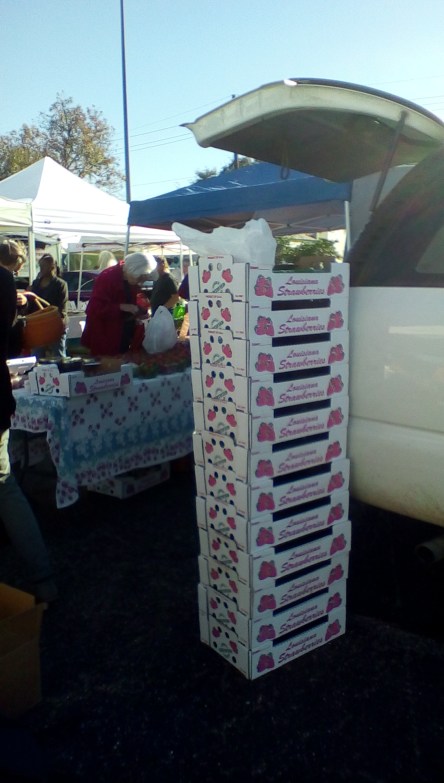
As Farmers Market Coalition and University of Wisconsin delve ever more into the design and the research around Indicators for Impacts, others interested in this work continue to ask for informal help in adding common-sense evaluation to their market work. In a recent conversation with a state market leader, we discussed testing new methods for evaluating vendor success besides just asking for sales numbers. One of those could be counting flats or boxes stacked, once sold. This is certainly not an exact science, but as an indicator of trends or of seasonal spikes, it could prove to be very handy.

For those vendors who sell a single product like these strawberries currently available at New Orleans markets, a market manager can easily note the stacked empty boxes or flats (the unsold flats remain in the truck out of the sun and away from harm). Currently, this vendor sells a pint for 4.00 and is not offering many quantity breaks yet as this is the very beginning of the season; of course, they will offer quarts, half flats and flats at different prices once the season begins in earnest.

Here we can see that she has already sold (around 2.5 hours into the market) 12 flats with 12 pints at 4.00 for a total of 566.00. Let’s assume that she sold a few flats to chefs and maybe offered samples and maybe a price break to a few of her regulars, or even to the market as it had school tour events that Tuesday, so let’s round it off to a day so far of around 700-750 in sales. She only has a few left, so maybe she brings in in the ballpark of 1000.00 on this market day. She also sells honey and some strawberry preserves, but those sales are minimal from my estimation, and are more about extending her visibility at markets on rainy weeks when she cannot pick or when the cold keeps her early berries under wraps.

We won’t make the mistake of assuming any of this is profit but it is helpful to monitor how some of the anchor vendors are doing at different points of the season. Their shoppers may very well travel to market primarily for their goods and then stop at other stalls to purchase more. No doubt that fruit vendors attract seasonal shoppers, especially at the  beginning, the height and at the very end of their fruit season when either specific types (early adopters, chefs, canners) or just more fruit lovers seek them out. Knowing who is drawn to the market by which anchor vendors and when can help pinpoint the marketing in future seasons.

The flat or case count also allows managers to understand the production strategy for a vendor and may help that vendor evolve it over time. For example, when this vendor does move to flat pricing later in the season, is that a moment for the market to add events and messaging to let more people know?  Or, should the market wait until the crowd begins to slow and then begin messaging? How much is planted and expected to be sold at different points in the season? What does the vendor consider a good day at these points: everything sold as quickly as possible or having enough for her regular shoppers? Can the market can handle more berries?

Additionally, can the market position like products nearby, like dairy, or at least add signage that points from one to the other on spikey days?

Lastly of course, this can be seen as another way to show sales among vendors that offers some contextual information too:

One vendor sold an average of 200 pints of local berries at every Tuesday market during the good weather of November and early December. The availability of berries that early in the season is due to this vendor adding a cold-hardy Canadian variety to their crop plan to extend berry availability at the market by two more months.

Or the picture can tell the story and be added to the report to the community at the end of the year.

The point is to think of gathering and using data as doable and as human-scaled as the market itself…

…and to get to that berry vendor early in the day.

Can Hospitals Heal?

Read a great report today by The Democracy Collaborative that should be a must read for all food system organizers. It is vital that markets build their capacity to anchor their food systems, and hospital partnerships have evolved tremendously to assist with that. Hospitals can offer space for campus and other  market types, fund incentivizing healthy eating, change their purchasing to offer farmers another sales outlet, conduct research with markets, offer trained health professionals to assist with strategy and outreach and much more.

More on the campus market: this is one of the early types that came from Market Umbrella’s trans•act work; I have continued to use it as a framework when working with new market partners. I think campus markets can work in more cases, but the governance, products and partnerships have to be aligned closely to the goals of the market: So in this example, since the shopping population is usually drawn entirely from inside the campus,there may be a natural ceiling on sales for the vendors. Yet, the well designed campus market may find other ways to incentivize or reward these vendors including offering more exclusives on product offerings, rewarding consistent vendors with reduced fees, putting them first in line for institutional purchases, offering a pre-sold market box to campus members to bolster sales or even allowing those vendors to access the services for free on the day they come to sell at market!

The market may even hire its manager from the campus and should include campus market champions (using Kaiser-Permanente’s early language) on their board. Since the shopping base is more or less a controlled population, projects could focus more on sharing information for the campus and creating a welcoming and attractive respite or reward of hospital work or appointments.


The University of Wisconsin Population Health Institute found that over 40 percent of the factors that contribute to the length and quality of life are social and economic; another 30 percent are health behaviors, directly shaped by socio-economic factors; and another 10 percent are related to the physical environment where we live and make day to day choices—again inextricably linked to social and economic realities. Just 10 to 20 percent of what creates health is related to access to care, and the quality of the services received.

Some call this new approach to health “the anchor mission,” meaning that a hospital not only provides charitable and philanthropic support for the community, but begins to re-orient its institutional business practices to benefit the place in which it is based.

The Small Business Beginner’s Guide to Snapchat

“Last week, we polled readers about which social media platform they felt LEAST comfortable using heading into the new year…
In just one week, we had hundreds of marketers respond that Snapchat was their least comfortable platform for marketing.

Now it’s true that we haven’t written a LOT about the social media platform ourselves, but the last time we discussed Snapchat, we said that their new feature Discover was worth exploring as a business. Many of the publishers who have joined the partnership already have given positive feedback saying it has allowed them to reach a new audience they would have never found without Snapchat.

When diving into Pew Research, we found that the audience they speak of is mostly made up of 18 to 29-year-olds on their mobile devices.

So before you continue on to read about how to start using Snapchat for your small business, think about your audience and see if your target market may fit into this category. If not, Snapchat may not be the right platform for you, if your target audience does fit into this demographic – keep reading...”


For Children Impoverished at Least a Year, Food Stamps Provide Critical Stability 

Ratcliffe’s research has shown that a secure environment is incredibly important. Analyzing 40 years’ worth of data, Ratcliffe found that many children cycle in and out of poverty and that 1 in 10 is persistently poor, spending at least half their childhood below the poverty line. Persistently poor children have substantially worse outcomes as adults and growing up in disadvantaged neighborhoods, moving a lot, or having parents with lower educational achievement can further affect poor children’s chances at success. SNAP and other benefits, however, can help stabilize families, priming children to break out of the cycle of poverty.

Source: For Children Impoverished at Least a Year, Food Stamps Provide Critical Stability | Community Commons

History of the Local Food Hub in New Orleans: Hollygrove and Jack and Jake’s

Food hubs are still so new that it is still unclear to most of us how they function best when they do function well. Are the best cooperatively managed or run by a non-profit or as sole proprietors? Funded slowly through income or quickly in one season with grants and other investments? How do they work with their sistren and brethren: farmers markets, CSAs, farmstands, mobile markets and the like? Here is how the USDA describes them:

Food hubs are businesses or organizations that “aggregate the crops of small farmers (to) provide enough local food for not just consumers but schools etc. By offering a combination of aggregation, distribution, and marketing services at an affordable price, food hubs make it possible for many producers to gain entry into new larger-volume markets that boost their income and provide them with opportunities for scaling up production.

Here is a link to their 2012 report.

Jack and Jake’s has called themselves the first food hub in Louisiana; this version came to New Orleans in 2009 through John Burns who has family ties to rural farming in the state and worked for a short time at the area’s first storefront aggregator of local goods, Hollygrove Market. Actually, at one time, Hollygrove Market was presented as a food hub too and received much attention with that description. It now focuses on urban farming education and selling local products collected from market farmers and others who drop off at the site, all sold at its storefront or online store. They do offer delivery for a very low fee when the purchase is under 50.00.  The term food hub is no longer found on their site.

So after working for Hollygrove for a few months, John Burns announced his for-profit and expansive food hub, originally to be located just a few blocks away.  He received a great deal of press and significant investment money and the offer of a few high-profile locations in the 5 years that he ran the project. Unfortuantely, by most local standards, the amount of attention this project received didn’t seem to match the output in that same period.

Finally, he left the project and then the developers renamed the project the Dryades Public Market. It’ll be interesting to see if he shows up again with his Jack and Jake’s brand.

Here is some timeline of this idea’s history that I could remember or dig up:

Jack and Jake’s, a New Orleans entrepreneurial startup company founded in 2009, has created the very first local food hub in Louisiana.

2010 Earhart location, called a grocery store at this point

2012 90,000+ sq ft food hub. The details are not included, but my memory is that the hub they refer to in this story were 2 locations: a warehouse in Slidell that they used as a collector for farmers to drop off items in 2012 but suffered damage in Hurricane Isaac and forced its closure and their Earhart location which was never opened.

2014 New location in a renovated school building on Oretha Castle Haley Blvd, complete with 1,000,000 city loan

2015 Founder John Burns out, new name as a public market but still called Jack and Jakes

2015: New CEO and new name

The long-delayed Jack & Jake’s Public Market in Central City has a new name and a new leader, reports the Advocate. The project, which benefited from a $1 million loan from the city, has rebranded as Dryades Public Market. Dan Esses, chef and owner of Three Muses on Frenchmen Street, will lead the project.


December 30, 2016

Dan Esses, the CEO of Dryades Public Market on Central City’s Orthea Castle Haley Boulevard, will leave the market in two months.

“It was just time for me to move on. I gave it as much as I could,” said Esses, who is also a partner in Three Muses on Frenchmen and Maple streets and owns the pasta company Esses Food. “This is an amicable move.”

Esses does not expect the market’s board to name a successor CEO. In a letter to shareholders and lenders, Esses said that eliminating his salary was necessary “in light of our economic reality.”

“There will be restructuring and downsizing,” he said in an interview. “They’re just looking to shrink the footprint a little.”

A consultant specializing in grocery stores and turnaround strategies has been hired and will provide concrete suggestions by the end of February.
 

Purpose Defined: Developing a Market Mission

A 2012 webinar that I did for FMC on mission statement development. As we move into deeper design of the Farmers Market Metrics Program, having markets that have their mission written and shared is extremely helpful when embarking on any in-depth evaluation system. Thought it might be helpful to repost.

Farming oysters and clams

Recently, I heard an absorbing edition of Louisiana Eats (food and culture maven Poppy Tooker’s radio show full of “edible content”)  about seafood, and specifically about oysters and clam production along the Gulf Coast of the U.S. Poppy visits a new “off-bottom” oyster farm that is producing bigger and cleaner oysters than ever before and talks to our pal Rusty Gaude, marine biologist and seafood extension agent who has been working on increasing varieties of clams and oysters for many years.  I wrote a short piece about the oyster project a while back and now with Poppy’s show, could actually visualize and understand what they are doing down there.

As for Rusty’s excellent work, I wrote a bit about it recently here.

I know Poppy knows a great deal about oysters as she and I (with funding from Kellogg for our market organization to make teaching videos) had interviewed innovative oystermen in Puget Sound among others, a few years back. The amount of time that she volunteered for ours and other projects confirms how committed Poppy is to improving the lot for Gulf Coast fishing families while also educating folks on the need for reducing the erosion that is likely to sink New Orleans within the next 75 or so years.

To me, the link to all of this is the market organization that first introduced Poppy and Rusty (and me) and allows all kinds of leaders in the community to ask for feedback or space to test out ideas: this is the type of work that farmers markets can curate and encourage even if they are not the main recipient of those new goods-after all, more regional sustainable goods available helps everyone.

Read about another innovative project to reduce the erosion using artificial reefs that encourage oysters to grow and protect the coast.


From 0 to 35 in MS

I have worked with markets and farmers in Mississippi for a dozen years and have found more barriers to getting regional food accepted than in most other areas of the US, yet also have met some of the most optimistic and capable people  working on it there.
What’s interesting is that in going from a deeply (still) entrenched commodity/plantation culture of farming directly to a new economy of small family farming for markets and restaurants can mean that some of the middle steps can be skipped, which is beneficial to innovative growers.

In other words, the situations is similar to what has happened in many non-industrialized or colonized countries in regards to technology; having skipped the landline era, the new users adapt much more quickly to the technology of mobility*.
I can see this leapfrogging in play for sustainable farming in the Gulf States with new farmers pushing the envelope with pesticide-free and heirloom varieties at markets and in CSAs, rather than  being influenced by the less inspiring midcentury distribution system that hardened growers’ experience into growing the hardiest and tasteless products to ship.
The area around Oxford MS is one that is ready for takeoff. The small farmer markets offer organic products at a higher rate than the New Orleans farmers markets for example, and the average age of the vendors seems markedly less than the US average, to my unscientific eye. The chef quoted in the article below is a pal of mine and had been the Board President of the New Orleans-based Market Umbrella before Katrina, and now is a leader in the regional food movement in Oxford. He offers his knowledge to the markets and farmers around the area as well supporting the leading agricultural advocates, Mississippi Sustainable Agriculture Network (MSAN), which was founded with Wallace Center support a few years back. Corbin and MSAN are good example of the quiet revolution happening up there.

Additionally, the folks in Hernando MS (north of Oxford, closer to Memphis TN) are leading the state in innovative healthy living strategies and thinking deeply about how to expand regional farming to support those strategies. Their weekly market is large enough to attract serious attention from regional funders and even policy makers, and I have hopes that they might soon attempt to create a year round market.

Continue reading

Baker shutting the door on markets


I had written about this baker giving up the weekday market almost exactly 2 years ago and now via his wonderfully written email newsletter excerpted and linked at the bottom of this post, I see that he is about to give up the remaining farmers market that he attends.

I have certainly heard a wide range of reasons given by producers about why markets no longer work for them, and thanks to my long ago human resources training, I learned to ask myself and my market peers what I used to ask of my staff about departing or failing employees:

Did we do all that we could do to help this person succeed? Did we offer the same resources and attention that we could offer or do offer to others? What else should we offer (if anything) to help situations like this not happen as often in the future? Or are there just circumstances out of anyone’s control that made this inevitable?

When I post this news on my personal FB page, I guarantee you I’ll hear  responses from market shopping friends as well as non-market shopping friends telling me their opinion of his products and his stall, both good and bad, a few who will blame the market and still others who will shrug and say it goes with the territory.

I also guarantee you that when I go and talk to him directly about this email, he will be fair (he always is) to the market management but also specifically critical about markets. He will suggest marketing ideas to me, some of which might very well work for this market and some that have been tried and not worked in the past, all of which may or may not have helped his business. I expect that we will find ourselves in somewhat of a standoff, although I will agree with him that markets should be reactive to the needs of their anchor and to their specialty vendors. I’m not saying that this market was not – I cannot know what the recent relationship is-  but wearing my hat of a market strategist for a minute, any and all markets should constantly fine tune their management and marketing based on their measurement of positive and negative impacts, and that does include measuring a spectrum of individual stall activity across the market.

The trick is to measure within the context of each business’ set of goals and true interest in being at markets long-term.

As a specialty item vendor (he’d  disagree with that description I am guessing, but his breads are unique enough for purchase that they have to be seen as specialty rather than staple goods still), finding his customers can be slightly more tricky than it is for the market to find the anchor vendors customers. And to further confuse matters, in some markets, once in a while the specialty vendors ARE the anchor vendors.

Continue reading

Farmers market ‘reconnects’ with campus 

This is a project I have assisted whenever called on to do so. This university attracts a great many rural and suburban from a diverse set of backgrounds and yet has almost no attention paid to environmental sustainability or food policy in its coursework, outside of a very few entrepreneurial and committed professors.

A selected student runs the 2-3 times per semester market, and is in charge of adding vendors, running the actual market day and doing on-campus marketing. From my vantage point, this simple project has taught quite a few young adults about farming and about healthy food at a point when they are willing to take in new information. It has also opened an ongoing discussion of why the campus outlets don’t offer better and local food whenever possible.
This market is also an example of the expanded typology that we need to categorize and share so that organizers or partners don’t only expect a 30 + member heavy-on-raw-goods Saturday morning market as the only appropriate intervention. The goals of this market are closely tied to their unique structure and strategy or, what we used to call the 4Ms at Market Umbrella (well, I still call them that)-the market’s mission, management, marketing and measurement. Those first two Ms are the framework for the internal systems created and are linked (the mission should tell you what type of management/governance is required) and the following two are designed once the system of management has been created.

(By the way, this is also a framework we used for evaluating any new project at MU for many years: we first decided if any project suggested was clearly within our mission; then we discussed the type of supervision (management) that would be required and decided if we had the skills and hours to do it well; any marketing and outreach also meant ensuring that our vendors and present shoppers understood the project and of course measurement was based on the external benefits of the project but the impact on the market itself was also measured. Even if the project was successful by external measures, if the present market community felt the project had negative impacts that outweighed the positive ones, then it was not repeated or made into a actual program past pilot stage.)

Many vendors found having a farmers market on campus was beneficial towards the students. It offered students a way to buy local food. Ory explained that Locally Preserved products could easily be incorporated into easy meals for college students. One option is adding their apple pie butter to a bowl of oatmeal for flavor.

Source: Farmers’ market ‘reconnects’ with campus | lionsroarnews


Some background from the professor and the founder…

Big data doesn’t have to be Big Brother

This article easily says what I attempted to do in my 3-part Big Data, Little Farmers Markets posts earlier in the year.

The same data and algorithms that wreak havoc on workers’ lives could just as easily be repurposed to improve them. Worker cooperatives or strong, radical unions could use the same algorithms to maximize workers’ well being…

…Big data, like all technology, is imbued within social relations. Despite the rhetoric of its boosters and detractors, there is nothing inherently progressive or draconian about big data. Like all technology, its uses reflect the values of the society we live in.

Under our present system, the military and government use big data to suppress populations and spy on civilians. Corporations use it to boost profits, increase productivity, and extend the process of commodification ever deeper into our lives. But data and statistical algorithms don’t produce these outcomes — capitalism does. To realize the potentially amazing benefits of big data, we must fight against the undemocratic forces that seek to turn it into a tool of commodification and oppression.

Big Data article

WW 2016 Early Bird Special closes Friday

Transforming Food Access
The Early Bird Special for the 2016 Transforming Food Access Summit closes in two days, this Friday, November 20th. If you’ve already signed up, we look forward to seeing you there. Otherwise, don’t miss out. Register before the 20th with the code EARLYBIRD2016, to receive a $75 discount on registration costs!

We are pleased to share an outstanding array of speakers, panelists, and contributors for this year’s summit, including featured speaker, Kevin Concannon, the Under Secretary for Food, Nutrition and Consumer Services at USDA.

Join a host of speakers from respected organizations in the field: Ecology Center, Fair Food Network, Farm Fresh Rhode Island, Fresh Approach, Common Market, DC Central Kitchen, DC Greens, Eat SF, The Food Trust, Hartford Food System, Health Care Without Harm, Maine Farmland Trust, Union of Concerned Scientists, Harvard Pilgrim Health Care Foundation, and many more. To see the comprehensive agenda, click here.

We are also happy to announce that on the evening of Monday, January 11, Wholesome Wave Founder & CEO, Chef Michel Nischan, and his local Atlanta friends, Hugh Acheson, Linton Hopkins, and Anne Quatrano, will host a “Chefs’ Potluck” welcome reception at the Floataway Cafe. We are thrilled to have these award-winning chefs who are dedicated to local, sustainable food join us that evening. There’s limited availability and tickets will be available on a first come first serve basis for Summit attendees.

Michel       Hugh Acheson.png       Linton Hopkins.png       Anne Quatrano.png

We would like to extend a thank you to our sponsors, Fresh Sound Foundation and Farm Credit Council, for their generous support of this year’s summit.

Fresh Sound.png                        Farm Credit Council.png

And finally, a special thank you to Wholesome Wave Georgia for their hospitality and advice.

Please contact programs@wholesomewave.org with any questions. For periodic updates, sign up for Summit emails on our website.

ww.png