London to Berea: a fall farmers market story

Leaving my London KY hotel while it’s still dark, I head north to Berea. As always, I’m gonna arrive too early even for the farmers market and for that reason (but also to soak up the local) I choose the state highway over the interstate, or as author William Least Heat Moon named these old roads, the blue highways. This road runs almost perpendicular to or crossing I-75 for most of the trip, at times less than a few hundred feet separate them. When it does come that close to the big booming noise of traffic just to the left, I look at the houses and businesses that have an interstate behind them and this road in front and wonder how those living there felt to be spared from the bulldozers and if “spared” is how they felt and or still feel.. 

Route 25 has existed since 1926 between Georgia and Michigan – well really now just to Covington KY just across the bridge from OH since I-75 eliminated all traces of it in Ohio and Michigan. It was once known as the Dixie Highway, which was the first road to connect the Midwest to the South starting in 1914. 

At first, I am momentarily blinded by cars (trucks mostly) heading the other way, and can see little that makes this drive worthwhile. But as the light starts to peek over the horizon, the shape of the surrounding area can be seen. Hills with sunlight highlighting the reds, oranges and green colors with scattered homes (almost all painted white), old barns (almost never painted but left to weather in browns and greys), churches (mostly red brick), and work buildings (almost all with dozens of mechanical items crowding them) placed throughout. In each coven of buildings, the oldest are being allowed to melt back into the soil rather than tearing them down, the next oldest leaning leeward but still probably functional, and the newest most often designed in one story ranch style or mobile home. The main road is newly paved (thanks Big Govt) and I pass hilly gravel roads on either side with names like Old Crab Orchard Road, Old Hare Road, and can see tantalizing signs for John Swift’s Lost Silver Mine and Daniel Boone’s Historic Campground.
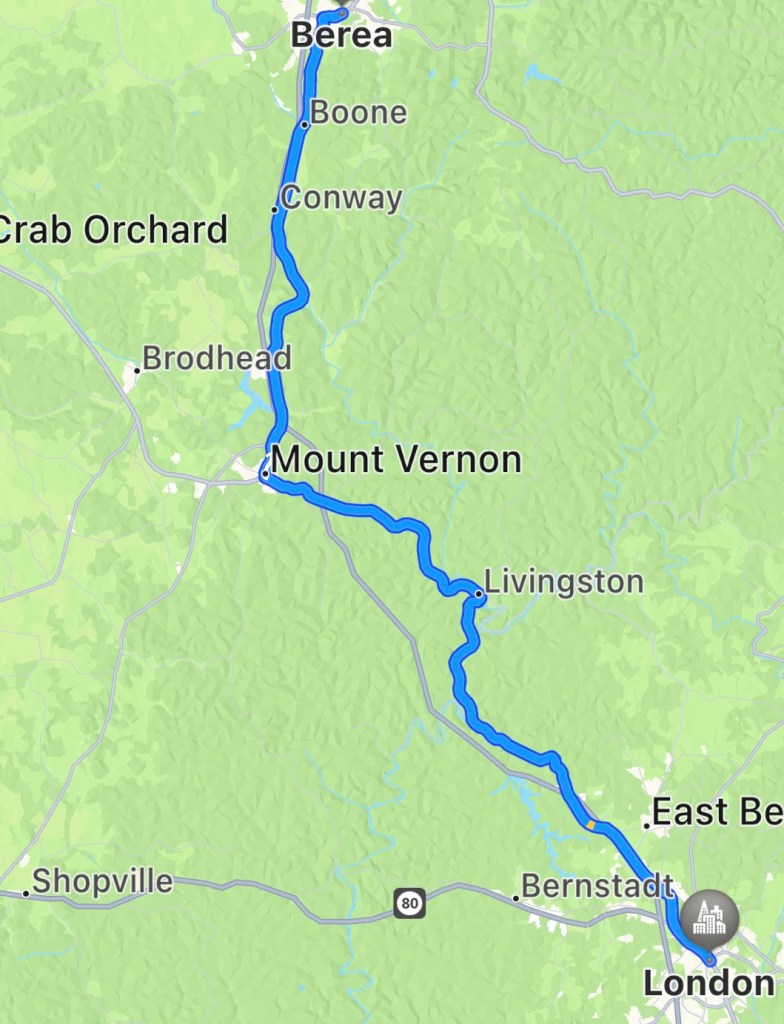
The road crosses the Daniel Boone National Forest which covers 21 counties of Kentucky with more than 708,000 acres in its glorious free space (once again thanks Big Govt). I pass through Livingston in Rockcastle County which is one of the park’s Trail Towns, where you can expect to find supplies and guides and food for traversing this rugged park.  

My trip is quiet and even peaceful as few vehicles are heading my way, and likely because of the next door interstate, no 18-wheeled trucks roar up behind or on side of me, menacing my little van.

Once in Berea, I spy the farmers market with its gorgeous new pavilion which is easily seen from all directions. From the road, I can see the vendors are still setting up and, knowing how anxious it can make them to have someone wandering around before they are ready, I instead take a right and head downtown, feeling confident I will find a good coffee somewhere near the famed college. More indications of Big Government doing its job appear on the way, including remodeled bridges, pedestrian crosswalks, smooth streets. I spy a jumble of signs that indicate culturally significant activities to the left, so I turn into an area named Artisans Village District which is a cluster of little cottages with retail signs designed to pull visitors looking for culture and craft. 

Not much going on there yet, but I find the open bagel and coffee house on the main road on its edge and get a honey wheat with maple bacon cream cheese with a good espresso and sit down in its modern, well-lit and friendly space.

 The line grows as soon as I sit and I note the number of families and working men and women already up and at it, all smoothly ordering a NY style bagel and artisanal coffee in Kentucky.

I finish my bagel and head to the market as it is opening time. I try to get to a market at its opening, and make some mental notes. Most of those things I look for do not have a right or a wrong way, they just reveal its culture. Things I look for:

Are all vendors set up by opening time?

Does the market indicate opening time with a bell or other manner?

Does the market have a welcome tent?

Are vendors offloading (walking their items in) or are their vehicles directly behind their table?

Is signage uniform or does it vary table by table?

How much diversity is there among the people vending? How about in its shoppers?

Do any vendors or the market indicate they can process government benefits like SNAP or FMNP?

Are there craft vendors?

Are there hot food vendors?

And so on. The list is extensive but with practice I have found I can note many things without being overt about it. Most of what I learn comes from the conversations with market manager and vendors and this day was no different.

I started by having a pleasant chat with its manager Olivia, who had a beautifully set up market welcome tent all ready to go, with SNAP signage very noticeable for those seeking to use their benefit dollars there. I assume that the tent with its Doubling Dollars information printed on it is likely given to the market by the entity that manages the program in Kentucky. 

The overall impression of the tent and of the market is one of extreme tidiness and with good sight lines.

I start at the right row of the 2 parallel rows, with a woman selling a variety of goods including persimmons, so I engage in a conversation about the varieties she sells. She knows a great deal about them and we talk about how shoppers now ask for them and how they are a food that is likely seeing a resurgence because of farmers markets (since so many varieties do not ship well to be able to sit in grocery coolers for weeks at a time.) When I ask, she (like most of their vendors) agreeably takes cards for payment for her goods. Having the ability to to swipe credit and debit cards has only recently moved to almost universal acceptance among vendors at many markets. Where it has happened all note the COVID era of risk mitigation as its cause when some markets were unable to use wooden tokens or were forced into drive through sales or unable to open at all. In all cases, farmers had to find an added method of processing payments and did. Now market managers happily tell shoppers to go through the vendors to swipe credit and debit even while SNAP is usually still handled at market level to everyone’s appreciation.

I see a friendly couple next to the persimmon seller who also have a variety of goods on their tables, including micro greens and beautiful tiny turnips. I would dearly love some micro green sprouts but being on the road I worry I wont be able to keep them safe in my coolers. I am regretfully about to turn away when I realize they also dehydrate and grind their microgreens into a powder, which I can store. I once again ask if I can use a credit card- they immediately answer yes but then cannot get a signal to process the card. The farmer grows anxious with the delay, although I am not as anxious. He mentions the signal is intermittent at this new pavilion and we discuss whether the city or the market can and should add a signal strengthener nearby. I finally root about my wallet to find that I have the exact dollar amount in there to cover my purchase; I offer it instead and he asks me if that’s “okay” to take my cash. “Of course” I answer and I silently turn that exchange over and over in my head because cash being used as the secondary payment  method is such a new development between customers and vendors at farmers markets.

I walk past other vendors beyond theirs but I keep my distance from the tables because I can see that they have vegetables I am unlikely to purchase. I do, however, catch their eye and say hello and, when I feel moved to do so, comment on their table or its products. I know that being ignored when selling in an open space can be uncomfortable and even painful and that a friendly hello can make a quiet sales hour seem slightly less scary.

I speed up to get to the second row and note that this has a slightly different feel with (seemingly) more younger or newer vendors on this side. (Which makes me wonder if vendors choose their own space or are assigned).

Close to the middle of the row, there is a kombucha and nutrition bar vendor with a tap encased in a beautiful wooden dispenser for cold brew and samples of kombucha. The vendor tells me the vendor 2 tents down (who is seated to the back working on other craftwork while someone else handles sales), made the display. We have a longish discussion about markets and intermediate sales for their business. They tell me they sell to a number of small businesses in the area but expect to maintain their farmers market presence to support farmers and to grow their business there, maybe even taking on more farmers markets in the future. 

I share tidbits of my research on markets including that many of the first “modern era” (1970-) markets began in university towns like Berea because the back-to-landers decided to stay  and grow organic food, so then created many of these new “grow it to sell it” markets; I say that it is interesting to me that markets in these towns continue to impress me with how they hold and even grow markets’ role in improving sustainability and introducing the area to products like hers Her quiet and firm reply that “it shows they (markets) are really about the shared culture” strikes me as rich with simple truth as we stand in an open pavilion on a cold fall morning in a town of 15,000 or so.

Finally I realize I am blocking a very polite shopper behind me and move away. I catch the eye of the woman I had purchased the persimmons from and smile from afar in thanks as I head toward my van to drive it to the next town.

2022 Proclamation for National Farmers Market Week

Summer Dive into Data II

Understanding Consumer Interest in Product and Process-Based Attributes  for Fresh Produce (2008) Authors Bond/Thilmany/Bond

Abstract

“The choices consumers make about fresh produce, such as where it is purchased and what they are willing to pay, are likely influenced by a range of private and public attributes. This study uses factor and cluster analysis techniques to explore the preferences of consumers who responded to a 2006 national survey to determine the dimensions over which consumers make purchasing decisions and to identify key market segments. Analysis is based on a variety of survey questions relating to preferences for various fresh produce traits and process attributes, as well as willingness to pay for a subset of these attributes. We find that although there is only a small degree of correlation between tested variables, four consumer clusters can be identified as market segments: Urban, Assurance Seekers, Price Conscious Consumers, Quality and Safety Consumers, and Personal Value Buyers. Each cluster values both private and public attributes, though with differing intensities and focus.“

————————————————————————————————

This is the type of data that is so very helpful in refining messaging. Each of these clusters has a potential connection to farmers market shopping and by using their defined values, a market might just attract a new cluster of shoppers.

The paper covers 4 clusters:

Personal Value Buyers (PVB) 27.9%

Quality and Safety Consumers (QSC) 26.3%

Urban Assurance Seekers (UAS) 23.3%

Price Conscious Consumers (PCC) 22.4%

______________________________________________________________________________________________________________

PVB

•Older, above-average educational attainment, relatively high incomes

•They value consistent availability and variety

•Do not value organic production, traceability, or relationship with producers as high as other groups

Potential Message: “The farmers market has x varieties of apples this month, including hard-to-find xx variety“

______________________________________________________________________________________________________________

QSC

•Lower to middle income, lower educational attainment, more concentrated in urban areas in South Atlantic and Pacific regions of U.S.

•They rank the importance of local production higher than the other clusters but choose indirect sales (grocery rather than farmers market or stands) for that local production

•Perceived safety is highly valued

Potential Message 1: “Fewer hands touching your food”

Potential Message 2: “The farmers picked fresh this morning.”

______________________________________________________________________________________________________________

UAS

•Relatively young, wealthy, more likely to live in urban South Atlantic and Pacific regions of U.S.

•Largest expenditures on produce

•Greater willingness to pay for organic, country of origin labeling

•Interested in potential public benefits

Potential Message 1: “Markets increase civic participation”

Potential Message 2: “Our market offers a children’s program that rewards kids for learning and participation.”

Potential Message 3: “More than half of our farmers offer certified organic products”

______________________________________________________________________________________________________________

PCC

•Lower-income less education, young, evenly distributed across the U.S.

•Greater willingness to pay for higher nutrients (enhanced Vit C) and locally produced 

Potential Message 1: “Local is our primary purpose.”

Potential Message 2: ” Fresher is more nutritious”

______________________________________________________________________________________________________________

Summer Dive into Data

As I mentioned in my previous post, I am on my way to Oregon to join the FSLN National Gathering Monday – Thursday this week. While there, I’ll be meeting up with inspiring leaders who can share ideas for how I can better serve the front-line direct marketing producers, market and CSA organizers, and my own FMC team.

On the first leg of this many-phased trip, I read two recent research papers, 1 on farmers markets and 1 on consumer interest in local food, and immediately found some very interesting information I can use in various projects. I’ll share some here in the hope it is also helpful to others.

The first was a research paper by John Metz and Sarah Scherer published in 2021 titled “The Rise and Decline of Farmers Markets in Cincinnati.” This is a great, well-researched paper for anyone wanting to understand the history of that region’s markets, and also for those interested in data on market closure factors in the area.

Methodology

They did site visits, interviewed managers, and recorded data on products sold, businesses location and gathered other information from informal conversations with vendors. They also consulted another unpublished local survey. (Twiss. Green Umbrella 2016)

Market organization

For this study, the researchers defined farmers markets as having 2 or more farmers selling their own goods (using the USDA’s loose definition) and added the stipulations that farmers at these markets must have ¼ acre or more in production for local sale. They also excluded sites that were the actual production site, defining those as farm stands. They defined Saturday markets as different markets than those that had weekday markets operating at the same site, resulting in 37 sites operating 42 different markets.

Numbers

The Greater Cincinnati market grew from 21 in 2004 to 41 in 2012 with a “25 increase in 2005 and a 35% jump between 2009-2010.” The number peaked in 2012 and then fell 17% (n34) by 2018.

From 2005-2018, 42 new markets opened but 25 closed in same period for a 60% reduction.

During the 2005-2018 era, 71% of the closed markets operated 3 or fewer years. In contrast, 1975-1989 era, 32% (n7) of the 22 closed in the first 3 years.

Vendor-Led and Community-Led

The authors classify markets by its decision-makers, with “Farmer-Focused” and “Consumer-Focused” (or, in the language of a report they cite by Gantla/Lev from 2015, Vendor-Led (VL) and Community-Led (CL)*. I prefer the Gantla/Lev language so I’ll use that here).

Metz and Scherer concluded that the founders’ vision for the market created and continued the market’s decision-making structure. That is in line with the Market Eras Research that I have shared and continue to refine.

Among the Vendor Led markets, 11 of 13 were begun by farmers or Extension. The authors define this type as existing to primarily provide farmers with venues to sell produce. The VL markets had fewer vendors than CL markets (a mean of 6.8 vs 19.4) and the only items that were not produce tended to be jams, jellies, relishes, and baked goods prepared by the farmer vendors. Market managers had fewer responsibilities since these markets tended to offer fewer activities and rarely to conduct data collection (sales, visitor counts, or shopper surveys.) None of the VL markets had a website during the period studied.

12 of the 13 were managed by volunteers, often running more than one. So of the 13 markets, there were only 7 managers. Most were over 60.

Among the Community-Led markets, only 2 of the 24 were started by farmers. These markets had slightly varying goals for their existence including providing healthy food to neighbors, helping farmers make a better living, but also included community development goals as well.

These markets had many types of prepared foods and usually had music, and other activities. Half of these markets also had crafts but allowing crafts is also definitely a subcategory among CL markets as the other half did not allow them at all.

Many of these markets did collect sales (7), shopper counts (12), and shoppers surveys (10) at some point in the time period studied although few did it consistently: only 3-5 of the 37 did consistent data collection in the period studied. And only 3 managers reported collecting daily sales data with another 4 estimating sales annually.

13 of 24 of the CL markets were managed by volunteers although 2 of these volunteers did receive a (small) stipend or the market waived the manager’s vendor fee. Of the 11 that received some sort of serious compensation, only 4 were full-time and had other responsibilities besides managing the market. The researchers analyzed that 6 of those 11 received between $17-$23 hour.

20 of the 24 managers were under 60.

All managers for both types identified as white and 31 of 37 as female.

This research’s conclusions as to why the Cincinnati markets closed:

  1. Farmers markets exceeded current consumer demand
  2. The unexamined assumptions and unconscious biases of market operators who were white reduced the markets appeal to Black, Indigenous/Native people, and communities of Color.
  3. New technology in food retailing that encouraged payment options and online shopping was (is) still difficult in farmers markets
  4. Shortage of farmers
  5. Poor management of market

One thing they did NOT find as a cause for closures among this area’s markets was internal competition from other markets. Their analysis suggests that of the markets that they studied, few of those that closed were within the competition range of other markets. They also note that the number of “Tailgate Markets” closing from 1985-2004 was matched by the number of “Non-Tailgate” new markets opening.

Such a valuable report! I appreciate how it was organized and the core data it offers. They cite our Pittsburgh market report from 2019 which is not surprising as the analysis is presented in a similar fashion. Their conclusions also reflect many reports that rely on historic data from farmers market eras and the characteristics of market types –  including the VT report from my colleague Jean Hamilton that they also cite.

Essentially: markets struggle if they are not organized collectively, if they do not fight for farmers to remain at their center, if they cannot keep a consistent, paid management team, and if they do not employ realistic methods to analyze the external and internal factors that impact their existence.

All of that shows the type of deep support we need funders to start to offer market organizations – which means beyond program $$. The program partnerships are extremely welcome but they come with the expectation of a lot of added work that is not always supported. We need funders and policymakers to understand the underlying mission and operations of each organization and form long term partnerships to maintain and expand those. To make that happen, market operators need to share these reports, collect their own and stop hiding the hard work they and their vendors do.

Footnote *Institution-Led is Gantla/Lev’s 3rd category and defined as markets run by larger orgs that do more than operate farmers markets.

Off to Oregon for FSLN retreat, then….

hello strangers! I promise I am back to writing regularly for this blog, now that the mad schedule over the last few years which includes FMC GusNIP TA facilitation structure, responding to the early COVID needs among market operators, the work to help get the World Farmers Market Coalition rolling, and also FMC’s new grants/project work underway and (excellent) staff almost all hired and onboarded.

FMC is hiring an admin position, 2 paid interns, and will likely have one more job posting in the next month.

So if you remember, I am on the road most of the summer, partly because of the hurricane trauma we live under here in New Orleans, and because since FMC is a remote workplace and I can go see and talk to market operators and farmers.

That travel really begins next week with a trip to Oregon for the Food System Leadership Network Vision and Strategy Event. I am excited to be attending this event, as I have long been associated with the Wallace Center both in my consulting for markets and in the support that Wallace Center offered FMC way back in 2006-2008. (The Resource Library and the FAQs on the FMC site were partially built by Wallace Center staff and contractors and were offered to FMC to help get the farmers market-specific website up).

If you will be at the retreat and are a farmers market operator or advocate and want to talk in person, please message me on the Whova app.

And if you are in OH, Chicago, VT, Pittsburgh, or DC and are a farmers market operator or advocate and want to talk in person message me at darwolnik at gmail.

Please add your market or organization name in the subject so I can fish it out of spam!

If I add more locations to my travel, I’ll let you know.

where ya been?

yeah I know- i’m the one who has been absent from my own blog! I have a LOT to share with my market community and will be posting regularly this summer here.

For now, I’ll share news of the TentTalk that I did with the FM Pros team; truly truly, I was honored to be asked, of course am horrified by the sound of my voice and my run-on sentences- but gotta admit- it sounds like me.

It will go live May 31st and if you are not subscribed you should be- its the best podcast in the market world.

and my extended interview (where Catt and I discussed market music licensing issues!) will run in their members monthly email the first Monday of June.

Flagship Market begins a national search for a new Executive Director


Today, Market Umbrella is entering a new and exciting chapter. The organization’s next Executive Director will have the opportunity to build upon Market Umbrella’s success to-date and grow the organization’s impact as a leader in farmers markets and food access. Key opportunities include deepening and expanding Market Umbrella’s community presence through focused relationship building and innovations to the market experience, as well as building Market Umbrella’s regional and national brand and stature. Leveraging the strong name recognition of the CCFM and the historical effectiveness of many of Market Umbrella’s programs, the new Executive Director will be in a position to spearhead strategic priorities that incorporate programmatic and partnership-based incubation of ideas. These strategic priorities will be grounded in and responsive to the evolving needs of the Market Umbrella community, particularly regarding racial equity and the impacts of the pandemic. Working in partnership with Market Umbrella’s dynamic Board, staff, and network of ecosystem partners, the next Executive Director will be a leading actor in promoting excellence for the CCFM and in advancing the organization’s mission of cultivating public markets for the public good.


https://worknola.com/job/328024/executive-director

Salvador on Plantation Economics

‘Our Food System Is Very Much Modeled on Plantation Economics’

And in the United States in particular, because of our history, not very long ago, the people that performed all of the jobs that I just listed right now, or their equivalents, those were performed by enslaved people, people whom we forced to do this for no pay, for no compensation; we appropriated their labor. And that era is not that long ago. As everyone listening knows, emancipation didn’t occur, at least officially, until 1865. But the fact is that emancipation never really came to agriculture, in the sense that we still don’t pay the full value of the labor that’s required to make the entire system work.


We need a food system that is fungible, that has redundancy built in. The so-called efficiencies that have been built into the highly specialized industrial model that we have right now, we are now learning, do not serve us when you have a situation where a single thing that is unpredicted takes out one pillar of the food system, and then the whole thing comes crumbling down. That’s not the kind of food system that we need. We need one that is more distributed, meaning that there are more nodes within the food system that can respond in the volumes and quantities and the formats that are necessary for where people are going to be using this food.

Now, a very good example of that is that the farmers that are doing well right now are the so-called small-scale family farmers. These are folks that produce in volumes, and who redistribute in local and regional networks, where they can respond very quickly, to where the schools are now becoming redistribution points for SNAP, for instance, or for school food that needs to be picked up by students that otherwise might not have access to that food, because they’re not coming to school every day, and so on. Or through farmers markets, another very important redistribution method which is very fungible. So we’re learning that that’s actually what works; we need to invest more in these kinds of highly distributed systems, and less in the highly concentrated systems.

Drive-thru farmers market report for 4/05/2020, New Orleans LA


Today my local farmers markets reopened as strictly drive-thru. No question that it was a great success in terms of the order levels (reported by vendors as I motored through) and the appreciation from shoppers. In addition, the staff looked MUCH more relaxed than they did with their once-only, timed entry, open-air market pilot that happened in mid March.

Our Baton Rouge-based Red Stick Farmers Markets are doing drive-thru markets as well, but slightly differently, as it is not entirely pre-order. Keep an eye on the BREADA website to see what Copper Alvarez and her team come up with next.

CCFMED at entranceDrive Thru

Executive Director Kate Parker at entrance of today’s market

For some background:

The Crescent City Farmers Market in New Orleans LA is normally held in parking lots around the city 6-7 times per week year round (one or two locations have been seasonal, and one recently closed for good, but they are almost always running 6 markets or more per week.) This entity’s parent organization, Market Umbrella,  has long been known for their innovative work to increase access and provide support to regional farmers and small businesses.

The CCFM vendors are almost all only direct-to-consumer businesses with a smidgen of side-door restaurant sales, although most of the chefs around town simply come to the market and buy what they need. From my experience as Deputy Director 2001-2011 this is because most of the vendors are not able to do delivery or even invoice sales because they are so small, so understaffed, or so far away. After all, this is a commodity-driven region that has mostly resisted building support for DTC farmers. And yes, the Deep South does seem to be even worse than most areas across the US.  So even in good times, its pretty rough for these farmers and businesses to find resources or support to pivot or to do multiple types of channels.

The market organization decided that walk up markets would not work for them for the duration of this emergency, for many reasons I am sure. I believe that each organization gets to decide exactly how they will handle this moment. Of course, this aligns with my long-held market TA response about which rules a new market should adopt: I answer (probably maddeningly) “use those rules that are understandable to your team, to your vendors, and to your shoppers and stakeholders. After all, you need to defend them and explain why you have them.”  So the same thing goes for this moment too. And all of that market context around rules has to co-exist within the rules (if they exist) set by your local municipality, county, and/or state.  As I’ve discussed elsewhere, for markets our usual go-to agency is agriculture, which  in this case has been mostly unable to do much to help us, as this is not a food-borne virus.  Instead, it’s been public health or disease control making the decisions,  agencies which often have less awareness or fewer partnerships with  open-air farmers markets and so less understanding of our protocols.

So that’s number one. Do what is best for your organization and your vendors. Just be transparent with your shoppers and stakeholders exactly WHAT that decision is and HOW it was made.

Next, how to order: First, it’s important to share that this very sophisticated, well-advised, well-staffed organization attempted an preorder app a few years back and it was not a success, so they shelved it.   After they closed their walk-in market a few weeks back, they instead began by partnering on a box program with a 3rd party entity where the local items are pre-selected and can be paid for with SNAP or other cards. It costs 40.00 and is also available for delivery. I have only seen a few pics and it looked a little light to me, but that just may be how the pictures have been taken. I think many regular and new market shoppers are perfectly fine with this box, but it seems that many others were not and that many of their vendors were unwilling or unable to sell this way. I am one of those unwilling to do a preorder box and instead I reached out to those vendors I usually purchase from and made arrangements with them whenever possible. I also took advantage of some of these other non-market choices below:

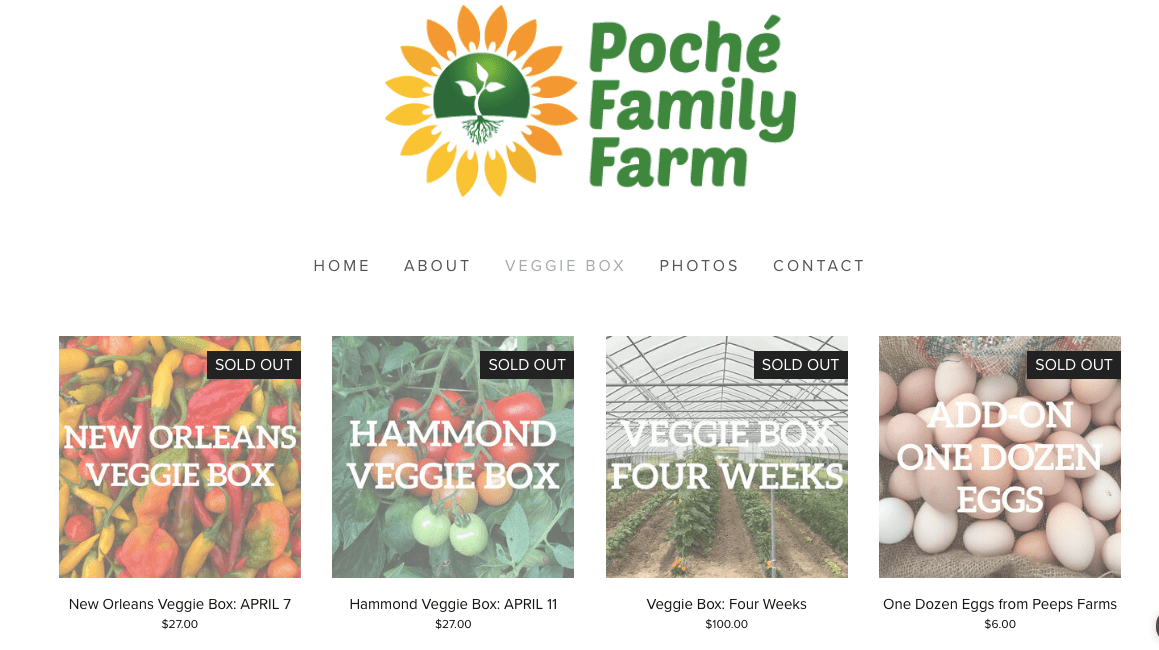
  1. A couple of market vendors began working with local chefs to sell a box directly from only one farm at their restaurant:PocheFMboxesApril
  2. Another version has been coffeehouses et al adding local produce to their long list of items they will pack up as a preorder. My local heroes here are Good Karma Cafe because they offer coffee, tea, their tinctures, their prepared items, and are selling the produce without asking any fees from those farmers. They need the local goods themselves for their prepared items, and they feel they benefit by adding customers who want a little local produce. And they truly believe in the quality of locally grown items. There are others around town doing something similar from what I am hearing.
  3. The local news featured a farm which usually sells only to restaurants selling boxes to walk ups outside one of those shuttered places. Not sure yet how that is working but it seems to be doing well.
  4. We had a few (and I mean a few, maybe 1 or 2)  farm aggregators selling to consumers already running successfully with farmers Kate and Grant Estrade from Laughing Buddha Nursery as the model that everyone else should learn from. (LBN is their longstanding retail nursery shop and their farm is called Local Cooling Farms.) They tell me that demand is way up, and even though a few of their usual farmers are using one of the other above methods and don’t need to sell through LBN as of now, that allowed them to pick up new farmers. And instead of doing their usual 6-7 drop offs at their hub partner sites around town each week, they are selling only at their nursery which has refrigeration and allows them to set up contactless pick up. (This couple should be doing monthly webinars for DTC farmers and maybe, sooner or later, they will have enough time to do just that. I’m a big fan as you can tell.)

Okay, so how well did the drive-thru market work?

At the beginning of this post,  I mentioned the level of vendor sales channel diversity because it matters.  I understand via a quick convo with market staff through face masks that getting this small group of vendors ready for this was a HUGE undertaking, which is no surprise to me. The vendors that agreed to participate were listed on the organization’s website with the items they would have, the cost for each, and the way to order from each individually (phone or text or email) and the manner to pay (Paypal, Venmo, manual card entry over phone, etc.)

CCFM website DriveThru

I say small group because the number of vendors at this market were far fewer than their usual open-air market. I understand that some told the market “I can’t sell enough to do pre-orders, so no thanks.” (And again, every vendor ALSO has the right to decide what works for their business without scorn, but I do believe when they hear how well this went for those this week, more will want to try it. I can tell you that this reticence may be partly based on their experience with a half-dozen 3rd party aggregator projects around town over the last decade which all started up to great acclaim and then all shuttered, often still owing them money.)

Other vendors told the market casually that they would take try it and take orders over the phone not knowing how many people would call in the first few hours! I think part of this rush to order was that news of this drive-thru came to most through the local media- and only a few days before the actual market.  So that type of publicity made it much bigger than it might have been without. (I might suggest that small less-staffed or experienced markets try week one through just reaching out to their email list at first if possible. Maybe ask local writers to hold the story until after week 1 is in the books-that is if the market is confident enough in their list.)

As a result of the great publicity, and the deep attachment to this market with its 25 years of service, vendor voicemail mailboxes were immediately full. And when  vendors called folks back, I’m not sure that each figured out they needed to do it in order of earliest calls to the latest, so it may be that some of those who called earliest lost out. (I think that happened to me with one vendor. And no biggie. I’l get them next week).

Some vendors did texting which seemed to work pretty well but to work it needed to be confirmed and sent to payment immediately. I tried two that were listed as text orders and only one called back. The one who did, did it exactly right- texted me the total, told me their Venmo account and I paid immediately.

Clearly, this requires that there is one person handling orders for each vendor for the open window period.  And that is easier said than done. (I’ll do another post on vendors soon with some feedback I received. Let me just say that the few I had time to answer me were very positive on this as a short-term solution during this pandemic but clearly exhausted from the added work. One vendor told me on camera he came close to his usual Saturday market in terms of the number of sales. He had 92 preorders, and he estimated that he usually gets 120 or so transactions over 4 hours at the Saturday market  but thinks he didn’t meet or exceed his usual Saturday only because “his system wasn’t ready for this.” And he promised he will get better at it. I’d also suggest that the anecdotal data from markets across the US seems to indicate that the average sale is higher than the normal market in present circumstances. Likely because people buy more, and we are also hearing that meat vendors are doing tremendously well.)

Location

In terms of where to hold this market and when, the organization had some (I assume informal) help from City Hall. Most of their current locations were not going to work as a drive through; sadly, one of their best locations has had too many cases of Covid-19 at the assisted living place that is situated on the same property to hold this there.  City Hall employee and engineer Jennifer Ruley, who has been working on safe street programs for almost 20 years stepped up; she personifies what I wrote last month about finding partners for this moment. She and the Market Umbrella E.D. Kate Parker were well acquainted from neighborhood work that both have been doing for decades. The team chose the parking lot of the most popular and community-minded po-boy* shop in town, which has been closed for the duration and is right next to the new multi-use greenway that MU wanted to use but was not available because of other uses. Jen met with market staff and Parkway owners on Saturday to think through traffic design. See their map below.

IMG_2642.jpg

Lafitte Street is under construction as part of the Greenway, and has houses on only one side. It has 6-7 side streets that dead end into this street and two major avenues on either end.

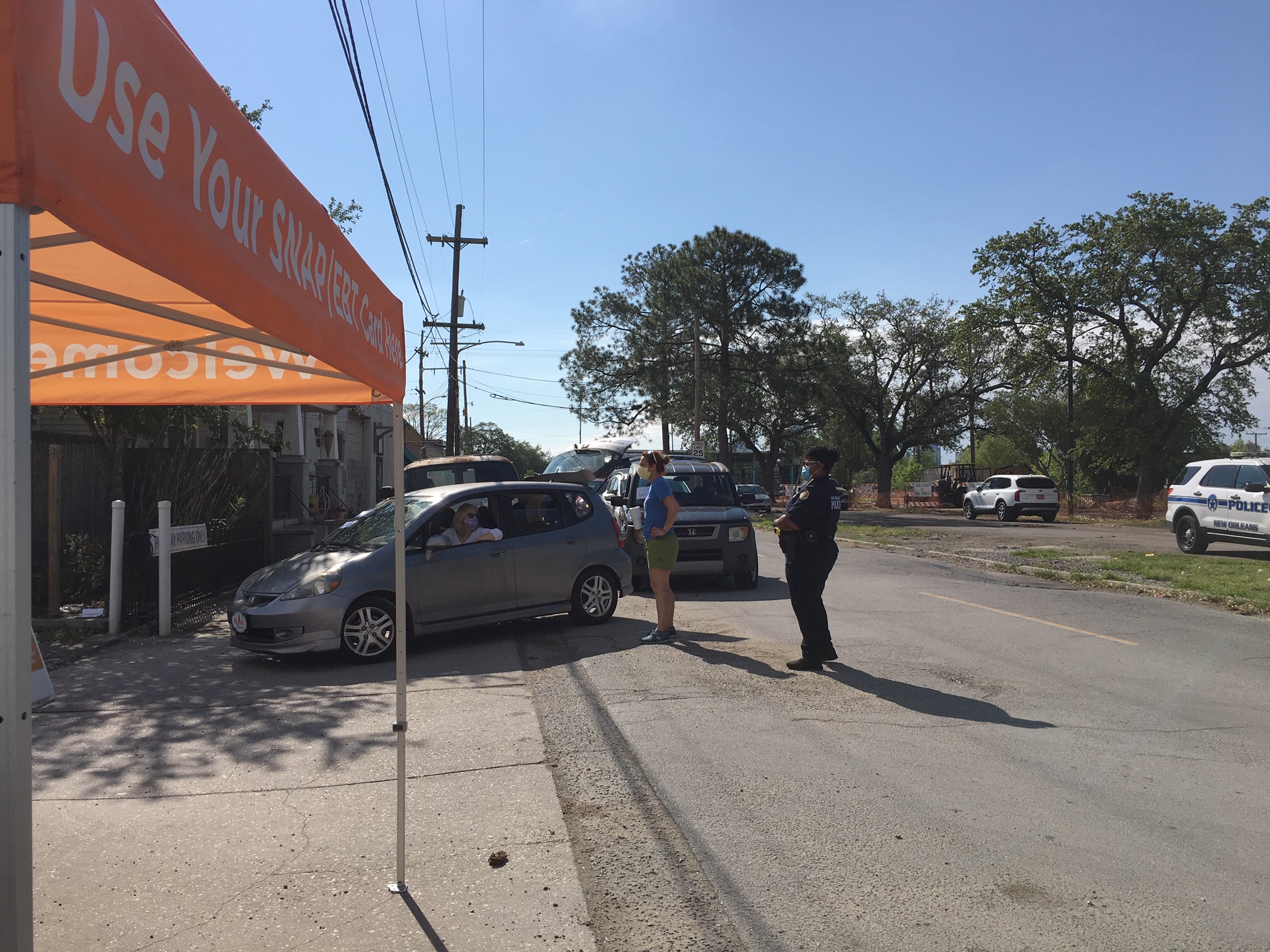
CCFMDT_Police directing at entranceexit

Orange was entrance, green was exit.

All in all, I’d say that it worked beautifully – up to a point. The early problem that I saw was that a few folks came down the side streets and poked in the line which, honestly, most of those already in line let go and didn’t get all screamy on them; after all, why? their order was already made. And really, most shoppers politely went to the end of the line without urging.

The other traffic issue that can be easily corrected next time was that the police should have closed the street off to all other traffic. Folks were turning on to the street unaware of the market, meaning to simply drive somewhere and often got caught up in the crawl. Additionally, the street should have been made only one way towards the market for these hours, and all shoppers directed to the far end avenue (Broad) to turn on to Lafitte. Again, all easily fixed for next time.

Yet this location seems like it is going to top out around 16-18 vendors and so the question becomes does CCFM add another location while keeping this one for the duration for that number of vendors, or just go find one big spot for all of their drive thru markets and vendors?  Seems like some of the vendors feel like 2 locations a week may max their ability to take orders and to take those, but they may feel differently as time goes on. If they add a second location what would the criteria be? My guess is easy access from main streets and from many parts of town, large parking lot with a fence or barricade around it to maintain safety and keep pedestrians out, in or near zip codes where there is density of drivers/shoppers, a well known location, vendor restroom access, and a partner/host to help.

Once in line, one CCFM staffer came down, said a cheerful hello and explained how it would work, and asked shoppers to get their trunks open before entering. Another staffer wrote the shoppers name on a piece of paper that was then stuck on the outside of the window so vendors could see the names and get their orders up.


The shopper drove in, made the circle with vendors checking your name and putting your orders in the truck. The last would close it.

I understand they figured out how to do some SNAP sales, but as I didn’t bother them any longer than I had to so I’ll have to get more info later. One way this may work is for those shoppers to have their pre-orders total written out, separated by  vendor and swipe their card for the total as they arrive and attach the paid receipt on the window for each vendor to see it was paid. Or have them place the orders as everyone else does, and the vendors to pack those and hand them to the market org before the bell rings to process on the machine in another line.

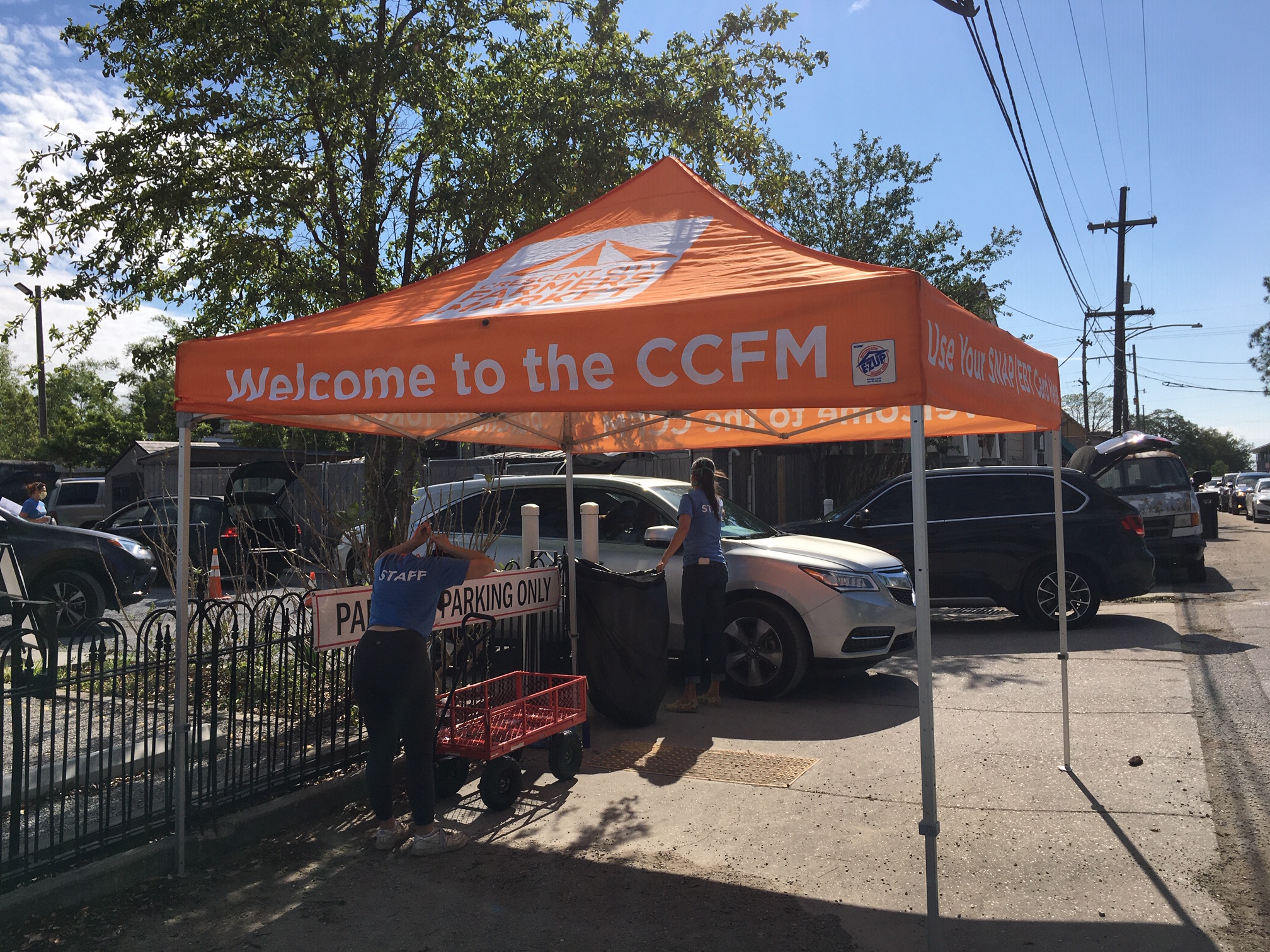
CCFMexitStaff takepaperoff windshield.JPG

CCFM tent at entrance/exit which (maybe) could still process SNAP?

a few issues:

Long market

Took longer than the 4 hours it was scheduled. There were timespans with long lines and then timespans with very short ones, so staggering the arrival next time may help.

There were too many vendors without PPE at all, no gloves or masks. All CCFM staff were equipped and had their market t-shirt on to make clear who they were, led by their E.D. who again, was out there at the entrance checking on everything. I am SURE that CCFM strongly suggested that vendors equip themselves but clearly too many had not paid much attention or could not find any.  One idea that I will float via my own social media  is for fervent CCFM shoppers to purchase cloth masks made by locals for their favorite vendors, and maybe get them a pair or cleaning gloves to wear if nothing else.  Since no money is changing hands, there is little need for dexterity.  I am sure that many of your shoppers would be happy to help get masks made and could possibly get gloves and sanitizer for your vendors too. (Update: within 15 minutes of me posting it, local people are getting masks made for these vendors! Update #2: NOLa folks made almost 200 masks for farmers which I have given to Baton Rouge, New Orleans, and Covington farmers markets.)

Big purchasers versus small. Some cars were stopping at every vendor and some only were picking up one or two items.  (It may work to stagger those by the number of vendor pickups one has, so that those with fewer transactions come later. Still to do that would require a LOT more work for the organization and it simply may not matter when vendors get better at this.)

How to check orders. Vendors were madly looking through page after page of orders, which didn’t seem to be in alphabetical order. (It might be helpful for the market organization to offer a simple spreadsheet that they can use for their orders and/or then print them out for everyone in order.It might also help for the organization to also have shoppers – when they arrive – list the market location number of each vendors who they had an order with, so if vendor #4 isn’t marked, vendor #4 doesn’t need to look through their list.)

Impact on the neighborhood. This needs to part of the measurement for any market: the positive and the negative impact on that area. Too often, markets only measure economic impact- which should always be measured – but also should also view the effect of noise, cars, trash, and other impacts on that area. These neighbors, without warning, had a line of cars belching exhaust into their houses for a few hours at a time when the weather is so beautiful that every window is probably open. It may help to stagger shoppers by time, to add another market day in another area, or to simply ask folks to turn their car off and let the police move clusters of cars at a time. I’ll find out more about how many cars came through but it sounded like the line was down to only a block long after an hour or so.

CCFM line in first hourDrive Thru

Costs. The design did require more staff than a regular market day and clearly a lot more planning was required. It did require police which I would assume will have to be reimbursed.  And the fees per vendor are assessed at a flat rate in this organization;  as the numbers of vendors were lower than they would normally be during this extremely busy market season**, they will have less income there. I will say that the partnership with Parkway Bakery’s free lot was inspired because they also came and helped, AND gave each car a free bag with a roast beef po-boy, local chips and water. And they have a very well-tended lot.

ParkwayGift

local chips, roast beef po-boy, branded memo pad, paper hat,  and a water bottle.


All in all, I hope these vendors and this staff sleep well tonight, knowing they have pulled off an extremely delicate and complicated market day. And that we deeply thank them.

I’ll let a shopper give the last word with what he told me after he picked up his items:

“It is a blessing, no matter how long it takes.”

AngelinaCCFM

Director of Markets Angelina Harrison watching it all.


**We’re in the middle of berry, lettuce, and just beginning tomato season and the weather is great in March and April here, usually low humidity and little rain which is holding true this year.