As many of you have heard, your national market support entity, Farmers Market Coalition, the organization that I have been attached to for the last decade as a staff person, and a half decade before that as a market leader supporting its development, is rethinking its role and structure.
Part of that rethinking means the elected board made a recent decision to put all staff on temporary furlough for at least January 2025, leaving just our Interim Director working to catch up on invoicing and administrative changes.
As painful as it can be to be open about the issues we are dealing with, FMC needs to do what we urge markets to do, which is to be transparent about development plans and challenges.
I have heard from enough markets and network partners that they believe FMC is essential to the field, and vow to be patient for its journey to find the right admin and funding structure, all of which make the idea of being laid off a little less awful.
Still, pulling off a rework is a HUGE task. I hope we can. I do think we can.
While I am off work at FMC, I am focusing on the Market Eras article and then prospectus for a book.
Expect to see more here about that and my own consulting for markets in the next few months but I promise to also share whatever FMC builds for its future when I am able to speak on its behalf again.
Finishing up 2024 work this weekend, to then preparation for supporting organizers amid the bookends of community and chaos in 2025.
But do not expect a deep dive in this post about what may happen in the national political arena around food and farming- at least not yet. Still time to consider plans, still time to replenish….
But in the meantime, here is what I have been saying in the past few months to market organizers that I am in contact with:
Leave blame and shame to other arenas.
Markets need to be centered as places of belonging and connection.
New Orleans LA Crescent City Farmers Market December 2024
Focus on big goals of system change by asking the market organization to consider:
How is the market moving the dial on farmland preservation? How is that work measured?
How is the market including marginalized people of color in its work- and not just as consumers, but as producers, as advisors, as mentors?
What about rural (if the entity is overtly urban focused), or urban (if overtly rural)?
What would that add to your work and to your market?
Does your team and community know the history of subjugation and of centering whiteness in your area?
Does your team and community even know the recent history of market culture (1970-) in your area? Why these markets were founded? Who founded them? How is the market still honoring that history and still intentional in its design?
What external pressures are limiting your work, and who and what processes might help you change those?
What internal structures are limiting your work, and who and what new processes might help you change those?
How are you preparing for interruptions to farming or markets, whether through civic or climate instability?
What is the big idea for your market that you would like to tackle in 2025?
What keeps getting moved off the to-do list every year?
How can we include more people in our work lives, to bring new voices into the work, but also to make sure we are being held accountable and supported.
Can the urge to wait for “perfect” be ignored in favor of what is possible and practical?
I’m out on my “summer tour” of the northeast part of the US leaving my beloved New Orleans simmering and hunkering down for hurricane season, one that is projected to be an extremely active one.
When I began to regularly (around 2009) to leave for weeks and then for the summer, I got a lot of raised eyebrows and jokes about it, but those have completely stopped in more recent years. My take on that is that all New Orleanians are now accepting of the fragility of our coast, and constantly preparing for interruptions that come with the loss of land and the rising temperatures of the Gulf. So now, leaving for a time is one of the new normals. No more friendly texts of “wimp” allowed.
What has also changed is the number of natural and civil interruptions happening in the other places that I visit.
In the areas that I was in just over the last series of months, we watched the Vermont and Kentucky floods, the Canadian wildfires, and many other localized disasters that elicited organizing from one or more market organizations.
That organizing was rarely to raise money or awareness for the market entity, but rather, focused on their role as conveners (using their site for recovery), as analysts of the local/regional food system for media or policy makers, and/or as pass-through entities to get resources to their vendors.
The very nature of open-air markets allowed these varied and immediate responses, since most are without infrastructure and therefore have no physical damage to their own organizational assets. I say that with consideration, because many had to move their location for a few months or even longer, which requires design and logistical planning, work even longer hours than before, and pay for new marketing and messaging to let everyone know what and where the new version was happening.
And for the markets that provide centralized payment processing, the damage to shopper or vendor homes and/or businesses can often mean more and higher average transactions because of increased government benefits and private philanthropy, which in turn – although very welcome – increases the costs of managing such a system, and does not come with appropriate administrative funding increases. (In fact, it seems appropriate to mention here that for most market organizations, ANY significant increased use of their centralized system does not increase their income at the same level, if at all. That is the opposite for brick and mortar stores since those entities own the items they are selling and more items sold mean more profit for the store.)
I point this all out because I have been in the position many times to hear funders and policymakers slide right past markets when discussing how to invest in regional food systems that have suffered losses or interruptions. It also raises a red flag when we use the word resiliency to congratulate those who make it through the recovery phase, even though there are a few other phases before and after.
After the 2005 Katrina Levee Breaks, we had artists sew some of these words into prayer flags for us: Return/Reconnect/Recovery/Reopen/Renew/Rebuild/Rejoice/Rest. What those of us in the Gulf Coast mix since 2005 know now is that resilience comes after all of those if it comes at all.
Recovery does not describe resiliency as one cannot “bounce back” while still in the emergency. Instead, during recovery, we watch markets and other local entities “spend down” their social, intellectual, economic savings, but almost always see the attention moving on when true resiliency should have been measured – meaning long after, and no ‘R” savings account replenishment offered.
As another example, during the COVID crisis, the word resilient was used for direct to consumer outlets opening during the restrictions and although that part WAS incredibly difficult, little research was done on the larger-than-normal turnover of market staff that by state and network leaders noted after the restrictions lifted and markets were allowed to return to previous operational structures.
Resiliency also does not take into account how institutional power brokers use the moment of an emergency to shift the burden of future emergencies away from the formal civic sector and on to informal and individual recovery efforts. Of course, local community leaders should always have a leadership role in recovery but they shouldn’t be expected to raise the majority of the funds, or to be the only local response visible to their neighbors, yet in multiple emergencies, this is increasingly typical. (How many local GoFundMe campaigns, can or clothing drives, and or free 24/7 power/charge stations are managed by corporations?)
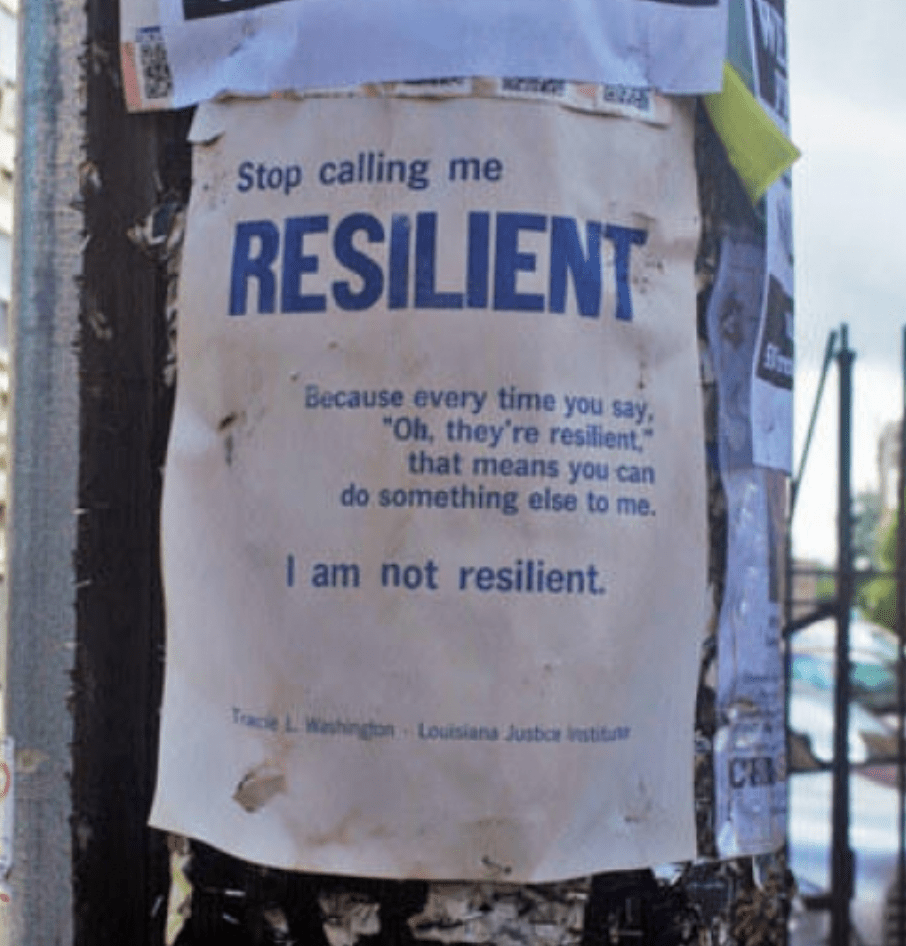
During the early days of recovery, a local activist in New Orleans famously refused the word:
So is it even possible to rescue the word to be meaningful to local activists and grassroots organizations, or is it (as Ms. Washington says in the poster above) a word one does not want applied?
How should market communities partner with the formal sector without ceding any local power?
And as importantly, how do we prepare for the injustices likely to be raining down on our communities because of civic and natural emergencies even as we take care of our own health and well-being?
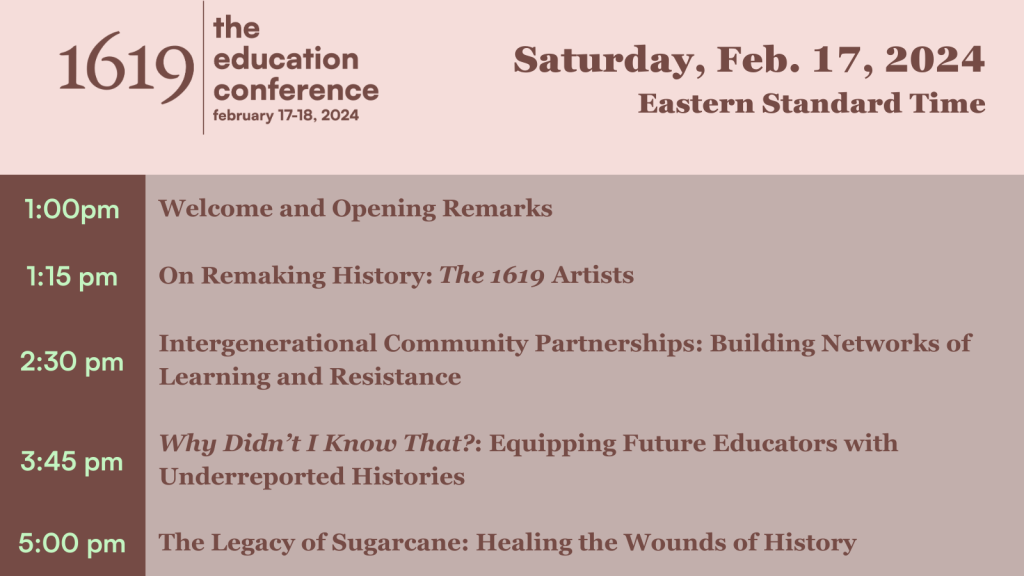
This was an extraordinary set of panels, with the final hour sharing the current difficult situation for a Louisiana black family farm. Learn more and support this farm: http://www.provostfarmllc.com
Highly recommend the educational resources supplied by the Pulitzer Center in association with The 1619 Project. If we want to lead a new system of farming through our work, we need to envelop these experiences and lessons into our governance and business models.
When Charisse was hired as FMC’s E.D. earlier this year, I was intrigued both by her background and her plan to take that big job on, AND to continue to oversee her wildly successful company Lokal Artisan Foods with its French Toast Bites brand. As someone who had also alternated between for-profit entrepreneurial work and community organizing, I was very excited to experience this type of energy from our new leader.
And what energy it was. Charisse never seemed to meet a situation in which she didn’t have the confidence to address, never lacked a joke or self deprecating aside to lessen any awkwardness, and always made sure that folks felt seen and heard, richly using their names and building a special communication with each person. I marveled at all of it. I told her so and hope that I told her so in a way that she accepted it.
She was a constant learner, which I knew had made already her kin among our market leaders, since that is the energy they also bring. I often told her that market managers were gonna love having someone like her in this role and I felt she knew exactly what I meant. Of course one of her first public outputs as our E.D. was establishing a new vendor fund because she had lived that concern, both as a PA market manager and as an entrepreneur.
I was grateful to see how much time she spent on the World FMC Academy calls, attending almost all of them (choosing the early am option of the 2 they offer, in order to make time for them before her long work day started), listening in and sending me dozens of questions and comments during and after those calls.
She jokingly reminded the FMC team on almost every call how recently she had arrived, sharing what day number she was on as FMC’s ED. (She began on June 20, so she was with us for one week shy of 7 months.)
I was humbled by her willingness to use her energy, her enormous social capital, and intellectual bank to assist FMC. To lead an overwhelmingly white staff and white culture to its hoped for future as a leader in the new anti-racist, entrepreneurial, and joyous food system for which farmers markets should lead.
I met her in person only twice, as it was normal for our staff to only meet up once or twice a year in our little remote-officed NGO with staff working at home from coast to coast to coast across the US. I was happy that our East Coast Deputy Director Willa had more face time with Charisse, as did our Philly-based admin/membership person, Meghan. It was great seeing that team begin to form. I was sorry for those staff who never had the pleasure to meet her in person.
I looked forward to seeing her much more in person in 2024.
I’m stunned at this loss.
Not only for FMC, but for her own community and family, and the loss of such promise.
I’m also angry with our world for not taking better care of black and brown (especially female) leaders. I take that indictment as my own future work as well, and promise to do better to support and honor these women.
Here’s to you, Charisse McGill. Rest In POWER.
Part of the FMc team: Willa, Meghan, me, Charisse and Bec in NYC in June at World FMC event
I’m excited to finally be able to spend the time on writing the history of the modern era of farmers markets. Thanks to all who have filled out the survey form already, but if you haven’t yet, here it is again:
The purpose of this will likely be a series of articles for market leaders, policy leaders, and researchers to better understand the importance of the farmers market in the local food movement, with its flexibility in fulfilling market day and also system level impacts while remaining the public, informal face of the entire movement. There are many external challenges ahead, and my hope is this research will offer strategies for offering support to market organizations and to center farmers, foragers, ranchers, and harvesters who are the stewards of land and water and community leaders in every sense.
If the articles turn into a book, it will also be for those general readers who are interested in community and current history, who can learn how to support their local markets more fully .
A few books from my collection. Some of you may note that only one is really what we would define as a farmers market. Even though many of the books in the above pic do not focus on the modern farmers market, I’m sure we’d all agree that knowing what we had previously is vital to understanding the recent past and the present too.
Shout out to The Dane County Farmers Market book seen above which is a treasure trove of the type of primary data that is sooo helpful. Not only does it detail the entire history of what is one of the first of our kind (opening September 30, 1972) designed as a community-led, transparently governed, open-air farmers market, but I also love that the book arranges that history in chapters by its eras of market manager! (Of course I love that because as an FMC staffer, I follow the strategic plan which prioritizes our work in directly supporting market operators.) Kudos to authors Mary and Quentin Carpenter, with equal credit to Mary’s term as market manager.
So how many of you have published histories of your market? Feel free to leave links in the comments…
Yes, I hear you chuckling as to my poor poor life, traveling twice in one year to Rome to work with the World Farmers Market Coalition. Accepted.
Still, I have a few butterflies and some anxiety about this trip because the stakes keep raising in terms of how to have an impact on those that WFMC amasses for us, including trade ministers, ag leaders, FAO, USDA, US Embassy staff, funders, among many many others. (And then, once back, how to share the global excitement around farmers markets with US stakeholders?)
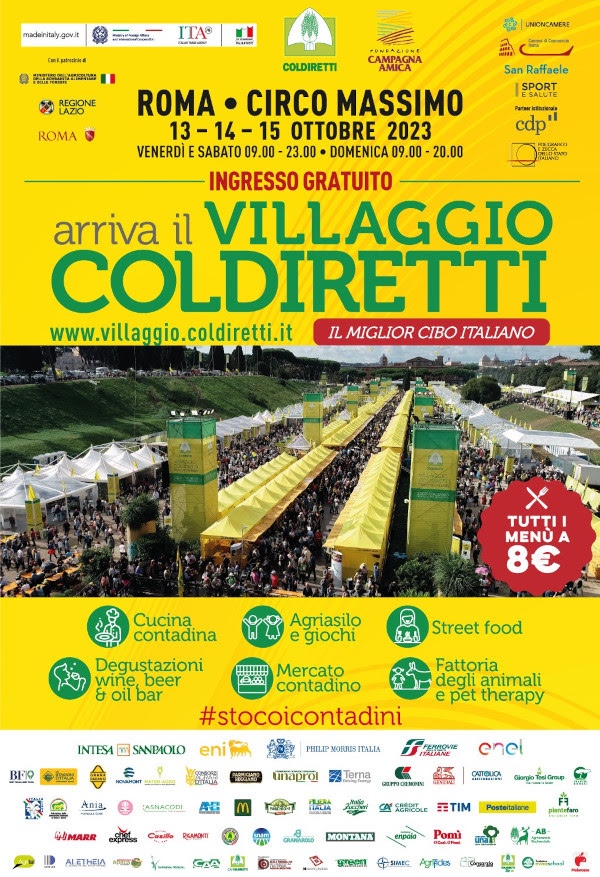
The exciting news is that this trip will be held at the Villaggio Coldiretti, a 3-day farmers market educational event held at the Circus Maximus, which on our last trip, Bruce Springsteen was using as his concert hall. (We were able to hear the sound check and see the crowds build for that event because the WFMC events were nearby at the gorgeous Circo Massimo farmers market operated by our Italian WFMC partner Campagna Amica.)
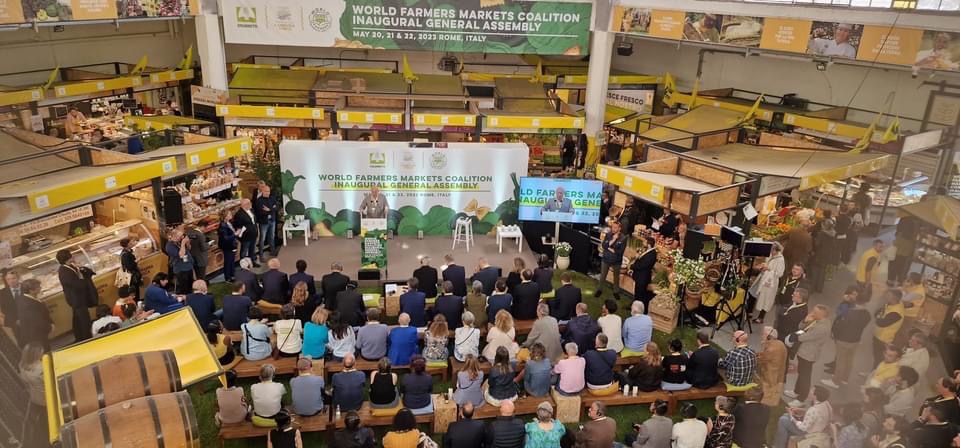
WFMC Member Assembly May 2023
I’ll be cramming facts and figures and stories into my head especially around nutrition incentive programs as this is one US pilot that our fellow market leaders are eager to hear about. Please reply to this with any that you think I should share, and I’ll do my best to report back here and on FMC’s social media.
One of the messages that I use in my farmers market support work is to urge operators to make sure the programmatic and governance oversight is made more visible, so that the work can be better supported financially and through partnerships and policy.
“Don’t hide the hard work” is how I often say it.
One of the main reasons this is so necessary is because of the enormous success of the estimated 9,000 market sites in the US in increasing social cohesion, healthy food access, local economic activity, ecological stewardship, and other positive impacts of regional food systems.
But even though there are significant impacts, the pop up nature of many of our sites and the high-impact but low capacity staffing most employ can make it difficult to explain.
And often market leaders hear this talk of sharing the impacts and think despairingly of being required to undertake long data collection assignments and text heavy reports to communicate this.
Instead, the answer may be something as simple as a visual image or a quote that illustrates the relevance of this work to the larger civic community.
This map is one such example. It is of the national park in Ohio and includes the farmers market that is held in the park, as well as images of (just a few of many more) of the other farm sites along the path. It also places the market as part of this ecological system which is also a wonderful message.
Can you spot the market? (It’s helpful to pinch to zoom in to the map to look around)
And can you see how this is one great way to share a measurement of impacts?
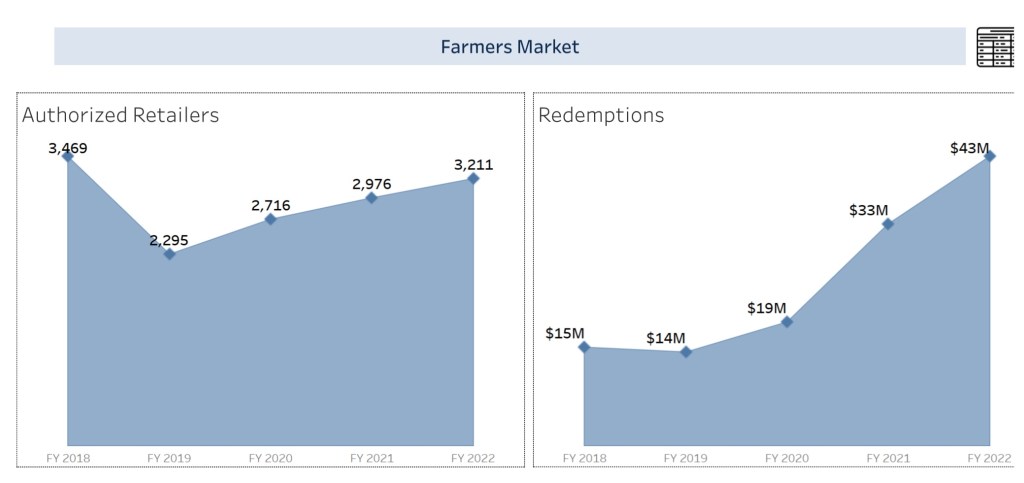
Farmers markets continue to increase their overall SNAP sales
Direct Marketing Farmers increase sales as well, although not as fast as FMs. It is also possible that DMFs are making some of these sales at farmers markets.
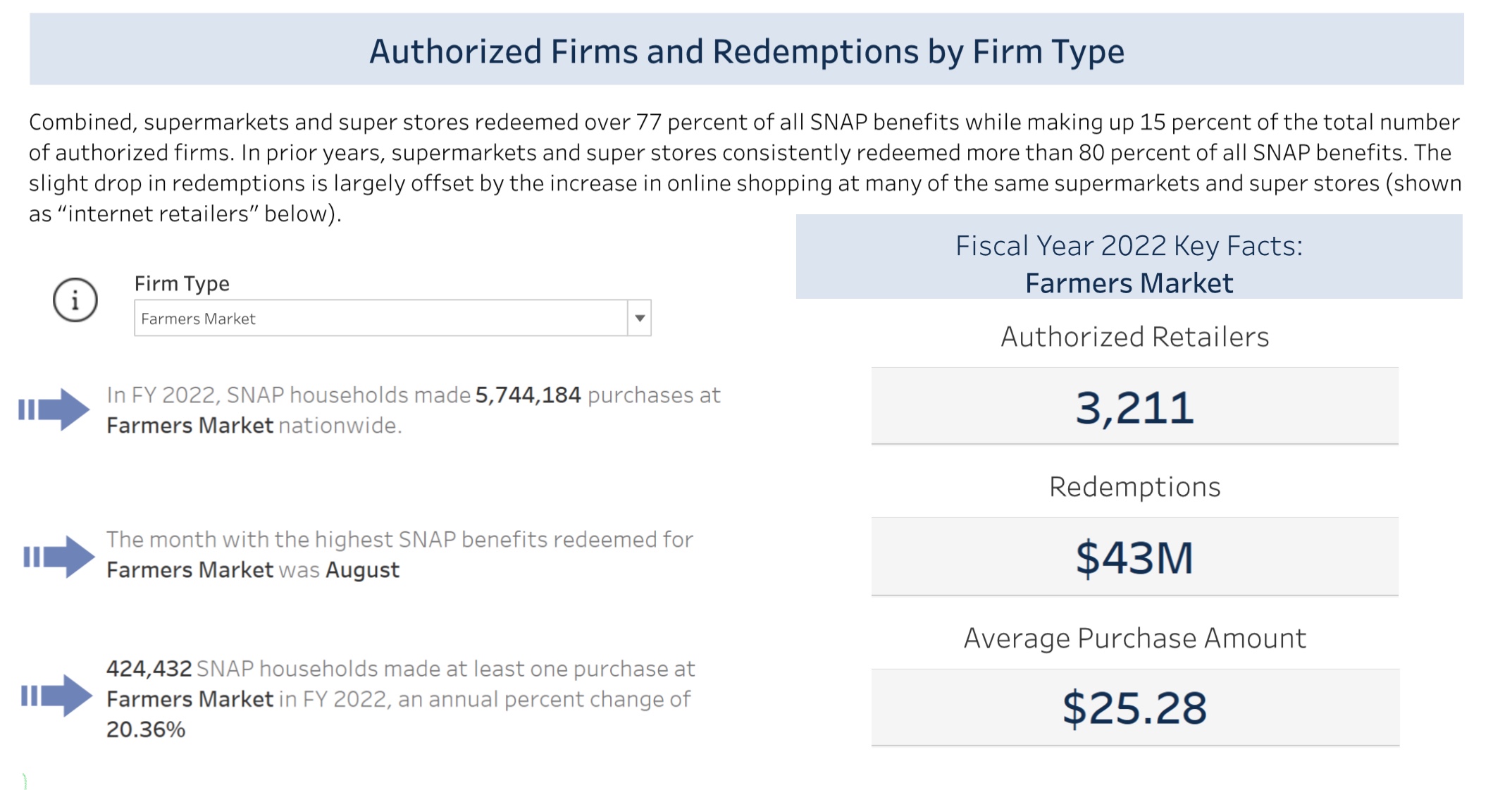
Not sure how this Average Purchase Amount is calculated; this metric may be actually be “Average Amount Debited from SNAP Card” since the total issued by the farmers market entity may not (and where matching incentives at many markets are, likely not) be the total amount spent by the shopper. And on the other end, in some cases the total issued is not always spent entirely, and instead saved for future shopping trips.
The average sale for DMFs is impressive. This metric may be more precise as an average sale per shopper, since for most DMFs the total is tallied and then the card is debited rather than the other way around as is done at most farmers markets centralized terminal models.
I have begun to formally write a history of the US farmers market movement that has developed since 1976. As some readers may know, I began to gather histories of markets more than 20 years ago, writing down reminiscences from founders, reading collected histories, and creating the start of a framework that I use to explain the re-emergence of this ancient mechanism. Take a look at this post that does its best to give an overview of this framework:
In preparation for this writing project, I have begun to collect more histories from each of those eras (as well as those outliers who don’t so neatly fit into the larger era) which I believe will become a series of articles around the modern farmers market movement and is meant to offer information to funders, shoppers, and to partners in order for farmers market communities to gain more sustained support.
I’m asking leaders to add their market history to my database through this quick form. I’ll follow up with more q for some of those who respond to ask to use them as a case study.
Am in Vermont for the month of July, partly to continue my long association with farmers market organizers, NOFA-VT, and related partners around regional food systems. As a summer/fall climate refugee, albeit one who is very privileged to be able to easily move about the US— i also travel seeking a permanent home for the many summer/fall months when my own home is close to unlivable because of climate.
This trip I spent 2 weeks in South Burlington, moved to Royalton for 2, then will be in Montpelier for the last/first week of August before heading to Montreal for the day and then back to Midwest to work on projects in Ohio and PA.
As all readers can surmise, being here for the Vermont Floods last week was alarming, but also increases my respect for this tiny rural state. During the storm, I watched the news closely, stayed awake most of the night, checking social media updates and texting friends more in the path of the storms.
Once the storm passed, the recovery was immediate. That included a rapid declaration of disaster by the White House (at the clear request of the Republican governor) which triggers a great many resources to begin to flow. Radio, television and online sites shared ways to raise funds for those affected and where to find emergency services. Crews were out repairing roads bridges and train trestles the day after the storm. One farmer told me by text: “this is a much more catastrophic storm in comparison to Irene but everyone is organized and willing and able to help this time, it makes it seem so much less mentally daunting.”
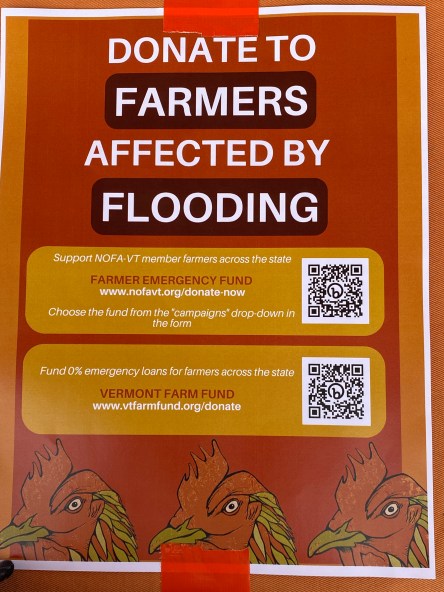
The local news today suggested that the department of Ag, known in VT as the Agency of Agriculture, Food, and Markets (often shortened as the “Agency” ) is still waiting for clarity around the declaration of disaster specifically from the USDA to see what else they can offer producers, may of whom have already shared heartbreaking losses (what I have heard are stories such as one farm losing 900 birds, another saw all of their beehives swept away.) And according to a story posted by VT Digger reporter Hannah Cho, all of the new American families who farm at Intervale Center in Burlington and in Winooski lost everything: “For the majority of their 100 farmers, “this is not a hobby [nor] a business,” Laramee said. Most have full-time jobs as janitors, food workers and in hotels. The crops the farmers grow go towards feeding their households throughout the entire year.” (To donate to this effort: https://www.intervale.org/donate)
The state-based entities led NOFA-VT working together as always on regional food and farming are moving very quickly to collect and share resources that often arise from neighbors,Including local businesses.
So as Vermonters begin the phases of recovery (community care, priority assessment and property evaluation), most of it will likely happen with overwhelming stress, random fits of exuberance around community, with depression and fear mixed in – and that’s just to get to the rebuilding.
What is not clear yet is how this state will define resilience in the future; what we have learned in the Gulf Coast is that, as disasters come again, many of our systemic recovery phases now require extraordinary personal levels of resilience that are not matched by institutional levels of resilience, leaving more and more of this work up to informal groups of neighbors and resources. Let’s hope Vermont can do better using ours and others examples.
(Originally posted in 2017; republishing to get it back to the top)
Anyone who works on farmers markets (hopefully!) understands that one major area that is constantly hampering our effectiveness in creating this new world of community food systems is the lack of reckoning with the institutional racism within the systems that make up our material world.
Or, as Raj Patel said at Slow Food Nations 2018: “You don’t fix the past with a certain type of tokenism; you fix it with a reckoning. And that reckoning is something the food movement has yet to have.”
To me, the argument among some growers and organizers that there are “too many farmers markets” indicates that the field is in dire need of growing its reach and thinking through re-positioning its outcomes. It seems clear to me that we need to turn back to prioritizing the production side of the equation, supporting growers and other producers more directly and more widely, and increasing purchasers at our thousands of markets by redefining the language of shopping at markets as transformative for the community and nourishing for ones own family even as we continue to make them truly welcoming to all types of people.
So to see the recent strong emergence of the food justice movement, led by people of color, focusing on collaborative production and on innovative messaging on why choosing healthy food is activism at its purest form has been inspiring and humbling at the same time for many white allies. Inspiring to see how the work is imbued with innovation and collaboration at every level (see Dara Cooper’s quote and interview at the end as an example), and humbling because there is so much history around these injustices that many of us still don’t fully comprehend. With the emergence of this chapter, we will gain access to a new set of tools and pilots to learn how to better organize on systemic issues that depress our markets’ and food systems potential. Which means that when market leaders get to the “unconscious competence” level of their market work and build systems, their seasoned staff can join housing boards, mobilize on public transportation systems, work on greenways and environmental degradation hot spots, become a voice on county level policies to incentivize using productive land for food and so on to really grow our market communities.
Another massive contribution that black, native and other writers and organizers of disenfranchised communities are bringing to the food and farming table is a demand for context and disciplined language as seen in the rejection of the “food desert” label. Because of black leaders explaining its weakness, I have long rejected that language in my farmers market work starting in New Orleans, as it implies scarcity rather than the truth: a systemic denial of resources to that community. And often there IS food – sometimes it’s a lot of bad food which is hard to combat when using food desert language to organize, or the structure of food procurement is so informal that it is missed by those defining it (supermarkets are the main indicator of food security which is a pretty weak indicator) or the lines of the supposed desert are drawn in such a way as to not encapsulate actual neighborhoods or assets. This piece is very helpful to keep in the front of ones mind when discussing this with fellow staff and with the larger community.
The great Karen Washington has said a lot on this subject:
What I would rather say instead of “food desert” is “food apartheid,” because “food apartheid” looks at the whole food system, along with race, geography, faith, and economics. You say “food apartheid” and you get to the root cause of some of the problems around the food system. It brings in hunger and poverty. It brings us to the more important question: What are some of the social inequalities that you see, and what are you doing to erase some of the injustices?
We’re trying to raise awareness of the history of the land and on how to live sustainability on what’s around us,” Sherman notes that much of his work centers on recovering the cuisine that existed among American Indians prior to the arrival of European settlers. On reservations, American Indians were restricted in their rights to hunt, fish, or forage, and thus forced to make do with US Army rations of flour, lard, and salt—which were later replaced by the commodity food program.
Dara Cooper: “We need the ability to feed and nourish our communities, and the repair of the systematic harm that has and continues to be done to Black people,” Cooper says emphatically. To that end, NBFJA is working on a broad campaign in coalition and community with Black-led “Free the Land” focused organizations. We need to shift away from the ways in which capitalism teaches us to have private control over land. We have to move away from extraction of land for a very few, and shift toward land reform that addresses indigenous right to sovereignty and Black people’s right to self-determination in our communities in a collective way.”
Leah Penniman of Soul Fire Farm / Farming While Black: “Food sovereignty is about who’s in charge … and ultimately what gets to our plates.”
I have a goal to write each week here; I hope this is helpful for all of you.
Wanted to share my current reading list in the hopes that it may spark a discussion of what you are reading:
The Brinkley book has been fascinating, not only because I’ve been a huge fan of Rachel Carson since the 1980s (who I believe has never received her due for exponentially increasing awareness of environmental extinctions and illness’ connections to unchecked pesticide use) but also because this author has a talent for creating a compelling story around the leaders of the environmental movement which is spurring my thinking around my farmers market book currently in draft form.
This Rome travel book is because I will be joining many of my fellow market peers and attending the World Farmers Market Coalition meeting in May.
Graeber’s incredible analysis into how direct action groups collect and organize is another keeper of his for me from this late great writer.
This book about my home state and one of its fishing community is a new one for my bookshelf after I saw and heard its thoughtful author at a recent literary festival in New Orleans. As someone who has worked closely with a few commercial fishers and so try to keep an ear and eye out to be always learning more about their future, I am expecting this to give me great insight on what that community is facing in our current political, ecological and cultural “spend-down” time.
Jackson MS is a place that doesn’t get enough notice nor enough support from its state nor the feds for the challenges they face or enough credit for the innovative work happening there from many including from Cooperation Jackson. Also, anytime I can read in detail about food access within one community, I find it offers many lessons I can use in many places.