Indicating health

Windowsill Pies, New Orleans LA pie makers

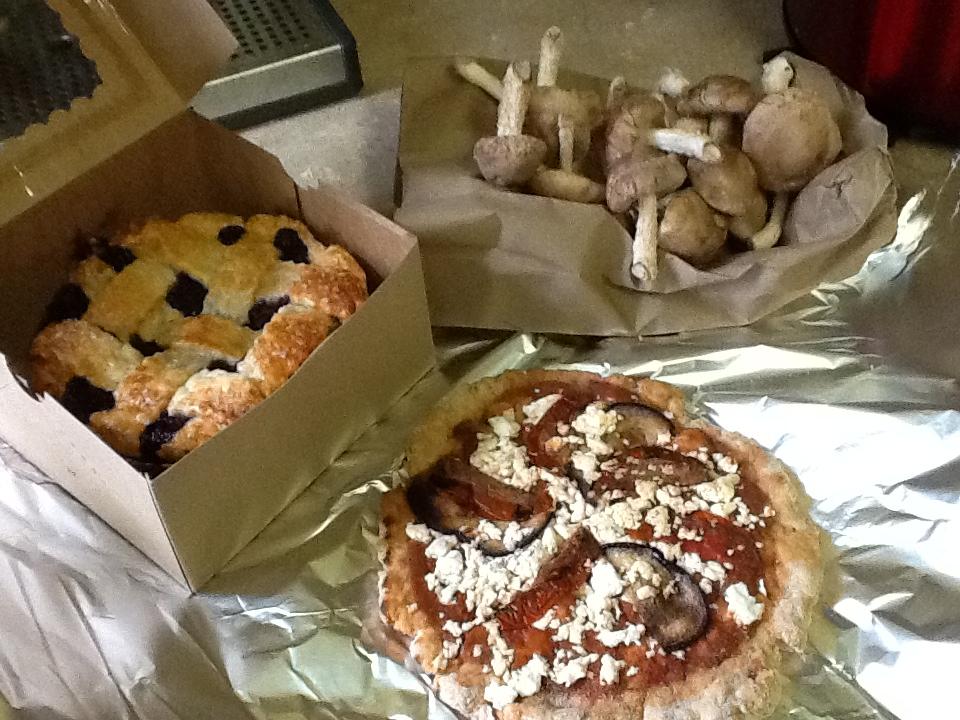
Blueberry pie from Windowsill Pies and gluten-free pizza and shrooms from the Rue family, all from Covington Farmers Market..

Take a long look at that picture. To many, it may only show another dang food picture that was posted online but to me it represents something else entirely.
All of those goods came from the Covington Farmers Market, which is a parish (to most of you outside of Louisiana, parish=county) seat market located 40 miles from downtown New Orleans and across Lake Pontchartrain in an area of what used to be called the Ozone Belt for its pine tree greenery.
The gluten-free pizza was sold to me by a teen who was selling them on behalf of her family business and could tell me what was in their pizzas and why, could take my money and offer change with a genuine smile and good wishes. The mushrooms were on their table too and collected as a side option to their prepared food sales, as well as used in their goods.

The pie was sold to me by 2 entrepreneurs that buy their ingredients locally as often as possible (literally pointing to the honey seller that provided the basis of this pie’s lack of refined sugar). This vendor’s artistic tendencies suit their product list well, all of the way to the windowed boxes for their pies and their oil cloth tablecloth and vintage aprons presentation.
What is important to me as a shopper about this picture is that it represents a (still) unusual way of buying food; I can ask each of them exactly what is in their goods and how they were made. They are working to replace industrial ingredients with natural and closer-to-home versions that offer more taste. And of course, not only did I get a chance to talk directly with the makers of these goods and to encourage them further, but that I was able to buy from young women, all just beginning farmers market sales. All of the made goods were delicious and will be bought many times again. I may buy them for myself on a week in which I know I am just not going to feel like cooking or they may be used to share with friends when they come to spend the day at the pool or may even be brought to a party I am invited to as my gift.

Market managers know that farmers markets are THE incubator for businesses that are not ready for or do not want storefronts. The chance to take a small idea and grow it slowly and carefully is a necessary step for any entrepreneur, yet the places one can do this are so limited that markets are among the only ones that regularly offer that opportunity. Many experienced market shoppers know that when they see new goods at markets that are advanced in their ingredients and presentation, they must immediately support them vigorously and talk them up to their friends. In turn, market managers need to monitor these vendors and introduce them to those shoppers (as this market’s manager did to me) as well as search for those vendors’ new shoppers, who may not already be present.
In other words, these vendors often represent a new age in a market. Its important to remember that young vendors trying items that can only be sold at farmers markets are who we want to see more of in markets. These folks cannot (or do not) sell their goods to Whole Foods or ship them worldwide; they design products for the type of person who stops and asks about their ingredients and their process. Therefore, they are an indicator species, which is defined beautifully in the Encyclopædia Brittanica as an organism that serves as a measure of the environmental conditions that exist in a given locale.

If indicator species show the health of an environment, then their low activity can alert to danger in a market’s health or when increasing, can show vitality. Encouragement of diversity of products, gender, age, ethnicity and business goals is exactly what each market must be setting as a goal daily, weekly, monthly and so on. To me, the presence of these indicator vendors and others at this little market show its emerging strength. And offers some damn tasty research at the same time.

FMC’s FMPP report

A fascinating report from FMC and MU about the Farmers Market Promotion Program.

Press Release here

Report and more information here:

FMPP Report

Louisiana to close spring inshore shrimp season Thursday | Gulf Coast – WDSU Home

The education that markets must do to encourage more direct interaction between shoppers and vendors includes things like explaining fishing seasons along and near coastal waters. I have found that many, many people in my state are unaware of the seasonal nature of shrimping and are unaware of the difference between the fleets that are fishing in the Gulf (federal waters) and the family boats using the “inside” waters (state waters).
And that the very presence of fishers in these waters allows all of us concerned with oil companies and others that are constantly extracting from our waterways to have “eyes on the street” as it were.
In short, markets must remember that information is their currency.

Officials say data collected in recent weeks by state biologists indicate increased quantity, distribution and percentage of small, juvenile white shrimp within these waters. The decision to close this area was made in an effort to protect these developing shrimp and provide opportunity for growth to larger and more marketable sizes.

http://www.wdsu.com/news/local-news/gulf-coast/louisiana-to-close-spring-inshore-shrimp-season-thursday/-/12537462/20972638/-/svxc95/-/index.html#ixzz2Z2V8CBYo

&lt”>

This graph is also useful:

Graphic from Times-Picayune

and this view from the seafood trade journal:
La Seafood and markets

“Anti-Food Truck Meddling Ends Up Ruining Miami Farmer’s Market”

I know many markets are using food trucks as a way to get more traffic to markets, especially weekday and evening markets. Based on this and other articles that I run across, it sounds like food trucks should be specifically written into market rules to head off this sort of unwelcome publicity.
In New Orleans, we added a “Green Plate Special” many years ago so a restaurant could come and sell for a month of Tuesdays at one of our tents (it was a 10 am-2 pm market then, now it’s 9-1), as long as they had entrees under 10 bucks, sourced from the vendors when possible and followed the specific risk and vendor rules for serving prepared food.

This added amenity was to help us to draw office lunch traffic and it has done that and much more over the years, although I have to admit it killed off a lot of the prepared food items that the other vendors were selling, but maybe that was a blessing in disguise after all. It made those vendors concentrate on their fruits and veg staples and to stop trying to corner the sandwich business at the market.
And even though it was a difficult start (can I tell you the number of restaurants and chefs that I haunted in those early years?) 99% of those that participated over the years that I ran the markets asked to be able to return.

We wrote guidelines for that spot and asked them to pay double what our regular vendors paid which was still a bargain for what they received: shoppers already amassing needing food and meals, in a market with seating and local producers willing to sell items for the menu. So I recommend that markets think about how to include caterers, restaurants and food trucks into their market, but to do it without upsetting the balance of the market too much.
By the way, this article seems to suggest that this is not a “true” farmers market as most of us across the U.S.  define that term, but is more of a food and artisan market. I know Florida has many of those and they seem to be an appropriate market type and serve their shoppers and vendors well in many case but maybe we need a type to describe the market that offers prepared food as its main offering. As I often say to markets when they ask me if a rule is “okay,” it’s only important that the market can defend and explain their rules to their community. If they can, if people around there understand and most agree, then I say full steam ahead.
Okay, one story about the Green Plate. When we developed the idea, we would talk about how we wanted restaurants like Commander’s Palace to do this (often rated as the #1 fine dining restaurant in New Orleans) and although we asked them in the beginning, they quickly sent their regrets (as they are very polite folks). We were seen as a quirky little food event and hadn’t moved to “beloved institution” phase at that point…
After the levee breaks of Katrina 2005, this 100 year old+ restaurant had some damage, needed time to repair and to the great sadness of many New Orleanians, did not reopen that year. However, in 2006, they asked us if they could come to do the GPS, brought their A-team and spread the word that they would sell quarts of their famous turtle soup and a few beloved entrees. So that first day (right after we ring the bell to open the market) we hear a cheer from their tent and see the celebrated chef and owner holding a ten dollar bill over their heads while saying with great emotion, “Our first sale since Katrina!”
The next week, they brought their Maitre d’to manage the line that went out of the market.

So I’ll never forget how our little market helped this great establishment and how our original dream came true all at once. All because we always thought: “what if…”

Anti-Food Truck Meddling Ends Up Ruining Miami Farmer’s Market – Hit & Run : Reason.com.
Cuba Jan 2014

Fact finding mission is in order. Anyone?

Cuba Jan 2014.

State and Network Leader Discussion Series

Calling all State Association and Market Network Leaders: Please register for the FMC State and Network Leader webinar discussion on July 8th, at 4pm EST/1 PST. We will be discussing the Mobile Market App and any challenges that markets and networks face using smart phone technology. Darlene Wolnik, independent consultant to public markets, will be moderating. Please be ready to ask any questions or share comments during the call, or feel free to submit questions beforehand. This is meant to be a discussion among leaders, not an informational webinar.

Last month, several participants called in to the webinar via phone only. Unfortunately, due to the limitations of this technology, those participants were in ‘listen only mode’ and couldn’t speak or ask questions. If possible, join the webinar through your computer AND your phone, for optimum sound and participation!

However, these calls are recorded and notes taken so everyone can share after the call is over. If you are a network leader and have not received the invitation, email Liz at farmersmarketcoalition.org to receive a registration.

Food & Farm Bill of Rights

This came up on a listserve today. Thankfully by opening that email I was reminded of this page’s existence and reassured by the possibility of a stray elected official doing something right for all Americans.

Food & Farm Bill of Rights | Congressman Earl Blumenauer.

The Dallas Farmers Market is no longer controlled by the city. What happens now?

The Dallas Farmers Market is an interesting version of a public market. Almost a decade ago, I was invited to Dallas for a set of public meetings (along with DC/Fresh Farm founder Ann Yonkers) to help the chefs, farmers and food entrepreneurs get to the next step in reorganizing this market.It seemed then that a lot of competing ideas were on the table and that to get it moving, they would need both deep design options and mission development. This news may signal that they have taken the necessary next step.

The Dallas Farmers Market is no longer controlled by the city. What happens now? (And what becomes of Pecan Lodge?) | City Hall Blog.

Concert to raise money for EBT program

Great idea from the Cobblestone Farmers Market (coincidentally a market that I profiled in my Market Governance paper) about how to fundraise for incentives. This does more than just raise a bit of money; it also explains the deeper mission of the market to the general public and may also shake out more funders for the future.

Concert to raise money for EBT program – Winston-Salem Journal: Tidbits.

Creamery settles dispute with feds

“Randy and Karen Sowers will forfeit $29,500 to the government. U.S. Attorney Rod Rosenstein accused the couple in mid-April of violating federal currency reporting requirements — known as structuring — by depositing money in increments of less than $10,000 so they would not have to fill out forms required under the Bank Secrecy Act. The statutes are meant to curtail money laundering.
The Sowerses have owned a farm off Bolivar Road in Middletown for more than three decades and have operated it as the South Mountain Creamery since 2001. They have maintained their innocence and said they learned what structuring was only when Treasury Department officials showed up at the farm in late February to question them about the deposits.
The couple deal with a lot of cash at farmers markets, they said, and the deposits totaled similar amounts every time.”

Creamery settles dispute with feds – The Frederick News-Post : Archive.

The Farm Bill Deserved to Fail

“By rejecting reforms and doubling down on mean-spirited cuts in nutrition and the SNAP program, a critical mass of people across the political spectrum couldn’t stomach this bill. The result was a strong ‘no’ vote, leadership looking embarrassed, and the House in disarray.”

Rep. Earl Blumenauer, U.S. Representative from Oregon

Cloud computing is a trap, warns GNU founder

This subject is one that markets must consider as we turn to online accounting and data management systems. Selecting a good offline backup system may be as necessary as finding the right cloud storage or computing system.

Cloud computing is a trap, warns GNU founder | Technology | guardian.co.uk.