Finishing up 2024 work this weekend, to then preparation for supporting organizers amid the bookends of community and chaos in 2025.
But do not expect a deep dive in this post about what may happen in the national political arena around food and farming- at least not yet. Still time to consider plans, still time to replenish….
But in the meantime, here is what I have been saying in the past few months to market organizers that I am in contact with:
Leave blame and shame to other arenas.
Markets need to be centered as places of belonging and connection.
New Orleans LA Crescent City Farmers Market December 2024
Focus on big goals of system change by asking the market organization to consider:
How is the market moving the dial on farmland preservation? How is that work measured?
How is the market including marginalized people of color in its work- and not just as consumers, but as producers, as advisors, as mentors?
What about rural (if the entity is overtly urban focused), or urban (if overtly rural)?
What would that add to your work and to your market?
Does your team and community know the history of subjugation and of centering whiteness in your area?
Does your team and community even know the recent history of market culture (1970-) in your area? Why these markets were founded? Who founded them? How is the market still honoring that history and still intentional in its design?
What external pressures are limiting your work, and who and what processes might help you change those?
What internal structures are limiting your work, and who and what new processes might help you change those?
How are you preparing for interruptions to farming or markets, whether through civic or climate instability?
What is the big idea for your market that you would like to tackle in 2025?
What keeps getting moved off the to-do list every year?
How can we include more people in our work lives, to bring new voices into the work, but also to make sure we are being held accountable and supported.
Can the urge to wait for “perfect” be ignored in favor of what is possible and practical?
I’m out on my “summer tour” of the northeast part of the US leaving my beloved New Orleans simmering and hunkering down for hurricane season, one that is projected to be an extremely active one.
When I began to regularly (around 2009) to leave for weeks and then for the summer, I got a lot of raised eyebrows and jokes about it, but those have completely stopped in more recent years. My take on that is that all New Orleanians are now accepting of the fragility of our coast, and constantly preparing for interruptions that come with the loss of land and the rising temperatures of the Gulf. So now, leaving for a time is one of the new normals. No more friendly texts of “wimp” allowed.
What has also changed is the number of natural and civil interruptions happening in the other places that I visit.
In the areas that I was in just over the last series of months, we watched the Vermont and Kentucky floods, the Canadian wildfires, and many other localized disasters that elicited organizing from one or more market organizations.
That organizing was rarely to raise money or awareness for the market entity, but rather, focused on their role as conveners (using their site for recovery), as analysts of the local/regional food system for media or policy makers, and/or as pass-through entities to get resources to their vendors.
The very nature of open-air markets allowed these varied and immediate responses, since most are without infrastructure and therefore have no physical damage to their own organizational assets. I say that with consideration, because many had to move their location for a few months or even longer, which requires design and logistical planning, work even longer hours than before, and pay for new marketing and messaging to let everyone know what and where the new version was happening.
And for the markets that provide centralized payment processing, the damage to shopper or vendor homes and/or businesses can often mean more and higher average transactions because of increased government benefits and private philanthropy, which in turn – although very welcome – increases the costs of managing such a system, and does not come with appropriate administrative funding increases. (In fact, it seems appropriate to mention here that for most market organizations, ANY significant increased use of their centralized system does not increase their income at the same level, if at all. That is the opposite for brick and mortar stores since those entities own the items they are selling and more items sold mean more profit for the store.)
I point this all out because I have been in the position many times to hear funders and policymakers slide right past markets when discussing how to invest in regional food systems that have suffered losses or interruptions. It also raises a red flag when we use the word resiliency to congratulate those who make it through the recovery phase, even though there are a few other phases before and after.
After the 2005 Katrina Levee Breaks, we had artists sew some of these words into prayer flags for us: Return/Reconnect/Recovery/Reopen/Renew/Rebuild/Rejoice/Rest. What those of us in the Gulf Coast mix since 2005 know now is that resilience comes after all of those if it comes at all.
Recovery does not describe resiliency as one cannot “bounce back” while still in the emergency. Instead, during recovery, we watch markets and other local entities “spend down” their social, intellectual, economic savings, but almost always see the attention moving on when true resiliency should have been measured – meaning long after, and no ‘R” savings account replenishment offered.
As another example, during the COVID crisis, the word resilient was used for direct to consumer outlets opening during the restrictions and although that part WAS incredibly difficult, little research was done on the larger-than-normal turnover of market staff that by state and network leaders noted after the restrictions lifted and markets were allowed to return to previous operational structures.
Resiliency also does not take into account how institutional power brokers use the moment of an emergency to shift the burden of future emergencies away from the formal civic sector and on to informal and individual recovery efforts. Of course, local community leaders should always have a leadership role in recovery but they shouldn’t be expected to raise the majority of the funds, or to be the only local response visible to their neighbors, yet in multiple emergencies, this is increasingly typical. (How many local GoFundMe campaigns, can or clothing drives, and or free 24/7 power/charge stations are managed by corporations?)
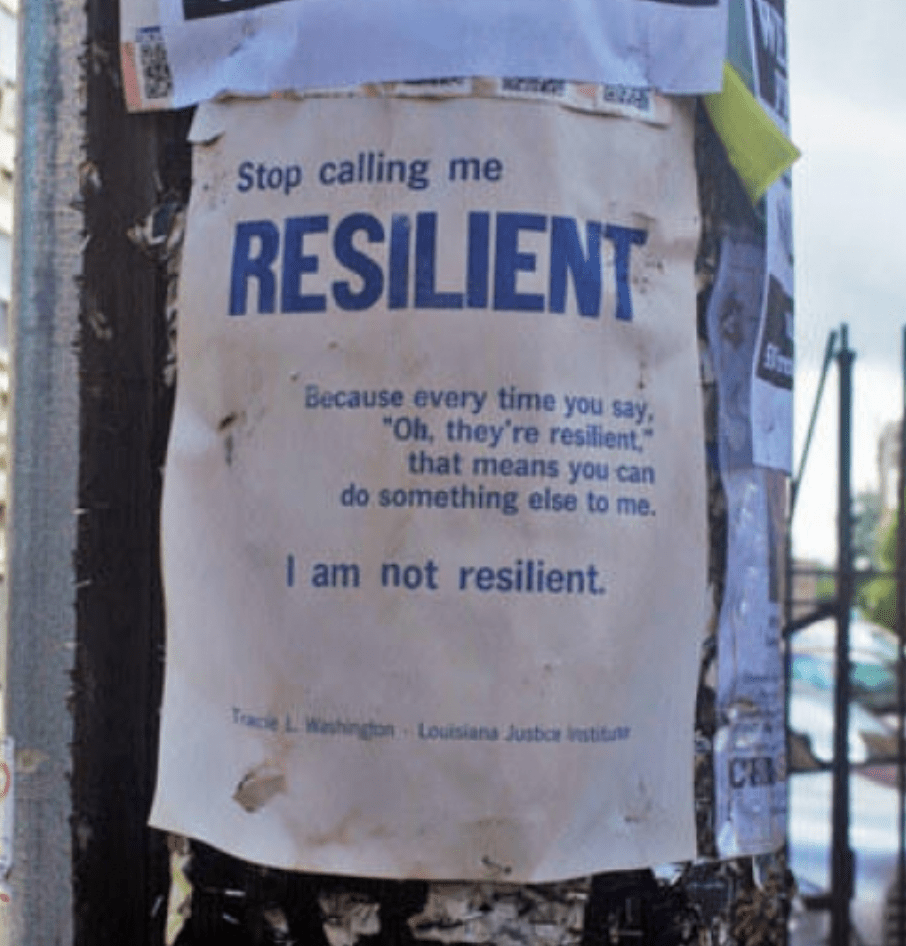
During the early days of recovery, a local activist in New Orleans famously refused the word:
So is it even possible to rescue the word to be meaningful to local activists and grassroots organizations, or is it (as Ms. Washington says in the poster above) a word one does not want applied?
How should market communities partner with the formal sector without ceding any local power?
And as importantly, how do we prepare for the injustices likely to be raining down on our communities because of civic and natural emergencies even as we take care of our own health and well-being?
I’ve got a post on the FMC site about my recent travel mentioned in the last post but am adding a point of view on this blog too:
My October 2023 trip to work with Campagna Amica and World FMC was focused on U.S./Mediterranean team sharing around cash incentives and learning more about multi-functional ag. The global interest in cash incentives is obviously not aligned with the US SNAP model (as few have this sort of national program) but is about the other incentives we see at markets offered to certain segments of audiences to participate such as FMNP, Produce Prescription, children’s market clubs and others, as well as the matching programs of those coupons.
My FMC blog focuses on that subject so all that I’ll add here is that based on the dozens of recent conversations I’ve had within the US and now with leaders across the world, I believe it is beyond time for the US farmers market sector to reframe the purpose and goals of our farmers market incentive work.
The public health sector is a great partner especially around the SNAP & matching work with quite clear goals, but farm direct leaders must hold their own theory of change as to why THEY do these intensive programs. These might include increasing the number of recurring shoppers, assisting farmers to fairly earn enough and expand the type of regional products, improving health outcomes, reducing customer confusion and expanding education by having a single point of information at the market’s tent, using multiple incentives to expand civic engagement and local participation among partners and of course, building a sustainable program framework that doesn’t cripple low-capacity/high-efficiency farmers markets and direct to consumer farmers by matching its seasonality and type of messaging and measurement.
By doing that, farm direct outlets can be clear with Congress and with USDA about why some of the recent trends to prioritize farmer terminals over central terminals, or why restricting matches only to fruits and vegetables rather than allowing them to use their matches for any regionally produced item available at a well-curated farm direct outlet have not always been the appropriate model.
Always happy to talk more about these ideas both as a FMC staff member or as an independent consultant for markets. Contact me if that is helpful and check out the FMC blog post linked at the beginning of this post to find FMC resources.
Now on to multi-functional agriculture.
This is an approach that:
… “refers to the fact that agricultural activity, beyond its role of producing food and fibre, may also have several other functions such as renewable natural resources management, landscape and biodiversity conservation and contribution to the socio-economic viability of rural areas”….”the use of the concept can be traced back to the Food and Agriculture Organization (FAO)”
So in theory, it requires us to think of agriculture as a system of healthy support of land and of people and not just as production. In practice, it suggest that we need to tie our farm direct efforts to those projects that prioritize biodiversity, justice, health, and rural places.
Italy has adopted this approach within their massive farmer association Coldiretti, and it was on display during the Villaggio. Farmers, agritourism leaders among others with their Coldiretti yellow flags and hats in the hundreds sat for hours in the tents while national political leaders lined up to explain how their approach will offer results. Urban leaders on panels indicated their deep knowledge of the territorial market sphere, underlining their commitment to the fact that their city’s future is tied to their region’s future. Their national farmers market entity Campagna Amica used the occasion to showcase their development of the World FMC to discuss how to connect the concentration of urban farmers markets to the rural places those markets depend on across the globe.
So it was exciting to see and to hear about this approach even while it is undeniable that the issue in the US is there are few viable connections any longer between rural and urban and as a result, massive misunderstandings of the other among the denizens of each. Even the 10,000 of so farmers market sites we can brag about often promote urban ag over multi functional ag, may inadvertently disincentivize rural activities among market vendors, and often fail to measure rural outcomes of their work or only measure market day sales.
U.S. farmers markets could start to operationalize this approach through connecting CSA, farm stands, and agritourism to their efforts – and not just as a part of the market day:
Asking producers if they have those type of activities and how they can be promoted through the farmers market;
Offering two-way benefits for urban shoppers and rural farmers such as those outlined in Kuni;
Highlighting the role of land stewardship as alleviating rapid overdevelopment in the region and how the worst effects of climate change benefit from natural spaces protecting developed ones;
If farm direct is to thrive, it will require seeing it as a pathway to creating better places, to building more closely knit communities, and to adding locally controlled “wealth” for urban and rural, which of course should mean land or knowledge wealth as often as usually means financial wealth.
Check out this list as one set of policies that would help all citizens and all places:
The Ten Pillars of PDA and RUBI’s 21st Century Rural New Deal:
1. Rebuild Farm, Forest and Food Economies
2. Reward Work and Ensure Livable Wages
3. Dismantle Monopolies, Empower and Support Local Business
4. Invest in Community and Regional Infrastructure
5. Re-Build Small Town Centers
6. Cultivate Self-Reliance and Resilience
7. Invest in Rural Healthcare
8. Fully Fund Rural Schools
9. Make Rural and Small Town Housing Affordable
10. Re-Localize Rural and Small Town Banks
I’m excited about sharing this international language and approach for farmers markets as IT will build capacity for their organizations while it draws their producer partners closer to them in a shared future.
My regional watershed which encompasses 2 major Louisiana cities, a bunch of rural parishes and even a few counties of neighboring state MS. Ive long suggested this is the size of the food system we should set as our goal. Www.pontchartrainnetwork.org
I have a goal to write each week here; I hope this is helpful for all of you.
Wanted to share my current reading list in the hopes that it may spark a discussion of what you are reading:
The Brinkley book has been fascinating, not only because I’ve been a huge fan of Rachel Carson since the 1980s (who I believe has never received her due for exponentially increasing awareness of environmental extinctions and illness’ connections to unchecked pesticide use) but also because this author has a talent for creating a compelling story around the leaders of the environmental movement which is spurring my thinking around my farmers market book currently in draft form.
This Rome travel book is because I will be joining many of my fellow market peers and attending the World Farmers Market Coalition meeting in May.
Graeber’s incredible analysis into how direct action groups collect and organize is another keeper of his for me from this late great writer.
This book about my home state and one of its fishing community is a new one for my bookshelf after I saw and heard its thoughtful author at a recent literary festival in New Orleans. As someone who has worked closely with a few commercial fishers and so try to keep an ear and eye out to be always learning more about their future, I am expecting this to give me great insight on what that community is facing in our current political, ecological and cultural “spend-down” time.
Jackson MS is a place that doesn’t get enough notice nor enough support from its state nor the feds for the challenges they face or enough credit for the innovative work happening there from many including from Cooperation Jackson. Also, anytime I can read in detail about food access within one community, I find it offers many lessons I can use in many places.
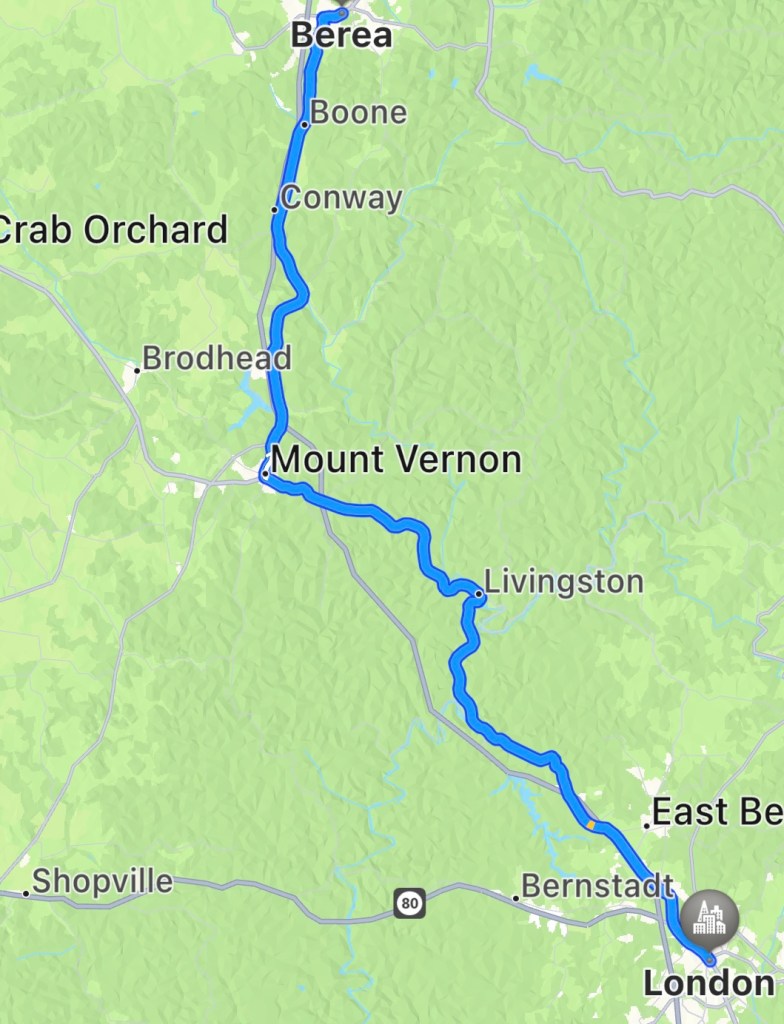
Leaving my London KY hotel while it’s still dark, I head north to Berea. As always, I’m gonna arrive too early even for the farmers market and for that reason (but also to soak up the local) I choose the state highway over the interstate, or as author William Least Heat Moon named these old roads, the blue highways. This road runs almost perpendicular to or crossing I-75 for most of the trip, at times less than a few hundred feet separate them. When it does come that close to the big booming noise of traffic just to the left, I look at the houses and businesses that have an interstate behind them and this road in front and wonder how those living there felt to be spared from the bulldozers and if “spared” is how they felt and or still feel..
Route 25 has existed since 1926 between Georgia and Michigan – well really now just to Covington KY just across the bridge from OH since I-75 eliminated all traces of it in Ohio and Michigan. It was once known as the Dixie Highway, which was the first road to connect the Midwest to the South starting in 1914.
At first, I am momentarily blinded by cars (trucks mostly) heading the other way, and can see little that makes this drive worthwhile. But as the light starts to peek over the horizon, the shape of the surrounding area can be seen. Hills with sunlight highlighting the reds, oranges and green colors with scattered homes (almost all painted white), old barns (almost never painted but left to weather in browns and greys), churches (mostly red brick), and work buildings (almost all with dozens of mechanical items crowding them) placed throughout. In each coven of buildings, the oldest are being allowed to melt back into the soil rather than tearing them down, the next oldest leaning leeward but still probably functional, and the newest most often designed in one story ranch style or mobile home. The main road is newly paved (thanks Big Govt) and I pass hilly gravel roads on either side with names like Old Crab Orchard Road, Old Hare Road, and can see tantalizing signs for John Swift’s Lost Silver Mine and Daniel Boone’s Historic Campground.
The road crosses the Daniel Boone National Forest which covers 21 counties of Kentucky with more than 708,000 acres in its glorious free space (once again thanks Big Govt). I pass through Livingston in Rockcastle County which is one of the park’s Trail Towns, where you can expect to find supplies and guides and food for traversing this rugged park.
My trip is quiet and even peaceful as few vehicles are heading my way, and likely because of the next door interstate, no 18-wheeled trucks roar up behind or on side of me, menacing my little van.
Once in Berea, I spy the farmers market with its gorgeous new pavilion which is easily seen from all directions. From the road, I can see the vendors are still setting up and, knowing how anxious it can make them to have someone wandering around before they are ready, I instead take a right and head downtown, feeling confident I will find a good coffee somewhere near the famed college. More indications of Big Government doing its job appear on the way, including remodeled bridges, pedestrian crosswalks, smooth streets. I spy a jumble of signs that indicate culturally significant activities to the left, so I turn into an area named Artisans Village District which is a cluster of little cottages with retail signs designed to pull visitors looking for culture and craft.
Not much going on there yet, but I find the open bagel and coffee house on the main road on its edge and get a honey wheat with maple bacon cream cheese with a good espresso and sit down in its modern, well-lit and friendly space.
The line grows as soon as I sit and I note the number of families and working men and women already up and at it, all smoothly ordering a NY style bagel and artisanal coffee in Kentucky.
I finish my bagel and head to the market as it is opening time. I try to get to a market at its opening, and make some mental notes. Most of those things I look for do not have a right or a wrong way, they just reveal its culture. Things I look for:
Are all vendors set up by opening time?
Does the market indicate opening time with a bell or other manner?
Does the market have a welcome tent?
Are vendors offloading (walking their items in) or are their vehicles directly behind their table?
Is signage uniform or does it vary table by table?
How much diversity is there among the people vending? How about in its shoppers?
Do any vendors or the market indicate they can process government benefits like SNAP or FMNP?
Are there craft vendors?
Are there hot food vendors?
And so on. The list is extensive but with practice I have found I can note many things without being overt about it. Most of what I learn comes from the conversations with market manager and vendors and this day was no different.
I started by having a pleasant chat with its manager Olivia, who had a beautifully set up market welcome tent all ready to go, with SNAP signage very noticeable for those seeking to use their benefit dollars there. I assume that the tent with its Doubling Dollars information printed on it is likely given to the market by the entity that manages the program in Kentucky.
The overall impression of the tent and of the market is one of extreme tidiness and with good sight lines.
I start at the right row of the 2 parallel rows, with a woman selling a variety of goods including persimmons, so I engage in a conversation about the varieties she sells. She knows a great deal about them and we talk about how shoppers now ask for them and how they are a food that is likely seeing a resurgence because of farmers markets (since so many varieties do not ship well to be able to sit in grocery coolers for weeks at a time.) When I ask, she (like most of their vendors) agreeably takes cards for payment for her goods. Having the ability to to swipe credit and debit cards has only recently moved to almost universal acceptance among vendors at many markets. Where it has happened all note the COVID era of risk mitigation as its cause when some markets were unable to use wooden tokens or were forced into drive through sales or unable to open at all. In all cases, farmers had to find an added method of processing payments and did. Now market managers happily tell shoppers to go through the vendors to swipe credit and debit even while SNAP is usually still handled at market level to everyone’s appreciation.
I see a friendly couple next to the persimmon seller who also have a variety of goods on their tables, including micro greens and beautiful tiny turnips. I would dearly love some micro green sprouts but being on the road I worry I wont be able to keep them safe in my coolers. I am regretfully about to turn away when I realize they also dehydrate and grind their microgreens into a powder, which I can store. I once again ask if I can use a credit card- they immediately answer yes but then cannot get a signal to process the card. The farmer grows anxious with the delay, although I am not as anxious. He mentions the signal is intermittent at this new pavilion and we discuss whether the city or the market can and should add a signal strengthener nearby. I finally root about my wallet to find that I have the exact dollar amount in there to cover my purchase; I offer it instead and he asks me if that’s “okay” to take my cash. “Of course” I answer and I silently turn that exchange over and over in my head because cash being used as the secondary payment method is such a new development between customers and vendors at farmers markets.
I walk past other vendors beyond theirs but I keep my distance from the tables because I can see that they have vegetables I am unlikely to purchase. I do, however, catch their eye and say hello and, when I feel moved to do so, comment on their table or its products. I know that being ignored when selling in an open space can be uncomfortable and even painful and that a friendly hello can make a quiet sales hour seem slightly less scary.
I speed up to get to the second row and note that this has a slightly different feel with (seemingly) more younger or newer vendors on this side. (Which makes me wonder if vendors choose their own space or are assigned).
Close to the middle of the row, there is a kombucha and nutrition bar vendor with a tap encased in a beautiful wooden dispenser for cold brew and samples of kombucha. The vendor tells me the vendor 2 tents down (who is seated to the back working on other craftwork while someone else handles sales), made the display. We have a longish discussion about markets and intermediate sales for their business. They tell me they sell to a number of small businesses in the area but expect to maintain their farmers market presence to support farmers and to grow their business there, maybe even taking on more farmers markets in the future.
I share tidbits of my research on markets including that many of the first “modern era” (1970-) markets began in university towns like Berea because the back-to-landers decided to stay and grow organic food, so then created many of these new “grow it to sell it” markets; I say that it is interesting to me that markets in these towns continue to impress me with how they hold and even grow markets’ role in improving sustainability and introducing the area to products like hers Her quiet and firm reply that “it shows they (markets) are really about the shared culture” strikes me as rich with simple truth as we stand in an open pavilion on a cold fall morning in a town of 15,000 or so.
Finally I realize I am blocking a very polite shopper behind me and move away. I catch the eye of the woman I had purchased the persimmons from and smile from afar in thanks as I head toward my van to drive it to the next town.
I am always scouring for new books that may help our markets to advance their system change work. One major lesson I work to keep in my front mind is how best to assist market operators in prioritizing working as networks rather than “silos.”
In many of those posts, I consider the effect of climate chaos and civil unrest on the still-fragile, but always-energetic pop up farmers market sector, and suggest that the success rate of reducing organizer and producer burnout and increasing engagement is almost entirely dependent on thinking regionally, or as you will hear later, territorially.
The idea of regionalism may seem already knit into the community food movement, but I see plenty of examples of food leaders misinterpreting true regionalism. One example is how few urban farmers market managers and volunteers visit their rural and exurban vendor farms regularly. Or, how few community food leaders speak up for regional planning issues which directly impact their farmers and other producers. And I talk to plenty of rural farmers market operators who bypass the replicable operational lessons that their urban sistren and brethren market operators have to share, or mistakenly feel they don’t need to focus on justice work.
And long before 2022, all organizers were struggling with the rapidly unfolding and difficult work of assessing and mitigating disruptions, either because they thought only hyper-locally or, didn’t define their region as expansively as it needs. For example, in 2005 when the federal levees broke after Hurricane Katrina ravaged LA and MS, my organization Market Umbrella struggled to find enough partners to rebuild our region – but not because we had not thought regionally previously, but because the region we HAD developed was entirely in the same situation. In other words, we had established a bioregion for our farmers markets (even going as far as defining our allowable vendor range as anywhere in the “American Alligator region” which spanned multiple states as the climate and agricultural products were shared with New Orleans) but in terms of truly creating organizational and community resilience, we would have benefited from deeper relationships north and west – and not just south and east – and in other sectors such as housing and transportation. (We also struggled because few other entities were able to work regionally which is part of what disaster exacerbates and why you have to have that approach before the bad day comes.) So I now know only so well that political, cultural, and even historic trade regions are as vital for food organizers to know for their own work. And while ensuring that racial justice is front and center in our work, simply ignoring those outside of our “blue” or “red” area will not serve our shared goals very well.
In terms of offering a global framework, the FAO report titled “Mapping of territorial markets; methodology and guidelines for participatory data collection” was recently recommended to me. The report essentially defines what the US calls “local” or “producer-only” markets (of course, neither of which are entirely precise) as territorial markets. From the report: The Committee on World Food Security (CFS) defined these ‘embedded markets’ as ‘territorial markets’ (CFS, 2016a), characterized by the following criteria: ◗ They are directly linked to local, national and/or regional food systems (the vast majority of products, producers, retailers and consumers are from the given territory). ◗ They are more characterized than other markets by horizontal (i.e. non-hierarchical) relations among the various stakeholders. ◗ They are inclusive and diverse in terms of stakeholders and products. ◗ They have multiple economic, social, cultural and ecological functions within their respective territory, and are thus not limited to food supply.
◗They are the most remunerative for smallholder farmers (as compared to other kinds of market), as they offer the farmers greater bargaining power over prices. ◗ They contribute to structuring the territorial economy, creating wealth and redistributing it within the territory. ◗ They can be formal, informal or a hybrid of the two. ◗ They can be located at different levels within territories (local, national and cross-border).
What is especially instructive to me about this description is the work we have in front of us in the U.S. to ensure our farmer markets measure up to this and to other categorizations and our policy partners understand it too.
All of this chat about networks leads to a recommendation for a model encapsulated in a new book due out in October:
Kuni: A Japanese Vision and Practice for Urban-Rural Reconnection
In the book, Tsuyoshi Sekihara and Richard McCarthy take turns with descriptions and illustrations of what reimagining of the rural-urban relationship might look like and what results it could offer. Sekihara is the founder of the Kamiechigo Yamazato Fan Club, a community development organization focused on the holistic revival of Japan’s rural areas, while Richard was the founder and the longtime director of the U.S. based regional farmers market organization, Market Umbrella that I mentioned above.
“Kuni” is both a reimagining of the Japanese word for nation and an approach to reviving communities. It shows what happens when dedicated people band together and invest their hearts, minds, and souls back into a community, modeling a new way of living that actually works. A kuni can be created anywhere–even a hamlet on the verge of extinction–and embodies 7 key principles:
Everyone is equal in a kuni
Kuni is equipped with a regional management organization–a democratic organization that takes care of small public services
Kuni is a link between residents and repeat visitors
Life in a kuni is circular–consumption and production are in balance
Kuni embraces the whole person
I’ll add a bit of Wendell Berry here with how he suggested communities should also think through the appropriate scale for human centered regionalism:
“We must not outdistance local knowledge and affection, or the capacities of local persons to pay attention to details, to the “minute particulars” only by which, William Blake thought, we can do good to one another.”
Much of what Kuni (and Berry) are lifting up, we are seeing in some extraordinary US farmers markets and food work, most often led by Black, persons of color, and indigenous leaders. No surprise to me that what white-led and designed organizations are trying to figure out in the current work to become active anti-racist allies, our sisters and brothers knew already.
Chiefly among that is to eschew linear, hierarchal, purely capitalistic roles and structures for those that value the entire human, have a democratic center, and prioritize balance and inclusion. Once a community embraces that, the sky is the limit in terms of impact and organizational health. That will be the reward for listening to leaders who came to this work with system change as their goal and to those who are leading us with care and intention: that the food community thrives by establishing regional connections, valuing human-centered innovation and the realization of our shared future.
At the end of this second year of the COVID era, I’ve been thinking a great deal about the thousands of market leaders, tens of thousands of producers, and the hundreds of thousands of our neighbors who have continued to prioritize regional food in their lives even during this horrific pandemic.
I think we had hoped that we had passed the biggest test of the COVID crisis, but it is possible that we may have a bigger one: to find the fortitude to safely withstand the succession of its outbreaks over the next few months and possibly even years while still attempting to grow the number and diversity of those able to purchase healthy food for their families. And to do that even as other shocks (climate chaos, the pitched battle over white supremacy, crumbling infrastructure) hit our communities at the same time.
People often call this being resilient.
Resilience is the ability to adapt to difficult situations. That seems straightforward, but many communities have pointed out that very adaptation can become the only action or the status quo, allowing government to rely on that resiliency rather than attempting to solve the underlying issues. Depending on the crisis or series of crises, it can be depleted and once gone, can mean catastrophe for a community by allowing outside actors to become the only arbiters of what happens during recovery.
-from the site Edge Effects:
Resiliency-based planning, however, has been opposed by grassroots organizations and activists. In 2015 in response to the City of New Orleans’s resilience strategy, posters started appearing throughout New Orleans quoting Tracie Washington of the Louisiana Justice Institute. “Stop calling me resilient,” the posters read, “Because every time you say, ‘Oh, they’re resilient,’ that means you can do something else to me. I am not resilient.” As (it) makes clear, instead of simply addressing the cause of environmental degradation such as land loss, Louisiana has apparently accepted the inevitability of this degradation–and is learning how to cope.
We should acknowledge and credit resiliency but insist on creating more participatory and dynamic solutions, focusing funding and efforts to those that are contextual to that place and its scope.
In terms of being contextual to that place, writer Jane Jacobs suggested that one of municipalities’ main activities be (I’m paraphrasing her here) actively replacing imported goods and ideas with regional goods and home-grown creativity whenever possible. To do what Jacobs suggested requires participatory structures and illustrative pilots for government to draw from. That ability to test multiple solutions at the community level would be one strategy that food system leaders can use in outlining as to why our work is so important to municipalities’ plans.
And whenever we talk about scale in food systems, the discussion often settles into a set of camps including (a) those who think the goal is to scale up food production to meet industrial food’s demands and (b) those who firmly believe that food is itself an antidote to scaling up, and (c/d) those who want to keep industrial food functioning and participating in local food production even as they work on alternatives and so on. The development of multiple systems may be best explained in the 2 Loops Theory of the Berkana Institute which I have written about previously that describes those roles to be played.
Also, whenever scale comes up, I think of this from Wendell Berry:
It is a formidable paradox that in order to achieve the sort of limitlessness we have begun to call sustainability, whether in human life or the other life of the ecosphere, strict limits must be observed. Enduring structures of household and family life, or the life of the community or the life of the country, cannot be formed except within limits. We must not outdistance local knowledge and affection, or the capacities of local persons to pay attention to details, to the “minute particulars” only by which, William Blake thought, we can do good to one another.
Within limits, we can think of rightness of scale. When the scale is right, we can imagine completeness of form.”
In other words, scale itself needn’t be the enemy; rightness of scale allows us to still pay attention to details, to measure how we do good to one another.
How do we find that rightness of scale?
Writer Ihnji Jon outlined a scale of political action that can serve either ever-expanding (globalized) or ever-narrowing (localized) as long as they are:
1) “subject to territorial conditions”,
2)”posses a degree of intensity that allows it to be influential across different systems”,
3) “are large enough to retain complexity that allows them to have interaction effects”
So as we think about farmers markets and community food systems, the right scale would keep the food system leaders able to pressure government to deal with the underlying issues, would encourage funding for localized active, inclusive democratic networks, would support communities to rebuild as slowly or quickly as they need and use local leadership in doing so, and most importantly would democratize all of the resources needed to create the new adapted normal. That would mean resiliency would be properly supported by functioning systems and would measure its spread as an opportunity to make real changes in that place, rather than celebrating it as a solution.
That could mean radically changing the emergency food system to reduce the bureaucracy of getting support when needed and increasing actual mutual aid, it could mean working to become the true center of inclusive civic spaces, it could mean engaging with the educational system to link regional food to childhood health, it could mean that regional climate initiatives become focused on food production and in championing the stewardship of local people…
All of that is possible, even if it is not yet probable. I hope to begin to outline examples of systemic thinking and scaled planning among farmers markets and their regional food system efforts on this site in 2022. Please share those you know about in the comments.
and lastly, I hope each of you takes some time the rest of this year to replenish your own reserves. Please do consider how you can engage with your community in ways that reduce the need for the reservoir of your resiliency to be emptied in each crisis and that increase your joy in the lovely way each of you does good to others in farmers market spaces.
The link below is to a post from Richard Florida on examining rural-urban tropes that are used ad nauseum often in lieu of updated facts. It is my opinion that with this type of analysis (often done for the excellent CityLab), Florida has mostly made up for what many believe was his famous yet flawed theory of an emerging creative class as the main driver of economic success. Many of his critics believed he included too many non-creative careers in his accounting, or that he cherry-picked cities where his theory fit best, or they pointed out its lack of info on the structural inequities that allow some (read young white people) to have unequal access to resources and to opportunities. (I’d also add that the very mobile/online nature of many of the careers and the age of those who hold them means any effect will need a longer span of years to truly analyze its effect.)*
Unfortunately, that original theory has been misused over and over again by municipalities, allowing developers to profit from shiny “open space” monuments to unchecked consumerism for technology-addled people to sit in silence, more divided than ever, rather than insisting on meaningful public spaces serving a diverse group of people. I know many farmers market leaders that read this blog know exactly what I mean by that rush to capitalize on it.
Since the election of 2016, the rural/urban discussion has become a juggernaut of its own, and yet in most analysis, it still lacks regional context and nuance. I am sure that is not surprising to anyone, as that is the norm in American election campaigning. In terms of our work in farmers markets however, this issue is something we must understand and own and we cannot allow easy reads of it to stand. The good news is that our work illuminates what Florida and others have already found, and our data can help even more good analysis to follow – that is, when we collect and share data and when we challenge our own assumptions.
For example, I always question food system activists when they use the term “urban agriculture” because I don’t think it means anything. Or rather, I don’t think it means what they think it does. It seems to me that term does disservice to both urban producers and to their rural sistren and brethren, as well as confusing the visitors that we want to attract. I also challenge rural activists when they refuse to share their lessons learned with their urban colleagues. Cannot tell you how many times people have rolled their eyes at me when I suggest they publish something about their small town triumph, or when I suggest they go to regional conferences that include urban topics. And our just-as-dedicated suburban food system leaders almost always get scornful dismissals from rural and urban colleagues and funders even while they are seeing a huge influx of immigrant diversity in their midst, as cities becomes too expensive for many newly arrived residents.
This is important because as I have written on this blog previously, I believe one major impediment to more resilient food systems is this lack of regional thinking, and the unwillingness of many food activists to explore the effect of their work across planning or political boundaries or to think critically beyond the short-term outcomes of their project.
When farmers markets are thriving, I find they are challenging assumptions and boldly expanding who depends on that market community. So understanding your own regional rural-suburban-urban challenge seems like a good first step to your farmers markets becoming place-based regional hubs of innovation, inclusion, and import-replacement. (that alliteration just happened, I swear.) I hope Florida’s piece helps.
Not all of rural America is in decline. Far from it. Significant parts of it are thriving, while others have economies that are in transition. The same is true of urban and metro areas of all sizes. Some are succeeding, others are failing, and still others are standing still.
The reality is that economic growth is not only uneven and unequal between urban and rural places; it is also uneven within them. Some cities and large metros are growing like gangbusters, while others are declining; some suburban areas are booming, while others are beset by economic dislocation and poverty. So it is with rural places.
As usual, I’d like to offer my thoughts as to what may be in store for farmers market organizers and producers in the coming year (as I did in past years: 2018, 2017…)
With the end of year passage of the Farm Bill (coming as a welcome surprise after watching the summer-long legislative shenanigans in the House), the organizing for direct marketing for 2019 is now slightly altered -as soon as the government opens up again that is! The inclusion of LAMP in the farm bill offers markets some stability for grant funding over the next 5 years and also means a better-to-great chance of FMLFPP funding being included in future farm bills. Two other changes may be significant for farmers markets: the requirement of a 25% match for FMPP proposals (it had only been required for LFPP proposals previously), and the language to “support partnerships to plan or develop regional food systems” which is funded at 5 million per year. The FMPP match requirement seems to indicate that the grants will be prioritized for those who build deep partnerships into their proposals, and seems to be born out by the added 5 million for partnership work. Getting this funding could put market organizations in leadership roles in regional policy work, especially in terms of vendor needs (more in a minute on this), disaster response planning, and climate change initiatives with municipalities- that is if the grant language (when written by AMS) directs this funding to individual markets. If it turns out that the funding is really directed more to your state and network associations, I would expect them to use it to build capacity for their markets, especially in the area of increased data collection capabilities and dynamic data-driven analysis. That would align with my 2017 mantras for markets:
Don’t Hide the Hard Work Function like a Network Whenever Possible
Two other areas that I expect to be active among markets in the coming year and beyond is in verification of local claims and in product development initiatives. The first has been climbing the ladder of priorities since the explosion of meal kit box programs, grocery store fragmentation, and the use of “local” in marketing language by every kind of player in intermediate channels (i.e. specialty stores, restaurants.) Farmers Market Coalition has even begun to discuss this regularly in house and included this topic in the farmers market track of 2018’s inaugural Direct Marketing Ag Summit. It was ably covered in a presentation by Washington State Farmers Market Association’s Colleen Donovan whose work on market integrity is well known, and by Boulder County Farmers Market CEO Brian Coppom who is fast becoming a great national spokesperson for farmers markets on the subject. FMC also added to the conversation around brand integrity in 2018 by taking over the management of the Buy Fresh Buy Local brand.
There is much to do on local verification and protection of the brand, but my sense is the best way for markets and other local food authorities like BFBL leaders to own it is (1) going through a process to find out the community definition of local/regional that works best there, and (2) transparent verification systems that explain/illustrate geographic proximity and proper stewardship of land and water. Once those are accomplished, state legislative language protecting it may be helpful.
The product development work is a little less visible, but is happening among some innovators. I’ve had recent conversations about this work with Grow NYC and a few others and expect to hear more, especially with the increased use of Metrics by markets to collect data. That data collection has been a game changer for market organizations as the necessity of collecting data from their vendors has sometimes turned out to be a point of contention. That tension is usually because those markets have never systematically collected market day data or used longitudinal data as the basis for market day decisions, relying entirely on management levels or outside funding priorities to decide when to add vendors or market days or even when doing event planning!
In the past few years of pilots with markets, the Metrics team (which includes me of course!) has advocated that the best way to make the need for collection understandable to ones vendors is to openly and simply share market level data which can then be compared privately with their own business and product- level data, allowing for more complete business intelligence for those entrepreneurs. Building this type of partnership with vendors also levels the field, as data becomes the lingua franca of market day decision-making rather than those decisions being (or seeming to be) made willy-nilly or behind closed doors without vendors input. The more market leaders think about, research, and support development and marketing of biodiverse items at their markets, the more they will understand their vendors businesses and consumer preferences and will be able to build partnerships and find funding to add products that data shows will do well at that market. All of that will quell much of the pushback on data collection-over time.
Throughout this post, the one word I have used again and again is the one that I hope sticks with markets: partnerships. These need to be more foundational (meaning include those partners in how the market itself is managed not just about the shared program), more dynamic (check in regularly to see if they are working and why), and be more diverse (hopefully self-explanatory). These partnerships, if designed well, will absolutely reduce the wear and tear on market staff and minimize turnover and burnout.
If every market reading this post set a goal to add two more (*non-traditional) partners to their program development planning, and started to consider their vendors as partners, I think 2019 would be a banner year in farmers market development.
*non-traditional: meaning partnerships beyond those who have shared outcomes in terms of direct marketing agriculture or increasing use of federal benefit programs for healthy food (although the latter were non-traditional partners not so long ago). This could include immigration services agencies who could help with vendor and shopper development, agencies working on public transportation amenities who could help with adding walking, biking, bus-riding people to markets, social justice organizations working on civic engagement, real-estate professionals who are in contact with new residents and could direct them to their local market, and so on.
For the past year and a half, I have been attempting to wrangle the last seven years of FMC’s technical assistance around market evaluation (and the last 18 for me) into some sort of timeline and “lessons learned” to present to researchers and partners interested in farmers markets and data.
The process of writing a peer-reviewed paper was new to me and my fellow authors and the entire FMC team soldiered on with me as best they could, cheering me on and adding much needed perspective and edits at different points of the process. After a year and a half of drafting and reviewing, we released the article linked below through the skill of the JAFSCD team, but also because of the support of the USDA/AMS team. I think it should be said as often as possible that the AMS team is firmly dedicated to assisting farmers markets with whatever trends that arise, and in developing programs at USDA that reflect the current conditions of markets in order to increase their ability to support family farmers and harvesters. The evaluation work is just one example of how they have watched developments and offered support where they thought applicable.
The reason for FMC to put effort into this type of academic article is to make sure that researchers see the opportunity to have market operators be part of the process around what data is collected via markets and market vendors, and how it is used. It certainly doesn’t mean that we think that all of the work to collect and clean the data should be shouldered by the markets only or that using the data is their work alone. I hope that is clear in this paper. But we DO think that market work is increasingly focused around managers and vendors making data-driven decisions, and so the way the market team spends its time and how well it analyzes and shares data also has to evolve. That isn’t our choice; that is the result of the world taking a larger interest in regional food and farming, as well as the constant pressure from the retail food sector. Many in that latter group want to cash in on the trust and authenticity we value without holding the same accountability to producers that we have. We have to fight that, and doing it with data is the best way.
Finally, we think there is still much to know about the barriers to embedding data systems for grassroots markets; this paper only covers what we have learned since 2011 and up to the beginning of 2018. Much more is constantly being learned and will be reflected in the TA we offer markets and their partners.
Please email me with comments and questions about the paper and its findings.
Dar
—————————————————————————–
FMC press release: December 18, 2018 – Collecting data at farmers markets is not a new endeavor. But until recently, the data was largely collected and used by researchers, often to understand the role farmers markets play in the broader food system. Over the last seven years, the Farmers Market Coalition (FMC) – a national nonprofit dedicated to strengthening farmers markets – has partnered with research institutions and market organizations to better understand how market organizations have begun to collect and use data.
While until recently it was rare for market organizations to participate in the collection of their own market-level data, more and more markets have reached out to FMC over the last decade for data collection technical assistance. In 2011, the organization began to identify common characteristics and impacts of market programs, and realized more research into evaluation resources and tools that could be used easily by understaffed market operators was needed.
In a new article published in the Journal of Agriculture, Food Systems, and Community Development (JAFSCD), FMC outlines the industry need behind creating the Farmers Market Metrics (Metrics) program, and a timeline of the steps and partnerships that led to the creation of the tool, as well as best practices uncovered during its development.
Key recommendations include:
Create assigned roles for the market’s data collection team, and choose training materials that set expectations for seasonal staff, volunteers, and interns to maximize time and efficiency.
Prioritize staff support to allow market leaders more time to oversee data collection.
Gain vendors’ trust in the program for sharing and storing sensitive data.
Patience and support from funders and network leaders for each market’s level of capacity and comfort with data collection.
More assistance from funders and network leaders in helping markets select metrics to collect, as well as advancing data collection training for market staff.
The use of tools such as the USDA’s Local Foods Economic Toolkit, coupled with consistent support from academic partners, will encourage market leaders to delve more deeply into economic data and to feel more confident sharing results.
“FMC’s efforts to craft a suitable set of resources and a data management system for high-functioning but low-capacity market organizations has helped many stakeholders understand and share the many positive impacts their partner markets are making,” said FMC Senior Advisor and article author Darlene Wolnik. “But our analysis concludes that there is still foundational work to be done by those stakeholders to aid these organizations in collecting and using data.”
Wolnik continued, “The good news is that market-level data collection yields important information that markets can use to improve operations, share with researchers, communicate impacts to stakeholders, advocate for and promote vendors, and more.”
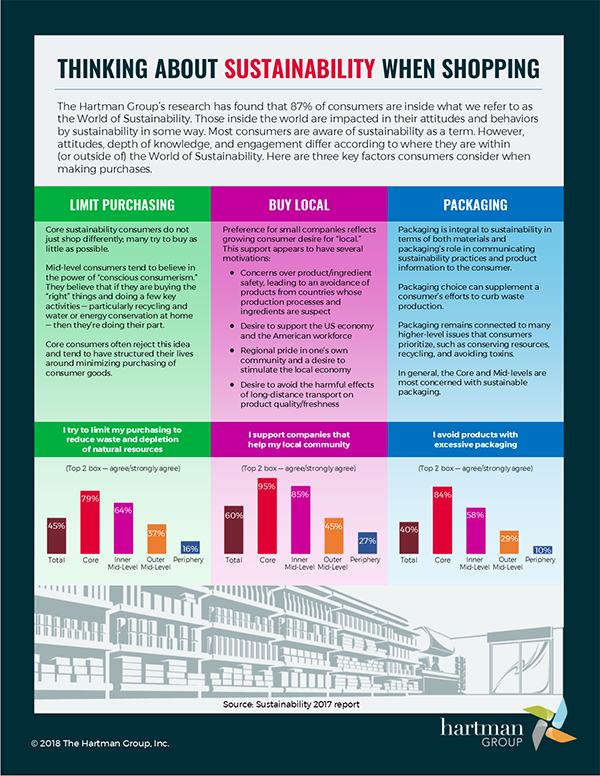
The Hartman Group’s research has found that 87% of consumers are inside what we refer to as the World of Sustainability. Those inside the world are impacted in their attitudes and behaviors by sustainability in some way. Most consumers are aware of sustainability as a term. However, attitudes, depth of knowledge, and engagement differ according to where they are within (or outside of) the World of Sustainability. Here are three key factors consumers consider when making purchase
If you read the From 0 to 35 in Mississippi post here last fall, you know that the good food revolution in my neighboring state has been lacking a few important items to help build their capacity such as USDA processing facilities. The news of one opening in MS is very, very welcome as without it, producers are severely limited to what, where and how much they can sell. Let’s hope this is the beginning of a new level of infrastructure for direct marketing family farms across the Magnolia State.
The urban excitement around local food is not matched by farmers in the countryside. This is a serious debit and an economic one. We have several problems, not the least being that the demand for local food going up in cities has met the rural culture coming down. The economic lives of the people who grow our food and do the work of getting it to our tables must no longer be ignored. I think we know this now. We need more farmers. They need to know how to farm well and to be able to afford to farm well. And, they need to be able to have land to farm on. Land that is not so debt-encumbered that they are instantly in an emergency…
…If what has happened to our farmers and to our country’s rural landscapes is the result of decisions made in places of power far removed from the places harmed, then different decisions can be made.
An earlier blog post of mine links to one of my fav opinion pieces from Mary Berry that everyone in food systems should check out.
And also makes me think of a post I had written about refraining from jumping to new “solutions” in food system work and the need for balance in food organizing.
Gar Alperovitz is a historian, political economist, activist, and writer. He has written many books, including The Decision to Use the Atomic Bomb, and, more recently, What Then Must We Do? Straight Talk About the Next American Revolution. He grew up in Racine, Wisconsin, and has contributed to numerous efforts at economic reconstruction, including in Youngstown and Cleveland, Ohio. All of which he discussed with n+1.
n+1: What is the Cleveland Model?
GA: The idea is to set up an institution, not a corporation, but something else, within a geographic community. And then on that structure you build worker-owned and multi-stakeholder firms that cannot be sold off, which is critical. This means that any growth that happens is distributed more equally because everybody collectively and individually owns a piece of the asset whose value is appreciating, whose revenue is growing.
Then you’ve got these anchor institutions I was talking about earlier: hospitals and universities—Case Western, Cleveland Clinic, University Hospitals. Medicare, Medicaid, education efforts—lots of public money in the area: Those three Cleveland institutions alone purchase $3 billion in goods and services a year. That’s leaving aside salaries and construction—just what they buy. And, until now, none of it from that area. So the model directs some of that purchasing power to the multi-stakeholder firms and co-ops.
Now, these are not your traditional small-scale co-ops. The model draws heavily on the experience of the Mondragon Cooperative Corporation in the Basque Country of Spain, the world’s most successful large-scale cooperative effort, which now employs around eighty thousand workers in more than 250 high-tech, industrial, service, construction, financial, and other largely cooperatively owned businesses.
In Cleveland now, there are three such firms. The Evergreen Cooperative Laundry [ECL] is the flagship, and it capitalizes on the expanding demand for laundry services from the health-care sector, which is huge, something like 18 percent of the national GDP and growing. After a six-month initial “probationary” period, employees begin to buy into the co-op through payroll deductions of fifty cents an hour over three years (for a total of $3,000). Employee-owners build an equity stake in the business over time—a potentially substantial amount of money in a tough neighborhood. Also, it’s totally green, with the smallest carbon footprint of any industrial-scale laundry in northeast Ohio. Most industrial-scale laundries use four to five gallons of water per pound of laundry; ECL uses eight-tenths of a gallon to do the same job.
The second employee-owned enterprise is Evergreen Energy Solutions, which does large-scale solar panel installations on the roofs of the city’s largest nonprofit health, education, and municipal buildings—again, those anchor institutions I was talking about.
The third enterprise is Green City Growers, which operates a year-round hydroponic food production greenhouse in the midst of the Glendale neighborhood in east Cleveland. The 230,000-square-foot greenhouse—larger than the average Walmart superstore—will be producing more than three million heads of fresh lettuce and nearly half a million pounds of (highly profitable) basil and other herbs a year.










 Helping Farmers Markets Grow