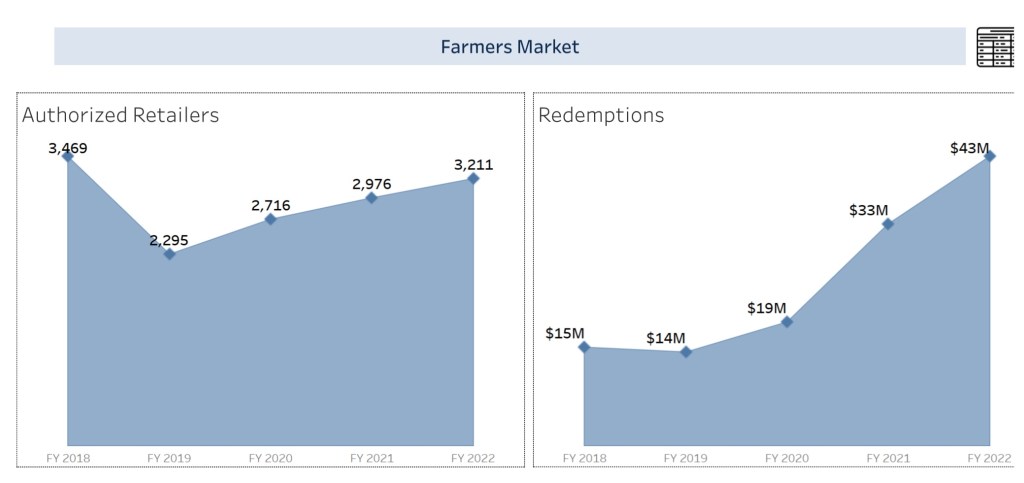
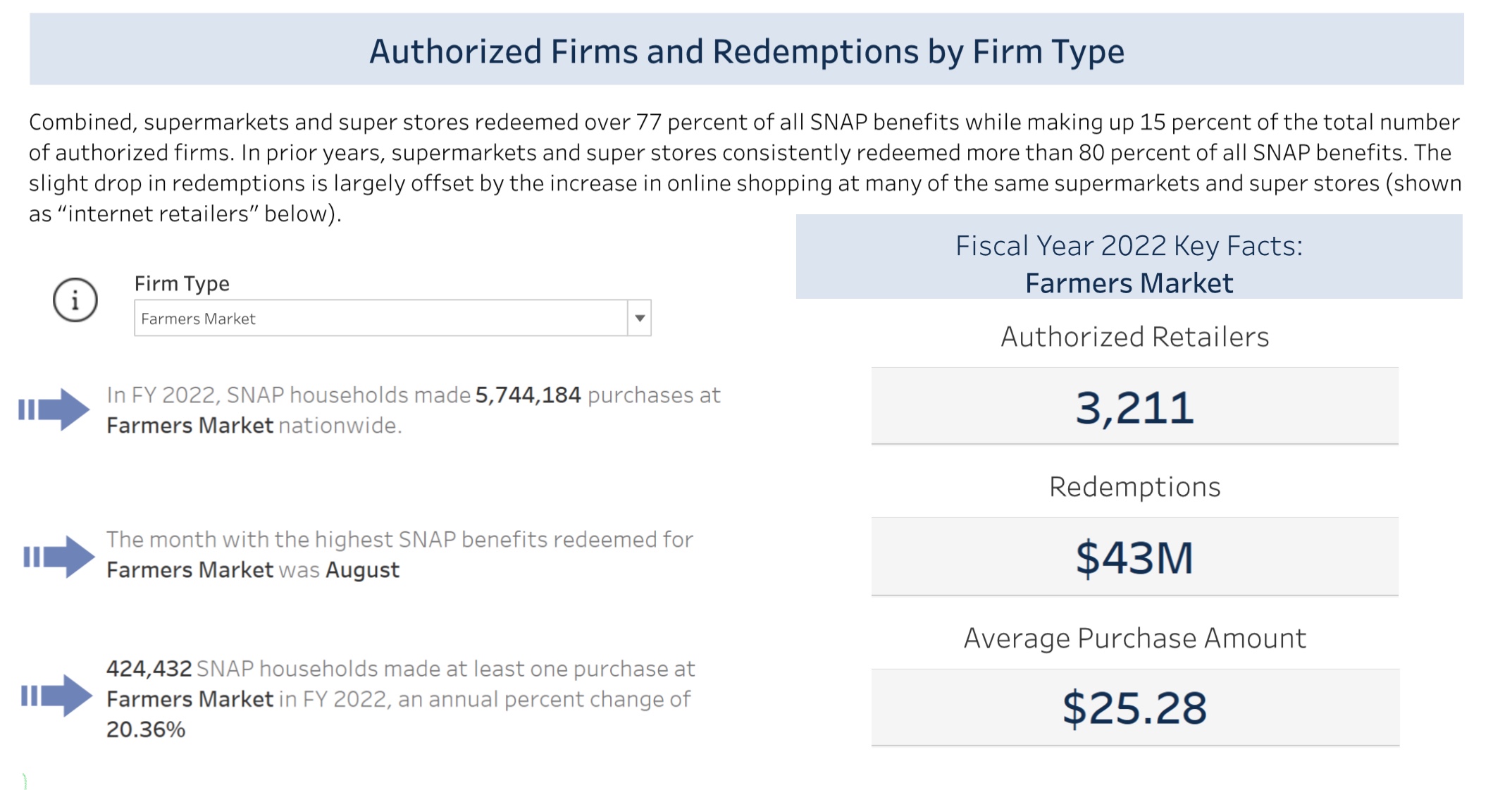
2022 National SNAP FM/DMF data (source: USDA FNS )

Farmers markets continue to increase their overall SNAP sales

Direct Marketing Farmers increase sales as well, although not as fast as FMs. It is also possible that DMFs are making some of these sales at farmers markets.

Not sure how this Average Purchase Amount is calculated; this metric may be actually be “Average Amount Debited from SNAP Card” since the total issued by the farmers market entity may not (and where matching incentives at many markets are, likely not) be the total amount spent by the shopper. And on the other end, in some cases the total issued is not always spent entirely, and instead saved for future shopping trips.

The average sale for DMFs is impressive. This metric may be more precise as an average sale per shopper, since for most DMFs the total is tallied and then the card is debited rather than the other way around as is done at most farmers markets centralized terminal models.

Call for historical data

I have begun to formally write a history of the US farmers market movement that has developed since 1976. As some readers may know, I began to gather histories of markets more than 20 years ago, writing down reminiscences from founders, reading collected histories, and creating the start of a framework that I use to explain the re-emergence of this ancient mechanism. Take a look at this post that does its best to give an overview of this framework:

In preparation for this writing project, I have begun to collect more histories from each of those eras (as well as those outliers who don’t so neatly fit into the larger era) which I believe will become a series of articles around the modern farmers market movement and is meant to offer information to funders, shoppers, and to partners in order for farmers market communities to gain more sustained support.

I’m asking leaders to add their market history to my database through this quick form. I’ll follow up with more q for some of those who respond to ask to use them as a case study.

Here is the form to fill out:

https://forms.gle/i2YfaZhYsuiMcHnc6

And thanks.

London to Berea: a fall farmers market story

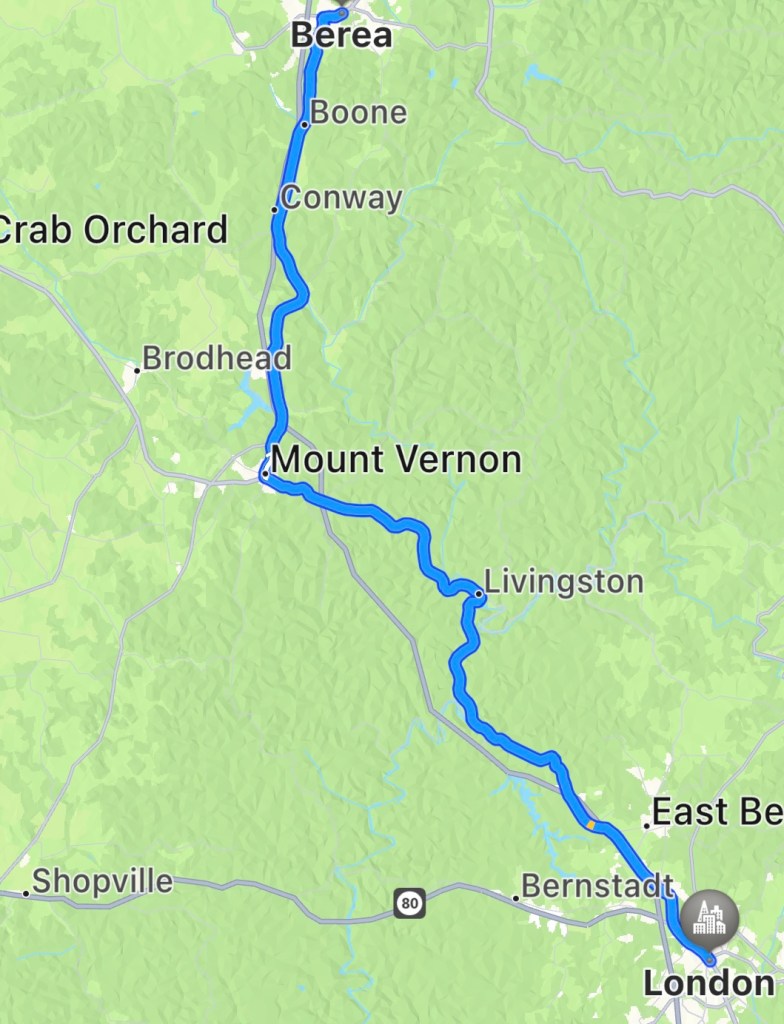
Leaving my London KY hotel while it’s still dark, I head north to Berea. As always, I’m gonna arrive too early even for the farmers market and for that reason (but also to soak up the local) I choose the state highway over the interstate, or as author William Least Heat Moon named these old roads, the blue highways. This road runs almost perpendicular to or crossing I-75 for most of the trip, at times less than a few hundred feet separate them. When it does come that close to the big booming noise of traffic just to the left, I look at the houses and businesses that have an interstate behind them and this road in front and wonder how those living there felt to be spared from the bulldozers and if “spared” is how they felt and or still feel.. 

Route 25 has existed since 1926 between Georgia and Michigan – well really now just to Covington KY just across the bridge from OH since I-75 eliminated all traces of it in Ohio and Michigan. It was once known as the Dixie Highway, which was the first road to connect the Midwest to the South starting in 1914. 

At first, I am momentarily blinded by cars (trucks mostly) heading the other way, and can see little that makes this drive worthwhile. But as the light starts to peek over the horizon, the shape of the surrounding area can be seen. Hills with sunlight highlighting the reds, oranges and green colors with scattered homes (almost all painted white), old barns (almost never painted but left to weather in browns and greys), churches (mostly red brick), and work buildings (almost all with dozens of mechanical items crowding them) placed throughout. In each coven of buildings, the oldest are being allowed to melt back into the soil rather than tearing them down, the next oldest leaning leeward but still probably functional, and the newest most often designed in one story ranch style or mobile home. The main road is newly paved (thanks Big Govt) and I pass hilly gravel roads on either side with names like Old Crab Orchard Road, Old Hare Road, and can see tantalizing signs for John Swift’s Lost Silver Mine and Daniel Boone’s Historic Campground.

The road crosses the Daniel Boone National Forest which covers 21 counties of Kentucky with more than 708,000 acres in its glorious free space (once again thanks Big Govt). I pass through Livingston in Rockcastle County which is one of the park’s Trail Towns, where you can expect to find supplies and guides and food for traversing this rugged park.  

My trip is quiet and even peaceful as few vehicles are heading my way, and likely because of the next door interstate, no 18-wheeled trucks roar up behind or on side of me, menacing my little van.

Once in Berea, I spy the farmers market with its gorgeous new pavilion which is easily seen from all directions. From the road, I can see the vendors are still setting up and, knowing how anxious it can make them to have someone wandering around before they are ready, I instead take a right and head downtown, feeling confident I will find a good coffee somewhere near the famed college. More indications of Big Government doing its job appear on the way, including remodeled bridges, pedestrian crosswalks, smooth streets. I spy a jumble of signs that indicate culturally significant activities to the left, so I turn into an area named Artisans Village District which is a cluster of little cottages with retail signs designed to pull visitors looking for culture and craft. 

Not much going on there yet, but I find the open bagel and coffee house on the main road on its edge and get a honey wheat with maple bacon cream cheese with a good espresso and sit down in its modern, well-lit and friendly space.

 The line grows as soon as I sit and I note the number of families and working men and women already up and at it, all smoothly ordering a NY style bagel and artisanal coffee in Kentucky.

I finish my bagel and head to the market as it is opening time. I try to get to a market at its opening, and make some mental notes. Most of those things I look for do not have a right or a wrong way, they just reveal its culture. Things I look for:

Are all vendors set up by opening time?

Does the market indicate opening time with a bell or other manner?

Does the market have a welcome tent?

Are vendors offloading (walking their items in) or are their vehicles directly behind their table?

Is signage uniform or does it vary table by table?

How much diversity is there among the people vending? How about in its shoppers?

Do any vendors or the market indicate they can process government benefits like SNAP or FMNP?

Are there craft vendors?

Are there hot food vendors?

And so on. The list is extensive but with practice I have found I can note many things without being overt about it. Most of what I learn comes from the conversations with market manager and vendors and this day was no different.

I started by having a pleasant chat with its manager Olivia, who had a beautifully set up market welcome tent all ready to go, with SNAP signage very noticeable for those seeking to use their benefit dollars there. I assume that the tent with its Doubling Dollars information printed on it is likely given to the market by the entity that manages the program in Kentucky. 

The overall impression of the tent and of the market is one of extreme tidiness and with good sight lines.

I start at the right row of the 2 parallel rows, with a woman selling a variety of goods including persimmons, so I engage in a conversation about the varieties she sells. She knows a great deal about them and we talk about how shoppers now ask for them and how they are a food that is likely seeing a resurgence because of farmers markets (since so many varieties do not ship well to be able to sit in grocery coolers for weeks at a time.) When I ask, she (like most of their vendors) agreeably takes cards for payment for her goods. Having the ability to to swipe credit and debit cards has only recently moved to almost universal acceptance among vendors at many markets. Where it has happened all note the COVID era of risk mitigation as its cause when some markets were unable to use wooden tokens or were forced into drive through sales or unable to open at all. In all cases, farmers had to find an added method of processing payments and did. Now market managers happily tell shoppers to go through the vendors to swipe credit and debit even while SNAP is usually still handled at market level to everyone’s appreciation.

I see a friendly couple next to the persimmon seller who also have a variety of goods on their tables, including micro greens and beautiful tiny turnips. I would dearly love some micro green sprouts but being on the road I worry I wont be able to keep them safe in my coolers. I am regretfully about to turn away when I realize they also dehydrate and grind their microgreens into a powder, which I can store. I once again ask if I can use a credit card- they immediately answer yes but then cannot get a signal to process the card. The farmer grows anxious with the delay, although I am not as anxious. He mentions the signal is intermittent at this new pavilion and we discuss whether the city or the market can and should add a signal strengthener nearby. I finally root about my wallet to find that I have the exact dollar amount in there to cover my purchase; I offer it instead and he asks me if that’s “okay” to take my cash. “Of course” I answer and I silently turn that exchange over and over in my head because cash being used as the secondary payment  method is such a new development between customers and vendors at farmers markets.

I walk past other vendors beyond theirs but I keep my distance from the tables because I can see that they have vegetables I am unlikely to purchase. I do, however, catch their eye and say hello and, when I feel moved to do so, comment on their table or its products. I know that being ignored when selling in an open space can be uncomfortable and even painful and that a friendly hello can make a quiet sales hour seem slightly less scary.

I speed up to get to the second row and note that this has a slightly different feel with (seemingly) more younger or newer vendors on this side. (Which makes me wonder if vendors choose their own space or are assigned).

Close to the middle of the row, there is a kombucha and nutrition bar vendor with a tap encased in a beautiful wooden dispenser for cold brew and samples of kombucha. The vendor tells me the vendor 2 tents down (who is seated to the back working on other craftwork while someone else handles sales), made the display. We have a longish discussion about markets and intermediate sales for their business. They tell me they sell to a number of small businesses in the area but expect to maintain their farmers market presence to support farmers and to grow their business there, maybe even taking on more farmers markets in the future. 

I share tidbits of my research on markets including that many of the first “modern era” (1970-) markets began in university towns like Berea because the back-to-landers decided to stay  and grow organic food, so then created many of these new “grow it to sell it” markets; I say that it is interesting to me that markets in these towns continue to impress me with how they hold and even grow markets’ role in improving sustainability and introducing the area to products like hers Her quiet and firm reply that “it shows they (markets) are really about the shared culture” strikes me as rich with simple truth as we stand in an open pavilion on a cold fall morning in a town of 15,000 or so.

Finally I realize I am blocking a very polite shopper behind me and move away. I catch the eye of the woman I had purchased the persimmons from and smile from afar in thanks as I head toward my van to drive it to the next town.

2019 data collection strategies-South Champlain Islands and Capital City Farmers Markets, Part 2

from Part 1

For the last few years,I have worked on an FMPP-funded project under the supervision of NOFA-VT’s Direct Marketing Coordinator, Erin Buckwalter. This project will aid in building a culture of data collection at Vermont’s farmers markets and has included resource development, evaluation strategies for all market types, and direct technical assistance and training. Because of this, I added a second annual trip besides my usual winter conference attendance. And lucky for me, it was scheduled for the summer rather than the usual winter trip, which, although very lovely, is somewhat limiting for this Southerner and means I see few markets.

Erin suggested that we create a team of market managers, agency leaders, and market volunteers to gather data for markets in August. The goals were multiple:
1. model good data collection habits
2. network markets interested in data collection
3. test out some methods for different types of markets
4. look for opportunities for needed resource development on evaluation
5. see more markets and make a direct connection with market leaders
6. collect some data!

She sent out an email to a few markets to nominate themselves. Obviously we needed to be able to do them in a short span of days, the successful applicants needed to have a use for the data, and they would have to have some capacity to assist the team.

We ended up with 2 excellent choices: Champlain Islands Farmers Market – South Hero, held Wednesday afternoons 3-6 pm, and Capitol City Farmers Market (Montpelier) held 9-1 pm Saturdays.

They were wonderful choices because they were so very different, and they have enthusiastic leadership that are very interested in the data.

Capital City Farmers Market-Montpelier

The team:
Jennie Porter, NOFA-VT’s Food Security Coordinator
me
Dave Kaczynski , Montpelier FM board member, VTFMA board member
Sherry Maher, Brattleboro Winter mkt leader, and NOFA-VT’s lead for in-state data collection strategies on this project
Alissa Matthews, VT Agency of Ag, Food and Food Systems (VAAFM)
NOFA-VT alumni Jean Hamilton and Libby MacDonald
Elizabeth Parker from Sustainable Montpelier Coalition who offered to stay and help when we approached her as a shopper that morning.

Dave and his fellow board member Hannah Blackmer were our leads for the this farmers market collection. This required a very different plan than South Hero, as the Montpelier market is much larger and is situated on a busy shopping district street. As most Vermonters know, this beloved market has been around for 40 years, but has already had to move locations more than once, and will have to do that again after this year. So questions about location had to be added to this survey which meant a flurry of emails and even some refinements to the survey on Saturday morning- thankfully, there is a copy/print company right down the street that was open.
And because this market was on a Saturday morning, market leaders who were interested in doing team data collection could not help, as most were either running their own market or working another job.
So because we had a smaller than necessary team, and the survey would take longer, we decided on a different and relatively new method for collecting the visitor count. We used a method that works better for small teams and for less busy markets: the Sticker Count.
The idea is to give each adult who enters the market a sticker to wear, telling them that we are counting the attendance that day, and then count how many stickers were given out to assess the number. And by wearing the sticker, we won’t double count them.
This method can be fun and less taxing to counters than clicking entries, but it has its own issues, such as:
1. The community has to be aware of this activity beforehand and know to take a sticker but only one.
2. Since counts are estimating potential shoppers, kids are not usually counted. That can be difficult when kids cannot take one of these stickers as they are often the only ones who want to wear a sticker. (Our solution was to stick those stickers to the back of our paper that someone had refused to take to be able to give kids one of those. That way the child’s sticker was not adding to our count. Another way to solve this will be to have kids-only stickers to hand out.)

3. Complex layouts can also make this hard (although complex layouts make ALL counting hard!) and CCFM has ONE fascinating and complicated layout:


In terms of the survey, we decided to have more ways to complete them as we had a goal to get over 260 completed surveys:
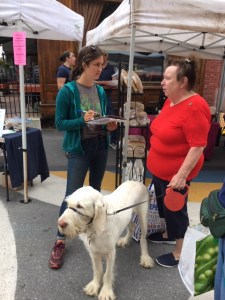
• “intercept” surveys, which means a surveyor asked questions and wrote the answers on their form

•  self-reported surveys under a tent, where people could fill out the forms on their own on paper, or on one of our laptops set up for that;


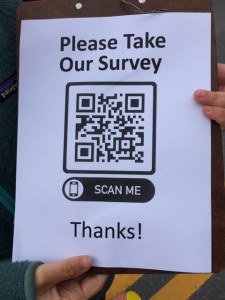
•  having signs with a QR code for smartphone users to snap a picture using their smartphone which takes that phone to the form online.


The tent was ably staffed by Alissa Matthews, who we decided to have there because she has been involved with this relocation process and could better answer questions about the possible locations and is always calm and cheerful . Dave set the tent up beautifully, both by adding eye-catching signs and table coverings. He also knows how to make tables comfortable for those reading or writing by adding leg extensions which helped as well. His survey work is also stellar; he is a natural at it.
The tent was constantly bustling, Alissa aided by me or by nearby Sticker Queen, Libby McDonald.

One issue at the tent was that the online form was designed to require an email address, which is helpful to ensure only one response per email, but it seemed to freak out those at the computer. The reason the online survey was also included was partly to gather more responses next week after market day, because the location issue is significant for the entire market community to be able to weigh in. Oddly, those doing the self-reporting paper surveys at the same tent were less concerned about the email request on their form and even when we told people they didn’t have to fill out their email on those forms, they often did, saying they would be happy to learn more about the market or the relocation process. (And those doing intercept surveys don’t ask for emails at all.) Another issue was that the printed self survey had a few areas that confused people (the frequency of visit choices were too close together so many people circled more than one choice, and lots of folks missed the other side!) One last issue that I noted a few times were both members of a couple were filling out surveys, which means their economic contribution that day would be doubled. I don’t think any of these damaged the day’s data in a major way, but these are the issues that can arise with allowing self-reported survey completion.


The sticker counting started off extremely well, with aforementioned volunteer Libby taking the entrance near to our tent as her stickering responsibility. We worked out language around that, as brandishing a sticker at someone entering a market could seem off-putting, and the market had less time to let folks know beforehand that we’d be doing this.

Instead of “Can I offer you a sticker? The market is counting everyone attending..” which offers an easy chance for a NO.

we settled on:

“here’s a sticker for you (putting it gently on a shoulder or handing to the person) ; the market is counting everyone attending by giving each adult a sticker. The good news is if you wear it, we’ll not bother you again!”

3-5 of us were constantly handing out stickers (and the surveyors also had stickers if someone they stopped had gotten past us), all strategically placed near entrances or busy areas. We also had signs at all of the vendor booths and also explained what was happening and asked them to steer anyone without a sticker to one of us.

Our estimate was that maybe 20% were not stickered, especially later on when larger groups started to show up and we couldn’t get to them all. That part is still a very rough guess, but with more trials, we may get better at it.

Still, it was a cheerful, participatory way to do counting and many people were intrigued by the idea and one person even said enthusiastically to one of our team when asked if she had taken a sticker: “Yes,  I was counted today!”  Honestly, that made my day.

Overall, the numbers of surveys far exceeded our goal (we even had to go print more surveys for people to fill out!), our count felt as if was a good test and the team felt relatively confident about the numbers.


The Cap City Team: Me, Dave, Sherry, Jennie, Jean, Alissa, and Libby (sorry to miss Elizabeth who had left.)

Part 1

2019 data collection strategies-South Champlain Islands and Capital City Farmers Markets – Part 1

Checking out different ways that markets collect and use data is one of my chief duties in developing evaluation tools over the past 20 years. And since part-time at FMC, I have also contracted directly with some markets and networks, mostly on data collection strategies, which also informs my FMC duties.
One of those delightful synergies can be illustrated through my long time relationship with Northeast Organic Farming Association- Vermont (NOFA-VT). For the last few years, I have worked on an FMPP-funded project under the supervision of NOFA-VT’s Direct Marketing Coordinator, Erin Buckwalter. This project will aid in building a culture of data collection at Vermont’s farmers markets and has included resource development, evaluation strategies for all market types, and direct technical assistance and training. Because of this, I added a second annual trip besides my usual winter conference attendance.  And luckily for me, it was scheduled for the mid-summer rather than the usual winter trip, which, although very lovely, is somewhat limiting for this Southerner and has meant few market visits.

Erin suggested that we create a team of market managers, agency leaders, and market volunteers to gather data for markets in August. The goals were multiple:
1. model good data collection habits
2. network markets interested in data collection
3. test out some methods for different types of markets
4. look for opportunities for needed resource development on evaluation
5. see more markets and make a direct connection with market leaders
6. collect some data!

She sent out an email to a few markets to nominate themselves. Obviously we needed to be able to do them in a short span of days, the successful applicants needed to have a use for the data, and they would have to have some capacity to assist the team.

We ended up with 2 excellent choices: Champlain Islands Farmers Market – South Hero, held Wednesday afternoons 3-6 pm, and Capitol City Farmers Market (Montpelier) held 9-1 pm Saturdays.

They were wonderful choices because they were so very different, and because they have enthusiastic leadership that are very interested in the data and learning more about collecting it.

Champlain Islands Farmers Market – South Hero
is one of those organizations that operate markets 2 days a week in 2 different locations. As such, it means the two are actually quite different in terms of vendors, products, programs, and visitors.
The Wednesday market is held behind a church and its location was partly chosen to take advantage of the visitors who are on that part of the island before they turn to the ferry. It has around 16 vendors, offering a wide variety of what is needed by seasonal visitors who will be cooking in their vacation kitchens and what permanent residents need for their table. Because the site is offered by a third party, sharing data on the positive impacts of this location is always helpful, as is analyzing the functionality of the site. Cindy Walcott, Market Chair/Treasurer and Julia Small (market manager) were gracious hosts, giving a lot of assistance to our team.

The team:
Erin
me
Dave Kaczynski , Montpelier FM board member, VTFMA board member
Sherry Maher, Brattleboro Winter mkt leader, and NOFA-VT’s lead for in-state data collection strategies on this project
Janice Baldwin also from the Brattleboro Winter Market
Alissa Matthews, VT Agency of Agriculture, Food, and Markets (VAAFM)
Anisa​ Balagam​, the new market manager of the Winooski Farmers Market​.​

This market organization has collected data previously and has devised an almost fool-proof way to count their visitors. Since the parking is routed from the main road via a narrow drive to a graveled area, they can position someone at the beginning of the drive, counting every car and the number of adults inside. Additionally, it also allows the market to collect the license plate state which is extremely important as Cindy says that the attendance for this weekday market usually about 50% Vermonters.

Using their counting sheet, two of us went to the vantage point to gather the count. Cindy has also downloaded a counting app on her smart phone, having set it up previously to capture the same detailed data, but we decided to go paper.

Cindy gives us an overview of the counting method the market uses.

The rest of us would gather surveys from the visitors, and since we had a good crew size, could team folks up and also allow them to take breaks to shop and eat.
They had a tent and tables for our use, and we decided to put it in the location where we could best capture folks on their way out. Deciding if the team will survey folks coming in or out is one of the decisions the collection supervisor needs to make before or on the day of – with input from the team.

Whether you do it on the way in or out has a lot to do with the shopping behavior

-are people frantic about missing items that quickly sell out? they will be less interested in doing the survey on the way in.

-are people loaded down with bags and have a long way to go to their parking? they may be less interested in offering data on the way out, although having tables and a tent to put their items down does help!

-and if you are asking intent on learning about their purchases that day, it may be better to wait until the end of the shopping trip. – However, if you have a small market with a lot of regular weekly shoppers, it may be okay to do it as they come in as the amount spent may not vary as much week to week for those shoppers.

We began the day with a group logistical meeting: introductions, and discussing who would be where and how to get breaks when needed. Depending on the group, a quick round of role plays with the survey sheet may also helpful. Cindy gave us the likely attendance number (which decides how many surveys to collect), and the type of shoppers this market usually experiences. My responsibility as the Data Collection Coordinator was simple for this market (and was a very different job for our Saturday market visit at Capital City – more on that in Part 2) but even when it is simple, the Coordinator should be constantly rotating, collecting completed sheets to make sure things look right, re-assigning folks when necessary, and generally seeing what else can be done (and if possible, doing data collection too.)
The crew was eager and because it was a group of market leaders was great at problem-solving, very willing to engage with shoppers, and able to gracefully steer “I don’t know” answers to a specific amount or answer.

market map

The market had originally had us next to the Land Trust info booth, but after a short discussion, the team decided that moving our tent to a spot closer to where we estimated the path to leaving the market would be was better for us. Dave also suggested that we move the picnic table into our tent for folks to sit or to place their bags, and since the day began rainy,  Julia thought it fine to do just that.
The survey collection went great as everyone was very willing to stop and answer questions. I find that the majority of people (90-95%) are always very open to this, especially if the opening line is something like “Can you spare a minute to help the market?”  It has almost always been true on the farmers market data collection teams that I have worked that surveyors constantly exceed the collection goals set for them because they find it easier and more fun than they originally expected. Sometimes it is harder to get them to slow down, which can be necessary to make sure that a comparable number of surveys are collected in each hour.Making it fun for the surveyor and not taxing to the respondent are other reasons that the survey should be well designed and as short as possible!

I must say for this experience of having every person we asked say yes AND people making a beeline for us to take the survey before we approached them was delightful, and is a credit to the excellent pre-market communication that the market had with this community and also makes it clear that the community understands that this is a data-driven market.
Well done Champlain Island Farmers Markets!

More later on the data that was collected, once it has been cleaned and organized by the market organization and NOFA-VT. We did exceed our goal for the number of surveys that the team and the market agreed it wanted to collect. For most markets, collecting 10-15% of the usual attendees will be a good number, but there are ways to calculate that further.

Anissa uses the tent

Erin does the first survey

Data collection and time for sharing and general conversations too


Part 2