I’m excited to finally be able to spend the time on writing the history of the modern era of farmers markets. Thanks to all who have filled out the survey form already, but if you haven’t yet, here it is again:
The purpose of this will likely be a series of articles for market leaders, policy leaders, and researchers to better understand the importance of the farmers market in the local food movement, with its flexibility in fulfilling market day and also system level impacts while remaining the public, informal face of the entire movement. There are many external challenges ahead, and my hope is this research will offer strategies for offering support to market organizations and to center farmers, foragers, ranchers, and harvesters who are the stewards of land and water and community leaders in every sense.
If the articles turn into a book, it will also be for those general readers who are interested in community and current history, who can learn how to support their local markets more fully .
A few books from my collection. Some of you may note that only one is really what we would define as a farmers market. Even though many of the books in the above pic do not focus on the modern farmers market, I’m sure we’d all agree that knowing what we had previously is vital to understanding the recent past and the present too.
Shout out to The Dane County Farmers Market book seen above which is a treasure trove of the type of primary data that is sooo helpful. Not only does it detail the entire history of what is one of the first of our kind (opening September 30, 1972) designed as a community-led, transparently governed, open-air farmers market, but I also love that the book arranges that history in chapters by its eras of market manager! (Of course I love that because as an FMC staffer, I follow the strategic plan which prioritizes our work in directly supporting market operators.) Kudos to authors Mary and Quentin Carpenter, with equal credit to Mary’s term as market manager.
So how many of you have published histories of your market? Feel free to leave links in the comments…
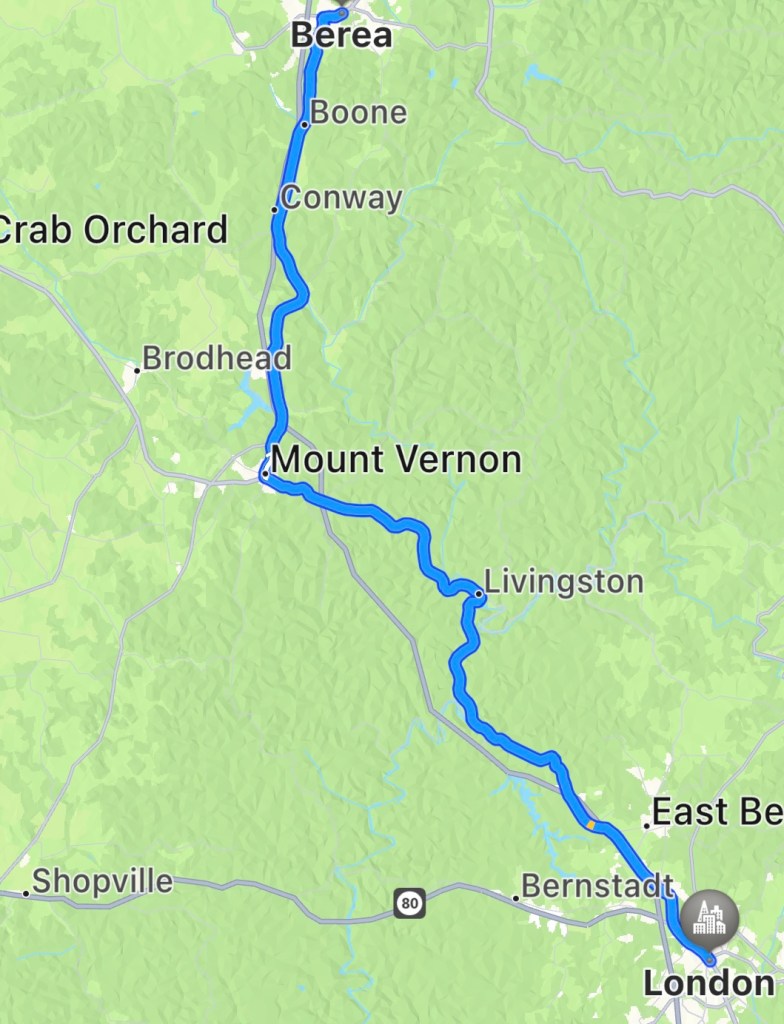
Leaving my London KY hotel while it’s still dark, I head north to Berea. As always, I’m gonna arrive too early even for the farmers market and for that reason (but also to soak up the local) I choose the state highway over the interstate, or as author William Least Heat Moon named these old roads, the blue highways. This road runs almost perpendicular to or crossing I-75 for most of the trip, at times less than a few hundred feet separate them. When it does come that close to the big booming noise of traffic just to the left, I look at the houses and businesses that have an interstate behind them and this road in front and wonder how those living there felt to be spared from the bulldozers and if “spared” is how they felt and or still feel..
Route 25 has existed since 1926 between Georgia and Michigan – well really now just to Covington KY just across the bridge from OH since I-75 eliminated all traces of it in Ohio and Michigan. It was once known as the Dixie Highway, which was the first road to connect the Midwest to the South starting in 1914.
At first, I am momentarily blinded by cars (trucks mostly) heading the other way, and can see little that makes this drive worthwhile. But as the light starts to peek over the horizon, the shape of the surrounding area can be seen. Hills with sunlight highlighting the reds, oranges and green colors with scattered homes (almost all painted white), old barns (almost never painted but left to weather in browns and greys), churches (mostly red brick), and work buildings (almost all with dozens of mechanical items crowding them) placed throughout. In each coven of buildings, the oldest are being allowed to melt back into the soil rather than tearing them down, the next oldest leaning leeward but still probably functional, and the newest most often designed in one story ranch style or mobile home. The main road is newly paved (thanks Big Govt) and I pass hilly gravel roads on either side with names like Old Crab Orchard Road, Old Hare Road, and can see tantalizing signs for John Swift’s Lost Silver Mine and Daniel Boone’s Historic Campground.
The road crosses the Daniel Boone National Forest which covers 21 counties of Kentucky with more than 708,000 acres in its glorious free space (once again thanks Big Govt). I pass through Livingston in Rockcastle County which is one of the park’s Trail Towns, where you can expect to find supplies and guides and food for traversing this rugged park.
My trip is quiet and even peaceful as few vehicles are heading my way, and likely because of the next door interstate, no 18-wheeled trucks roar up behind or on side of me, menacing my little van.
Once in Berea, I spy the farmers market with its gorgeous new pavilion which is easily seen from all directions. From the road, I can see the vendors are still setting up and, knowing how anxious it can make them to have someone wandering around before they are ready, I instead take a right and head downtown, feeling confident I will find a good coffee somewhere near the famed college. More indications of Big Government doing its job appear on the way, including remodeled bridges, pedestrian crosswalks, smooth streets. I spy a jumble of signs that indicate culturally significant activities to the left, so I turn into an area named Artisans Village District which is a cluster of little cottages with retail signs designed to pull visitors looking for culture and craft.
Not much going on there yet, but I find the open bagel and coffee house on the main road on its edge and get a honey wheat with maple bacon cream cheese with a good espresso and sit down in its modern, well-lit and friendly space.
The line grows as soon as I sit and I note the number of families and working men and women already up and at it, all smoothly ordering a NY style bagel and artisanal coffee in Kentucky.
I finish my bagel and head to the market as it is opening time. I try to get to a market at its opening, and make some mental notes. Most of those things I look for do not have a right or a wrong way, they just reveal its culture. Things I look for:
Are all vendors set up by opening time?
Does the market indicate opening time with a bell or other manner?
Does the market have a welcome tent?
Are vendors offloading (walking their items in) or are their vehicles directly behind their table?
Is signage uniform or does it vary table by table?
How much diversity is there among the people vending? How about in its shoppers?
Do any vendors or the market indicate they can process government benefits like SNAP or FMNP?
Are there craft vendors?
Are there hot food vendors?
And so on. The list is extensive but with practice I have found I can note many things without being overt about it. Most of what I learn comes from the conversations with market manager and vendors and this day was no different.
I started by having a pleasant chat with its manager Olivia, who had a beautifully set up market welcome tent all ready to go, with SNAP signage very noticeable for those seeking to use their benefit dollars there. I assume that the tent with its Doubling Dollars information printed on it is likely given to the market by the entity that manages the program in Kentucky.
The overall impression of the tent and of the market is one of extreme tidiness and with good sight lines.
I start at the right row of the 2 parallel rows, with a woman selling a variety of goods including persimmons, so I engage in a conversation about the varieties she sells. She knows a great deal about them and we talk about how shoppers now ask for them and how they are a food that is likely seeing a resurgence because of farmers markets (since so many varieties do not ship well to be able to sit in grocery coolers for weeks at a time.) When I ask, she (like most of their vendors) agreeably takes cards for payment for her goods. Having the ability to to swipe credit and debit cards has only recently moved to almost universal acceptance among vendors at many markets. Where it has happened all note the COVID era of risk mitigation as its cause when some markets were unable to use wooden tokens or were forced into drive through sales or unable to open at all. In all cases, farmers had to find an added method of processing payments and did. Now market managers happily tell shoppers to go through the vendors to swipe credit and debit even while SNAP is usually still handled at market level to everyone’s appreciation.
I see a friendly couple next to the persimmon seller who also have a variety of goods on their tables, including micro greens and beautiful tiny turnips. I would dearly love some micro green sprouts but being on the road I worry I wont be able to keep them safe in my coolers. I am regretfully about to turn away when I realize they also dehydrate and grind their microgreens into a powder, which I can store. I once again ask if I can use a credit card- they immediately answer yes but then cannot get a signal to process the card. The farmer grows anxious with the delay, although I am not as anxious. He mentions the signal is intermittent at this new pavilion and we discuss whether the city or the market can and should add a signal strengthener nearby. I finally root about my wallet to find that I have the exact dollar amount in there to cover my purchase; I offer it instead and he asks me if that’s “okay” to take my cash. “Of course” I answer and I silently turn that exchange over and over in my head because cash being used as the secondary payment method is such a new development between customers and vendors at farmers markets.
I walk past other vendors beyond theirs but I keep my distance from the tables because I can see that they have vegetables I am unlikely to purchase. I do, however, catch their eye and say hello and, when I feel moved to do so, comment on their table or its products. I know that being ignored when selling in an open space can be uncomfortable and even painful and that a friendly hello can make a quiet sales hour seem slightly less scary.
I speed up to get to the second row and note that this has a slightly different feel with (seemingly) more younger or newer vendors on this side. (Which makes me wonder if vendors choose their own space or are assigned).
Close to the middle of the row, there is a kombucha and nutrition bar vendor with a tap encased in a beautiful wooden dispenser for cold brew and samples of kombucha. The vendor tells me the vendor 2 tents down (who is seated to the back working on other craftwork while someone else handles sales), made the display. We have a longish discussion about markets and intermediate sales for their business. They tell me they sell to a number of small businesses in the area but expect to maintain their farmers market presence to support farmers and to grow their business there, maybe even taking on more farmers markets in the future.
I share tidbits of my research on markets including that many of the first “modern era” (1970-) markets began in university towns like Berea because the back-to-landers decided to stay and grow organic food, so then created many of these new “grow it to sell it” markets; I say that it is interesting to me that markets in these towns continue to impress me with how they hold and even grow markets’ role in improving sustainability and introducing the area to products like hers Her quiet and firm reply that “it shows they (markets) are really about the shared culture” strikes me as rich with simple truth as we stand in an open pavilion on a cold fall morning in a town of 15,000 or so.
Finally I realize I am blocking a very polite shopper behind me and move away. I catch the eye of the woman I had purchased the persimmons from and smile from afar in thanks as I head toward my van to drive it to the next town.
The link below is to a post from Richard Florida on examining rural-urban tropes that are used ad nauseum often in lieu of updated facts. It is my opinion that with this type of analysis (often done for the excellent CityLab), Florida has mostly made up for what many believe was his famous yet flawed theory of an emerging creative class as the main driver of economic success. Many of his critics believed he included too many non-creative careers in his accounting, or that he cherry-picked cities where his theory fit best, or they pointed out its lack of info on the structural inequities that allow some (read young white people) to have unequal access to resources and to opportunities. (I’d also add that the very mobile/online nature of many of the careers and the age of those who hold them means any effect will need a longer span of years to truly analyze its effect.)*
Unfortunately, that original theory has been misused over and over again by municipalities, allowing developers to profit from shiny “open space” monuments to unchecked consumerism for technology-addled people to sit in silence, more divided than ever, rather than insisting on meaningful public spaces serving a diverse group of people. I know many farmers market leaders that read this blog know exactly what I mean by that rush to capitalize on it.
Since the election of 2016, the rural/urban discussion has become a juggernaut of its own, and yet in most analysis, it still lacks regional context and nuance. I am sure that is not surprising to anyone, as that is the norm in American election campaigning. In terms of our work in farmers markets however, this issue is something we must understand and own and we cannot allow easy reads of it to stand. The good news is that our work illuminates what Florida and others have already found, and our data can help even more good analysis to follow – that is, when we collect and share data and when we challenge our own assumptions.
For example, I always question food system activists when they use the term “urban agriculture” because I don’t think it means anything. Or rather, I don’t think it means what they think it does. It seems to me that term does disservice to both urban producers and to their rural sistren and brethren, as well as confusing the visitors that we want to attract. I also challenge rural activists when they refuse to share their lessons learned with their urban colleagues. Cannot tell you how many times people have rolled their eyes at me when I suggest they publish something about their small town triumph, or when I suggest they go to regional conferences that include urban topics. And our just-as-dedicated suburban food system leaders almost always get scornful dismissals from rural and urban colleagues and funders even while they are seeing a huge influx of immigrant diversity in their midst, as cities becomes too expensive for many newly arrived residents.
This is important because as I have written on this blog previously, I believe one major impediment to more resilient food systems is this lack of regional thinking, and the unwillingness of many food activists to explore the effect of their work across planning or political boundaries or to think critically beyond the short-term outcomes of their project.
When farmers markets are thriving, I find they are challenging assumptions and boldly expanding who depends on that market community. So understanding your own regional rural-suburban-urban challenge seems like a good first step to your farmers markets becoming place-based regional hubs of innovation, inclusion, and import-replacement. (that alliteration just happened, I swear.) I hope Florida’s piece helps.
Not all of rural America is in decline. Far from it. Significant parts of it are thriving, while others have economies that are in transition. The same is true of urban and metro areas of all sizes. Some are succeeding, others are failing, and still others are standing still.
The reality is that economic growth is not only uneven and unequal between urban and rural places; it is also uneven within them. Some cities and large metros are growing like gangbusters, while others are declining; some suburban areas are booming, while others are beset by economic dislocation and poverty. So it is with rural places.
As usual, I’d like to offer my thoughts as to what may be in store for farmers market organizers and producers in the coming year (as I did in past years: 2018, 2017…)
With the end of year passage of the Farm Bill (coming as a welcome surprise after watching the summer-long legislative shenanigans in the House), the organizing for direct marketing for 2019 is now slightly altered -as soon as the government opens up again that is! The inclusion of LAMP in the farm bill offers markets some stability for grant funding over the next 5 years and also means a better-to-great chance of FMLFPP funding being included in future farm bills. Two other changes may be significant for farmers markets: the requirement of a 25% match for FMPP proposals (it had only been required for LFPP proposals previously), and the language to “support partnerships to plan or develop regional food systems” which is funded at 5 million per year. The FMPP match requirement seems to indicate that the grants will be prioritized for those who build deep partnerships into their proposals, and seems to be born out by the added 5 million for partnership work. Getting this funding could put market organizations in leadership roles in regional policy work, especially in terms of vendor needs (more in a minute on this), disaster response planning, and climate change initiatives with municipalities- that is if the grant language (when written by AMS) directs this funding to individual markets. If it turns out that the funding is really directed more to your state and network associations, I would expect them to use it to build capacity for their markets, especially in the area of increased data collection capabilities and dynamic data-driven analysis. That would align with my 2017 mantras for markets:
Don’t Hide the Hard Work Function like a Network Whenever Possible
Two other areas that I expect to be active among markets in the coming year and beyond is in verification of local claims and in product development initiatives. The first has been climbing the ladder of priorities since the explosion of meal kit box programs, grocery store fragmentation, and the use of “local” in marketing language by every kind of player in intermediate channels (i.e. specialty stores, restaurants.) Farmers Market Coalition has even begun to discuss this regularly in house and included this topic in the farmers market track of 2018’s inaugural Direct Marketing Ag Summit. It was ably covered in a presentation by Washington State Farmers Market Association’s Colleen Donovan whose work on market integrity is well known, and by Boulder County Farmers Market CEO Brian Coppom who is fast becoming a great national spokesperson for farmers markets on the subject. FMC also added to the conversation around brand integrity in 2018 by taking over the management of the Buy Fresh Buy Local brand.
There is much to do on local verification and protection of the brand, but my sense is the best way for markets and other local food authorities like BFBL leaders to own it is (1) going through a process to find out the community definition of local/regional that works best there, and (2) transparent verification systems that explain/illustrate geographic proximity and proper stewardship of land and water. Once those are accomplished, state legislative language protecting it may be helpful.
The product development work is a little less visible, but is happening among some innovators. I’ve had recent conversations about this work with Grow NYC and a few others and expect to hear more, especially with the increased use of Metrics by markets to collect data. That data collection has been a game changer for market organizations as the necessity of collecting data from their vendors has sometimes turned out to be a point of contention. That tension is usually because those markets have never systematically collected market day data or used longitudinal data as the basis for market day decisions, relying entirely on management levels or outside funding priorities to decide when to add vendors or market days or even when doing event planning!
In the past few years of pilots with markets, the Metrics team (which includes me of course!) has advocated that the best way to make the need for collection understandable to ones vendors is to openly and simply share market level data which can then be compared privately with their own business and product- level data, allowing for more complete business intelligence for those entrepreneurs. Building this type of partnership with vendors also levels the field, as data becomes the lingua franca of market day decision-making rather than those decisions being (or seeming to be) made willy-nilly or behind closed doors without vendors input. The more market leaders think about, research, and support development and marketing of biodiverse items at their markets, the more they will understand their vendors businesses and consumer preferences and will be able to build partnerships and find funding to add products that data shows will do well at that market. All of that will quell much of the pushback on data collection-over time.
Throughout this post, the one word I have used again and again is the one that I hope sticks with markets: partnerships. These need to be more foundational (meaning include those partners in how the market itself is managed not just about the shared program), more dynamic (check in regularly to see if they are working and why), and be more diverse (hopefully self-explanatory). These partnerships, if designed well, will absolutely reduce the wear and tear on market staff and minimize turnover and burnout.
If every market reading this post set a goal to add two more (*non-traditional) partners to their program development planning, and started to consider their vendors as partners, I think 2019 would be a banner year in farmers market development.
*non-traditional: meaning partnerships beyond those who have shared outcomes in terms of direct marketing agriculture or increasing use of federal benefit programs for healthy food (although the latter were non-traditional partners not so long ago). This could include immigration services agencies who could help with vendor and shopper development, agencies working on public transportation amenities who could help with adding walking, biking, bus-riding people to markets, social justice organizations working on civic engagement, real-estate professionals who are in contact with new residents and could direct them to their local market, and so on.
For the past year and a half, I have been attempting to wrangle the last seven years of FMC’s technical assistance around market evaluation (and the last 18 for me) into some sort of timeline and “lessons learned” to present to researchers and partners interested in farmers markets and data.
The process of writing a peer-reviewed paper was new to me and my fellow authors and the entire FMC team soldiered on with me as best they could, cheering me on and adding much needed perspective and edits at different points of the process. After a year and a half of drafting and reviewing, we released the article linked below through the skill of the JAFSCD team, but also because of the support of the USDA/AMS team. I think it should be said as often as possible that the AMS team is firmly dedicated to assisting farmers markets with whatever trends that arise, and in developing programs at USDA that reflect the current conditions of markets in order to increase their ability to support family farmers and harvesters. The evaluation work is just one example of how they have watched developments and offered support where they thought applicable.
The reason for FMC to put effort into this type of academic article is to make sure that researchers see the opportunity to have market operators be part of the process around what data is collected via markets and market vendors, and how it is used. It certainly doesn’t mean that we think that all of the work to collect and clean the data should be shouldered by the markets only or that using the data is their work alone. I hope that is clear in this paper. But we DO think that market work is increasingly focused around managers and vendors making data-driven decisions, and so the way the market team spends its time and how well it analyzes and shares data also has to evolve. That isn’t our choice; that is the result of the world taking a larger interest in regional food and farming, as well as the constant pressure from the retail food sector. Many in that latter group want to cash in on the trust and authenticity we value without holding the same accountability to producers that we have. We have to fight that, and doing it with data is the best way.
Finally, we think there is still much to know about the barriers to embedding data systems for grassroots markets; this paper only covers what we have learned since 2011 and up to the beginning of 2018. Much more is constantly being learned and will be reflected in the TA we offer markets and their partners.
Please email me with comments and questions about the paper and its findings.
Dar
—————————————————————————–
FMC press release: December 18, 2018 – Collecting data at farmers markets is not a new endeavor. But until recently, the data was largely collected and used by researchers, often to understand the role farmers markets play in the broader food system. Over the last seven years, the Farmers Market Coalition (FMC) – a national nonprofit dedicated to strengthening farmers markets – has partnered with research institutions and market organizations to better understand how market organizations have begun to collect and use data.
While until recently it was rare for market organizations to participate in the collection of their own market-level data, more and more markets have reached out to FMC over the last decade for data collection technical assistance. In 2011, the organization began to identify common characteristics and impacts of market programs, and realized more research into evaluation resources and tools that could be used easily by understaffed market operators was needed.
In a new article published in the Journal of Agriculture, Food Systems, and Community Development (JAFSCD), FMC outlines the industry need behind creating the Farmers Market Metrics (Metrics) program, and a timeline of the steps and partnerships that led to the creation of the tool, as well as best practices uncovered during its development.
Key recommendations include:
Create assigned roles for the market’s data collection team, and choose training materials that set expectations for seasonal staff, volunteers, and interns to maximize time and efficiency.
Prioritize staff support to allow market leaders more time to oversee data collection.
Gain vendors’ trust in the program for sharing and storing sensitive data.
Patience and support from funders and network leaders for each market’s level of capacity and comfort with data collection.
More assistance from funders and network leaders in helping markets select metrics to collect, as well as advancing data collection training for market staff.
The use of tools such as the USDA’s Local Foods Economic Toolkit, coupled with consistent support from academic partners, will encourage market leaders to delve more deeply into economic data and to feel more confident sharing results.
“FMC’s efforts to craft a suitable set of resources and a data management system for high-functioning but low-capacity market organizations has helped many stakeholders understand and share the many positive impacts their partner markets are making,” said FMC Senior Advisor and article author Darlene Wolnik. “But our analysis concludes that there is still foundational work to be done by those stakeholders to aid these organizations in collecting and using data.”
Wolnik continued, “The good news is that market-level data collection yields important information that markets can use to improve operations, share with researchers, communicate impacts to stakeholders, advocate for and promote vendors, and more.”
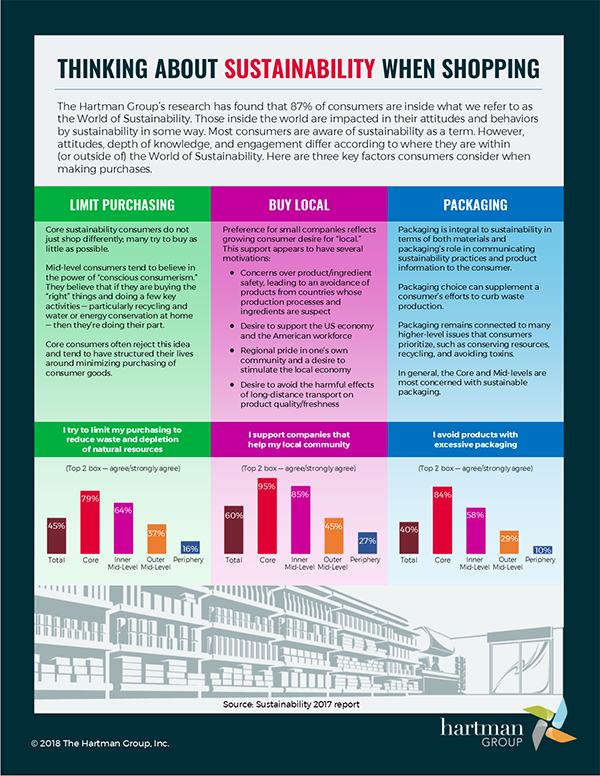
The Hartman Group’s research has found that 87% of consumers are inside what we refer to as the World of Sustainability. Those inside the world are impacted in their attitudes and behaviors by sustainability in some way. Most consumers are aware of sustainability as a term. However, attitudes, depth of knowledge, and engagement differ according to where they are within (or outside of) the World of Sustainability. Here are three key factors consumers consider when making purchase
My great pal Stacy Miller is always in constant learning mode, especially interested in learning through the experience and ingenuity of farmers and other entrepreneurs in her local community. This podcast is fascinating for the detail that she offers about product development, marketing concerns, trends in snack foods, and the props to farmers markets and FMC of course (and an honestly humbling plug for the Dar Bar but let’s leave that aside for now although I remain grateful that my name rhymes with bar.)
This is a great example of how a value-added business can offer authenticity to market messaging, how these innovative vendors can illustrate the market farmers story through storytelling and through lovely presentation of their ingredients offering healthy, delicious snacking. So let’s remember what those vendors offer our markets and honor them too.
“We found ourselves in this incredibly competitive environment where you want to test new concepts and give customers something new,” Gupta said. “We needed a way to bring in some of these hyper-local entrepreneurs, these small-batch products that you can find at farmers’ markets. And the way to do that was to lower the barriers to entry.”
The wheeled carts, left over from the market’s days as a train station, already were being leased to a few businesses that needed no refrigeration — like Lansdale’s Boardroom Spirits and newcomer Birdie’s Biscuits — for use as pop-up stands in the center of the building. The feedback from customers and owners was good, Gupta said, so last fall he and members of his team started working with the Health Department on turning the former Wan’s Seafood into a flexible space for multiple kiosks. The space has no built-in cooking station, but other than sinks, refrigeration, and the proper permits and licenses, it turned out little was needed for businesses to start selling ready-made food.
Nielsen, a research and consulting firm, said last month that for the first time in a decade, shoppers were making more trips to stores, but coming out with less in their baskets. “They’re not stockpiling their pantries as much,” said Jordan Rost, the company’s vice president for consumer insights. “They’re really buying more fresh produce and prepared meals.”
Mr. Ruhlman predicts that much of what is sold in the center of the store — the cereal, canned soups, detergents and Ziploc bags — will be largely bought online in the not-too-distant future as food shoppers become more accustomed to e-commerce.
I love when artisanal producers find a way to urge shoppers to become more than shoppers. One of the possible metrics that may be added someday to the Farmers Market Metrics program at Farmers Market Coalition is measuring how market shoppers influence their friends shopping and also how they share ideas and tips about local items with other retail outlets. How many times do market shoppers ask their produce manager to stop carrying out of state items and instead stock locally available items during the seasonal high point? How many shoppers are the carriers of information about market items availability for their neighbors and friends?
My guess is plenty…
The Matzo Project uses that same energy to expand their reach across the US of their wonderful crackers.
How great would it be if markets offered blank cards to their shoppers so they could leave a note and share news of a market offering with their friends and even a few select retail outlets?
As a secular retail anthropologist and a farmers market consultant, this article is like a bite of my market vendor’s satsumas right now:
DE-lightful!
The healthy = expensive intuition is just one of “a universe of mental shortcuts” that we rely on to choose food, and many of those shortcuts also appear to be flawed. Previous research has described a “supersize bias,” for instance, in which consumers ignore calorie counts and other health information when presented with a meal that seems like a good value. The majority of Americans also embrace what’s called the “unhealthy = tasty intuition” — the belief that food must be unhealthy to taste good.
Obviously, that last line is the one markets should consider and maybe even draw part of their marketing strategy from it. If used properly, a message like “delicious tastes found here” can be an inviting message and could draw a wider audience to markets than the buy local messages that our field has long employed. And clearly better than using “healthy” to entice eaters who are not in the grips of a healthy living focus.
From the report mentioned in the article:
Schulte-Mecklenbeck, M., Sohn, M., de Bellis, E., Martin, N., & Hertwig, R. (2013). A lack of appetite for information and computation. Simple heuristics in food choice:
According to our findings, people are inclined to rely on simple strategies that limit search when making food choices. In addition, our participants paid more attention to the dishes’ image and name at the expense of nutritional information such as caloric and salt content… However, previous investigations (using, for instance, self-reports and eye tracking) have also concluded that many consumers are reluctant to make use of food label information.
I saw this very thing during my days as a buyer at Whole Foods, and as an office building convenience store chain general manager and even before that, when working back in the 1990s on a campaign to increase the number of organic items in Giant Eagle stores. In all of those instances, I noted how people would evaluate the healthy food with a confused look, often moving with almost a sleepwalker’s mien. In contrast, their physical behavior became very purposeful and focused once on aisles with less choice or less scientific data to absorb (like soda or paper goods). That the amount of data to process for many was simply too much was my takeaway. As an example, I remember a farmers market coworker who had come to healthy food late in life told me that “all” he bought was organic produce and since Whole Foods “only carried organic” he bought all of the produce he could not get from farmers at that store only. I shared the news that no, Whole Foods didn’t ONLY carry organic produce and that the pricing signs were color coded as to whether they were organic or not (and that most was not organic). He was in shock to find that out; turns out he had never noticed the color coding or the words organic or conventional on the signs, probably because there was so much for him to learn as he began to shop there.
So that was a good example of shopper overwhelm. And from someone who was savvy enough to work at a market too.
So this is the type of aha that I wish for each of you. I also suggest that spending some time on research like this will be helpful to understanding what and how to dole out the info that is vital to any successful marketing/outreach campaign.
Bloomberg: On average, the companies surveyed have just 27 days worth of cash reserves – or money to cover expenses if inflows suddenly stopped – according to the JPMorgan study, which analyzed 470 million transactions by 570,000 small business last year. Restaurants typically hold the smallest cash buffers, with just 16 days of reserves, while the real-estate sector boasts the biggest, at 47 days.
I’d like to see cash reserves and other business practices as metrics for Farmers Market Metrics in a later iteration. My sense is that the internal data of a market’s (and of its businesses’) bookkeeping and accounting-norm practices can be collected under the term “Resiliency” and offer advocates some wonderful data in order to extend the lifespan and/or decrease the learning curve of new or expanding farmers markets and its businesses.
It has long seemed to me that many small businesses within markets mistake cash flow for profit which often leads to surprising exits from those markets. Therefore, the more a market understands the difference between these two for itself and can begin to assist its types of business with establishing baselines for this data, the more that the USDA and other supporters can be encouraged to offer even more detailed assistance.
Using a variety of research methods, students with disabilities and conventional students at San Francisco State University studied “how the principles of Inclusive Universal Design practice can promote equity with respect to access and use of the physical environment.” Their findings can certainly assist market organizers and their methods should influence how we gather data.
The Symposium & Workshop sought to orient and prepare students with disabilities to educational and professional career opportunities in the design disciplines. There were three primary goals and collaborative interfaces.
(1) To introduce inclusive human-centered design applications in the design curriculum at SFSU that will orientate students, both the students with disabilities and conventional university design students to the holistic benefits of design education and practice that go beyond the exclusive and limited convention of mainstream design applications.
(2) Exposing students to inclusive participatory design empathy methodology.
(3) Identifying and creating design concepts for the product environment and interior space that facilitates one’s ability to access and manipulate the active learning and recreational environment at home, or at school.
This approach to data collection and design is available to busy and to “under-resourced” food organizers through resources and trainings available for purchase, and in online and in-person individual and group trainings. The two companies that I usually send people to are Luma Institute for their wonderful resources on how to use this process (I also took their in-person course, thanks to FMC and the Knight Foundation) and Ideo, which has influenced some food system funders, like Ford Foundation. Both offer online individual and group courses.
I would suggest that this sort of professional development is exactly what can be included in grants or even sponsored by neighboring businesses of a market to undertake as a team. This approach is similar to the methods that are either included (or will be) in the Farmers Market Metrics program, in tools such as the Marketshare section of Market Umbrella’s site and in the Farmers Market Toolkit instruments on the British Columbia Farmers Market site.
The final newsletter includes findings from these two projects:
Students Design Shopping Cart for Elderly Community
Supermarket carts are solid enough to lean on, but collapsible “granny carts” often used at urban farmer’s markets do not provide appropriate support for people with mobility issues, Fisher explained. “The idea of a cart is not exotic, but (it’s) important to my life,” Fisher said.
After conducting multiple interviews in the aging community, Lopez and Renard realized the need for a supportive personal cart is widespread. Renard said existing carts are generally constructed with weak materials with little attention to aesthetic.
“People put a little bit of thought and design into (portable carts), but they just paint (them) that nasty old-person beige,” Renard said. “Just because people are aging, they don’t want ugly products. They want something that fits their needs but is also stylish – (a product) they aren’t embarrassed to use.”
They credit their inspiration to Dr. June Fisher, an 82-year-old occupational health physician and Bay Area product design lecturer who worked closely with the duo throughout production.
She said she looks forward to having a CityCart of her own, something supportive enough to navigate a farmers market and pick up a few heirloom veggies without relying on someone else.
“The design came from a particular person’s need – my need,” Fisher said.
Designing a Better Shopping Experience with a Holistic Approach to Aging in Place
Several methods were employed such as group and individual in-depth interviews, immersive observations, shadowing and experience mapping session. By means of these methods it was conceived that elderly face several physical challenges while shopping.
These challenges are mostly due to their physical decline, are mainly coherent with the existing literature most of which have not been responded for many years. The main areas of concern were the large size of food packages, standing in long checkout lines, reading the labels, using the carts and baskets, size and layout of stores, shelves and location of products.
The study showed a very social aspect to shopping experience. Participants found shopping to be an experience than can be fun and social. The nostalgia from old ages and existing cultures around the world were two main sources of comparison for the elders. Elders showed to be very perceptive of personal social interactions of them as customers with the seller or store staff. They desired to personally know the staff and be known by them. They liked the staff to remember them and their preferences. They looked for a personal relationship with the staff; one that helps building trust in both parties. They also liked to make conversations and take advice from them on which food to buy or how to cook a special dish with the food and more. Talking of advice was always hand in hand with ‘trust’.
Findings showed that the seniors associated the personal familiarity with the seller and making regular conversations with him to sense of trust towards the seller. The general view of shopping environment was an environment for shopping, having fun and social interactions. They were specifically enthusiastic about communicating with the younger generation and truly appreciated the young people’s patience when they needed more time to learn.
The participants liked to be specially treated, not in a manner that suggests they are not capable of doing it themselves or that they are old, but a special care based on friendly relationships,
One of the prominent findings of the research was elders’ discomfort when standing in long lines. Some had to physically strain while standing, finding leaning on the carts to be the only option to alleviate the hardship. Also, over the course of study a few times people brought up the idea of a resting area where they could sit for a while and take a breath. The combination of these findings led the researcher to design a service to address the mentioned issues. The service is called, “Valet Checkout”.
These methods can reduce the learning curve for markets and increase the likelihood of success in the final design.
As excited as many are about an American folk/rock singer composer winning the Nobel Prize for Literature, the economic prize is also worthy of mention here. First though, my favorite song lyrics of Mr. Dylan:
I ain’t gonna work on Maggie’s farm no more
No, I ain’t gonna work on Maggie’s farm no more
Well, I wake in the morning
Fold my hands and pray for rain
I got a head full of ideas
That are drivin’ me insane
It’s a shame the way she makes me scrub the floor
I ain’t gonna work on Maggie’s farm no more
I ain’t gonna work for Maggie’s brother no more
No, I ain’t gonna work for Maggie’s brother no more
Well, he hands you a nickel
He hands you a dime
He asks you with a grin
If you’re havin’ a good time
Then he fines you every time you slam the door
I ain’t gonna work for Maggie’s brother no more
I ain’t gonna work for Maggie’s pa no more
No, I ain’t gonna work for Maggie’s pa no more
Well, he puts his cigar
Out in your face just for kicks
His bedroom window
It is made out of bricks
The National Guard stands around his door
Ah, I ain’t gonna work for Maggie’s pa no more
I ain’t gonna work for Maggie’s ma no more
No, I ain’t gonna work for Maggie’s ma no more
Well, she talks to all the servants
About man and God and law
Everybody says
She’s the brains behind Pa
She’s sixty eight, but she says she’s fifty four
I ain’t gonna work for Maggie’s ma no more
Many of Dylan’s interpreters suggest this is a criticism of capitalism or of the military industrial complex. That actually leads us to a chat about the economic prize this year, given to Oliver Hart and Bengt Holmström for their contributions to contract theory. (Disclaimer: not only am I not an economist or a lawyer, my understanding of these theories is very casual and centered on my community organizing work. I may over or understate many of these theories and will always edit when better information comes my way. Feel free to add to my knowledge via email as needed.)
Contract theory focuses on the relationship between the parties in a contract, especially those which are asymmetrical in terms of how much information each side has access. The world contains scads of examples of information asymmetry: citizens and media, citizens and police or the military, employees-employers, consumers and technology providers etc. When one party has access to more information than the other, the fairness of the contract should be questioned. The other contract issue relevant to markets and farmers is what are called incomplete contracts. This covers the likelihood that a contract in present time cannot always cover every possible outcome and so often must be renegotiated at some time; in th, t case it is possible that renegotiation can go off the rails because of lack of trust.
In many ways, these scenarios describe much of what drove farmers and their advocates to the creation of the alternative food and farming movement. The desire for fairness and trust for both producers and for eaters led to transparency being one our chief indicators of success and in keeping the heart of our movement in direct marketing channels which offer simple ways to create fairness. But even within those models, there can be an information asymmetry. For example, some farmers markets have created systems where information only flows from vendor to market and not the other way around. In others, vendors cling to systems that ask little of them as far as information sharing with the market. One way to gauge whether this is an unequal contract is at the time that the agreement is being changed.
Still, the very nature of the mutual dependency and face to face nature of farmers markets and their vendors can usually correct these small imbalances. Same goes for other type of direct marketing contracts, especially CSAs which began as simple contractual relationships between producers and eaters for a single season and a single farm. More recently, some CSA relationships have become imbalanced: like when a farmer offers a member a credit for a bad season, even though the contract in a CSA explicitly states that the shopper loses their investment if the crop fails. Or, when a CSA farmer begins to morph into an aggregator of goods from nearby farms and cottage industry producers without creating a updated contract with their shoppers that outlines the new rules of bringing those goods to the shopper.
However, the concern over unfair contracts really “scales up” when systems move into intermediate (back door or bin sales) and wholesale (middle-man or pallet sales) contracts. Here, I’ll focus on intermediate sales, as wholesale sales are a whole other kettle of fish and in most cases, are beyond the capacity or interest of small family farms. (The reason for that is that few of those systems have really changed anything about their purchasing policies or their regulations for small farms, and so the costs and risk are all on the side of the farmer still.)
The hope is still that restaurant owners and wholesale buyers will build contracts with producers with the same transparency and information sharing as those in the direct marketing sector, but often that has not been the case. The key to mutually beneficial agreements on all levels of our food work relies on building contextual contracts and incentivizing them for all involved. What are the main benefits for a producer to sell at a lower cost to a chef? Well, two might be consecutive, consistent sales and the ease in delivery (meaning the farmer can deliver when most convenient to him or her and get quick payment), and yet rarely are these benefits described in agreements for most of our producers when they sell at these levels. What is the main benefit for the buyer? Often it is the quality of the product or the name recognition of the producer attached to the goods and yet rarely are those benefits understood and outlined in these agreements.
One way to incentivize the fairness of the contract in these situation may be to create a shared asset owned by all of the parties, such as a mutually owned cold truck or even branding. Another way to make them contextual might be to have an external party monitoring the agreement. Maybe this is where farmers market leaders can grow their influence?
And of course, markets managing transactions through card technology has led to lopsided contracts with processors. Markets scramble to understand these complex agreements which exist over different eras of management and open markets to many new layers of liability. Another issue is that the energy that markets must reserve for reaching and encouraging benefit program shoppers is often wasted by the lack of good information about the client lists from local or federal government authorities. Too many markets I talk to have no idea how and where to reach these shoppers in their area and when you take in the short time that the majority of these shoppers remain on these programs at any one time (also not shared by most government entities), successful outreach becomes even more unlikely. The market vendor in this situation is also underrepresented in a fair contract, as most markets – or the processors working directly with farmers – use boilerplate agreements about card processing with their vendors.
So, one can see from just these few examples that center around direct marketing and intermediate farmers how many contract issues arise. So maybe before the alternative food system becomes another one of Maggie’s farms, let’s spend some time on increasing transparency and incentives for everyone’s benefit.




 Helping Farmers Markets Grow